
On a visit to Detroit with my brothers last weekend, I was surprised to discover just how close the city streets are to the edge of the United States. Walk out of Detroit’s downtown Renaissance Center through the south doors (yes, I did just say “south”), cross Atwater Street, and you’ll find yourself standing on the edge of the Detroit River staring at Canada on the other shore. Almost has you thinking in metric, “eh?”

Here’s something I probably learned in middle school and promptly forgot: the border between Canada and the U.S. runs right through the middle of Lake Erie (and the Detroit River). It’s as if Americans and Canucks had a long drawn-out discussion about who deserved the lake more, and then clinked glasses of Budweiser and Molson with, “Okay, you get half and we get half”. The same thing happened with three of the other four Great Lakes (America somehow got all of Lake Michigan) and that’s why – at least in Detroit – Canada lies to the south.
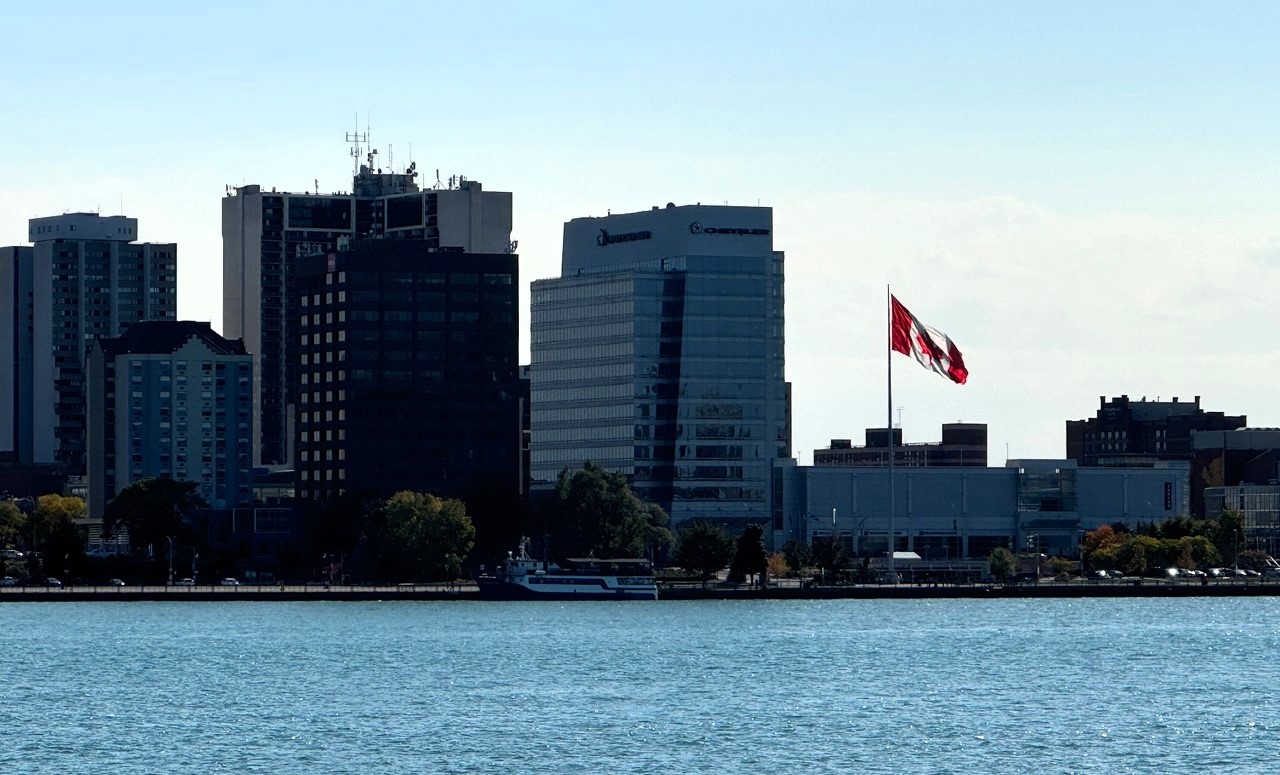
Not that you’d know it’s Canada, mind you. Aside from the giant red and white flag billowing on the far shore, the streets, buildings, cars; everything looks exactly the same as America. You might as well be looking at Saint Paul from Minneapolis. And Windsor (the Canadian town you see) is so close you might as well swim for it. The Detroit River is only a mile wide at this juncture. I kind of wondered what would happen if I did swim for it. Would a flurry of border patrol boats appear out of nowhere to haul me in?
Instead, my brothers and I kept it legal and drove across the Ambassador Bridge (there’s the Detroit-Windsor tunnel if you prefer). It felt a little strange to hand over passports just to go to dinner. And once we sat down at our Windsor table we were greeted with a hearty “Happy Thanksgiving!” Thanksgiving? Had we gone through some sort of time warp? Oh, right – Canada celebrates Thanksgiving in October.

Naturally we asked our server how Canadians celebrate Thanksgiving. She thought about it for a moment and said, in her wonderful Inland North accent, “Oh, y’know, we gather with our families and have the meal.” That’s it? Not even an embarrassingly-large, dozens-of-dishes, eat-’til-you-burst meal? Just food with family? But in fact, Canadian Thanksgiving is pretty much the same as “down south”. Explorers crossed the ocean, landed safely in the New World, established a settlement, held a feast of thanks, blah-blah-blah.

Despite our server’s succinct description, the Canadian Thanksgiving meal includes most of the dishes we enjoy on this side of the Detroit River (including turkey). Canucks also celebrate with parades, Oktoberfests, and other festivals. There’s even a “Thanksgiving Classic” courtesy of the Canadian Football League. Makes me wonder if the Detroit Lions somehow found a way to play that football game along with every (U.S.) Thanksgiving Day game since 1934.

As we crossed back over the bridge after dinner, two thoughts entered my mind. One, the waterfront houses on the Canadian side of the Detroit River have a view of the United States all day long instead of seeing their own country. That seems a little odd. And two, I wondered whether goods and services in Windsor (or beyond) would be worth leaving the U.S. for, instead of just purchasing the same in Detroit. You’d have to pay the bridge/tunnel toll both ways for a little Canadian Bacon (or backbacon), which might compromise the benefit. You’d most certainly run out of pages for the stamps on your passport.
 Earlier I said something about “almost” thinking in metric. No, you really do have to think in metric in Canada. As soon as we crossed over the Detroit River, our car’s GPS changed directions into kilometers (clicks) and meters. Suddenly the next turn was “100 meters” away instead of “300 feet”. Believe me, it’s a little disorienting watching the meters count down (slower) than the feet you expect. After several bottles of wine at dinner (liters?), at least we could still navigate back to the bridge. Otherwise this post might be coming to you from “up north”.
Some content sourced from Wikipedia, “the free encyclopedia”.


 Life In A Word