
I managed to get through high school literature class without having to wrestle with Shakespeare, not even once. To me, Romeo and Juliet are simply characters from a movie I’ve never seen. Hamlet is another name for a small village. Othello is a board game I played as a teenager. But hey, maybe I should be a fan of Shakespeare. After all, he gets the credit for penning the phrase “pomp and circumstance”.
 It’s true – “Pride, pomp, and circumstance (of glorious war!)” is a line from Shakespeare’s play Othello, written way back in 1603. Somewhere in the hundreds of years since, “Pomp and circumstance” became the name of the musical march we all associate with graduation ceremonies. But for today’s purposes, pomp and circumstance (or “P&C” if you will) means “formal and impressive ceremonies or activities”. And Monday’s presidential inauguration ceremony was the perfect example of that.
 I am a big fan of American P&C. Without it the inauguration ceremony would’ve been nothing but mundane repeat-after-me oaths. With it you get your heart fill-er-upped with pride. Monday’s ceremony was replete with red, white, and blue decor. American flags were everywhere. The guests of honor were escorted to their seats by men and women in splendid uniforms. The cannons nearby boomed over and over when the oaths were completed. And for my American dollars, nothing says pomp and circumstance like those patriotic anthems.

Having spent most of my years in Colorado Springs, “America the Beautiful” is close to my heart because its lyrics were born from the top of nearby Pikes Peak. All credit to Carrie Underwood for her performance of its first verse on Monday, enduring technical difficulties to sing a cappella. Then there was the charismatic Rev. Lorenzo Sewell, embellishing his prayer of gratitude with the opening lines of “My Country Tis of Thee”. And you’d be forgiven for shedding a tear during the soaring “Battle Hymn of the Republic”, belted out by the men and women of the U.S. Naval Academy Glee Club (and earning a standing ovation).

But I’m forgetting one more anthem. Or should I say, I can’t forget the one more. Yes, Christopher Dean Macchio (“America’s tenor”) sang “The Star Spangled Banner” to close out the inauguration ceremony, but he also performed another anthem to kick things off and I’m still humming it today. Why, I ask myself, have I never heard “O, America” before?
“O, America” – go figure – was written by an Irishman. Brendan Graham penned the lyrics into a big hit for the group “Celtic Woman”. You’d think the words would be from the perspective of someone overseas but “O, America” is clearly about someone here… and someone now. Have a listen and I think you’ll agree. In the words of Othello, “O, America” is all about “pride, pomp, and circumstance”. This week I am filled with all three.
LEGO Notre-Dame de Paris – Update #2
(read about the start of this “church service” in Highest Chair)
I’m glad I remembered my antiperspirant today. Bags 2 and 3 – of 34 bags of pieces – encouraged sweat, tested patience, and made me realize my fingers are anything but nimble. My hands are still shaking after the hour and change it took to build this section.
 We started by tiling the cathedral floor. Look closely – those black and white pieces aren’t all the same shape or orientation. I installed one wrong and almost needed pliers to get it back out. Imagine if you made the same mistake on the floor of the real Notre-Dame. You’d get fired for wasting priceless marble!
 Having said that, the floor was just a warm up for the colonnade that now rises up around the altar. It is made from tiny, tiny pieces! I think LEGO should invent special gloves that a) allow you to easily grasp these little guys while b) protecting your fingers from their sharp edges. Pressing them into place again and again can be painful! Those beige column supports you see on the tile floor left little round dents in my fingertips.
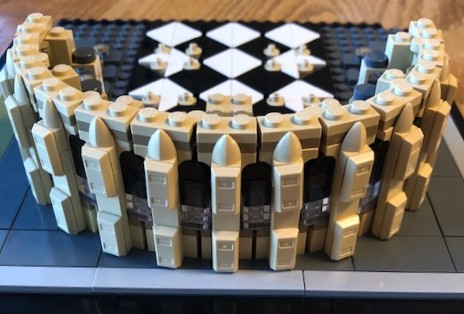 Finally, notice the repetitive structure of the colonnade, like a circle of rocket ships ready to launch. LEGO shows you how to build one of these vertical elements (each one is about twenty pieces) and then goes, “Okay Dave, do that fourteen more times”. The Grand Piano was also tough but I wouldn’t say it was repetitive. Notre-Dame de Paris has found a new way to test my patience.
Running build time: 1 hour 37 min.
Total leftover pieces: 5
Some content sourced from the Irish Central article, “Irishman’s song ‘O America’ performed at Trump’s inauguration”, and Wikipedia, “the free encyclopedia”.



 Life In A Word