
In trying economic times like these, it wouldn’t surprise me to hear about people using credit cards to pay their bills. After all, when you have more month at the end of the money you do what you must to stay above water. But it’s a bit of a fool’s game isn’t it, creating one debt to eliminate another? Its what we call robbing Peter to pay Paul. And speaking of the Christian apostles, let’s talk about robbing John to pay Peter.
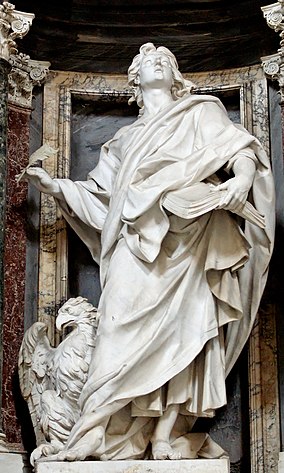
As promised when I began construction of the LEGO model of Notre-Dame de Paris last month (read about how I started this project in Highest Chair), I’d like to pay homage to a few of the world’s prominent cathedrals along the way. These magnificent structures are places of worship at heart but oh-so-much more besides. Each can be completely different in look and location. My goal here is to not have you walk away from Notre-Dame thinking “seen one, seen them all”.
What better place to start than at the most significant cathedral in the world? I’ll give you three hints. It’s located in the middle of Rome. It serves as the seat of Rome’s bishop (who just happens to be Pope Francis). And it’s named for one of the most influential figures in the Bible. Okay, time’s up, let’s have it. Did you guess St. Peter’s?
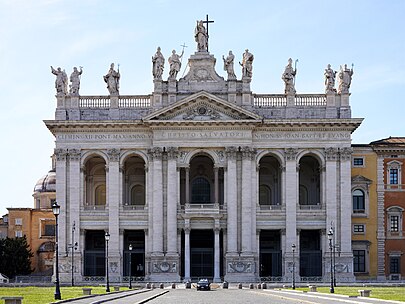
If St. Peter’s was your guess, you’d be… incorrect, and in fact, incorrect three times over. The St. Peter’s you’re thinking of – the “largest and greatest” church in the world – is not even a cathedral (but merely a basilica). St. Peter’s is not even in Rome, since the Vatican is technically its own country. Finally, St. Peter’s is not the seat of the pope (or any other bishop), even though Francis does live close by. Instead, the award for most significant cathedral goes to Saint John Lateran.
The Lateran cathedral is about a 5K jog from St. Peter’s Square. In fact, if you were to make the walk from one church to the other you’d pass by several of Rome’s highlights. The Pantheon. The Trevi Fountain. Piazza Venezia. The Forum. The Colosseum. Eventually you’d be standing in front of the imposing facade you see above.
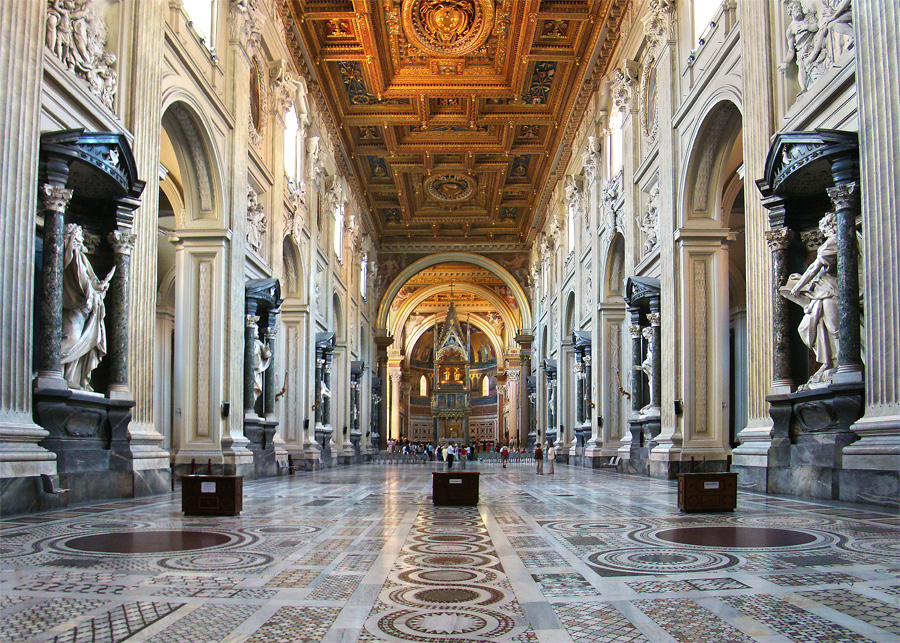
Saint John Lateran is old – even by Rome’s standards – first established in the mid-300s. It sits on the site of the former Lateran family palace. The cathedral survived several fires, earthquakes, and periods of deterioration, eventually retreating into the shadow of the grander St. Peter’s. In the 1700s the Lateran received a complete overhaul, including the facade you see today. But it has always served as the cathedral of Rome. In fact, a plaque near its ancient bronze doors deems (in Latin): “… mother and head of all churches in the city and the world.”
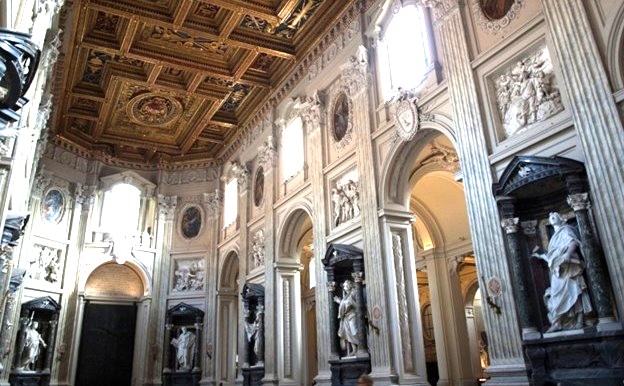
Like Notre-Dame de Paris, the Lateran boasts a lot more than just the structure itself. Giant statues of the twelve apostles line the interior of the sanctuary. Six popes are buried here. The ancient Egyptian obelisk in front of the church is the world’s tallest. Finally, the Lateran claims to have hosted significant relics of Christianity over its many years, including the Ark of the Covenant, the wooden table where Jesus hosted the Last Supper, and (for the less faint of heart) the skulls of St. Peter and St. Paul.
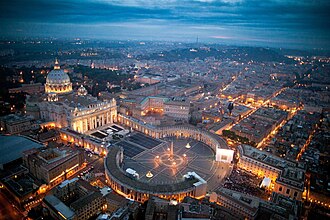
It goes without saying; a trip to Rome isn’t complete without a visit to St. Peter’s and its surrounds. The sheer size and elegance of the basilica is unparalleled and worth several hours (if not days) of your time. But now you know; Saint John Lateran also deserves your attention. It’d be a shame to travel all the way to Italy and back without claiminng a visit to the most significant cathedral in the world.
LEGO Notre-Dame de Paris – Update #6
(Read about the start of this “church service” in Highest Chair)
The model-building word of the day, boys and girls, is structure. Bag 9… of 34 bags of pieces, brought us face-to-face with the finished look of Notre-Dame de Paris’s iconic flying buttresses, installed carefully around the walls of the cathedral’s east end. Most of those “pasta bits” I showed you in our last visit amounted to fourteen (or about half) of the cathedral’s buttresses. They look like tiny cannons, don’t they?


Remember, the structural support of this cathedral is on the exterior, allowing for tall, thin walls, and more uninterrupted open space inside. Someone could come up with the ten coolest structural elements for buildings and I’d have buttresses “fly” to the top of the list.
If Notre-Dame’s parishioners felt a sudden sense of security and stability, it’s because the giant hand of Dave was buttressing the very walls around them as they worshiped. And if these structural elements aren’t elegant enough, they also house horizontal pipes to drain the water from the cathedral roof.

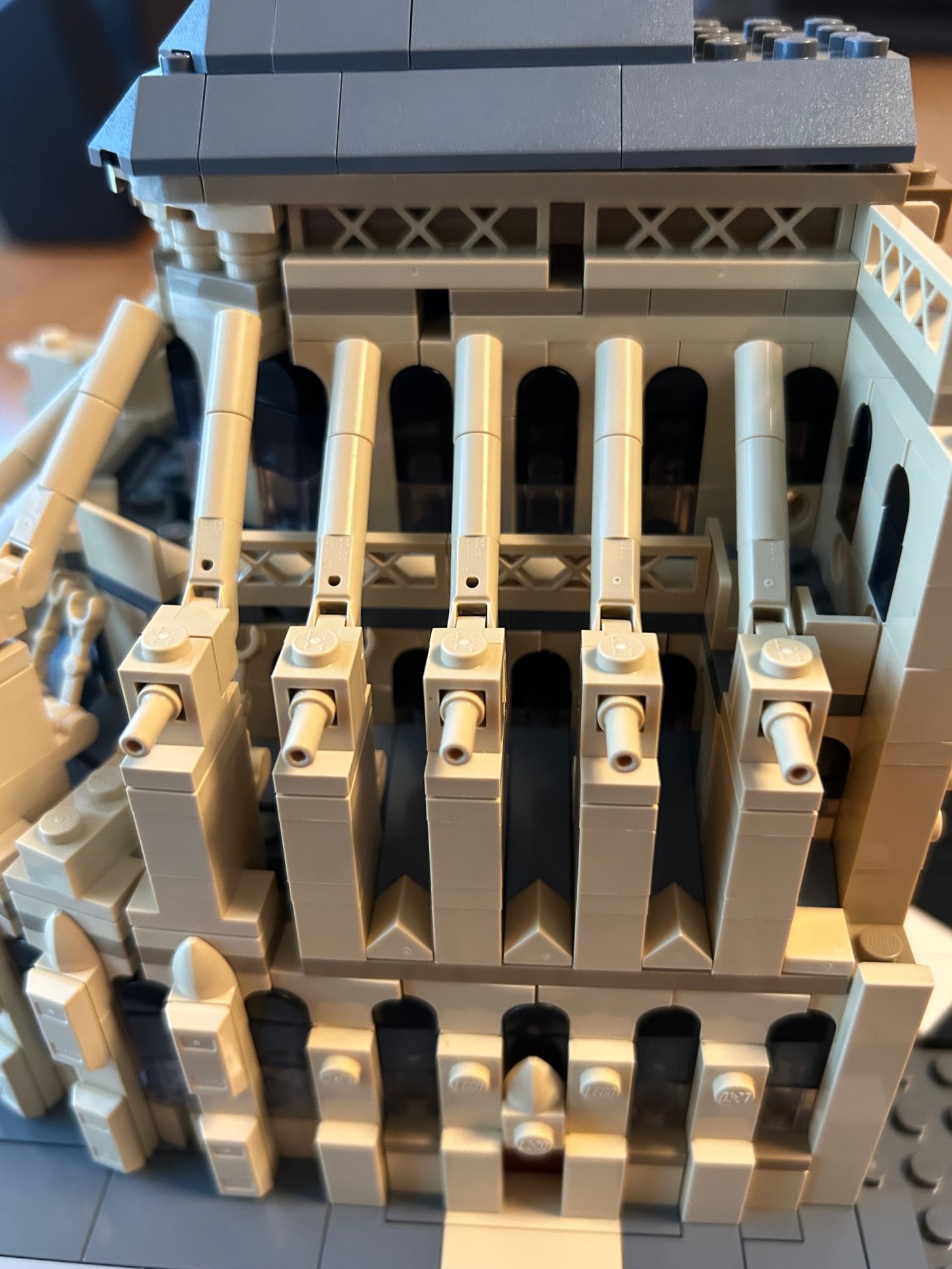
I keep referring to the cathedral’s “east end”, but now that we’re starting to see the finished product we should use proper terms for church architecture. We’ve effectively completed the chancel, which is the altar and surrounds to the east of the transept. Picture a giant Christian cross laying on the ground. The top of the cross is the chancel and the crossbar is the transept. The lower length of the cross, where most of the parishioners sit, is the nave. At the very bottom of the nave will be the bell towers.

Today’s build was not without its adventures. A small black piece escaped to my home office floor early on, prompting a prolonged hands-and-knees search. I swear I heard the piece clatter to the floor yet neither hands nor knees made the encounter. I was perplexed. Finally, with the aid of my handy-dandy iPhone flashlight, I found the crafty little devil way, way back in the dark central recess of my desk. This little guy was clearly making a move to freedom. Sorry, bud; it’s time to come home.

Finally, I thought the adjacent photo was worth including. Pretty much every single LEGO piece of Notre-Dame de Paris is unique in size and shape. Except this one. How does a singular “trademark” LEGO block end up amongst thousands of irregular pieces? Sadly, this piece was installed one level below the dark gray roof line of the chancel, which means you’ll never see it in the finished product. So I figured it deserved its moment of glory here instead.
Running build time: 5 hrs. 32 min.
Total leftover pieces: 23
Some content sourced from Wikipedia, “the free encyclopedia”.





 Life In A Word