Only In Iowa

If you’ve ever made graham crackers from scratch (which are miles better than the store-bought ones), there’s a step in the recipe where you have to get your hands dirty. Take a stick of butter, cut it into very small pieces, dump the pieces into the mixture of dry ingredients, and dive on in with your fingers until the dough starts to clump together. It may be the only time butter and my hands ever come in contact with each other. Which is also to say, I won’t be sculpting a butter cow any time soon.
Sculptor, cow

Creating art out of food seems like an inevitable destination. I mean, back in Michelangelo’s day everyone was taking a block of marble and seeing what they could do with it. Then all but one of them quickly realized there was only one Michelangelo. The others probably turned to an easier material to work with like wood or clay. 1,000 years on, we’re sculpting food. Chocolate is a popular medium. Cakes are shaped into just about everything imaginable. But a cow made out of butter – what’s that all about?

A more fitting Hawkeye State image

We turn to Iowa to learn more about this oddity.  Most people prefer to fly over Iowa but since you’re reading and not flying, let me enlighten you.  On the list of 10 Things to Know About Iowa, there is no butter and there is no cow. There are a lot of pigs (the most of any state) and millions of acres of corn (also “the most”), and Iowa’s “Hawkeye” nickname is a reference to the birth of the red delicious apple (who knew?).  But none of this gets us to butter and cows.

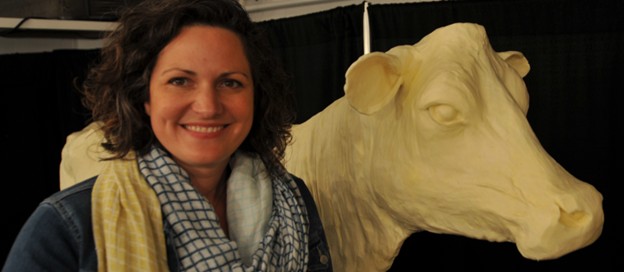
The “10 Things…” list does mention the Iowa State Fair, and it is here that we find real cows by the hundreds… and a life-sized one made out of butter.  The Fair, whose 2025 edition wrapped up three weeks ago, has been making “buttered cows” since 1911, thanks to five Iowans who’ve passed the butter baton down over the years.  The latest, Sarah Pratt, has been making the cows for the last nineteen years, and only after apprenticing with the last sculptor fifteen years before that.  Some people blog; others make cows out of butter.

The 1911 original

Like papier-mâché, a butter cow is created on top of a frame built from wood, wire, and/or metal.  Then we heap on some fun statistics.  600 lbs. of “low moisture, pure cream, Iowa butter” is applied to create a cow that’s five-and-a-half feet tall and eight feet long.  The sculptor’s “studio” is a walk-in cooler set to 40ºF.  After the cow is displayed at the fair, all that butter is recycled for use on the next ten years of cows.  Unless you’d rather use it for toast, which would butter 19,200 slices.

Michelangelo didn’t stop sculpting after his famous David, of course, and neither does Sarah Pratt with her butter cows.  Also following tradition, she creates a “companion sculpture” to keep the cow company.  Sometimes the companion is an homage to Iowa, such as a John Deere tractor.  Most years the companion is a random anniversary, like the 40th anniversary of Neil Armstrong’s walk on the moon (totally random because Neil wasn’t born in Iowa).  This year the sculpture featured the characters from “Toy Story”, denoting the movie’s 30th anniversary.  You get the feeling Sarah enjoys sculpting butter so much that a life-sized cow just isn’t enough.

Woody, Buzz

For all of my research, I can’t figure out why a cow made out of butter and Iowa belong in the same sentence.  Nearby Wisconsin and Michigan are better known for dairy cows.  California tops the list of the five states producing the most butter (and Iowa isn’t one of the other four).  No matter, this tradition isn’t stopping anytime soon.  The butter cow even has a place in the Smithsonian Institution (thankfully, as a replica that will never melt).

I love butter, but more on top of baked goods and in graham cracker recipes than in the shape of a cow.  I will admit to buying my butter by the brick instead of by the stick.  But now that I know about Iowa’s annual creations, I’ll never look at my morning toast again without thinking, mooooooooo.

Some content sourced from the Iowa State Fair website, the U.S. News article, “10 Things to Know About Iowa”, and Wikipedia, “the free encyclopedia”.


Going for a Spin, Spin, Spin

My wife and I enjoy popcorn after dinner, probably because we’re watching more movies at home these days. It’s easy prep thanks to our Presto air popper. Dump in the kernels, plug in the popper, and “presto”; a delicious snack in an instant.  Of course, one of these days our air popper will break and we’ll have to buy another one. Unlike our KitchenAid stand mixer, which will spin,spin,spin until the end of time.

KitchenAid’s classic stand mixer

If your kitchen is like ours, the cupboards are full of appliances that only make an occasional appearance.  Our Breville panini press hasn’t made a “melt” in months.  Our Marcato pasta maker last saw action in the early 2000s.  And our George Foreman grill is retired for good, because it’s just as easy to fire up the barbecue.  But our KitchenAid stand mixer spins to our “Aid” time and again, always ready to make bread dough, cake batter, or cookies.

Stand mixers date to the early 1900s.  KitchenAid’s version came along in the 1930s, and it wouldn’t surprise me to learn some of the original models are still spinning almost a hundred years later.  The appliance is just that good.  The KitchenAid was designed to be as simple, efficient, and robust as possible, and with only one task in mind: to spin ingredients in dizzying circles until they’re thoroughly mixed.  Sure, you can add dozens of specialized attachments but none change what the stand mixer does at its core.  Spin, spin, spin.

with slicer/shredder attachment

When I make a batch of cookies, I stand back in wonder as our KitchenAid does its thing.  As I add the ingredients, the paddle blade works harder and harder to blend them together.  By the time I get to the last of a dozen ingredients; say, chocolate chips, the mixer is practically bouncing across the counter as it struggles to plow through the dough.  You’d expect the mixer to break down at any second in an explosion of flying gears and sizzling smoke.  But it never does.

I know a lot of people who own a KitchenAid stand mixer, and I’ve never heard of one that stopped working.  Even if it did break, the appliance is designed for easy repair.  The parts can be swapped out individually and quickly, eliminating the need for a repair person or a new mixer.  It reminds me of the old Maytag washers, and how their repairman was described as “the loneliest guy in town”.

Like most appliances, Maytags aren’t what they used to be.  We yearn for the models from the 1980s or earlier, which could wash anything and never break down.  Today’s Maytags are a shadow of their former selves.  They don’t do as good of a job, and every five years you’re thinking about replacing them.  Not so the KitchenAid stand mixer.  I have no doubt ours will be a part of our kids’ inheritance someday.

Speaking of kids, our daughter has her own KitchenAid and it sits proudly on her kitchen counter.  Counter space in the kitchen is precious so only a few appliances deserve to be full-time residents.  A coffeemaker.  Some sort of toaster oven.  And a KitchenAid stand mixer, which somehow manages to look appliance-elegant with its curves and swoops.

Color “ice”, with copper bowl

“Mixmasters” (a popular nickname for the KitchenAid) aren’t cheap.  Most models run about $300 USD for the basic setup.  Consider though, it’s the only stand mixer you’re ever going to need.  KitchenAid even admitted they expanded their color selection and limited-edition models in an effort to generate more repeat customers.  (This year – and only this year – you can buy one in “iridescent periwinkle blue”.)

Our Colorado kitchen had a very cool below-counter cabinet, designed specifically for a heavy stand mixer.  You opened the door, pulled a shelf handle, and your Mixmaster rose effortlessly out of the cabinet on special hinges, snapping into place at counter level.  An appliance has to be awfully special to justify a custom cabinet.  Or a spot in the Smithsonian Museum, where the KitchenAid stands as a part of the Julia Child exhibit.

Right there on Julia’s countertop

I don’t need to go to the Smithsonian to see a stand mixer (nor do you).  I have my KitchenAid right here in the kitchen cabinet.  I can put down the laptop and whip up a batch of cookies anytime I want.  Like, right now.  Time for my Mixmaster to spin, spin, spin again, just like it’s done a thousand times before.

Some content sourced from The Atlantic article, “KitchenAid Did it Right 87 Years Ago”, and Wikipedia, “the free encyclopedia”.

Whirlybird Wonder

“Ginny”

If you haven’t been following the dog-and-pony pony-and-dog show taking place on Mars the last couple of months, you might want to break out the telescope. Not that you’ll be able to see a car-sized rover or a toy-sized helicopter from millions of miles away. But you can see Mars itself, and then you can imagine “Percy” and “Ginny” sniffing around the red dirt and rocks up there. They’re just sampling things to see if Mars can roll out the welcome mat to humans someday.

The rover “Perseverance” is the pony in this show; “Ingenuity” the dog. I want to talk about the dog. Last July Percy hitched a nine-month ride to Mars, launching from Florida’s Cape Canaveral aboard a massive Atlas V rocket. Little Ginny hitched a ride on Percy; she the steadfast little soldier clinging to the rover’s underbelly. Considering Ginny measures only a few feet in all dimensions, it must’ve been a hang-on-for-dear-life E-ticket kind of adventure.

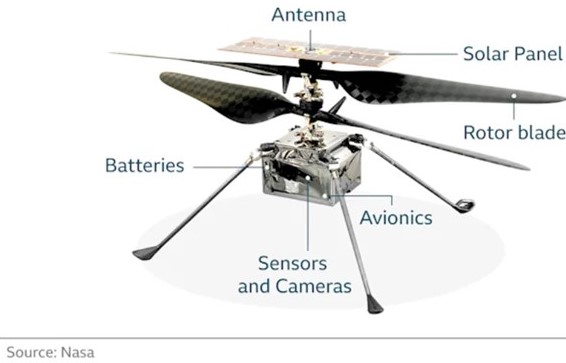
I’d love to make this a children’s story, but Ginny is anything but soft and cuddly. Have a look. She’s about as cute as a wasp. Consider Martian atmosphere is only 1/100th as dense as that of Earth, which means Ginny has virtually nothing to grab onto to sustain flight. But she whirls at five times the rate of a regular helicopter (2,400 rpm!), and then she rises.  Product safety warning: don’t go anywhere near Ginny’s rotor blades.

Ten days ago Ginny lifted off Mars to a skyscraping height of ten feet.  Then she hovered briefly before rotating about ninety degrees, kind of just observing the Mars-scape.  Finally, she landed.  The whole exercise lasted less than forty seconds.  Big deal, right?  Well, that little maneuver qualified Ginny as “the first powered controlled flight by an aircraft on a planet besides Earth”. Way to go, little wasp.  You just reserved a spot in the Smithsonian after you return home.

Will Ginny end up here?

When I picture Ginny clinging to the rover Percy, then hurtling through outer space for months on end, my middle-aged mind recalled the old Thunderbirds television show.  Thunderbirds featured the Tracy family (marionettes!) and their fleet of wicked-cool space vehicles.  The five Thunderbirds included a giant green supersonic carrier (“Thunderbird Two”), whose massive belly carried a yellow utility submersible (“Thunderbird Four”).  Kind of like Percy carried Ginny.  Trust me young(er) readers, Thunderbirds was awesome television in the 1960s… even if it was just puppets getting their strings pulled.

I’ve ridden in a helicopter exactly once in my life, on our honeymoon over the Napali Coast on the Hawaiian island of Kauai.  I turned to my bride mid-flight and probably uttered some not-so-nice words as I remembered how much I dislike heights.  The glass of champagne beforehand certainly helped.  For me, the fear has always been a toss-up between vertigo (physical) or the idea that terra firma is far, far below me (mental).  No matter the reason, heights just aren’t my cup of tea.

My acrophobia probably goes back to my first ride on a Ferris Wheel, with adolescent nightmares of slipping through the metal lap bar and taking an unplanned skydive.  Or ski lifts, where a little bit of fiddling with the lap bar latch could mean the end of everything.  Parasailing? (No).  Hang-gliding? (Never).  Hot-air balloons? (Why even ask?).  Sorry – airplanes aside, and only the bigger ones mind you – I prefer my thrills securely grounded.

For all the recent broadcast news on Percy and Ginny, I can’t seem to find the part of the story where Ginny returns to Percy, who then returns to the Atlas V rocket, who then returns to Earth.  I’m looking for the part about splashdowns and photo ops and ticker-tape parades – the happy-ending kind of stuff.  My earlier comment about a spot in the Smithsonian may have been a little premature (can you say, “Ginny replica”?).  Note to reader: if you do decide to make this a children’s story you might want to edit things a bit.  Just say our little pony and dog are now asleep on Mars, waiting for their human friends to get there someday.  It sounds much better than, “we just left them there”.

Some content sourced from Wikipedia, “the free encyclopedia”.