I’m All About Paul

Before another Independence Day celebration completely fades into the July of last week, I want to visit a story from early early American history. In 1973 I began middle school at Palisades-Brentwood Junior High, so named because it straddled the limits of both towns just outside of Los Angeles. But I never knew it as “Palisades-Brentwood”. A year after opening in 1955 it was rebranded Paul Revere Junior High. So Paul and I have a little something in common.  It’s like we’re compatriots, only separated by two and a half centuries. 
If you know nothing else about Paul Revere, you’ll recall his courageous “midnight ride”.  In the months leading up to the Revolutionary War in 1775 Revere took to his horse outside of Boston to alert “minutemen” of the approaching British troops.  Minutemen were residents of the American colonies trained to defend “at a minute’s notice”.  Revere himself was the notice, at least for what would become the early battles at Lexington and Concord.
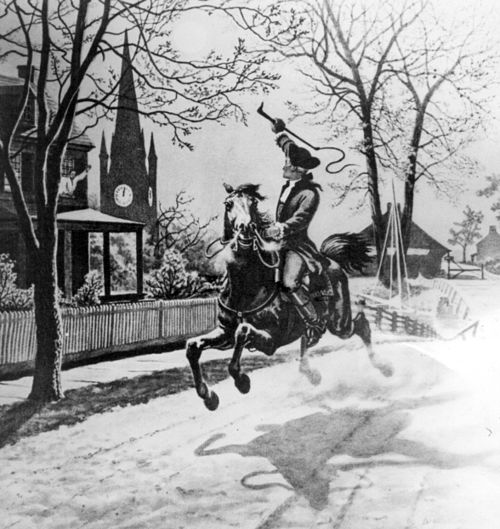
Longfellow’s impression

Were it not for Henry Wadsworth Longfellow a hundred years later, Revere’s legacy would’ve faded as quickly as last Friday’s fireworks.  Instead we have the poet’s “Paul Revere’s Ride” as the chronicle, with these well-known opening lines:

Listen, my children, and you shall hear
Of the midnight ride of Paul Revere,
On the eighteenth of April, in Seventy-Five:
Hardly a man is now alive…

Thanks to Longfellow’s poetic license (lots of it), we have a skewed version of what Revere did and did not do in April, 1775.  For starters, he was one of three riders spreading the news that “The British are coming!  The British are coming!” (so why didn’t the other two riders get any poetic love?)  Further, Revere never said the words “The British are coming!” but rather some disguised version of the warning to fool the Redcoats already hiding in the countryside.  And the famous “one-if-by-land, two-if-by-sea” lanterns were put in place by Revere, not for him.

Boston, MA

Revere didn’t even own a horse.  He had to borrow a neighbor’s steed  (named “Brown Beauty”) to make the ride.  And instead of galloping all the way to Concord as the poem suggests, Revere and his horse were captured by British troops somewhere along the way.  Lucky for Paul, the capture turned into a release when the Brits realized they were about to be overwhelmed by the locals.  So they took Paul’s horse and fled instead.

Enough of the history lesson (real or poetic).  Why a West Coast middle school would go with “Paul Revere” is beyond me, but the campus culture certainly embraced the name.  A select number of boys (including me) were the “Minutemen” who raised and lowered the American flag each day.  A select number of girls – “Colonial Belles” – were responsible for some similar task.  The school yearbook was known as the “Patriot”, while the newspaper was labeled the “Town Crier”.  And students called “Silversmiths” did something-or-other, but it certainly wasn’t casting fine products in Metal Shop.

Our school even plagiarized Longfellow (and not very well), as in:

Listen, my children, and you shall hear
of the growing pride of Paul Revere.
On the twelfth of September in Fifty-Five
Our middle school began to thrive.
 
If all I can point to is my middle school’s name, it’s a weak argument to claim Paul Revere and I have something in common.  We have nothing in common.  Revere was a Jack Paul of all trades, dabbling in roles from military leader to dentist, artist, and silversmith, before finally settling on copper caster.  Revere became the best caster of church bells in all of young America before his midnight ride became his signature accomplishment.
 
You’d be better off saying Revere and I were polar opposites.  I never served in the military.  I’ve only been the patient of a dentist (too often at that), I have zero art skills, I don’t make the silver (I just polish it), and the only casters I’m familiar with are the ones under a couple of my rolling chairs.
 
“Revere Ware”
Thanks to the church bell thing, Revere Copper Company became a successful business which still exists to this day.  You may remember their “Revere Ware” products, most of which are considered collectibles today.  Maybe I should collect a few pieces myself.  They’d remind me of the guy I seem to think I have something in common with.  Or at least, they’d remind me of junior high school.
 

Some content sourced from the Paul Revere Charter Middle School website, the History Channel article, “9 Things You May Not Know About Paul Revere”, and Wikipedia, “the free encyclopedia”.

Boston Long

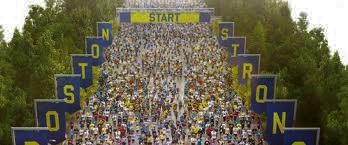
Durgin-Park, the venerable restaurant inside of Boston’s Faneuil Hall, recently closed its doors after almost two hundred years of operation. You read that right; D-P opened for business a few decades after the Revolutionary War, but served its last patron this year, citing “an inability to turn a profit”. For America at least, that’s some serious history. For Beantown on the other hand, that’s par for the course. After all, this week the Boston Marathon completed its 123rd consecutive running.

I am in awe of runners who qualify for – let alone run – the Boston Marathon.  It’s daunting enough to compete for 26.2 miles, but you can’t join the “fun” in Boston unless you complete a qualifying marathon in under 3 hours (men, ages 18-34), or 3.5 hours (women).  Consider, 3 hours is an average pace of 7 min./mile.  To appreciate that, go to the gym, crank up the treadmill to eight or nine miles/hour, and see how long you can maintain it.  Now imagine running that fast for three hours straight, up and down the city streets of Boston.  It’s superhuman.

The Boston is the world’s oldest annual marathon.  Simply achieving the age-specific qualification time is the goal of most elite long-distance runners.  But if that’s all you know about New England’s most-spectated event, you’re missing out on some fascinating race-related trivia.  Here’s a sampling:

  1. The Boston is run every “Patriots’ Day” (the third Monday in April), a holiday to commemorate the start of the American Revolutionary War.  Effectively, the marathon is a nod to freedom.
  2. The Boston was first run in 1897, one hundred years after the first Olympic marathon in Athens, Greece.  That marathon, as most know, was inspired by the fabled run of the Greek soldier Phillipides from Marathon to Athens, announcing a battle victory over the Persians.  Effectively, Phillipides’ run was also a nod to freedom.
  3. The Boston Red Sox play every Patriots’ Day in Fenway Park.  The game finishes in time for the fans to walk a mile east along the Charles River, arriving in Copley Square as the marathon runners are crossing the finish line.
  4. Until 1986, the men’s and women’s winners received a wreath of olive branches and a trophy; no cash prize.  Today?  First place: $150k, Second: $75k, Third: $40k, and Fourth: $25k.  Might want to dust off the running shoes and start training.
  5. Check out Derek Murphy’s “marathon investigation” blog here.  Derrick started his sleuthing five years ago and outed over 250 cheaters, including several who faked their race qualification times in order to run.  Too bad Derrick wasn’t around for the 1980 race, when Rosie Ruiz pulled off the marathon’s most famous heist (see her story here).
  6. In the 2011 race, Geoffrey Mutai of Kenya effectively broke the world marathon record (even though it wasn’t deemed official), finishing in 2:03:03.  Try that pace on a treadmill.  Set the speed at twelve miles/hour and… well… let it spin from a safe distance and just watch.
  7. The Boston draws an average of 30,000 participants each year, cheered on by 500,000 spectators.  The participants are divided into men’s and women’s categories of “elite runners” (i.e. pros), the remaining qualified runners (waves of 10,000), wheelchair-bound, and hand-cyclists.  The Boston even accommodates blind runners.
  8. The Boston is famous for Heartbreak Hill; the incline located a few miles from the finish where runners tend to hit an endurance “wall”.  Why the name? In the 1936 race, Johnny Kelley caught up with rival Tarzan Brown on that hill, giving him a pat on the back as he passed by.  Bad move.  Brown took the gesture as a challenge, found another gear, and went on to win the race.  Brown effectively “broke Kelly’s heart” and the hill gained a name forever.
  9. Halfway through the Boston, the lively women from nearby Wellesley College form a long “Scream Tunnel”, yelling and blowing kisses as the runners pass by.  These ladies are so loud, you’ll know the Scream Tunnel is coming a mile before you get there.
  10. And finally… the Boston Marathon is not really run in Boston; not until the final couple of miles.  Before that, you’re touring twenty-four miles of eight neighboring towns instead.

Remarkably, this year’s Boston Marathon included four finishers in the top hundred from right here in Colorado Springs.  The next day, my cycle instructor casually mentioned she’d run the race before.  Ditto my former boss at Hewlett-Packard.  And my sister-in-law has a good chance of qualifying in the next couple of years.  Superhumans.  As for me?  I do like to run, but I’d be happy enough just to spectate beside those hundreds of thousands of “Boston Strong”.  I’m just sorry I can’t have dinner at Durgin-Park afterwards.

Some content sourced from Wikipedia, “the free encyclopedia”; and the Mental Floss article, “11 Fast Facts About the Boston Marathon”.

Color of Courage

I am a civilian living in a “military town”, considering the number of Army and Air Force bases in and around Colorado Springs.  The contemporary Air Force Academy campus (USAFA) to the west is the dead giveaway, but the Army’s Fort Carson to the south is larger in terms of acreage and personnel.  Fort Carson is also the largest employer of any kind in this part of the state.  Then there’s Peterson Air Force Base to the east (co-located with our municipal airport), Schriever Air Force Base to the slightly-further east, and Cheyenne Mountain Air Force Station hiding in the foothills to the west (which may or may not have missiles pointed towards North Korea).

All this presence-of-the-defense in Colorado Springs prompts the question whenever I purchase: “military or civilian?”.  You get a deserved discount if you are the former.  I am the latter so I pay full price.  Safe to say I will also never be awarded the Purple Heart.

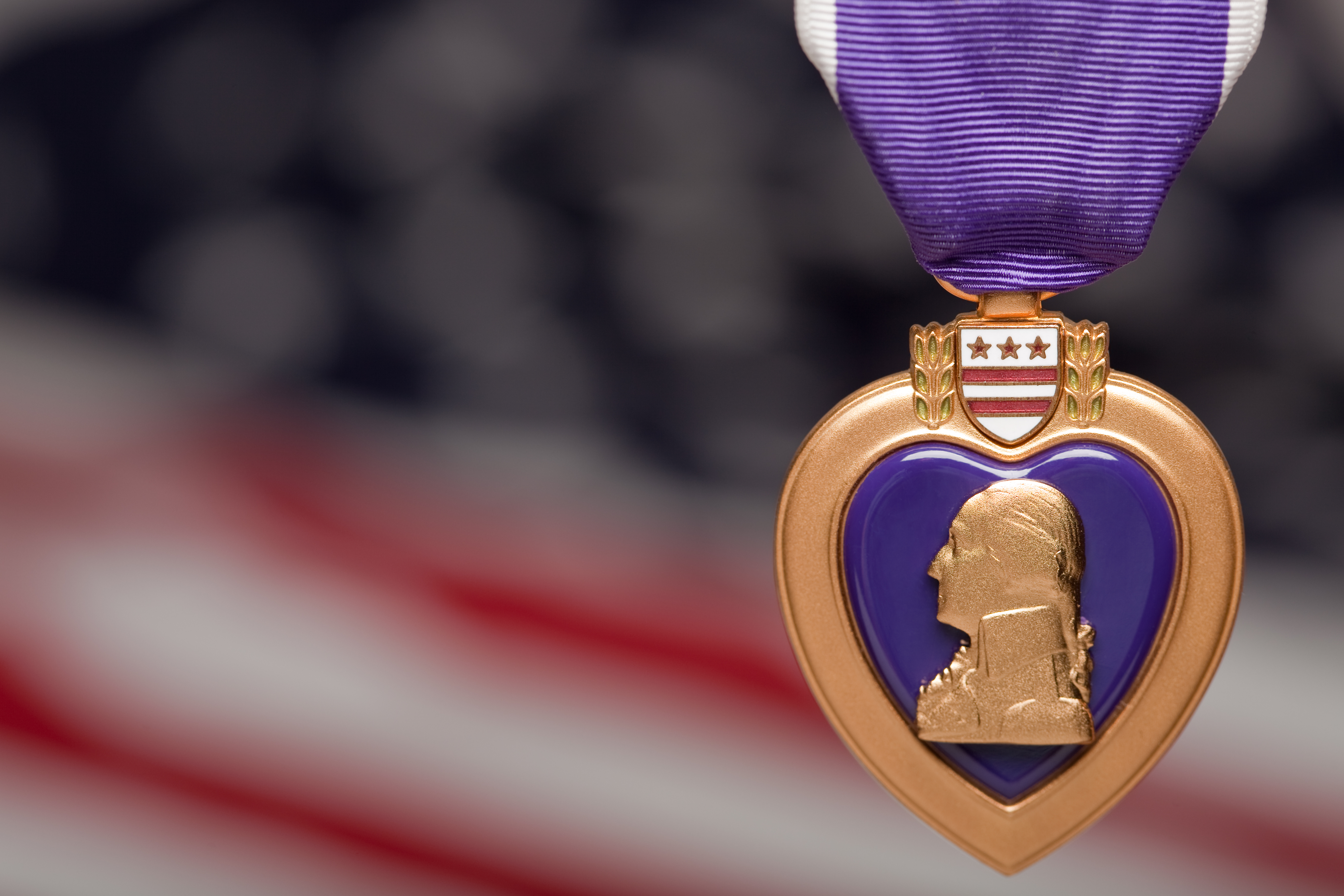
This past Monday (August 7th) was “Purple Heart Day” – on the list of U.S. Holidays and Observances – honoring the date the award was created in 1782.  The Purple Heart was not given between 1783 and 1931 – the span of time between the Revolutionary War and World War I – so it has “only” been awarded a total of 86 years since the days of George Washington.  That still amounts to countless acts of valor (over 1.8 million by some estimates).

I have the utmost respect for the men and women in uniform, so I am awed by those who receive the Purple Heart.  “Those” includes my father-in-law, who served and was injured in the Korean War back in the early 1950’s.  “Those” include various notables, including Kurt Vonnegut, Pat Tillman, Rod Serling, and Norman Schwarzkopf.  “Those” include Curry T. Haynes, who died less than a month ago.  Haynes served in the Army in the Vietnam War and received a total of ten Purple Hearts for the injuries he suffered.  That’s more decorations than any other recipient.

Ponder for a moment: Over a million Purple Hearts were awarded during WWI alone.  Another 350,000 were awarded during the Vietnam War.  All in defense of freedom.

Because decorations were not always documented (Purple Hearts were often awarded on the spot; even attached to the hospital beds of recipients), there is no accurate total.  Instead, the Military Order of the Purple Heart commemorated a network of roads, highways, and bridges in the states of Purple Heart recipients.  Whenever you see a sign like the one above, be reminded of the high (and frequent) price paid for your freedom.

Between 1942 and 1997, civilians serving in the armed forces were eligible to receive the Purple Heart.  Nine firefighters in the Honolulu Fire Department were decorated during the attack on Pearl Harbor.  After 1997, Congress passed legislation limiting awards to men and women in uniform.  Civilians now receive the Defense of Freedom Medal for similar sacrifices.

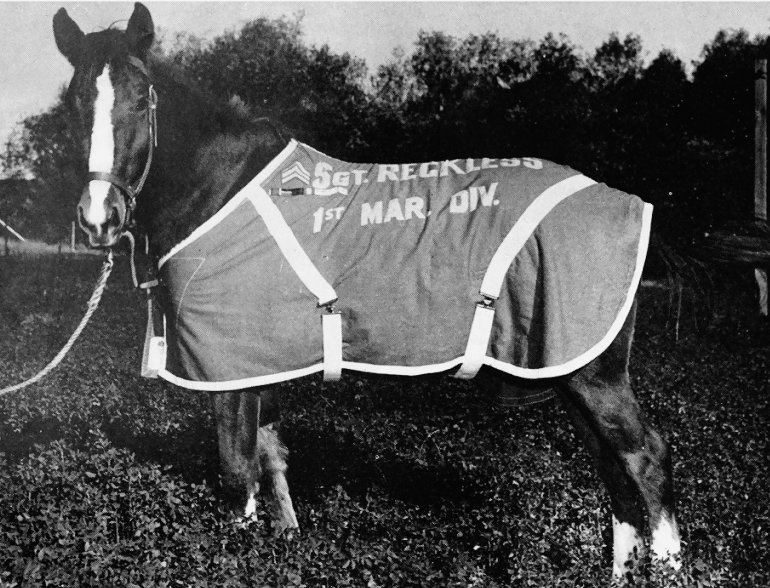
    Sergeant Reckless photo – by Andrew Geer

Animals are also eligible for the Purple Heart.  The most impressive: the decorated war horse Reckless, a thoroughbred mix rescued from the race track and trained by members of the Marine Corps.  Reckless served in the Korean War, frequently carrying supplies and ammunition to the front line.  Remarkably, Reckless memorized her routes so she could deliver unattended.  During one battle, she made 51 trips in a single day between supply depot and front line.  Reckless was wounded twice and thus received two Purple Hearts.  She was promoted to the rank of sergeant shortly after the war ended.  A plaque and photo of Reckless can be seen at the Marine Corp base Camp Pendleton in California.

As I began with, I’m a civilian living in a military town.  I am surrounded by my Colorado peers who serve or have served in the armed forces.  I may not be one of them, but at least I can tip my hat on the streets, especially to those who wear the Purple Heart.

Some content sourced from Wikipedia, “the free encyclopedia”.