Minuscule Marvels

For Christmas this year I’m putting a small ornament into my wife’s stocking. It’s a miniature of… well… let’s just leave it at “a miniature” in case she reads this post. But I know she’ll love this ornament and promptly hang it on our tree for the remainder of the season. Why will she love it? Because it’ll spark fond, romantic memories. But she’ll also love this ornament because she can’t help loving something that’s a little, well, little.

Ornaments are little

One of my bucket list items – still to be fulfilled – is a trip to the south of France for a taste of those wonderful wines created from Burgundy or Bordeaux grapes.  Maybe you hope to make the same trip some day so I’ll let you in on a little secret.  If your trip only allows a visit to Paris, you can still visit a vineyard… right in the middle of the city.  Most people visit the neighborhood of Montmartre to see the Sacre Coeur cathedral but most don’t know about the tiny vineyard just steps away.  Clos Montmarte produces wine on a single acre, from 2,000 vines forging a connection to the long-ago rural times of the region.  Compare an acre to the wineries in Bordeaux, with vines covering an average of fifty times that much property.

Harvesting the grapes at little Clos Montmartre

Clos Montmarte wines probably aren’t award-winning.  Who knows if I’d even care for the taste of their reds or rosés.  But does it really matter?  I love the thought of a teeny-tiny field of grapes right in the middle of Paris.  I love how the grapes are harvested by locals and transported to the cellars of the nearby Town Hall to be pressed and turned into wine.  The whole operation is appealing to me because it’s quaint and because it’s small.
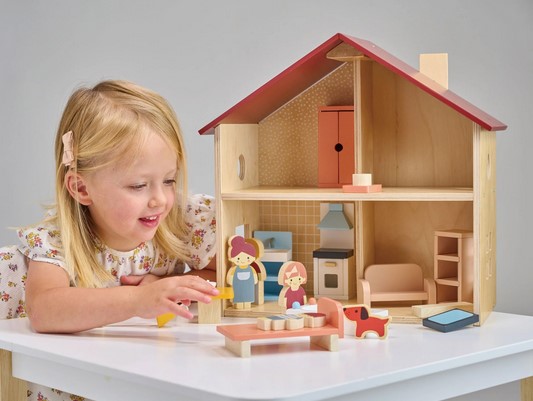
This affection for itty-bitty things must hearken back to our childhoods.  Who among us didn’t spend countless hours of playtime with (take your pick) little dolls, little cars, little houses, or scaled-down trains?  When we played at the beach we built little castles.  When we played in creeks we made little boats out of sticks or leaves and watched them flow with the water.  Tea parties meant tiny cups and plates on tiny tables.

My granddaughter’s little favorites

In today’s world the toys might be different but the attraction to small things remains.  It fascinates me to watch my (little) granddaughter choose her favorite toy from among dozens: a set of ten two-inch high Sesame Street characters.  She stands them up all over the house.  She hides them and then finds them.  She always seems to have one or two in her hands.  Even though my granddaughter doesn’t speak in complete sentences yet, she probably has complete thoughts as she considers tiny Big Bird.  You are a lot smaller than me and that’s why I like you so much.

Wee little cube

If you include Japanese toymaker MegaHouse in this year’s Christmas purchases, maybe you’ll go for their world’s smallest operational Rubik’s cube.  You can’t get one until next April, but picture this: the minuscule marvel is one 1,000th of the size of the original.  Pull out your metric measure to confirm it; a single face of the wee cube measures only 5mm from side to side.  Best throw a pair of tweezers into the Christmas stocking along with the cube.  There’s no way you’ll be able to rotate the Rubik’s colors with fingers alone.

Would I want the world’s smallest operational Rubik’s cube, you ask?  Heck yeah!  Consider, the faces of a traditional Rubik’s cube contain a 9×9 grid.  Then someone went and created a miniature Rubik’s cube with 2×2 grids.  I thought, how very cute.  I just had to have one so my original would have a little buddy.  My cubes are hanging out together on my home office shelf as we speak.  And they’re asking for an even littler buddy for Christmas.

Rubik’s “Mini”

So let’s summarize the pint-sized products we’ve covered today.  I already have the ornament for my wife in-hand (soon to be in-stocking).  I won’t put a bow on a bottle of Montmartre wine this year because I want the chance to see the tiny Paris winery for myself first.  And you probably thought I sprung for one of MegaHouse’s pee-wee Rubik’s cubes (and a pair of tweezers). Sadly, no.  I don’t have the $5,300 it costs to buy one (minuscule marvels aren’t cheap!) Thankfully, my wife will be happy with an adorable little ornament for $15 instead.

Some content sourced from the CNN Travel article, “The secret vineyard in the middle of Paris…”, and the CNN Style article, “This is the world’s smallest Rubik’s cube…”

It’s (Not) Just a House

Let’s agree to disagree today (one of my favorite catchphrases). You see things one way while I see them another. Perspective, angle, viewpoint – choose your word – we all come to our conclusions on different roads. Which is ironic, because four of us came to Frank Lloyd Wright’s Fallingwater on the same road three weeks ago.

I blogged about Fallingwater in Perfect Harmony a couple of years ago.  The post was meant to be a primer on what makes the house an iconic work of American architecture.  At the time I was also building LEGO’s version, which is as close as I thought I’d ever get to the real thing.  Today I can say I’ve checked an up close and personal visit off my bucket list.

Fair warning: there’s no convenient route to travel to Fallingwater, which shouldn’t surprise you about a house hidden in the forest.  You’ll drive ninety minutes southeast of Pittsburgh on two-lane roads, some in desperate need of repair. And watch carefully for the driveway entry; it kind of pops up out of nowhere.

You won’t get to see Fallingwater without booking a reservation beforehand.  Despite my dismay in last week’s post about required reservations in Rome they make a ton of sense with Fallingwater.  It’s a small house after all, so it’d be overwhelming if visitors just showed up and walked in.  We took the final tour on a Saturday and our guide said 600 others had already been through the house earlier in the day.

Fallingwater’s Visitors Center

Thanks to the resources of the Frank Lloyd Wright Conservancy (which is still buying up property around Fallingwater), the experience begins before you ever see the house itself.  The driveway wanders past a guard house to a modest parking lot.  From there you walk to a beautiful Visitors Center nestled in the trees.  A central outdoor seating area is surrounded by a small museum of Wright’s work, a cafe, and a gift shop that offers much more than shirts and postcards.  Frankly, the Visitors Center is a nice little work of architecture all by itself.

The walk to the house begins down a kind of woodsy nature trail, so you can see the rocks, trees, and other materials used to construct Fallingwater in their native forms.  What impressed me most about the tour is how you never see the house until you’re practically at its front door, making for a dramatic reveal.  Your walk descends through the canyon of Bear Run (the river over which Fallingwater is perched) until the house’s signature cantilevered forms emerge from the dense forest.

As I described it in Perfect Harmony, Fallingwater looks like it was “constructed entirely offsite and dropped gently within the forest by pushing aside a few tree branches”.  After seeing the house in person, I wouldn’t change a word of that statement.  The design is a marvel, not only in how the indoor/outdoor spaces integrate with their natural surroundings, but also in how it was built as if floating over the waterfall below.

Enough with the fawning over Fallingwater, am I right?  After the four of us took the tour we had a chance to process what we’d seen, and my wife’s and brother’s reactions were clear: it’s just a house.  It’s not even a nice house, with its low ceilings, dark spaces, and anything-but-cozy use of rock, concrete, and glass.  Fallingwater is hard to get to, and it’s in the middle of nowhere.  And with its hundredth birthday not far off, everything about the house has a decidedly dated feel.

I did my best to explain why I love Fallingwater.  My sister-in-law, who appreciates everything about the arts, understood the significance of the house.  She “got” what Frank Lloyd Wright was conveying in the design, and allowed the sacrifice of comfortable living for the sake of the indoor-outdoor interplay.  She probably took in the house the way she would a painting at the Louvre.  My wife and my brother, not so much.  For them the ninety minute tour was probably sixty minutes too long.

Fallingwater promotes the thought: “one person’s junk is another’s treasure”.  My treasure is architecture (so much so I studied it in college).  Yours is probably something entirely different.  It fascinates me how my brother spent years and years of research, consulting, and money to restore a 1960s vintage Ferrari in his back garage.  To me, cars get you from Point A to Point B; a mere convenience.  My brother could spend hours explaining why his Ferrari goes worlds beyond that statement.

Still lingering on my bucket list is a visit to Paris, where among the city’s many wonders stands the Eiffel Tower.  I want to see this engineering/architectural masterpiece from far and near, and of course, ascend it’s many levels to fully experience the structure itself.  For now however, I’ll have to settle for building LEGO’s version.  As with Fallingwater, we can all agree to disagree. The Eiffel is (not) just a tower.

Some content sourced from Wikipedia, “the free encyclopedia”.

Dreamy Las Vegas

DID YOU HEAR?  The price of Super Bowl tickets dropped this week!  That’s right, you and me will pay less for seats today than those jump-the-gun fans who got theirs ten days ago.  The game’s in three days so we’ve got no time to lose!  Let’s make our travel plans!

I’m gonna surprise my wife.  I mean, I’m the bigger football fan, yes, but she’ll be so proud of me for getting our game tickets for less!  And to celebrate “all things her” I figure, why not splurge on the rest of the trip since I’m saving money on the game?  Once in a lifetime, I’m telling myself.  Heck, by the time the Super Bowl comes to Vegas a second time she and I could be dead!

FIRST, new luggage.  I want the two of us to be those people, where just a glance at their bags has you thinking, “Whoa, who are they?”.  So, a quick trip to Tumi for a couple of their hard-shell packing cases ($1,500 per) and matching carry-on’s ($750).  Getting the gold finish too, because you’ve got to look the part if you’re going to Vegas.

SECOND, airfare.  I got me an itinerary lickety-split on Expedia, flying American.  Leave Thursday, return Tuesday. Turns out we can’t get there direct since we live in the middle of nowhere but at least we can fly first class, for just $6,826, with only $600 in taxes and fees.  Score!

THIRD, transportation to the hotel.  I’m not about to show up at the front doors with Tumi luggage in a rental car so it’s limo service for us!  My choice: a modest SUV for two (well, three, including our private driver).  I know, I know, I could’ve gone with the BMW stretch limo that seats twenty-five, but what are my wife and I gonna do – run laps around the inside of it?  Besides, the SUV is described as “… for the VIP who prefers discretion” and that’s a great way to describe my wife.  Round-trip: $375, with $75 in tips.

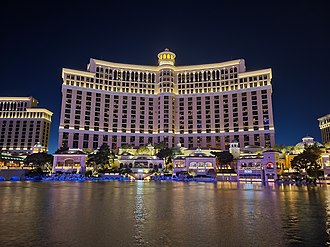
NOW THEN, the hotel.  Gotta be big and flashy, right?  Can’t be going to Vegas and the big game and staying at a Motel 6.  Let’s go with the Bellagio.  I don’t need a suite but I’d sure like a view of those lovely fountains.  The hotel website quotes five nights for a “1 King Bed Fountain View” at $10,113, including $3,144 in resort fees.  Yeah, I winced a bit with the five-figure quote but then the website flashed, Jackpot! This is today’s low rate! so I felt much better. The website also added a ten-minute timer on the rate but no worries – I booked it in less than five!  Makes the $300 room service dinners seem like nothing, doesn’t it?

Bellagio Hotel

In the days leading up to the game I’ll pamper my wife a little.  In fact, since I love the view of those Bellagio fountains so much, guess what?  I can order up a couples massage right there in the room! Only $650 for the two of us, including $110 of gratitude to the masseuses.  Then we’ll be nice and relaxed for a dinner at, say, the Eiffel Tower Restaurant at the Paris Hotel (and another view of those fountains).  We’ll start with Casco Bay scallops ($32), followed by mixed greens ($38) and the “Queen’s Cut Beef Tenderloin Filet Mignon” ($138), with a plate of accompaniments and sauces ($42).  We’ll finish up with a couple of the house special “Eiffel Tower soufflés” ($44), and wash it all down with a nice enough bottle of red ($80).  Another $110 in tax and tips calls it a night.

Paris Las Vegas

Now wait a sec’. Since when does anyone in Vegas “call it a night” after dinner?  So I thought about taking my wife to a big-name concert at the new Sphere but then it hit me. ‘O’ by Cirque du Soliel is right there in the Bellagio hotel!  Two orchestra-center seats: $657, and only $93 tax/fees!

FINALLY… what I’ve been building to for hundreds of words now – Super Bowl XVIII.  I’ve never been to Allegiant Stadium before and this’ll probably be my only visit, so…  No, I didn’t go completely off the rails (like seats on the fifty or a sky box) but I do want to see the plays up close and personal so it’s got to be lower bowl, at least the 20-yard line.  Oh man, what a relief!  I found the last pair of tickets in Section C137 for $29,000 out the door (only $5,000 in service fees!)  A flame emoji and a blinking “selling fast” sign had me sweating but I managed to get ’em before the next guy!  Don’t forget, these same tickets would’ve cost me even more just a week ago.  Can I find a bargain or what?

(Yawn… stretch…)

Oh, uh… hey… it’s Dave, your, uh, “weekly blogger”.  Holy cow, let me tell you, I just woke up from the craziest dream.  I was headed to the Super Bowl last-minute, see, and everything about the trip was the best Vegas had to offer.  Hotel, dinner, show, game tickets – the works.  Now that I’m awake, I’m wondering what all that fun would’ve cost me.  $53,598 comes to mind for some reason but I’m sure I didn’t “spend” anywhere near that amount.  Just a crazy dream.  Anyway, sorry to write and run but I’ve got to return a call to my bank, asking about unusual activity on my credit card.

Some content sourced from the CNN Business article, “Super Bowl ticket prices have dropped but they still cost a fortune”, and Wikipedia, “the free encyclopedia”.

Rocket Men (and Women)

A year from today, we’ll all be glued to our televisions and tablets watching the Olympic Games in Paris. I will be glued, at least.  The Summer Games get me all fired up, especially the track and field events. Especially especially the field events. I mean, c’mon, you can watch running all year long, but how often do you get to see a javelin thrown, a discus tossed, or a shot “put”? (and how often do you even say “javelin” or “discus”?)  But one field event tops all others.  There’s simply nothing more gawky-entertaining than a human launched into space by a pole.

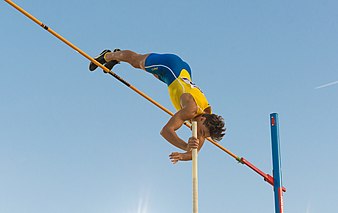
If you live in a two-story place with a fairly flat roof, it might be a little unnerving to learn Swedish-American pole vaulter Armand Duplantis can jump over your house.  While the rest of us have to walk around at ground level to get to your backyard, Armand will simply sprint up your front path, plant his pole in your rose bushes, launch himself past the bedroom windows and between the chimneys, and make a splash landing in your swimming pool.  Armand can do this because he can pole vault 20.4 feet, a world record he set last February.  It’s the fifth time this twenty-something has broken his own world record.

Duplantis

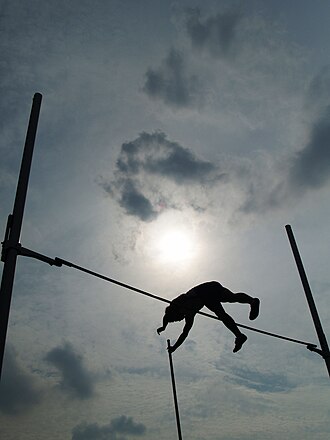
Pole vaulting is a truly bizarre sequence of movements constituting an Olympic event.  The vaulter balances a long fiberglass pole in one hand while sprinting down a rubber-surfaced runway. Just before running out of runway he or she raises the pole overhead with both hands, stabs the leading end into a boxed area on the ground, and pushes… hard.  The ensuing bend of the pole and a whole lot of momentum hoists the vaulter into the air, feet first.  With gymnastic flair, the vaulter then rotates his or her body around to be facing a high horizontal bar, just as gravity counters flight.  The final flop back to Earth (and onto a giant cushion) is typically punctuated with a mid-air fist pump if the bar is successfully cleared.

Armand doing what Armand does best

Imagine that exhilarating feeling when a pole vaulter is at peak height, pointing skyward, feet above body, pole released, practically cruising into the earth’s atmosphere.  As Elton John sings “… it’s gonna be a long, long time ’til touchdown brings me round again…”

Four Olympic field events involve jumping: 1) pole vault, 2) long jump, 3) high jump, and 4) triple jump (the ol’ “hop, skip, and jump”).  None of the last three hold my interest because they’re easy to do.  But not pole vaulting, not even close.  Launching my body even a few feet off the ground with a bendy pole?  Let’s just agree, I am no Rocket Man.

Pole vaulting brings to mind two questions (or three if you include Why in heaven’s name does anyone do this?).  First question: What happens if the pole breaks?  Seriously, sports equipment fails.  Golf clubs break in two with enough swings.  Tennis racket strings get loose.  At some point a pole vault pole will bend one too many times.  Yikes.  Second question: How does the pole translate horizontal energy into vertical energy?  It’s a physics problem akin to the catapult, but I’d have to go back to high school to solve it.  No thanks.

Leap of faith

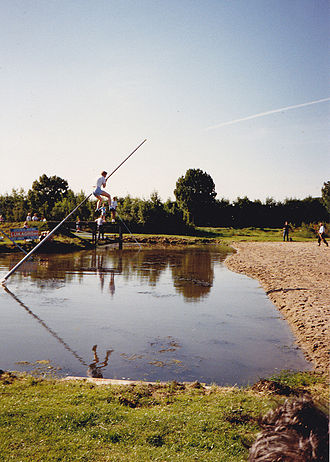
The origin of pole vaulting is a bit of a letdown.  My too-many-movies imagination pictured a medieval war, with soldiers clearing castle walls on long pieces of bamboo.  Instead, pole vaulting is a rough translation of an old technique used to scale narrow natural obstacles, like watery marshes.  Get a running start, plant the pole, and sail from one side of the marsh to the other.  But those poles don’t bend, and nobody cares how high you go as long as you make it over.  So you see, even the origin of pole vaulting is gawky. 

The pole vaulting world record was eighteen feet in 1970.  Fifty years later it’s been pushed two feet higher.  Do the math; maybe we’ll be clearing one hundred feet by the year 2773.  But we’ll probably have flying cars by then as well, so any interest in humans launched by poles will be gone.  My advice: watch the Paris Games, especially the pole vault.  These rocket men and women won’t be around forever.

Some content sourced from the CNN article, “Olympic champion Armand Duplantis…”, and Wikipedia, “the free encyclopedia”.

Making An Entrance

My son will complete the purchase of his first house next week. We’ve helped him mull over properties the last few months, scrutinizing everything from floor plans to foundations. But I always focus on whether a house has a formal entry or not. There’s something about a foyer that feels essential to me, as if to say, “Welcome!”.  Apple must’ve felt the same way when they designed their flagship store in New York City. Welcome to Apple Fifth Avenue.

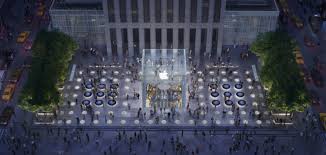
Apple Fifth Avenue

If you’ve been to an Apple Store (and who am I kidding here; we’ve all been to an Apple Store), you know they’re essentially a room of tables and shelves. You’re greeted up front, asked what brings you in, and directed to wherever you need to go. Apple Fifth Avenue, on the other hand, needs no greeters.  Its dramatic foyer beckons you in all by itself.

Apple Fifth Avenue’s entry is a 32 ft. glass cube dropped into the middle of a plaza in downtown Manhattan.  The adjacent skyscrapers make the transparent structure stand out even more.  There’s no signage whatsoever; simply a large, suspended Apple logo inviting you to descend the elevator or elegant spiral staircase to the store itself (which is entirely below ground).  It’s the same strategy employed by the Louvre in Paris, with its above-ground glass pyramid serving as the entrance to the museum’s lobby below.

Plaza skylights and “lenses”

Without this entry I’m not sure Apple Fifth Avenue’s design would garner much attention, yet there are other elements worth noting.  The surrounding plaza is dotted with 62 frosted skylights, bringing welcome natural light to the retail space below.  The plaza also hosts 18 “lenses” – reflective steel shells with glass tops – to give you peeks downstairs.  In the store itself you’ll find several (real) trees, with seating incorporated into their circular planters.

Planters double as seating

Apple Fifth Avenue became so popular a destination that secondary entrances were added (two staircases in the plaza) and the square footage of the store itself was doubled.

One of the more interesting stories behind Apple Fifth Avenue’s design concerned the size of the entry.  CEO Steve Jobs wanted a 40-ft. cube while the property owner insisted on 30.  To bridge the gap, a full-scale mock-up was created and placed in the plaza for Apple executives to see.  The problem: Apple didn’t want to draw the attention of the public any more than they had to.  So the mock-up was installed for just a couple of hours at 2 a.m. on a random weekday.  When a 40-ft. cube was deemed too large (sorry, Steve), it was quickly disassembled to reveal a smaller cube inside – the size of the one you enter today.

It’s about time I included a NYC building in my posts on architecture, wouldn’t you agree?  New Yorkers know I had plenty of choices, like the Empire State Building, Waldorf Astoria Hotel, St. Patrick’s Cathedral, and Grand Central Station.  But those have been around a long time.  Apple Fifth Avenue opened its doors less than twenty years ago, and is already in the top sixty on the list of America’s Favorite Architecture.

As I recall the houses we looked at with my son, some had no foyer whatsoever.  You walked across the threshold and found yourself standing in the front room or living room.  That’s no way to make an entrance, is it?  Apple knows better.  At most of their stores you get a greeter.  At Apple Fifth Avenue you get a full-on welcome. 

Now for the latest on LEGO Fallingwater…

____________________

LEGO Fallingwater – Update #10 (Read how this project got started in Perfect Harmony)

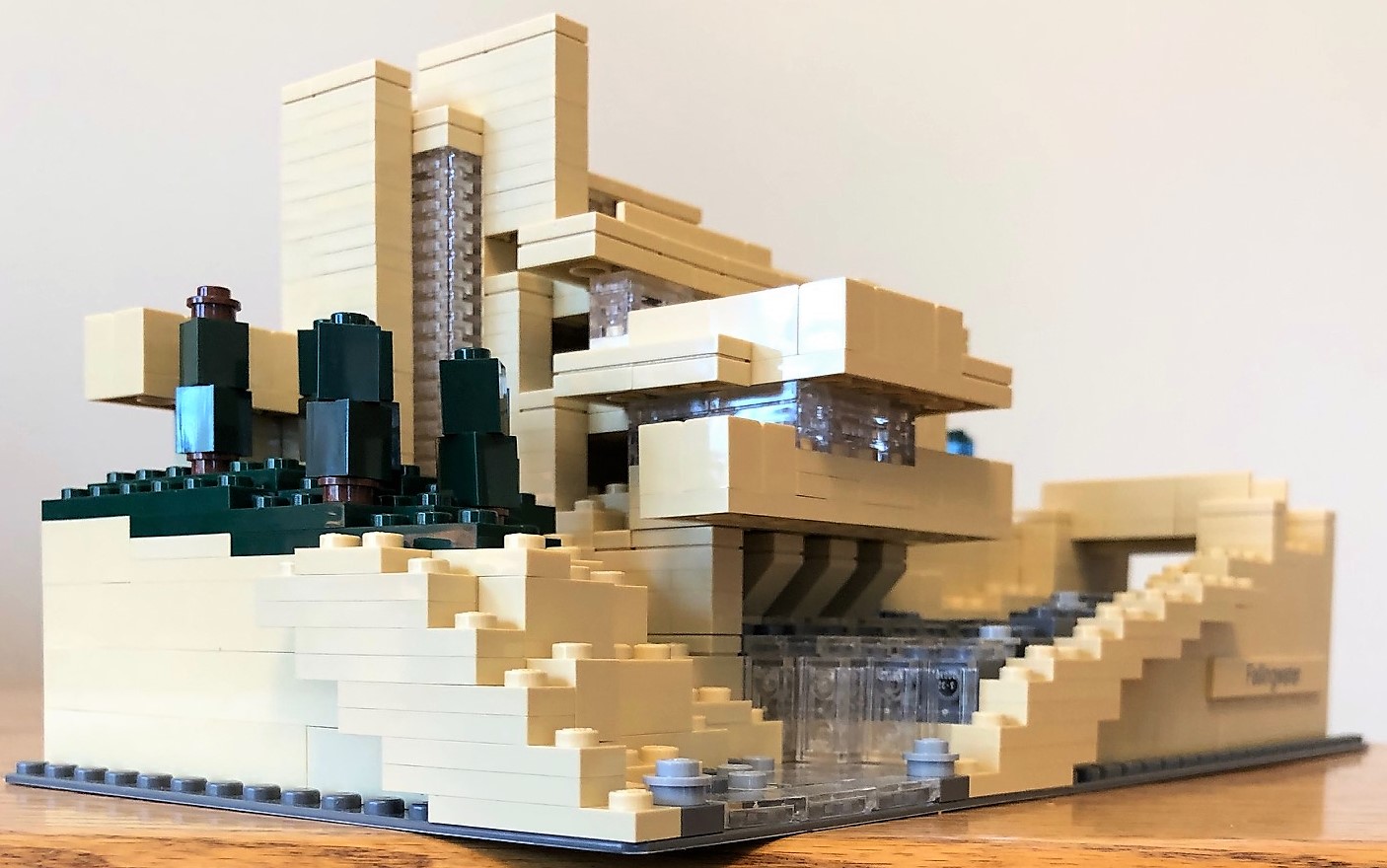
We’ve placed the very last brick into place, closing the assembly manual on our ten-week construction of LEGO Fallingwater.  92 pages (or 100%, or 222 minutes) into the build, here is the final product:

LEGO Fallingwater

The angle of this photo is intended to match the photo above so you can compare the model to the real thing.  I want to label the model “crude” but how about “rudimentary” instead?  The intricacies of LEGO models have come a long way since this one.

A note about missing pieces.  As I worked through the final steps I realized a handful of pieces were missing.  I write this off to a less-than-perfect mechanism doling out the pieces for each model (or was this done by hand?)  The LEGO Grand Piano wasn’t missing a single piece out of 3,000+.  The gaps aren’t obvious at a glance so we can still call Fallingwater complete.  Thanks for coming along for the ride!

Now for one last nod to Frank Lloyd Wright…

Oak Park Home & Studio

It’s fitting to finish where it all began.  Wright’s first design (of which he was the sole architect) was his own home, built just west of Chicago in 1889.

Frank Lloyd Wright Home & Studio, Oak Park, IL

The house’s style, “Seaside Colonial” (borrowing from similar designs on the East Coast) was Wright’s first experiment with the Prairie Style elements that would later come together in so many of his other designs.  The exterior is grounded with brick and stone while the interior has a largely open floor plan.  The barrel-vaulted playroom was built on a smaller scale; a deliberate nod to its young occupants.

Barrel-vaulted playroom

The rapid success of Wright’s architecture practice allowed for the expansion of the house a few years later, including the large octagonal structure you see on the left (for drafting studios, offices, a library, and a reception hall).  Wright wore all the design hats on this project, including the mechanical systems, lighting, furniture, and decor.

Wright’s Oak Park Home & Studio is a National Historic Landmark and is open to the public.  Even better, you can take a walking tour through the nearby neighborhoods to see ten houses he designed that still stand today.

Some content sourced from the Frank Lloyd Wright Foundation website, and Wikipedia, “the free encyclopedia”.

Iced Coffee

Place Dauphine

In the airy but over-aired romantic comedy Me Before You (2016), the dashing but damaged Will Traynor (Sam Claflin) laments bygone times when he refers to, “Paris. Place Dauphine, right by the Pont Neuf. Sitting outside the cafe with a strong coffee, a warm croissant with unsalted butter and strawberry jam.” Place Dauphine is not just a scene in Me Before You; it’s a real square in the heart of Paris.  And it probably has Will’s cafe, thanks to the nearby river and central views of the city.  Yet French cafes are growing scarcer every year.  In fact, these quaint little gathering places are disappearing in droves.

Painting by Vickie Wade

If someone asked me to paint a scene from a French country village, I’d surely highlight a charming cafe on a cobbled central space, bursting with patrons.  In the cafe, the proprietor would serve incomparable pastries alongside fine, pressed coffee.  The room would swell with music and chatter; the locals swapping their work-day adventures before heading home to supper.  The evening stopover in the cafe seems to me a staple of French culture.

So it pains me to read about closed doors on France’s rural cafes, according to a recent report of the Wall Street Journal.  Sixty years ago, you would find over 200,000 of them liberally dotting the country.  Today, there are less than 40,000.  “Progress” – in its various forms – has forced the rural worker out of traditional French industries and into the big cities.  Time once spent in the cafe is now given over to the workday commute.  Adds a village mayor, “Without a cafe, a village is pretty much dead”.

A “French cafe” in Ireland

Even though I’ve been to Paris, I can’t claim to have spent time in any of its cafes, not even the famed Les Deux Magots, where writers like Hemingway and Joyce were said to have gathered.  And yet, I’ve still experienced authentic “cafe culture” (and I don’t mean Starbucks).  On a trip to Ireland several years ago, my wife and I concluded our first day of sightseeing by ducking into what we thought was a small pub in downtown Dublin.  Turns out the place was more “French cafe”, complete with black-and-white prints on the walls, candle-lights on the tables, and coffee, tea, and pastries to beat the band.  We were so taken by the place we stopped in every afternoon for the better part of a week.  Perhaps the most showstopping memory of all: we never saw a phone, tablet, or laptop.  Patrons were there to gather and chat, or at least – in the case of a few loners – to lose themselves in a good book.

van Gogh’s “The Starry Night”

The French cafe is made all the more romantic thanks to the artist Vincent van Gogh.  In 1888 in the southern town of Arles, van Gogh observed the play of a cafe’s lights against the nighttime sky, which inspired his painting Cafe Terrace at Night, the precursor to his unequaled The Starry Night

“Yellow vest” protestors

Perhaps you recall France’s “yellow vest movement” a year or so ago, when protestors took to the streets to battle aggressive economic policies.  Turns out the French cafes played a part in the melee.  The government sought to impose an increased fuel tax to reduce the number of cars on the road.  The protesters interpreted the tax as an impolite shove, to get more people to move to the big cities.  In other words, less people in French country villages.  And no people in French country cafes.  Remarkably, one of the government’s concessions following the yellow-vest protests was subsidies towards small businesses.  Perhaps the French country cafe is not dead after all.

Had I written this post two weeks ago, I wouldn’t have come up with much positive spin on this topic.  But let’s face it, those of us “sheltered in place” right now yearn for social interaction (not social distancing).  We want face-to-face again, not Facetime.  We want the congregation, not just the church service.  So perhaps there’s a silver lining to the current pandemic after all.  When we return to “new normal”, my hope is we’ll have a newfound appreciation for gathering, instead of hiding behind our electronic devices.  As well, my hope is my next visit to France will find the doors of French country cafes wide open again, just beckoning me inside for “strong coffee and warm croissant”.