Living On The Edge

The state line between South Carolina (SC) and Georgia (GA) follows the twists and turns of the Savannah River. You know you’re heading into one state or the other whenever you cross the water. Driving from our part of South Carolina into nearby Augusta, GA is interesting. The interstate loops Augusta by starting in SC, touches a bit of GA, goes back to SC for a few miles, then continues into GA again as it follows the river. It’s an example of my life on the edge.

In California, W means “water”

Growing up on the coast of California, it never occurred to me the geography of my younger days was limited to only three of the four cardinal directions.  If I headed north I’d leave the urban stretches of Los Angeles for the more rural towns of the the central coast.  Head south and I’d parallel the beaches all the way to San Diego.  The only thing east of the city seemed to be the endless Mojave Desert.  As for the last of the four directions?  Not an option, at least not without a boat, plane, or a whole lot of swimming.  Horace Greeley would’ve never told me to “Go West, young man”.
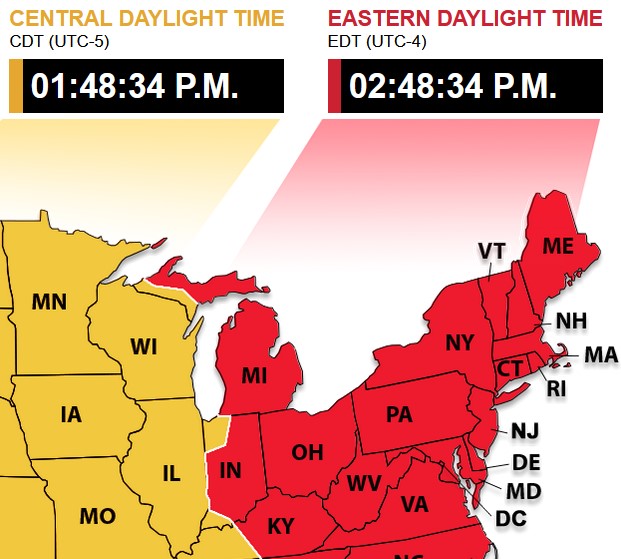
South Bend sits where the yellow and red come together at the very top of Indiana.

In my college years in South Bend, IN, I was a fifteen-minute drive from the line where the Central and Eastern time zones meet.  Back then you didn’t touch your clock for Daylight Savings, so half the year you were the same time as Detroit while the other half you were Chicago.  It was confusing, but not as confusing as someone who lived on one side of the line and worked on the other.  Imagine leaving the house at 8:00am, driving an hour, and arriving at the office at… 8:00am?  It’s a neat trick, pulled off by a lot of those who live on the edge of a time zone.

Raising our kids in Colorado Springs, we always knew which direction we were heading because the line of the Rocky Mountains lay immediately to the west.  Those peaks rose up like the Great Wall of China, just daring you to push through.  Sure, we drove the interstates into the Rockies for skiing, hiking, and such, but day-to-day we were down at the base, literally living on the edge.  Like California, we had one less cardinal direction at our disposal.

Grays Peak, on Colorado’s Continental Divide

The Rockies conceal another important edge, known as the Continental Divide.  The Divide is elevated terrain separating neighboring drainage basins.  Plain English?  The north-south line from which water flows either west to the Pacific Ocean or east to the Atlantic.  I always wanted to stop somewhere flat on the Divide and pour out a bottle of water.  Let’s see if it really flows both ways from the line, right?  It’s an experiment that to this day remains unconducted.
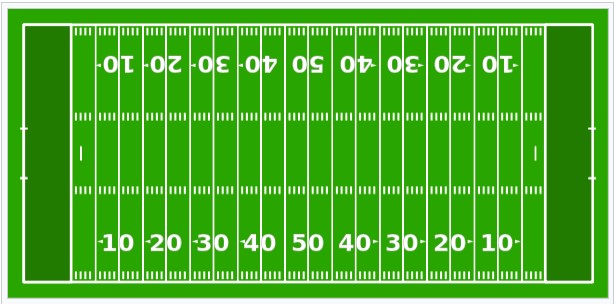
Football is a game of lines and edges

Football, one of my favorite spectator sports, is all about lines and edges.  One team faces the other, on an imaginary line defined by where the referee places the ball.  Cross that line before the ball is snapped and you’ll be flagged with a penalty.  Advance the ball ten yards past that line – to another imaginary line – and your team is awarded more play.  The sidelines of the field might as well drop off to a bottomless void.  Catching a pass outside of that edge is not allowed.  Running the ball outside of that edge brings the game to a halt.  But catching or running across the lines at end of the field?  That rewards you with a score.

$50 gets you a spot on “The Edge” sky deck

For all this living and playing on thresholds, maybe I should visit one of New York City’s newest high-rise attractions.  One hundred floors above the sidewalk, The Edge is billed as “the highest outdoor sky deck in the Western Hemisphere”.  Jutting out from its host building, The Edge allows unparalleled views of the city below, because the surrounding walls are solid glass, as is a portion of the deck floor itself (yikes!) If Spider-Man is your thing, you can go even higher by scaling the outside of the remaining floors of the skyscraper.  I have to say, this sort of thing draws a “fine line” between entertainment and, well, insanity.

I won’t be going to The Edge… ever.  I’m not good with heights, so anything above a pedestrian Ferris Wheel just isn’t my cup of tea.  Nope, leave me behind, comfortably grounded, where crossing the Savannah River from one state to another is plenty adventurous.  That’s my definition of life on the edge.

Some content sourced from Wikipedia, “the free encyclopedia”.

Behind the Wheels

Every summer when my wife and I head to the West Coast for a little sunshine and sand, the only intentional exercise we get is a walk on the beach or a dip in the ocean. So this year we decided our vacation equation needed to get behind the wheels. We skipped the flight, racked the bikes onto the back of the SUV, and drove 1,100 Utah/Arizona/Nevada desert miles to bridge the gap between Colorado and California. Now the Pacific Coast sun shines above, the Pacific Ocean waves crash below, and the bikes… well, the bikes just beckon to be ridden every day.

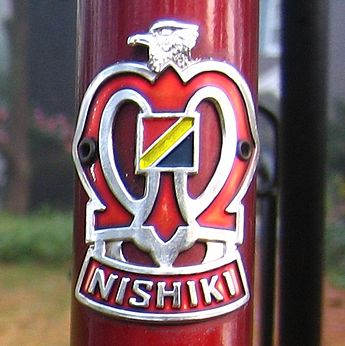
It’s already happened, as I suspected it would.  When we took our first pedal tour around this little seaside town, I saw him for a few fleeting moments.  He was a younger, thinner, blonder version of me.  He was seated confidently behind the drop handlebars of a white Nishiki Regal ten-speed, focused solely on the road in front of him.  He was dressed in Converse tennis shoes, ballcap in place of a bike helmet, white socks halfway to the knees.  When this kid wasn’t body surfing, playing basketball, or working the evening shift at McDonald’s, he was logging mile after mile on his bicycle, in search of driver’s license freedoms, even if he wasn’t old enough to have one.

My fleeting companion is the “me” of forty-five years ago.  In most respects it’s a long period of time.  In others we could be talking about last week.  Bicycling was serious thread in the fabric of my childhood.  It was a way to leave the familiar behind, to pursue esoteric wonders beyond the streets I grew up on.  Bicycling asked the questions, “Where would you like to go?” “Why?”  “And how far?”  At fifteen years old, the answers were limitless.

The Schwinn “Lemon Peeler”

My love of cycling began at a young age (and continues today in weekly spin classes at the gym).  I still remember the very first hand-me-down bike my brothers and I shared – a small blue two-wheeler with no gears, the kind you had to pedal backward to brake.  From there I graduated to a glam Schwinn Lemon Peeler Sting Ray, the all-yellow beauty with the fenders above fat tires, sporting the signature banana seat.

But my Nishiki Regal ten-speed brought bicycling to a whole new level.  I bought it myself: months of hard-earned allowance and odd-jobs cash plunked down for the biggest purchase of my young life.  The Nishiki granted me access to the more sophisticated language of bicycling; terms like “chain stay”, “saddle”, and “derailleur”, even if I couldn’t afford the Raleigh or Motobecane imports more deserving of those words.

Also, the Nishiki meant bike maintenance became a labor of love instead of a chore; a bonding afternoon with friends.  The shade of my dad’s carport colored our “workshop”, where we dismantled, fine-tuned, and reassembled over and over; my friends and I exchanging tools and advice for each other’s spare parts.  I still remember the final touch when the Nishiki was all back together: the pristine white finishing tape wrapped carefully around those drop handlebars, signifying it was finally time to ride.

I was never far behind…

One story of me and my Nishiki will always stand out.  It was all about beating the school bus home.  When the bell rang after my final class, I’d sprint to the rack, jump on my bike, and launch into the six-mile trek back to my house.  The bus meanwhile, needed several minutes to load its passengers, not to mention dozens of stops before it would’ve dropped me.  It was always a neck-and-neck battle as I’d pass the bus and then it’d pass me.  Most times I’d lose the race by mere seconds, easing up on the pedals in exhausted frustration.  But every now and then I’d get the victory.  Did some of my friends deliberately take their time exiting the bus, knowing I was in hot pursuit?  Maybe.

In 1979, a few months after I turned seventeen, a wonderful little film called Breaking Away won the Academy Award for Best Picture.  The movie centered around four friends, bicycling, and Bloomington, Indiana’s “Little 500” bike race, but it was mostly about coming of age.  Learning life’s lessons while putting the miles on the pedals.

Little wonder Breaking Away‘s lead character was named Dave.

[Note: If anything about this post resonates with you, be sure to read Steve Rushin’s Sting-Ray Afternoons.  The author’s childhood is set in Minnesota, but the growing-up memories are remarkably similar to my own.  Even the kid on the cover looks a little like me.  Steve and I could’ve been brothers.]

Some content sourced from Wikipedia, “the free encyclopedia”.

Climb Ev’ry Mountain

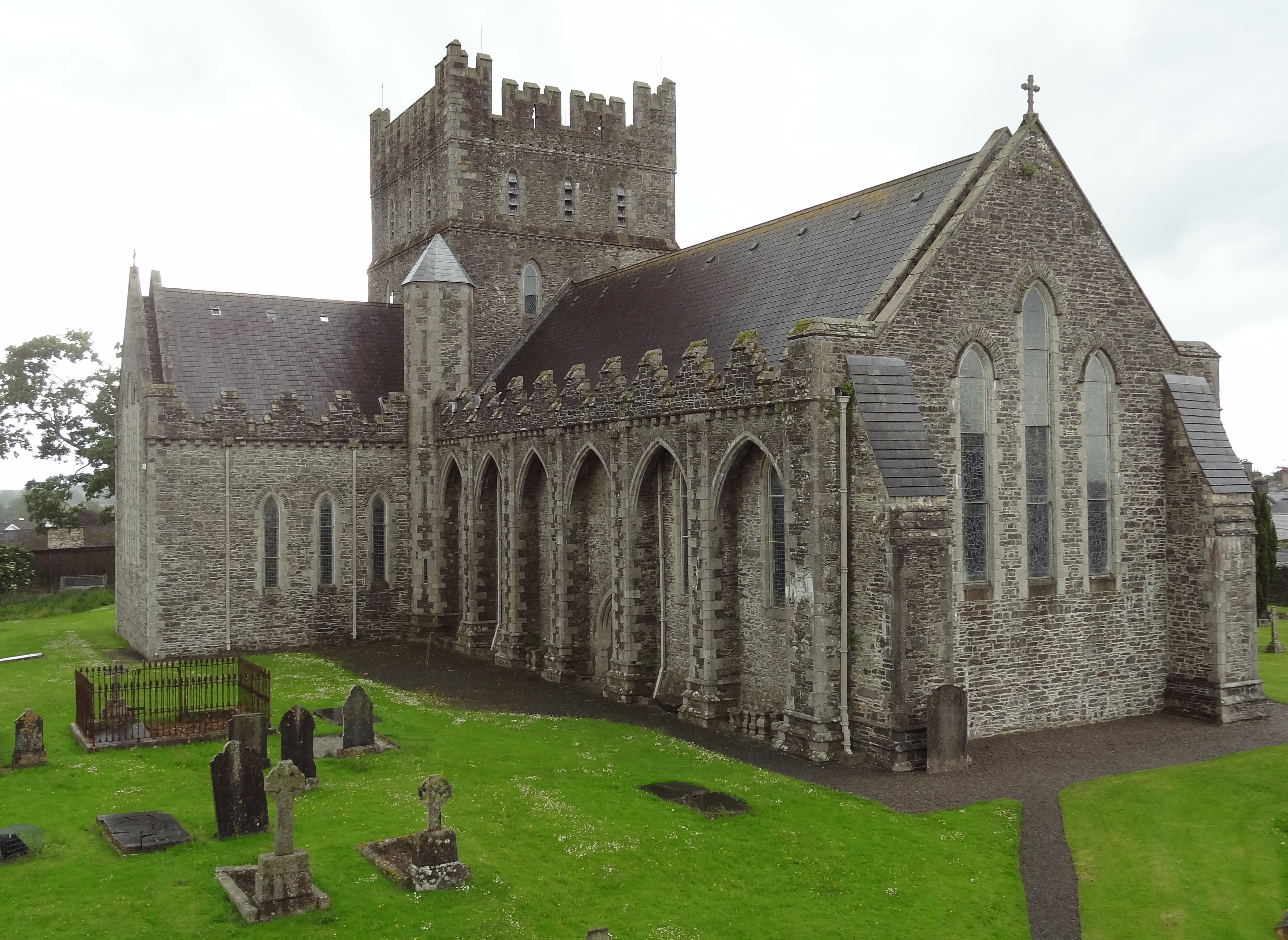
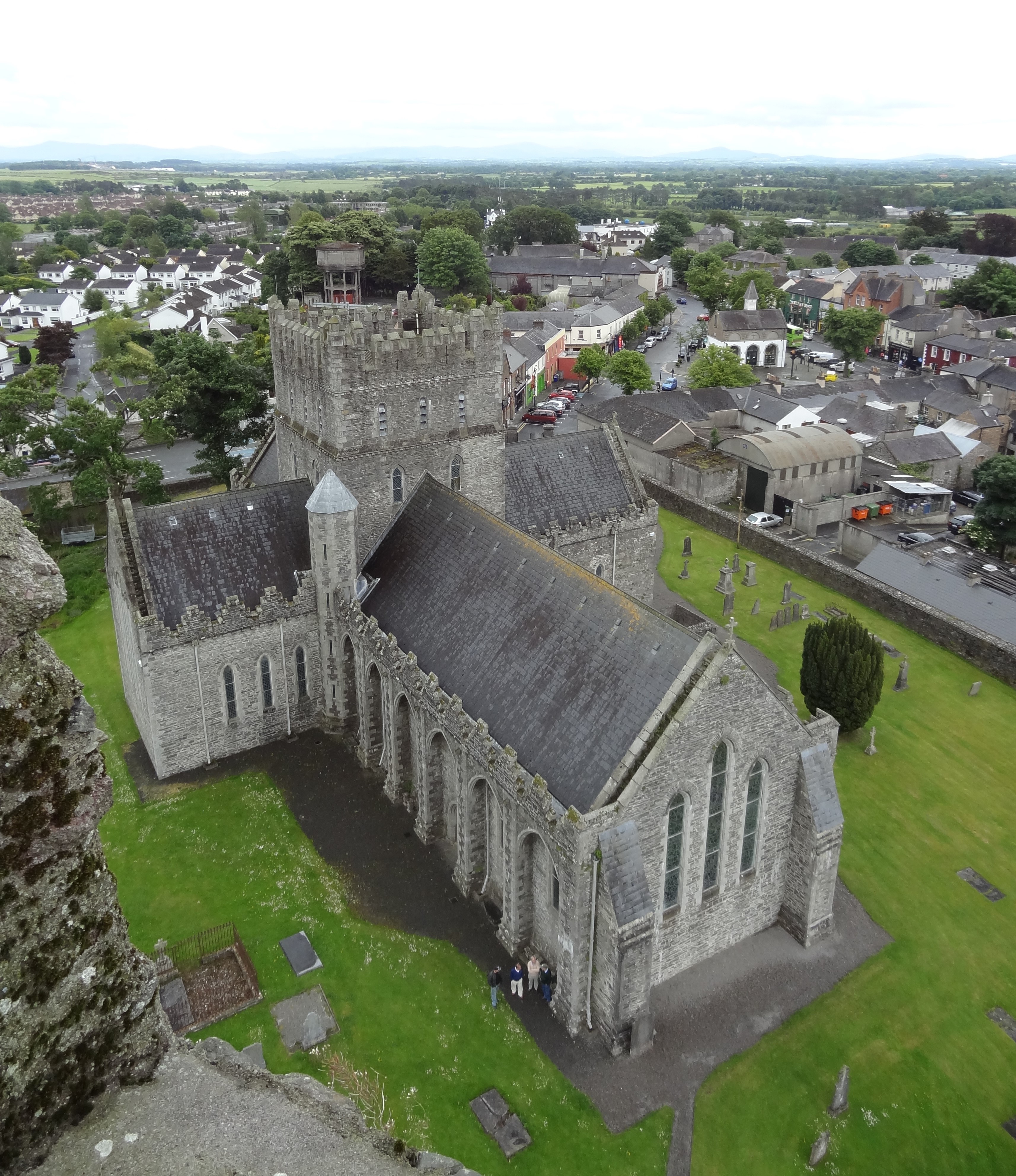
St. Brigid’s Cathedral dominates the quaint urban landscape of Kildare Town in central Ireland. The centuries-old stone church beckons the short walk up the hill from the village square, for a tour around Brigid’s domain. And while you’re on the grounds, you’ll be tempted to climb the adjacent tower for a bird’s eye view of the surrounding county. I assure you; the vistas are breathtaking.

A bird’s eye view from my own locale would be just as breathtaking right about now.  In the last ten days, I’ve ventured beyond my driveway once, for a mundane grocery shop at the local market.  For all I know, nearby Colorado Springs has been erased from the map.  For all I know, all my neighbors in the surrounding county traveled to a tropical island where they’re making merry, while I’m left to keep an eye on things back here at home.  Who nominated me for that job?

Proceed with caution!
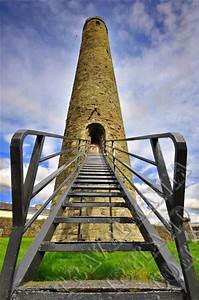
The tower “stairs”

No kidding, the view from the tower at St. Brigid’s is spectacular.  Not only do you see all of Kildare Town below, but you’ll be mesmerized by the lush green acreage of the adjacent Irish National Stud (and its countless roaming thoroughbred horses).  When my wife and I visited several years ago, targeting Kildare Town to see the cathedral of her namesake saint, I figured light a few candles and say a few prayers; not climb a ten-story tower.  I have a mild fear of heights so you can imagine my trepidation.  And here’s the kicker: there’s no code-sanctioned, easy-to-navigate stairwell within the tower.  Instead, you hand over a couple of Euros for the privilege of climbing a dozen ladders to the top.  I almost called it quits after the first few rungs.

My longing to “rise above it all” today is not just inspired by the pandemic, nor even my acrophobia-be-damned adventure up the tower at St. Brigid’s.  I also think about nearby Pikes Peak, the highest of the Rocky Mountains in this part of Colorado.  “America’s Mountain” tops out at 14,115 feet, and I’ve hiked to the summit several times (the trail begins at 6,000 feet).  You begin the journey on a series of easy switch-backing trails, which then give way to a remarkably gentle incline through a forest of Ponderosa pines.  For several miles under the treetops, you have no orientation to suggest you’re even climbing a majestic mountain.  But once you hit the tree line, everything upwards is a moonscape: rocks and dirt and scrub brush all the way up to the summit.  The view is stunning; as if you’re looking down from space.  You can see clear to Wyoming to the north and Kansas to the east.

Pikes Peak, through Garden of the Gods

I could use a mountain (or a ladder-filled tower) on my property right about now, just to connect with the world around me.  Oh sure, rural living means the stay-at-home rules are a minor inconvenience, but it’d sure be nice to confirm someone else is out there.  The local news shows human interest stories every night on TV, but c’mon, how many of us trust the media these days?

Here’s my very favorite climb-ev’ry-mountain memory.  I grew up in a narrow canyon on the outskirts of Los Angeles; so narrow in fact, some stretches could only accommodate a single row of houses on one side of a winding two-lane road.  Biking with the cars was taking your life in your own hands, as was scaling the canyon trails into the domains of rattlesnakes and other wildlife.

Lucky for me, a steeply rising network of paved residential streets branched off the canyon floor less than a mile south of our house.  On foot, those streets became a kid’s adventure up and out of the isolation.  I’d stock a daypack with cheese sandwiches, Pop-Tarts, and anything else I could pilfer from the pantry.  Some days I’d go it alone; others I’d drag my brother with me.  Up, up, up we’d climb, rising breathless until we could peer almost straight back down to the canyon floor below.  The final stretch of the topmost street – with houses perched precariously along on its edges – afforded a view of Los Angeles and the nearby Pacific Ocean like none I’ve seen to this day.  There I’d sit, munching snacks, wondering what all I was missing down there in the big city.

Today it’s the same feeling, only different.  What am I missing out there in the big city?  Is Wyoming still to the north and Kansas to the east?  Are cadets still at the Air Force Academy, anticipating this weekend’s socially-distanced graduation ceremony?  Have the majestic red rocks of Garden of the Gods finally crumbled?  Truthfully, I can’t answer any of these questions, not while I’m stay-at-home.  But at least I can see the summit of Pikes Peak from here.  At least I’m confident St. Brigid’s Cathedral still stands in Kildare Town (Notre Dame in Paris, maybe not so much).  And at least I can revisit fond memories, the kind I never thought I’d yearn for again.  On that note, think I’ll make a cheese sandwich.