(Not) Making Cents

The other day when I drove into town I felt a sneeze coming on, so I reached into my car’s pull-out coin drawer and grabbed a handkerchief. If I’d wanted a breath mint for my mouth or an eye drop for my contacts I’d reach into the same place. But I wouldn’t find quarters, dimes, nickels, or pennies anywhere in there.  Come to think of it, someday soon I won’t find pennies anywhere at all.

You probably caught the headline in your news feed.  The population growth of U.S. pennies is about to come to a grinding halt.  Our country will no longer mint shiny new “Lincolns” for the first time since their debut in 1787.  Two hundred years and change (ha) is a darned good run for a coin but the penny appears to have been done in by compelling arguments.  One, the production cost is three times the face value.  And two – and perhaps most humiliating – the penny’s face value has descended into, well, obsolescence.

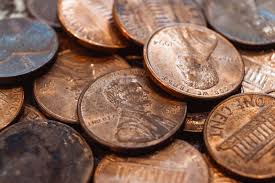
There was a time not so long ago when I wouldn’t pass up a lost penny lying in the street.  In addition to “free money” there was the old adage find a penny pick it up, and all day long you’ll have good luck.  Today you’d better settle for just the luck because you can’t buy anything for pennies anymore.  You’d be better off using them for more practical purposes like checking your tire tread depth or turning screws.  My brother and his wife turned thousands of their pennies into a beautiful, copper-colored floor for their kitchen.
Losing their shine

Speaking of copper (I’m easily distracted today) I had no idea pennies are no longer made of copper.  They’re primarily zinc because of the rising cost of metals (yet they still cost three cents apiece?)  You’d assume quarters, dimes, and nickels were made from an alloy of silver, lead, or aluminum, but – go figure – those coins are primarily copper.

Enough with the facts.  I’m bummed to see the penny put out to pasture.  Along with it goes a ton of childhood memories.  You could roll pennies into coin wrappers and enjoy the thrill of exchanging the whole lot for paper bills at the bank.  You could drop them into handheld banks for untold savings (and my banks were delightfully mechanical).  Finally, you could walk into any 7-Eleven or drug store, hit the candy aisle, and find several “penny candy” choices.  A chunk of Bazooka bubble gum, hard candies, or licorice whips could be purchased for just a few cents back then.

Three cents each… a long, long time ago

Practically speaking I’m on board with the penny’s retirement, because I can’t recall the last time I involved a cent in a financial transaction.  If something costs $9.99, are you telling me you’d reach into your pocket and pay the $9.99 in cash and coin?  Nope, you’d more likely hand over a ten-dollar bill and then what happens?  You get a penny in return.  What are you supposed to do with that?

Certain sayings will have to head out to pasture as well.  An expensive item can no longer be described as “a pretty penny”.  “A penny saved is a penny earned” literally has no value.  A frugal person should now be described as a “quarter-pincher” (in case the nickel and dime are also on life support).  And “pennies from heaven” certainly don’t describe good fortune anymore, even if the song of the same name will continue to be sung.
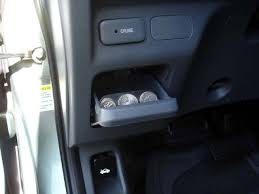
Do you have one of these?

For my money, I hope car manufacturers continue to include coin drawers in their dashboards.  I keep important things in there and I’d prefer not to change my ways.  Then again maybe I should keep a few pennies in the drawer, if only for my childhood memories.  Those will always have value.


LEGO Notre-Dame de Paris – Update #5

(Read about the start of this “church service” in Highest Chair)

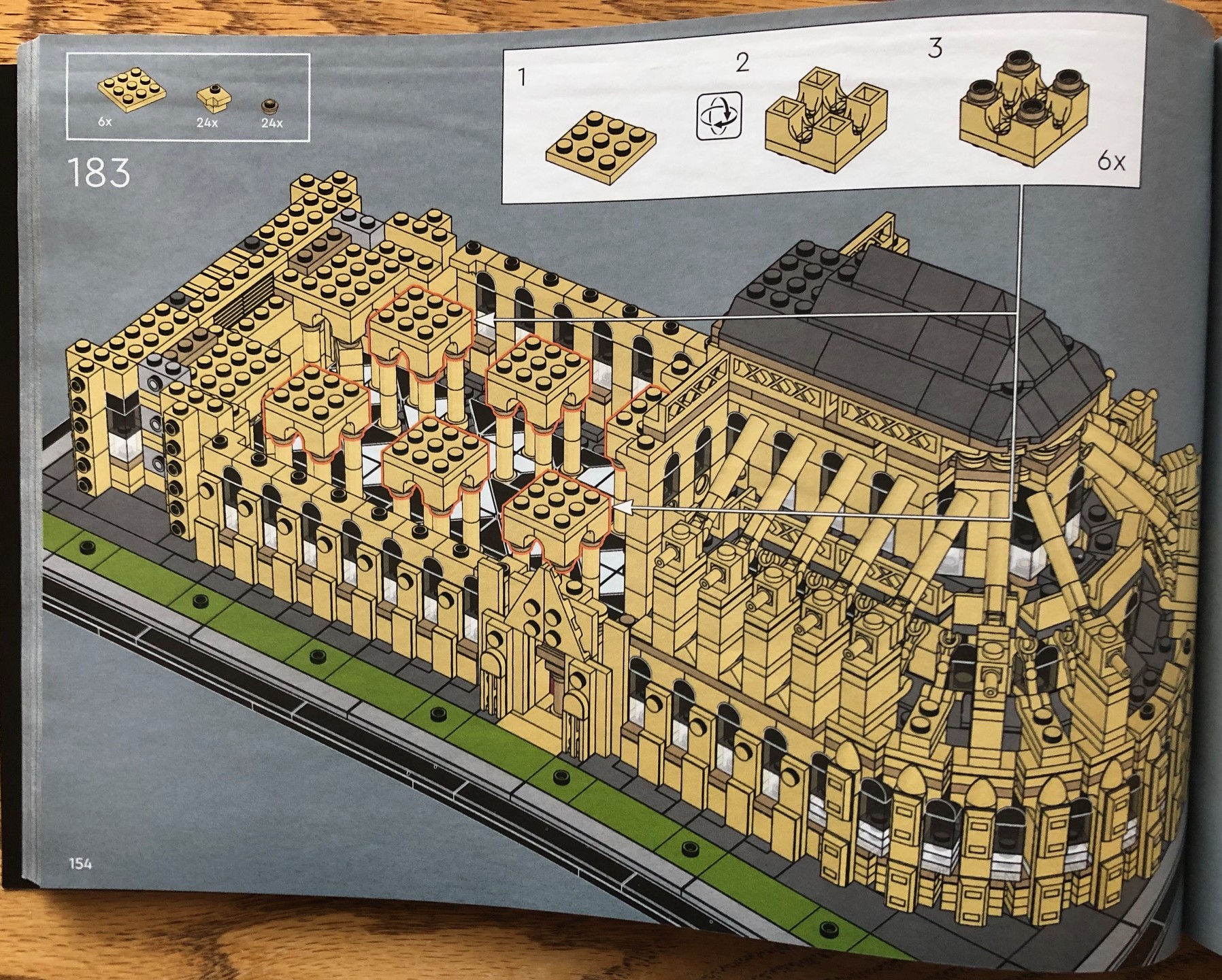
I decided to have my lunch today while working through Bag 8… of 34 bags of pieces.  That was a mistake.  I reached for a LEGO piece, grabbed a little block of cheese instead, and Notre-Dame de Paris almost had cheddar in its walls. I immediately vowed food would go nowhere near the assembly ever again.  It’s unnerving enough putting in the real pieces.

As I worked on the uppermost level you see here I used a little too much force, and a piece in the level below loosened and scampered down into the sanctuary.  I shook, rattled, and rolled the entire cathedral trying to get it out but to now avail.  Just before admitting defeat, the little devil finally emerged (he must’ve gone to confession).  And here’s where I learned an unnerving truth: re-assembling pieces long after you’re supposed to can be near impossible.  I had to tear down an entire wall to get the piece back in place.  We’re working in close quarters here, people.

“LEGO lever”

Today is also a good chapter to point out the tool to the right.  It’s a “LEGO lever” (my words), designed to easily remove a piece from a place it wasn’t meant to go.  I didn’t need my lever through the first seven bags, but today?  Half a dozen times.  My mind’s eye was off just a hair and I kept assembling pieces a quarter or half-inch off from where they were supposed to go.  LEGO lever = life saver.

Pasta noodles?

Bag 8 started slow and repetitious but finished grand and confident.  In fact, I was so full of myself after the mere forty-five minutes of construction, I boldly plunged into Bag 9.  Mistake.  I mean, look at the pieces in this photo!  Are these LEGOs or the little bits of pasta you find in your chicken soup?  Seriously, we may be almost a quarter of the way through the bag count but the pieces are shrinking.  Some Sunday soon the parishioners will look to the heavens and be burned by the giant magnifying glass above them.

Running build time: 4 hrs. 22 min.

Total leftover pieces: 17

Some content sourced from the CNN Business article, “Trump instructs Treasury to halt penny production”, and Wikipedia, “the free encyclopedia”.


Adventures in Library-ing

Early each calendar year I look back on the previous year’s expenses to discover areas in the family budget where I can trim. The price of food, gasoline, and other “have-to-have’s” always seems to go up, so I search for items that are not so “have-to-have” to balance things out. A good example is books. I read two or three a month on my Kindle e-Reader. At say, $14.99 a pop that’d be over $500 I could carve out of annual expenses… if I could only get those same books at no cost. But where-oh-where could I possibly find books for free?

You bibliophiles out there (and the rest of you, for that matter) are laughing as I’m about to describe going to the library as an adventure, but here’s the thing.  I’ve been e-reading on my Amazon Kindle for so long that the idea of holding a book and turning its pages – let alone checking one out of a library – has become, well, novel again.

I wouldn’t have reached this crossroads were it not for a particular book.  Amazon described Frank Delaney’s The Matchmaker of Kenmare just the way I’d hope: an intriguing WWII-era work of fiction.  So I went to “try a sample”(where Amazon allows you the first several pages of the book for free) and – horror of horrors – it’s not available in digital format.  WHAT?  No e-Version?  You’re saying, Amazon, I have to shell out $24.99 for the hard copy if I want to read it?

A book for $10 doesn’t make me pause but one for $25 sure does.  Hence began my library adventure.  The last time I spent meaningful time in one was in college (and I don’t want to tell you how long ago that was).  The library experience is probably different in every way now, starting online. When I “checked out” my library’s website (ha) I discovered I could get a digital library card almost immediately.  With the digital card I could reserve and check out books from the comfort of my home computer.  Hurrah, free books here I come!

Oh how I wish it were that easy.  Turns out, my library’s software is not compatible with an Amazon Kindle.  No digital books for me, sigh.  And besides, physical books – like the one I wanted – require a physical library card.  So with no other excuse to avoid it, I got in my car and headed off to my local branch.  Guess what?  Parking at the library is free.  Entering the building itself is free (no cover charge!).  Getting a library card is free.  Even the library bathrooms can be used without having to check out a book first.

Our main (and modern) library branch

Yes, this is my tax dollars at work of course, but the illusion of all this free stuff is fun while it lasts.  And boy howdy, libraries aren’t what they used to be.  Ours has all these rooms and services and people, as if the surrounding shelves of books are merely a carry-over from past generations.  You can sit down to public-access computers, attend a lecture, host a meeting, rent DVDs, buy coffee, and even spend time in a room of books dedicated to the history of the surrounding county.  Maybe this is all review for you, but it’s a little overwhelming for an e-reader who’s navigating libraries of the new world.

Our secondary (and ancient) library branch

There’s more to this adventure in library-ing than I have time for today (including the over-the-river and through-the woods visit to a different and decidedly ancient branch in my library’s network), but let’s close the book on this topic with a “laugh’s on me” conclusion.  As I was researching for this blog post I went to the Amazon page for my Matchmaker… novel again.  Go figure; it’s available in digital format after all, and even in paperback.  How did I miss these options the first time around?  Must be the library gods telling me to go old-school and get a physical copy for free.


LEGO Notre-Dame de Paris – Update #4

(Read about the start of this “church service” in Highest Chair)

Click the photo for a more detailed view

As Notre-Dame de Paris rises slowly from its foundations, I often picture a congregation of parishioners down there at ground level, sitting quietly in the pews.  Startled by the snap of a LEGO block above them, they gaze skyward, see my giant fingers, and wonder, “OMG is that the hand of God?”  No, no, little ones, it’s just Dave, working through Bag 7… of 34 bags of pieces.

The little devil was still in the bag

Today almost included the long-awaited moment where I realize with mock horror that LEGO left a piece out of one of their model sets.  I churned through my piles of pieces, endlessly stirring and turning them over and over, but to no avail.  A piece was missing, and that sick-to-your-stomach feeling settled in deep, the way you reach the end of a jigsaw puzzle minus one piece.  Then, to my utter amazement, I spied it out of the corner of my eye.  The tiny traitor was still in Bag 7.  Wow.  Good thing that plastic bag wasn’t already relegated to the trash, huh?

“Underfed” buttresses

On the other hand, with more excitement than it probably deserved, today we began construction of Notre-Dame’s signature flying buttresses.  At first I was disappointed in the LEGO pieces, because I thought they looked a little, well, “underfed”.  Then I remembered; we’re only beginning the structure of the buttresses.  The finished look you see on the outside of Notre-Dame is supported by a complex of arches and columns well below it.  Here I thought my “God’s hand” was already working at roof level but in fact, we’re only about halfway up the structure.

Running build time: 3 hrs. 32 min.

Total leftover pieces: 16

See You In (my) Church

When I went to Sunday school many, many years ago, they taught us the little ditty “Here Is The Church” (… here is the steeple, open the doors and see all the people). You’d make a church with your hands pressed together as you sang, raising the steeple by extending and touching the tips of your pointer fingers. Today, sixty-odd years later, those same hands will build a cathedral – Notre-Dame de Paris. Granted my church is made from LEGO blocks and the entire model will be smaller than a cornerstone of the real Notre-Dame, but at least the steeple is made from more than fingers.

So then, “Here Is The Cathedral”… in its purchased form. The cardboard box you see is not what I would call huge, but it’s an ample residence for 4,383 plastic pieces. These pieces dwell in thirty-four separate plastic bag communities, just begging to be liberated.  Buried underneath all these subdivisions (in the crypt, if you will) is the brick of an instruction manual, a veritable phone book of almost 300 pages. C’mon, you didn’t think we’d raise this cathedral in a single blog post, did you?

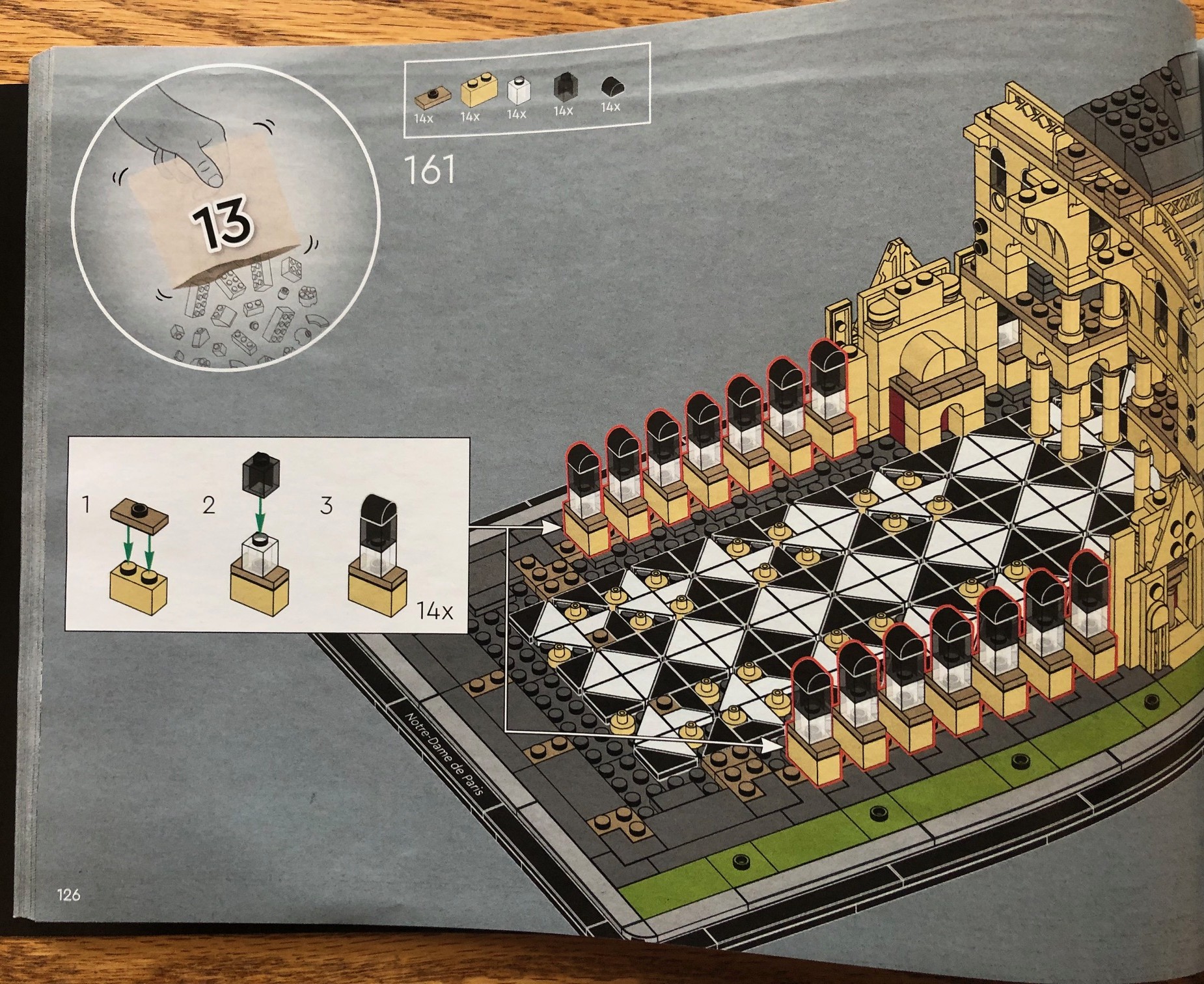
Mr. Instruction Manual could be called the mayor of this manufactured mess. He guides me on who gets together with who, when they get together, how they get together, and what it’s all supposed to look like as I go.  Mr. Manual has pages and pages of impressive illustrations (like this one), but also some LOL ones (like the one below). I mean, check out the upper left corner.  Am I really supposed to vigorously shake the bag out like that? The tiny residents will go running in all directions! We’re trying to create order from chaos here, people, not the other way around.

I expect all of the same challenges I encountered when I built the LEGO Grand Piano. I’ll think pieces are missing until somehow they appear right in front of me. I’ll connect pieces incorrectly and have to backtrack several steps to get them right. I’ll be left with extra pieces every now and then, and forever wonder if they were really “extra” or perhaps “overlooked”.  And I’ll police plastic piles around the meager real estate of my home office desk.  Maybe I require a shepherd’s crook or a bullhorn?  I mean, it’s me versus 4,383 others so you can see how one or two of them are bound to escape.

Here’s a thoughtful aspect of LEGO Notre-Dame de Paris, and oh-so appealing to the architect in me. The model will be built in the same chronological order as the original was (instead of, say, from the ground up). The first twenty years of Notre-Dame’s construction produced only the rounded east end you see here, which served by itself as a functioning church. The next twenty years generated the full footprint but without the roof, towers, and other noteworthy exterior elements.  The final sixty years brought everything across the finish line.  So I’ll be building the LEGO model in the same order, only in a hundred days (or less) instead of a hundred years.

10,000 piece tower

Before I snap Piece 1 onto Piece 2, let me dress down my many thousands of new plastic friends.  Together they comprise nowhere near the largest of the LEGO sets.  A model of Harry Potter’s Hogwarts Castle is over 6,000 pieces.  The LEGO Star Wars Millennium Falcon is over 7,500 pieces.  LEGO Titanic (er, before it sank): 9,000 pieces.  And standing regally at the top of the LEGO podium (and just a twenty-minute bus ride from Notre-Dame de Paris): the Eiffel Tower, the only LEGO model to exceed 10,000 pieces.  To each of these top-tens I say non.  Notre-Dame will be challenge enough for this builder/blogger.

LEGO Notre-Dame de Paris – Update #1

Now that we’ve had the prelude (so to speak) it’s time for the church service to begin!  Bag #1 – of 34 bags of pieces – houses the first 100 or so of the little guys.  LEGO thoughtfully opted for a sub-community in Bag #1 for the tiniest of residents (some of which are just begging for tweezers).

chaos

Mr. Instruction Manual (who is multilingual by the way; he speaks English, French, and Spanish), warns me to “… avoid danger of suffocation by keeping this bag away from babies and children!”  Mr. Manual also wants me to know my thousand of pieces were manufactured in five different countries: Denmark (of course), Mexico, Hungary, China, and the Czech Republic.

danger

It’s fair to say I haven’t stood in the LEGO “pulpit” for awhile.  I snapped pieces together incorrectly at least three times today.  I also thought I was missing pieces twice, and I fretted over the fact I ended up with two leftovers.  Let’s hope our church service is smoother next week!  In the meantime, here is the build of Bag #1.  Not much to look at but at least it’s the foundation of the east end of the Cathedral.  In 1163 Pope Alexander III oversaw the first stone being set in place.  In 2025 nobody saw me do the same.

order

Bag #: 1

Running build time: 25:38

Total leftover pieces: 2

Highest Chair

When we babysit our granddaughters here at the house, we tap into several items to make the job easier. A big basket of toys and stuffed animals sits in the corner of our living room. A dozen children’s books line the lowest shelf just waiting to tell their stories. Sesame Street is easily streamed on the nearby television. And at dinner time we roll out the high chair so everyone’s on the same level. So who would’ve thought a high chair would be my blog topic for today? Maybe you, if you know anything about cathedrals.

Notre-Dame de Paris

We’re almost there, loyal readers.  I will lay the corner-block of my LEGO model of Notre-Dame de Paris next week.  Why not this week, you ask?  Because before we crack the seal on the giant box of pieces, we need to pay a little respect to the real Cathedral.  I want you to know a few things about the stone and glass Notre-Dame before you witness the rising of the plastic one.

West facade

It’s a cathedral in the middle of Paris, Dave… what more do I need to know?  Uh, a LOT more.  To begin with, do you even know what a cathedral is?  I didn’t (and I have a background in architecture, for gosh sake).  It’s a big, giant church with stained glass and chapels and a raised altar, you say.  Well yes, you’re right, but what makes a church a cathedral?  Interestingly, it has nothing to do with the building itself.  Instead, a cathedral is the seat of a bishop (the ordained clergy-person who presides over the surrounding parishes). For lack of a church this person could just as easily be in a small house and it would still be considered a cathedral.

Cathedrals really do have “high chairs” on their altars for the bishops (cathedra in Latin means “seat”) but Notre-Dame de Paris is much more than a place for furniture.  First and foremost, it took a hundred years to construct (1163-1260).  In that era the building evolved from the common Romanesque style of the period to the more elegant French Gothic.  Notre-Dame feels unusually vertical and airy for a structure of its time and there’s a novel reason for this: flying buttresses.

Flying buttresses

Imagine Notre-Dame’s architect – Eugène Viollet-le-Duc – talking to the Paris city council in the twelfth century and saying, “Look guys, let’s think outside the box here… literally.  The structural support for this church ought to be outside of the building instead of inside”.  Why would the architect want this?  Because the flying buttresses assume the structural load that was previously handled by short, thick interior walls.  The result is taller, more dramatic spaces, filled with the light of high-up stained glass windows.  In other words, flying buttresses allow Notre-Dame to “reach for the heavens” much better than its Romanesque predecessors.

North rose window

There’s also more to this French “grande dame” than structure, of course.  Notre-Dame has twenty-nine chapels surrounding the main sanctuary (that’s gonna take a lot of LEGO).  It features three spectacular stained glass “rose” windows that would not be as large or as high were it not for those flying buttresses.  Notre-Dame’s twin towers host ten massive bronze bells and they each have first names.  “Emmanuel” (listen to his sound bite below) and “Marie” are so big they take up the entire south tower, while their eight ringing siblings all fit into the north tower.

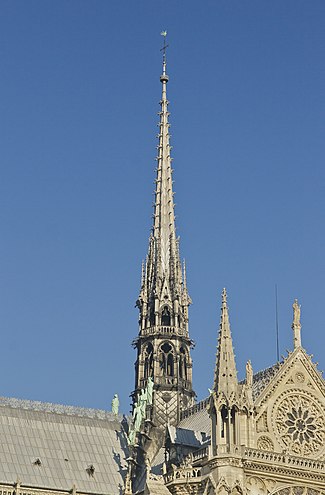
Notre-Dame also has a central flèche, a spire not unlike the ones you see on more modest churches.  This spire, however, is topped by a bronze rooster, which is not only the symbol of the French state but also a container for (supposedly) a small piece of the Crown of Thorns, worn by Jesus leading up to his crucifixion.

Rooster-topped “flèche”

As you would expect, Notre-Dame de Paris hosts countless works of art, whether paintings or sculptures.  Many of the sculptures are biblical scenes intended to educate the illiterate parishioners of the twelfth century.  But my favorite sculptures may be those of the twelve apostles, way up high surrounding the base of the flèche and looking outwards towards Paris… all except one.  St. Thomas – patron saint of architects – faces Notre-Dame itself, and was given the facial features of Viollet-le-Duc.

Okay, so now you know more about Notre-Dame de Paris than just the LEGO model.  Considering there are over 500 Gothic cathedrals in Europe, it’s impressive to see Notre-Dame at the very top of at least one “Top Ten Cathedrals” list.  We’ll visit some of those other “high chairs” in future posts, to add even more life to my pile of plastic pieces. In the meantime, my LEGO “church service” begins promptly at 10am next Thursday.

Some content sourced from Wikipedia, “the free encyclopedia”.

You Can Say That Again

When I was a kid, I remember (or was told) I used creative pronunciations for common words. Instead of cinnamon I’d say cimm-anin. Instead of spaghetti it was bis-ketti. The library was the lie-berry. Maybe back then my excuse was in just learning to talk but I can’t play that card as an adult. So when someone says Feb-YOU-air-ee instead of Feb-ROO-air-ee, or Shur-BERT instead of Shur-BET, I tend to wince.

We’ve made it to the time of year where we reflect on the previous one, and we do so in year-in-review lists. “Most Influential People of 2024”. “Best Television Shows of 2024”.  “Significant World Events of 2024”.  And how about this one?  Most Mispronounced Words of 2024.  Thanks to Babbel, maker of language-learning platforms, the hard audio evidence doesn’t lie.  Babbel came up with ten words people mispronounced over and over last year.

I could print Babbel’s list here, but it’d be a waste of your time so I’ll just hyperlink it instead.  Eight of the words I never ever used in 2024 (and never will), and the only reason I spoke the other two was because they’re the last names of politicians featured in 2024 headlines.  To be honest, the list made me question Babbel’s approach to learning languages.  Are these the words promoting a budding English speaker’s proficiency?

Babbel also listed mispronounced words from other languages, including one of my favorites: espresso.  Not sure how we Americans get that one wrong time after time, but we do.  Maybe the myriad “ex-” words in the English language have us saying EX-presso but the concentrated coffee drink sounds exactly as it reads: ES-presso.  Keep that in mind and your next Italian barista will be happy to serve you.

As long as we’re speaking Italiano let’s get another one right – al dente.  When you want your pasta cooked just right; “not too soft but firm to the bite”, you describe it as ALL den-tay, not ALLA dawn-tay.  I only know this because I learned Italian when I was in college.  If I didn’t know better myself I’d probably go with AL dent.

Notre-Dame de Paris

As long as we’re talking foreign language mispronunciation, let’s correct another one.  Notre-Dame de Paris, the medieval Catholic cathedral in the middle of Paris (and the middle of the River Seine), can be mispronounced so many ways it’s almost as devastating as the fire from which it was resurrected.  On the surface it sounds something like NOH-tur daym day PEAR-iss, which is “English-French” at its absolute worst.  In actual French it sounds like this: NOH-tr dam due PAH-ree, where the two “r”s almost sound like “l”s.

You never saw it coming but today’s language lesson is a segue to the topic I’ll be covering for the next several weeks and months.  Notre-Dame de Paris is a magnificent structure and a renowned work of architecture.  It’s also a new model created by the good people at LEGO.  And speaking of good people (great, actually), my wife put that LEGO model under the Christmas tree for me this year.

For those who enjoyed the long journey of my building the LEGO Grand Piano (which I chronicled in Let’s Make Music!), and the shorter journey of the LEGO Fallingwater House (Perfect Harmony), I’ll be at it again as I attempt to rise Notre-Dame de Paris from the “ashes” of 4,383 plastic pieces.  Won’t you join me on this foray into all things FRON-says?  (That’s “French” for those of you who mispronounce it.)  You’ll learn about the world’s cathedrals along the way, many of which took hundreds of years to construct.  Let’s hope my own build of Notre-Dame de Paris is a whole lot shorter than that.

Some content sourced from the CNN World article, “These are the most mispronounced words of 2024”, and Wikipedia, “the free encyclopedia”.