
I walk the dog late at night, just to be sure he doesn’t nudge me awake in the wee hours of the morning. The walk can be a chore when I’m tired but most nights it’s a quiet, peaceful stroll through our pitch-black horse pastures. We’re usually blessed with clear skies here in South Carolina, which means the stars and planets put on a display worthy of a paid ticket to an observatory. Regardless, the moment I’m out the door I’m in search of my other faithful companion: the moon.
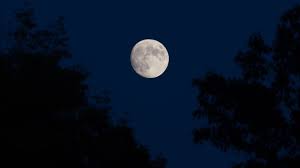
The “heavens” offer a plethora of topics to blog about (which I have: Saturn in Of Rings and Romans or Starlink satellites in Celestial Strings of Pearls, for example) but I’m overdue with a few words about the moon. Our nearest galactic neighbor is a constant wonder to me. The moon (or is it “The Moon”?) is the reason we have ocean tides here on Earth and solar eclipses far, far away. The moon has been the target of some of the most impressive space technology and exploration in history. But let’s put the science aside, shall we? Today I’d rather just muse about the moon as its sits in the night sky, like a shiny silver dollar laid out on top of a black velvet cloth.
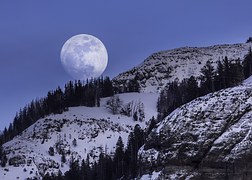
My favorite moons are full – the perfectly round ones – but the shadowed partials can be just as beautiful. Depending on the season and the atmosphere, the moon takes on countless looks. Some nights it rises giant above the trees, as if invisible binoculars rest before my eyes. Other nights the moon sits as an elegant crescent, a perfectly white slice of melon. Still other nights the moon doesn’t rise at all, or at least, not until well after I’m in bed. It’s a guessing game every time the dog and I head out into the dark.
I also make a game of trying to guess when the moon is full just by looking at it. On the nights just before or after it occurs the moon can still appear as full. So you have to look very carefully at the edges to decide if it’s perfectly round or not. Conveniently, the moon is full about once a month, or at least, once every month in 2024. Next year or the year after, perhaps we’ll get a “blue”: that second full moon in a calendar month. Doesn’t happen very often, of course.
Here’s a fascinating fact about the moon. It’s locked into place by the earth’s gravity, meaning it’s always showing you the same face. Try to picture the earth taking a trip around the sun (once a year or so), while it’s spinning on its own axis (once a day), while the moon is spinning around the earth. Technically the moon is rotating, just not on its own axis. So you never get to see “the dark side”.
Here’s another fact that makes me pause. If you drive across the United States from coast to coast and back again, you’re driving about 6,000 miles. Do that same drive thirty times and you’ve driven to the moon. Suddenly our celestial silver dollar doesn’t seem so far away, does it?
The next full moon (from my perspective), nicknamed “The Wolf”, is a week from this posting, on Thursday, January 25th. It’ll be the first full one of the new year. Good timing really, because some of you readers don’t make it to my blog until several days after the fact. If you’re exactly a week late, walk outside tonight after dark. A spectacular scene in the heavens awaits.
Some content sourced from Wikipedia, “the free encyclopedia”.

 Life In A Word