Minuscule Marvels

For Christmas this year I’m putting a small ornament into my wife’s stocking. It’s a miniature of… well… let’s just leave it at “a miniature” in case she reads this post. But I know she’ll love this ornament and promptly hang it on our tree for the remainder of the season. Why will she love it? Because it’ll spark fond, romantic memories. But she’ll also love this ornament because she can’t help loving something that’s a little, well, little.

Ornaments are little

One of my bucket list items – still to be fulfilled – is a trip to the south of France for a taste of those wonderful wines created from Burgundy or Bordeaux grapes.  Maybe you hope to make the same trip some day so I’ll let you in on a little secret.  If your trip only allows a visit to Paris, you can still visit a vineyard… right in the middle of the city.  Most people visit the neighborhood of Montmartre to see the Sacre Coeur cathedral but most don’t know about the tiny vineyard just steps away.  Clos Montmarte produces wine on a single acre, from 2,000 vines forging a connection to the long-ago rural times of the region.  Compare an acre to the wineries in Bordeaux, with vines covering an average of fifty times that much property.

Harvesting the grapes at little Clos Montmartre

Clos Montmarte wines probably aren’t award-winning.  Who knows if I’d even care for the taste of their reds or rosés.  But does it really matter?  I love the thought of a teeny-tiny field of grapes right in the middle of Paris.  I love how the grapes are harvested by locals and transported to the cellars of the nearby Town Hall to be pressed and turned into wine.  The whole operation is appealing to me because it’s quaint and because it’s small.
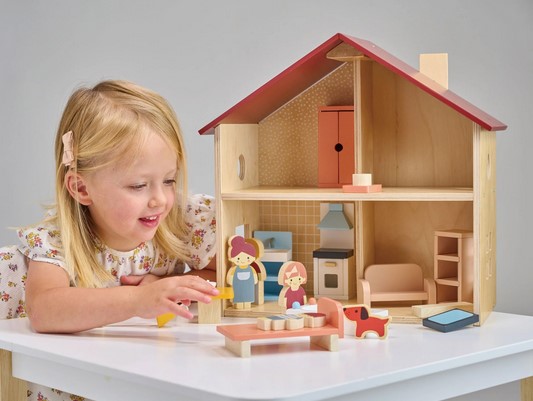
This affection for itty-bitty things must hearken back to our childhoods.  Who among us didn’t spend countless hours of playtime with (take your pick) little dolls, little cars, little houses, or scaled-down trains?  When we played at the beach we built little castles.  When we played in creeks we made little boats out of sticks or leaves and watched them flow with the water.  Tea parties meant tiny cups and plates on tiny tables.
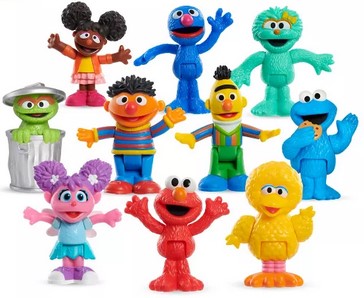
My granddaughter’s little favorites

In today’s world the toys might be different but the attraction to small things remains.  It fascinates me to watch my (little) granddaughter choose her favorite toy from among dozens: a set of ten two-inch high Sesame Street characters.  She stands them up all over the house.  She hides them and then finds them.  She always seems to have one or two in her hands.  Even though my granddaughter doesn’t speak in complete sentences yet, she probably has complete thoughts as she considers tiny Big Bird.  You are a lot smaller than me and that’s why I like you so much.

Wee little cube

If you include Japanese toymaker MegaHouse in this year’s Christmas purchases, maybe you’ll go for their world’s smallest operational Rubik’s cube.  You can’t get one until next April, but picture this: the minuscule marvel is one 1,000th of the size of the original.  Pull out your metric measure to confirm it; a single face of the wee cube measures only 5mm from side to side.  Best throw a pair of tweezers into the Christmas stocking along with the cube.  There’s no way you’ll be able to rotate the Rubik’s colors with fingers alone.

Would I want the world’s smallest operational Rubik’s cube, you ask?  Heck yeah!  Consider, the faces of a traditional Rubik’s cube contain a 9×9 grid.  Then someone went and created a miniature Rubik’s cube with 2×2 grids.  I thought, how very cute.  I just had to have one so my original would have a little buddy.  My cubes are hanging out together on my home office shelf as we speak.  And they’re asking for an even littler buddy for Christmas.

Rubik’s “Mini”

So let’s summarize the pint-sized products we’ve covered today.  I already have the ornament for my wife in-hand (soon to be in-stocking).  I won’t put a bow on a bottle of Montmartre wine this year because I want the chance to see the tiny Paris winery for myself first.  And you probably thought I sprung for one of MegaHouse’s pee-wee Rubik’s cubes (and a pair of tweezers). Sadly, no.  I don’t have the $5,300 it costs to buy one (minuscule marvels aren’t cheap!) Thankfully, my wife will be happy with an adorable little ornament for $15 instead.

Some content sourced from the CNN Travel article, “The secret vineyard in the middle of Paris…”, and the CNN Style article, “This is the world’s smallest Rubik’s cube…”
Finishing on a Low Note

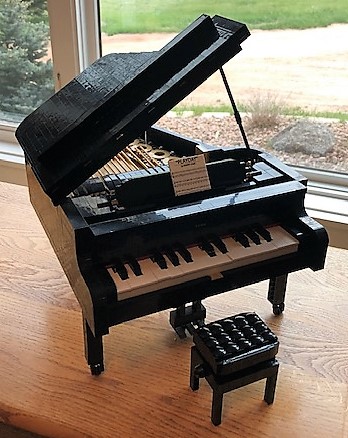
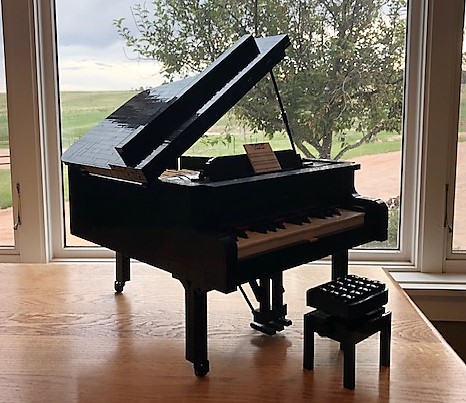
I usually associate “finishing” with sporting events. Think about the finish line of a car race, the eighteenth hole of a golf tournament, or the ticking seconds of the clock as a football game runs out of time. In these scenarios, the finish can be a tense, hold-your-breath moment, triggering a burst of euphoria if your favorite takes the win. So it comes as a bit of a surprise to reflect on the completion of my Lego Grand Piano. Tense? Hardly. Held my breath? Not at all. Euphoria? Anything but. No, this finish feels a little forlorn.

Three thousand, six hundred, and sixty-two tiny pieces ago, I began the assembly of Lego’s Grand Piano, just about the closest gift to “perfect” my wife has ever given me.  Piano is inextricably connected with my childhood – hours upon hours of practice and playing and determined progress at a tender age, eventually succumbing to other temptations of time.  Piano introduced me to commitment, skill, and patience, even frustration and disappointment.  My parent’s big, black grand sat patiently in our living room, beckoning me to play every time I passed by.  The instrument was always perfectly tuned and sparklingly clean, thanks to my mother’s weekly persistence with a dust cloth.  I can still hear her sweeping the eighty-eight keys from one end to the other – a delightfully musical moment.

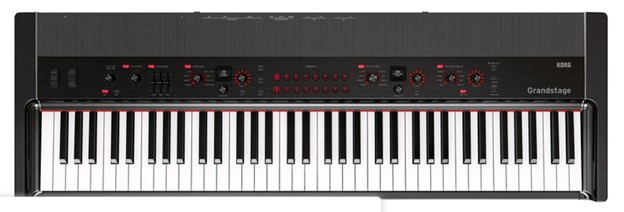
Korg’s “Sampling Grand” keyboard

Believe it or not, the Lego Grand Piano is the second gift of a piano from my wife.  On our wedding day in 1987, she presented me with Korg’s “Sampling Grand”, an electronic keyboard with weighted keys and surprisingly realistic sound, much less expensive than the real thing.  Thirty-five years later, the Korg still plays like a champ and still earns a spot in our living room. (Unlike the Lego version, the Korg was already assembled when I got it.)

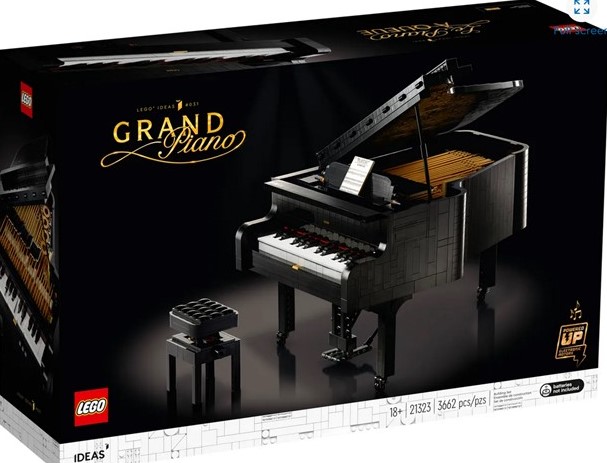
The start-to-finish journey of my Lego Grand Piano has been a more enjoyable ride than I expected.  When I opened the box last Christmas, I remember my jaw dropping a little, not only because I never saw the gift coming but because of the sheer complexity of the project staring up at me from the box  That’s a complicated-looking instrument, I thought.  That’s a ton of pieces, I also thought.

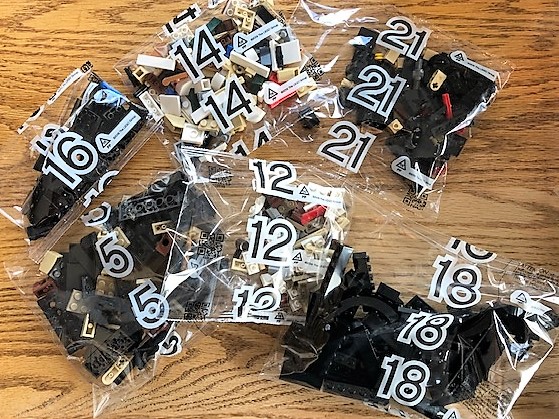
The unopened Lego box sat on my home office desk for a couple of weeks, looking elegant without even being touched.  My curiosity eventually got the better of me and I finally had a look inside.  Talk about intimidating.  A 500-page instruction manual awaited, along with forty-odd individual bags of pieces.  Even though this was a twenty-one-step journey, some steps involved “sub-bags” of tiny, tiny pieces, grouped separately so as not to escape!  Was I really brave enough to dive into this mess?

Contents of the box

The first chapter – shared with you readers on January 6th of this year (a date we Americans wish to forget) – spoke to my hesitation when I wrote an entire post about building the piano without actually building anything.  I just poked around the box and marveled at the contents and felt pretty good about even opening up the box.  But I did get started seven days later, and the subsequent journey was wholly satisfying and something of a weekly escape.

Leftovers

At first, I made several mistakes as the piano began to take shape.  Since the pieces are small it’s easy to place them backward, or even mistake one for another.  I also fretted when extra pieces remained after a given section of the build. (For the record, there were 38 extra pieces when all was said and done.  I can fit all of them into the palm of my hand.)  There were at least two instances where I had to disassemble several pieces to get back to the point where I’d done something wrong.  Those moments were utterly unnerving and confidence-shattering (take your pick).

[Author’s Note: After weeks and weeks of building the Lego Grand Piano, it only now occurs to me I’m describing one type of keyboard while typing on another. Don’t you just love the coincidence?]

So let’s finish this post by revisiting “finishing”.  What should be a moment of triumph feels a tad sad instead.  After the first few weeks, the build of the Lego Grand Piano became a weekly treat, accompanied by some of my favorite classical music.  Many stages were mini-surprises, not knowing what section I was building until the last piece was in place.  And of course, sharing the progress with all of you was also fun.  One reader admitted she would first scroll to the bottom of a post before reading my weekly topic.  She couldn’t wait to find out how the piano was coming along.

So, here we are now, finally done.  Next week’s post will feel a little empty without a reference to the Lego Grand Piano.  By total coincidence, my daughter got married this past weekend, also the end of a journey (months of planning and all).  My son just turned 30 yesterday, the finish line of his 20’s.  And soon, my wife and I will point our cars east for our move to South Carolina, the finish of our days in Colorado.  To be finished is to be sad?  You bet it is.

I’ll dive into another Lego build one of these days, I promise.  Maybe I’ll even take you along for the ride again.  In the meantime, I’ll flip the hidden switch and play the piano every now and then.  I’ll also find an acrylic box in which I can display this magnificent project.  After all, with my mother’s good habits in mind, I don’t want it gathering dust.

——————–

Lego Grand Piano – Update #21

(Read about how this project got started in Let’s Make Music!)

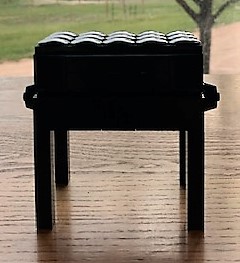
The finále of the Lego Grand Piano assembly, as expected, was the build of the pianist’s bench and the placement of the sheet music onto the stand.  Bag #21 – of 21 bags of pieces – was bigger than I expected.  I mean, a bench is a seat with four legs, right?  Not according to Lego.  This bench raises and lowers with the little dials you see on the sides, to accommodate the height of our fictitious pianist.


Let’s give credit where credit is due.  The Lego Grand Piano was designed by the guy you see below, Donny Chen, a 33-year-old piano teacher and tuner from Guangzhou, China.  No surprise, Donny’s passions are the piano and Lego.  He’s a lot smarter than I am, evidenced by this quote: “I’ve always seen toys as something to be imagined, not just played with”.  Me, I just played with toys.

[Pianist’s Note: The Lego Grand Piano DOES play, I know it does.  I just have to figure out two things.  One, how did I manage to disconnect the cable to the sound box buried deep within the piano frame?  Two, how the heck am I going to get it reconnected?  That’ll take more time than I have today and is part of why I “finished on a low note”.  But I’ll share a concert with you when you least expect it – I promise. “Stay tuned”.]

Donny Chen

Running Build Time: 14.0 hours.  Musical accompaniment: Jarratt and Reedman’s Hooked on Classics. Leftover pieces: 1

Conductor’s Note: Apologies to the purists but I just couldn’t resist this somewhat tongue-in-cheek accompaniment to the final chapter of the Lego Grand Piano.  Hooked on Classics is a top-ten Billboard Hot 100 hit from 1981, a mashed-up perversion of bits of the world’s most recognized classical pieces… overlaid on a drum track.  It was recorded by Louis Clark and the Royal Philharmonic Orchestra and bred several spin-offs (ex. Hooked on RomanceHooked on Classics came along just as I was wrapping up my childhood piano “career”.  I much prefer the originals of the several classical pieces in Hooked but maybe this peppy number is your cup of tea.  Have a listen:

Some content sourced from Wikipedia, “the free encyclopedia”.

Let’s Make Music!

At the request of several readers, I’ve decided to bring you along on the adventure of building the Lego Grand Piano my wife gave me for Christmas. I’m hoping this music-making journey amounts to a pleasing “concert” instead of an arduous one.  More akin to Beethoven’s Ode to Joy than Korsakov’s Flight of the Bumblebee. No matter how difficult this “piece” ends up “playing”, I can assure you of one thing.  It’s gonna take me a while; likely beyond when the snow stops flying in Colorado. 3,662 Lego pieces won’t snap together by my next blog post, nor the next one.  I’ll give brief updates at the bottom of my other topics as I progress. Movements if you will, instead of the entire piano concerto all at once.

And with a tap-tap-tap of the conductor’s baton, the performance begins!

To start, we have an elegant 23″ x 15″ x 6″ cardboard box containing our unassembled piano.  The box advertises the piano in three languages: English (Grand Piano), French (Le Piano a Queue), and Spanish (Piano de Cola).  The box cautions I should be over the age of 18 and batteries aren’t included. Batteries? In a grand piano?  But I digress…

The photos on the sides of the box tease the finished product.  First and foremost, the piano really plays once I assemble the several thousand pieces.  I don’t mean “play” as in a hidden music box with a digital soundtrack but “play” as in pressing the piano keys.  And speaking of piano keys, Lego provides only 25.  A real piano has 88.  In other words, the beautiful music my grand piano plays will be more Chopsticks than Chopin.  Makes sense because my Lego Grand Piano is only 12″ wide and 14″ deep.  Suddenly my fingers feel fat.

When I remove that elegant box top, here’s what I see inside:

As expected, the Lego pieces are divided into small plastic bags. (On the left, that is. The right is a smaller box-within-the-box looking like a square piano. We’ll get to that in a minute.)

If I organize the bags so you can see them better, I come up with this:


The audience gasps, in awe of the complexity of the performance unfolding before them.

Okay, NOW I have concerns.  First, the bag numbers start with “10”.  Hey Lego, what happened to 1-9?  Second, Bag 5 showed up among the double-digits like an orphan looking for a family.  Pretty sure Bag 5 belongs securely in that black box to the right.  Maybe Bag 5 was trying to escape.

At this point in the show, the phrase “missing pieces” tickles the pianist’s brain (but not the ivories).

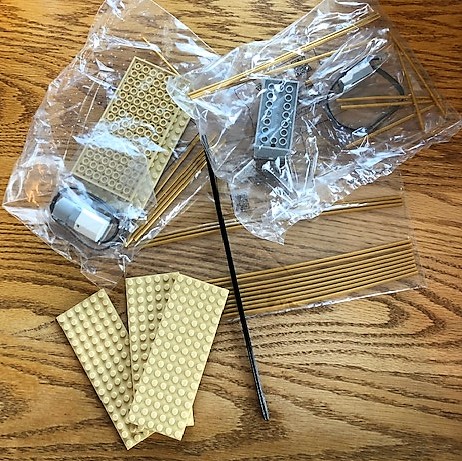
I also find the set of bags in the photo to the right.  I assume they pair with their partner-numbered bags when I get to that part of the concerto.  But maybe they don’t.  Maybe each of them is a little project unto itself.

Little beads of sweat populate the pianist’s forehead.

Yes, I’m nervous. I hastily put the bags back into the box (which suggests I’m already going backward with this project).  But I do want to see what’s inside that black piano-wannabe box to the right.  Have a look:


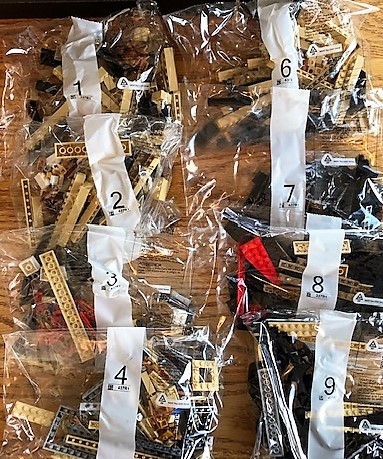
Well hello Bags 1-9! I also found a few more of those partner-numbered bags.  But check out the disarray in the photo on the right.  Here we have three more orphan bags and, shockingly, a few pieces that escaped their bags.  What’s going on here?

The audience shifts uncomfortably in their seats as the pianist hesitates.

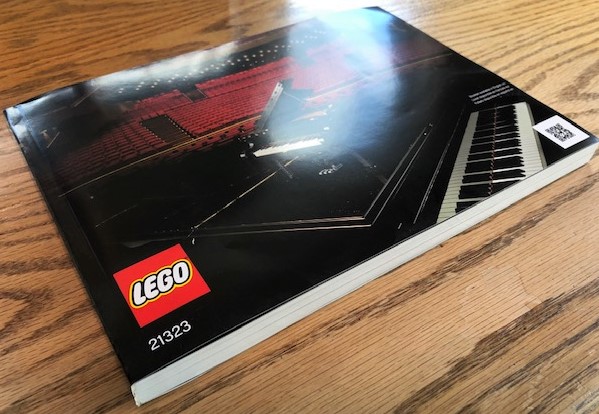
Finally, way at the bottom of the box, we have the pièce de résistance (Spanish: plato fuerte; English: main dish). Well hello, Mr. Instruction Manual.  Weighing in at a hefty 2.2 pounds and boasting 532 pages of mind-numbing steps, Mr. Instruction Manual is easily the heaviest item in the box.  He’s the equivalent of the phone book of a mid-sized city.  Furthermore, the plastic bag he came in included a little slip of paper shouting, “WARNING: To avoid danger of suffocation keep this bag away from babies and children.” Listen Lego, I’m not worried about babies and children; I’m worried about me.  I might be tempted to use that plastic bag to suffocate myself if I can’t complete my Grand Piano.

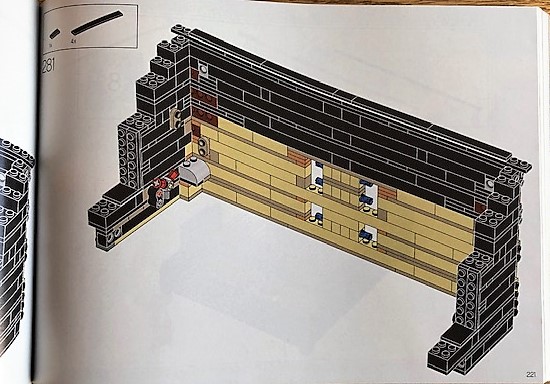
The pianist makes it this far into the performance without any faux pas’s (English: significant mistakes), but then I choose to open Mr. Instruction Manual to a random page. Terrible decision! Have a look:

Is this not an intimidating drawing? (Why yes, Dave, it is.) Does it look anything like a grand piano? (Why no, Dave, it does not.) Furthermore, you’re looking at Page 221, so we’re not even halfway through the build here.  I’m edging towards terrified, Lego.  Those pieces look small.  Those pieces look many.  And who’s to say the numbered bags make the one piece I’m looking for (amongst 3,361 of its plastic pals) any easier to find?

The pianist still hesitates, his hands shaking noticeably held just above the keyboard.

I wanted to finish this post with a photo of the first couple of pieces snapped together… I really did.  I wanted you to believe my music-making was officially underway.  But let’s be honest, my peek into the box where all those bags, orphans, and escaping pieces live, and the sheer size of Mr. Instruction Manual have me backing away from the keyboard (figuratively, followed by literally).  Sorry folks, tonight’s performance isn’t quite ready for prime time.  This pianist needs to change out of his sweat-drenched tuxedo into more comfortable clothing for now.  Let’s take an intermission, shall we?

The audience heads to the lobby.