Before another Independence Day celebration completely fades into the July of last week, I want to visit a story from early early American history. In 1973 I began middle school at Palisades-Brentwood Junior High, so named because it straddled the limits of both towns just outside of Los Angeles. But I never knew it as “Palisades-Brentwood”. A year after opening in 1955 it was rebranded Paul Revere Junior High. So Paul and I have a little something in common. It’s like we’re compatriots, only separated by two and a half centuries.
 If you know nothing else about Paul Revere, you’ll recall his courageous “midnight ride”. In the months leading up to the Revolutionary War in 1775 Revere took to his horse outside of Boston to alert “minutemen” of the approaching British troops. Minutemen were residents of the American colonies trained to defend “at a minute’s notice”. Revere himself was the notice, at least for what would become the early battles at Lexington and Concord.
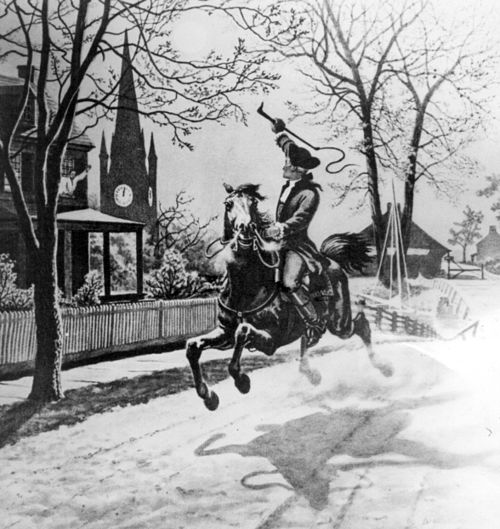
Were it not for Henry Wadsworth Longfellow a hundred years later, Revere’s legacy would’ve faded as quickly as last Friday’s fireworks. Instead we have the poet’s “Paul Revere’s Ride” as the chronicle, with these well-known opening lines:
Listen, my children, and you shall hear
Of the midnight ride of Paul Revere,
On the eighteenth of April, in Seventy-Five:
Hardly a man is now alive…
Thanks to Longfellow’s poetic license (lots of it), we have a skewed version of what Revere did and did not do in April, 1775. For starters, he was one of three riders spreading the news that “The British are coming! The British are coming!” (so why didn’t the other two riders get any poetic love?) Further, Revere never said the words “The British are coming!” but rather some disguised version of the warning to fool the Redcoats already hiding in the countryside. And the famous “one-if-by-land, two-if-by-sea” lanterns were put in place by Revere, not for him.

Revere didn’t even own a horse. He had to borrow a neighbor’s steed (named “Brown Beauty”) to make the ride. And instead of galloping all the way to Concord as the poem suggests, Revere and his horse were captured by British troops somewhere along the way. Lucky for Paul, the capture turned into a release when the Brits realized they were about to be overwhelmed by the locals. So they took Paul’s horse and fled instead.
 Enough of the history lesson (real or poetic). Why a West Coast middle school would go with “Paul Revere” is beyond me, but the campus culture certainly embraced the name. A select number of boys (including me) were the “Minutemen” who raised and lowered the American flag each day. A select number of girls – “Colonial Belles” – were responsible for some similar task. The school yearbook was known as the “Patriot”, while the newspaper was labeled the “Town Crier”. And students called “Silversmiths” did something-or-other, but it certainly wasn’t casting fine products in Metal Shop.
Our school even plagiarized Longfellow (and not very well), as in:
of the growing pride of Paul Revere.
On the twelfth of September in Fifty-Five
Our middle school began to thrive.

 Life In A Word