
Early each calendar year I look back on the previous year’s expenses to discover areas in the family budget where I can trim. The price of food, gasoline, and other “have-to-have’s” always seems to go up, so I search for items that are not so “have-to-have” to balance things out. A good example is books. I read two or three a month on my Kindle e-Reader. At say, $14.99 a pop that’d be over $500 I could carve out of annual expenses… if I could only get those same books at no cost. But where-oh-where could I possibly find books for free?
 You bibliophiles out there (and the rest of you, for that matter) are laughing as I’m about to describe going to the library as an adventure, but here’s the thing. I’ve been e-reading on my Amazon Kindle for so long that the idea of holding a book and turning its pages – let alone checking one out of a library – has become, well, novel again.
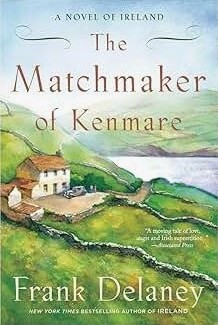 I wouldn’t have reached this crossroads were it not for a particular book. Amazon described Frank Delaney’s The Matchmaker of Kenmare just the way I’d hope: an intriguing WWII-era work of fiction. So I went to “try a sample”(where Amazon allows you the first several pages of the book for free) and – horror of horrors – it’s not available in digital format. WHAT? No e-Version? You’re saying, Amazon, I have to shell out $24.99 for the hard copy if I want to read it?
A book for $10 doesn’t make me pause but one for $25 sure does. Hence began my library adventure. The last time I spent meaningful time in one was in college (and I don’t want to tell you how long ago that was). The library experience is probably different in every way now, starting online. When I “checked out” my library’s website (ha) I discovered I could get a digital library card almost immediately. With the digital card I could reserve and check out books from the comfort of my home computer. Hurrah, free books here I come!
 Oh how I wish it were that easy. Turns out, my library’s software is not compatible with an Amazon Kindle. No digital books for me, sigh. And besides, physical books – like the one I wanted – require a physical library card. So with no other excuse to avoid it, I got in my car and headed off to my local branch. Guess what? Parking at the library is free. Entering the building itself is free (no cover charge!). Getting a library card is free. Even the library bathrooms can be used without having to check out a book first.

Yes, this is my tax dollars at work of course, but the illusion of all this free stuff is fun while it lasts. And boy howdy, libraries aren’t what they used to be. Ours has all these rooms and services and people, as if the surrounding shelves of books are merely a carry-over from past generations. You can sit down to public-access computers, attend a lecture, host a meeting, rent DVDs, buy coffee, and even spend time in a room of books dedicated to the history of the surrounding county. Maybe this is all review for you, but it’s a little overwhelming for an e-reader who’s navigating libraries of the new world.

There’s more to this adventure in library-ing than I have time for today (including the over-the-river and through-the woods visit to a different and decidedly ancient branch in my library’s network), but let’s close the book on this topic with a “laugh’s on me” conclusion. As I was researching for this blog post I went to the Amazon page for my Matchmaker… novel again. Go figure; it’s available in digital format after all, and even in paperback. How did I miss these options the first time around? Must be the library gods telling me to go old-school and get a physical copy for free.
LEGO Notre-Dame de Paris – Update #4
(Read about the start of this “church service” in Highest Chair)

As Notre-Dame de Paris rises slowly from its foundations, I often picture a congregation of parishioners down there at ground level, sitting quietly in the pews. Startled by the snap of a LEGO block above them, they gaze skyward, see my giant fingers, and wonder, “OMG is that the hand of God?” No, no, little ones, it’s just Dave, working through Bag 7… of 34 bags of pieces.

Today almost included the long-awaited moment where I realize with mock horror that LEGO left a piece out of one of their model sets. I churned through my piles of pieces, endlessly stirring and turning them over and over, but to no avail. A piece was missing, and that sick-to-your-stomach feeling settled in deep, the way you reach the end of a jigsaw puzzle minus one piece. Then, to my utter amazement, I spied it out of the corner of my eye. The tiny traitor was still in Bag 7. Wow. Good thing that plastic bag wasn’t already relegated to the trash, huh?

 On the other hand, with more excitement than it probably deserved, today we began construction of Notre-Dame’s signature flying buttresses. At first I was disappointed in the LEGO pieces, because I thought they looked a little, well, “underfed”. Then I remembered; we’re only beginning the structure of the buttresses. The finished look you see on the outside of Notre-Dame is supported by a complex of arches and columns well below it. Here I thought my “God’s hand” was already working at roof level but in fact, we’re only about halfway up the structure.
Running build time: 3 hrs. 32 min.
Total leftover pieces: 16






 Life In A Word