
My wife and I enjoy popcorn after dinner, probably because we’re watching more movies at home these days. It’s easy prep thanks to our Presto air popper. Dump in the kernels, plug in the popper, and “presto”; a delicious snack in an instant. Of course, one of these days our air popper will break and we’ll have to buy another one. Unlike our KitchenAid stand mixer, which will spin,spin,spin until the end of time.

If your kitchen is like ours, the cupboards are full of appliances that only make an occasional appearance. Our Breville panini press hasn’t made a “melt” in months. Our Marcato pasta maker last saw action in the early 2000s. And our George Foreman grill is retired for good, because it’s just as easy to fire up the barbecue. But our KitchenAid stand mixer spins to our “Aid” time and again, always ready to make bread dough, cake batter, or cookies.
Stand mixers date to the early 1900s. KitchenAid’s version came along in the 1930s, and it wouldn’t surprise me to learn some of the original models are still spinning almost a hundred years later. The appliance is just that good. The KitchenAid was designed to be as simple, efficient, and robust as possible, and with only one task in mind: to spin ingredients in dizzying circles until they’re thoroughly mixed. Sure, you can add dozens of specialized attachments but none change what the stand mixer does at its core. Spin, spin, spin.
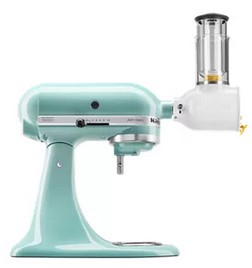
When I make a batch of cookies, I stand back in wonder as our KitchenAid does its thing. As I add the ingredients, the paddle blade works harder and harder to blend them together. By the time I get to the last of a dozen ingredients; say, chocolate chips, the mixer is practically bouncing across the counter as it struggles to plow through the dough. You’d expect the mixer to break down at any second in an explosion of flying gears and sizzling smoke. But it never does.
I know a lot of people who own a KitchenAid stand mixer, and I’ve never heard of one that stopped working. Even if it did break, the appliance is designed for easy repair. The parts can be swapped out individually and quickly, eliminating the need for a repair person or a new mixer. It reminds me of the old Maytag washers, and how their repairman was described as “the loneliest guy in town”.
 Like most appliances, Maytags aren’t what they used to be. We yearn for the models from the 1980s or earlier, which could wash anything and never break down. Today’s Maytags are a shadow of their former selves. They don’t do as good of a job, and every five years you’re thinking about replacing them. Not so the KitchenAid stand mixer. I have no doubt ours will be a part of our kids’ inheritance someday.
Speaking of kids, our daughter has her own KitchenAid and it sits proudly on her kitchen counter. Counter space in the kitchen is precious so only a few appliances deserve to be full-time residents. A coffeemaker. Some sort of toaster oven. And a KitchenAid stand mixer, which somehow manages to look appliance-elegant with its curves and swoops.

“Mixmasters” (a popular nickname for the KitchenAid) aren’t cheap. Most models run about $300 USD for the basic setup. Consider though, it’s the only stand mixer you’re ever going to need. KitchenAid even admitted they expanded their color selection and limited-edition models in an effort to generate more repeat customers. (This year – and only this year – you can buy one in “iridescent periwinkle blue”.)
 Our Colorado kitchen had a very cool below-counter cabinet, designed specifically for a heavy stand mixer. You opened the door, pulled a shelf handle, and your Mixmaster rose effortlessly out of the cabinet on special hinges, snapping into place at counter level. An appliance has to be awfully special to justify a custom cabinet. Or a spot in the Smithsonian Museum, where the KitchenAid stands as a part of the Julia Child exhibit.

I don’t need to go to the Smithsonian to see a stand mixer (nor do you). I have my KitchenAid right here in the kitchen cabinet. I can put down the laptop and whip up a batch of cookies anytime I want. Like, right now. Time for my Mixmaster to spin, spin, spin again, just like it’s done a thousand times before.
Some content sourced from The Atlantic article, “KitchenAid Did it Right 87 Years Ago”, and Wikipedia, “the free encyclopedia”.

 Life In A Word