Shark Attack!

Our annual summer vacations in San Diego have become a little more adventurous because of an increase in shark activity off the coast of California. I enjoy body surfing, but the thought of a pair of big, hungry jaws beneath the water’s surface gets my heart a-pounding. So imagine my shock when I really did have an encounter with a baby shark. Er, make those letters capitals. I meant to say “Baby Shark”.

My adorable two-year old granddaughter is just beginning to take off with her vocabulary.  She can say “Mama”, “Dada”, and even “Chop! Chop!” when she wants us to hurry up.  She also says “Bayba Shawk”… constantly, because she wants an adult to play the song for the forty-thousandth time.  After three weeks on repeat I can’t get the darned thing out of my head.  I need brain surgery.
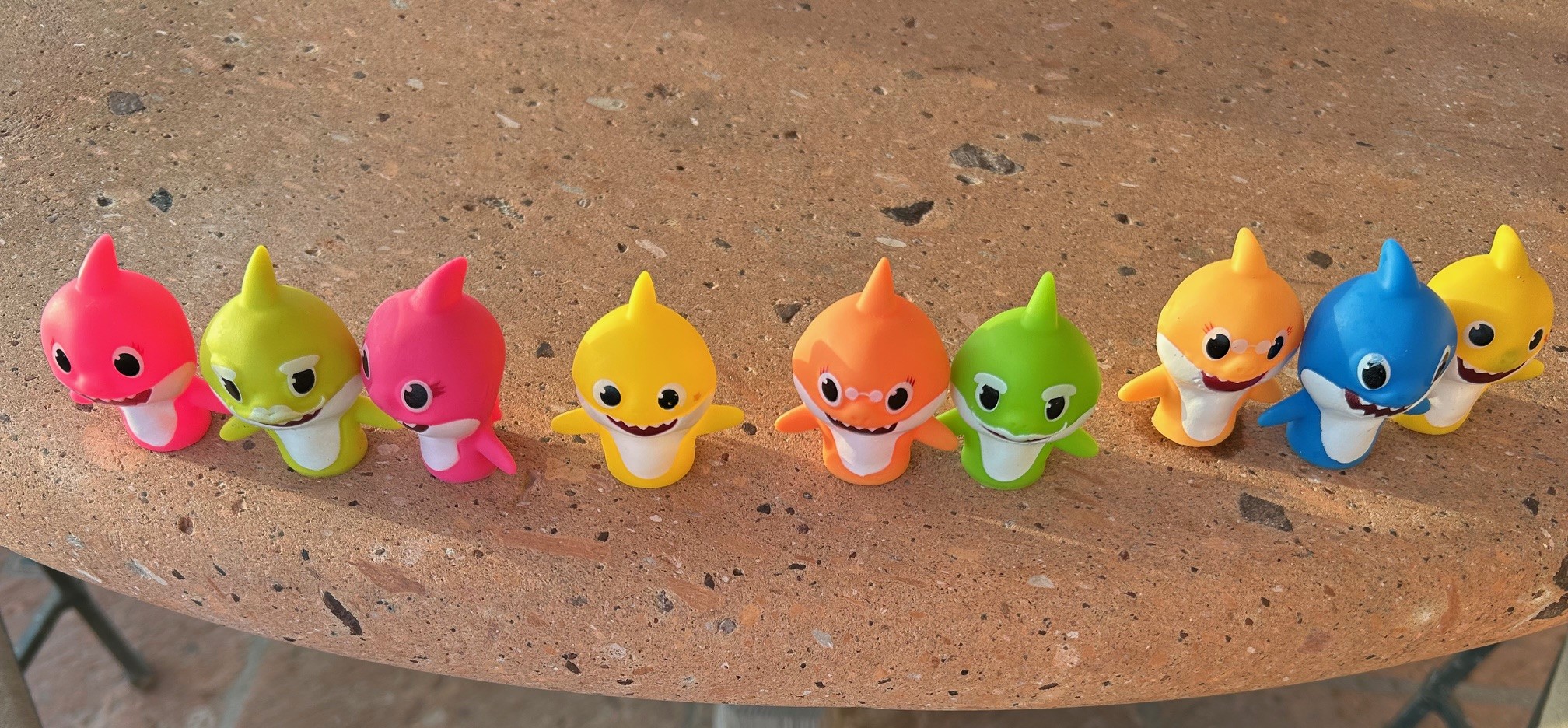
My granddaughter’s finger puppets

“Baby Shark” is the story of a little family of sharks hunting for fish.  The fish get away and… that’s it.  It’s not so much a story as an excuse to sing a verse about each family member: Baby, Mommy, Daddy, Grandma, and Grandpa.  The first time I heard it (forty thousand time ago) I wondered, Why doesn’t Baby Shark have siblings?  Where are his (her?) other grandparents?  Aunts?  Uncles?

Of course, it’s not really Baby Shark’s family that make the tune so addicting.  It’s the “doo’s”… as in doo doo doo-doo doo-doo.  You sing those six “doo’s” in every verse and that’s the part that gets into your head.  Add in the accompanying up-and-down arm dance (imitating the jaws of a shark) and you somehow have a hit.  More like a worldwide phenomenon.

If a children’s sing-song doesn’t get your attention, consider this.  “Baby Shark” is the most-watched YouTube video of all time.  I said of all time.  If your guess would’ve been something by Ed Sheeran or Katy Perry or Maroon 5 you would’ve also landed in the Top Thirty, but nowhere near the top of the list.  “Baby Shark” has been viewed over 16 billion times, more than twice the number as the runner-up.  And that’s only for the version from South Korea’s Pingfong.  The one by Cocomelon (a children’s YouTube channel) lands in twenty-third place with another four billion views.

The “Baby Shark Dance”

“Baby Shark” has been around longer than you might think.  It showed up somewhere in the late 1990’s in the public domain.  Then Pinkfong got ahold of it, created the 2016 video with cute little Korean kids, and the rest continues to be history.  Coincidentally, a lawsuit was settled just this month where an American songwriter claimed rights to “Baby Shark”.  He lost, but only because the song was still in the public domain when he created his version.  You can’t blame him for trying; “Baby Shark” has generated over $150M in revenue in the last ten years.

Of course, all that revenue comes from more than just a YouTube video (hence the “worldwide phenomenon”).  “Baby Shark” is showing up in places and with people that seem downright ridiculous.  There’s a children’s book and a television series.  There’s a video game.  It’s part of a tourism promotion for Singapore.  It’s used by certain professional baseball players as they walk up to the plate.  Or certain politicians as they walk up to the podium.  Finally, it’s the subject of a Kellogg’s breakfast cereal, a berry version of Fruit Loops with little marshmallows posing as sharks.  “Yum?”

My favorite use of “Baby Shark” comes out of West Palm Beach, FL.  Local authorities were desperate to clear a lakeside pavilion of homeless people, so they played the song over and over on loudspeakers until everyone left (running and screaming for the hills, no doubt).  If I’m inclined to run and scream myself, I can drive a couple hours north of here to see a production of Baby Shark Live, a 75-minute stage musical.  I’m not inclined.

The whole time I’ve been typing this post I’ve had doo doo doo-doo doo-doo on loop in my head.  If my hands and arms weren’t busy on the keyboard they’d be doing the Baby Shark Dance instead.  It’s maddening, and makes me want to body surf again with hopes I’ll be eaten by a real shark.  Instead, I’ll just hope I find another blog topic next week that consumes me more than “Baby Shark”.  I leave you with the video.  Guard your sanity.

Some content sourced from Wikipedia, “the free encyclopedia”.
Parts Party

I’ve always been fascinated – mesmerized even – by the mechanics of assembly line manufacturing. A product takes form from a single part, then moves down the line to where another part is added. Then another part, another, and another, until at long last the completed product presents itself at the very end for packaging. Assembly lines are becoming more and more automated, which begs the question: When will humans be removed from the process altogether?

“The Rouge”

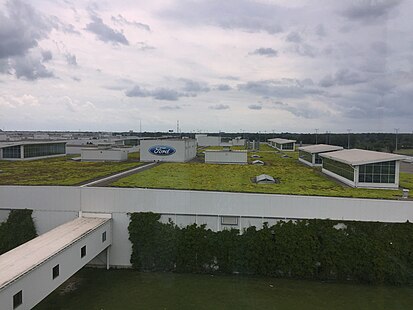
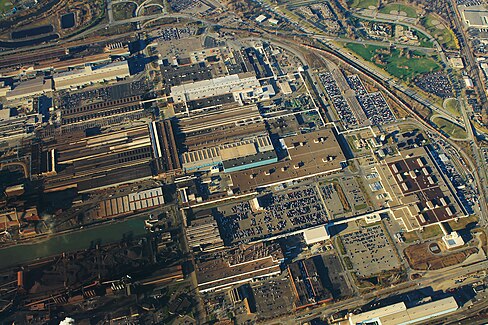
On a recent trip to Detroit with my brothers, we were lucky enough to snag tickets to a tour of the Ford River Rouge Complex, where the F-150 truck (gas engine) is mass-produced. Ford has over 65 manufacturing plants worldwide but I think “The Rouge” is the only one you can tour. And boy is it worth it. You walk away with a lot more admiration for a fully-built F-150 than when you first set foot in the building.

The tour begins on the bridge at the lower left

Ford doesn’t allow you to take photos inside The Rouge (and they keep a close eye on visitors) else I’d include a few here. The tour starts with a couple of promotional videos in comfortable theaters, followed by an elevator trip to the top of the visitors center for a look down at the vast campus. Then things get serious. You put away your phones, listen to the rules and regulations about behaving inside the factory, and off you go.

Ford F-150

Here are the eye-popping numbers. The F-150 travels the length of a four-mile assembly line as it grows from parts to finished product. That line includes over two hundred stops to add parts (which aren’t really stops because the truck is always being pulled along). A fully-functioning F-150 rolls off The Rouge assembly line every 52 seconds, which translates to a remarkable 650 new vehicles per ten-hour working shift. And finally, the whole process is far from automated. 6,000 workers assemble the vehicles, each a specialist in the given part, calibration, or inspection the truck demands.

Of course, an F-150 has far more than two hundred parts. Some of those assembly line stops are for the installation of major components. The entire dashboard, for example, or most of the engine are installed in a single stop. But you also have workers who do nothing more than take a rubber mallet and pound on rear taillight covers. Think about it.  Can you imagine hammering on taillight covers 650 times a day?  It’s mindless, it’s repetitive, and you have to wonder about the toll it takes on the human body.

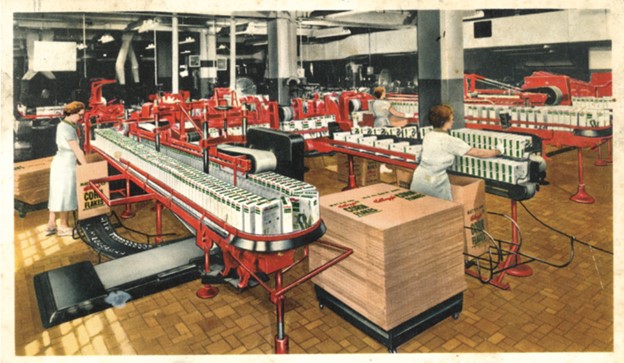
Cereal-making “back in the day”

Assembly line work can be more fun and less repetitive than building cars.  My family and I visited the Kellogg’s (cereal) factory in Battle Creek, Michigan in the early 1970s.  The smell of cooked corn flakes might’ve turned a kid’s nose but the tour was the next best thing to Willy Wonka’s.  You’d don a Kellogg’s paper hat and read the colorful brochure story about how “this little kernel went to Kellogg’s… first it was milled… then it was flavored…”.  Then you’d walk the assembly line of breakfast cereal, from cooking all the way to box filling.  The best part was at the very end, where you’d get free samples of all your Kellogg’s favorites, and postcards so you could brag about the place to your friends.  Alas, like many manufacturing facilities, safety and espionage concerns brought an end to the Kellogg’s tours in the mid-1980s.

At least I could watch assembly lines on TV after that.  How It’s Made was my kind of show.  The Canadian documentary spent years creating virtual factory tours so viewers could see the ins and outs of manufacturing processes.  In a single episode you’d watch the dizzying mechanics behind the creation of everything from candies to clothing to cars.  How It’s Made kind of gave you access where access wasn’t allowed.

Speaking of no access, the electric-engine version of the Ford F-150 – the “Lightning” – is produced in a plant where no tours are permitted (back to the espionage thing).  Instead, you watch a short video of the process after you’ve completed The Rouge tour.  How are the two F-150 assembly lines different?  Several thousand humans.  The Lightning production is almost entirely automated, with robotic machines hovering over the vehicles as they come together.  Our tour guide said the assembly line is eerily quiet, since a robot doesn’t require a banging mallet to add on a taillight cover.

For all my fascination with assembly lines and automation, I wonder whether “loss of humanity” is really the way to go.  All those jobs at The Rouge would disappear.  Machines would be one step closer to taking over the world.  Suddenly “handmade” sounds better than ever.

Some content sourced from the Michigan Blue article, “Visiting the Kellogg’s Factory”, and Wikipedia, “the free encyclopedia”.
 

Any Way You Slice It

Labor Day is right around the corner, but I call your attention to a couple of tastier holidays this time of year. Last Thursday was Peach Pie Day and a month henceforth will be Strawberry Cream Pie Day.  October will usher in Pumpkin Pie Day, as well as Boston Cream Pie Day.  In November, we’ll celebrate Bavarian Cream Pie Day.  Next May we’ll celebrate Apple Pie Day (and that one should be designated an American holiday).

These pie-eyed celebration days come and go with little more than crumbs for fanfare, but any attention to pie is a good thing in my book.  Whether sweet or savory, fruit or cream, single or double-crust, bite-size (“cutie pies”?) or multiple-serving-size; you can never have too many fingers in pie.

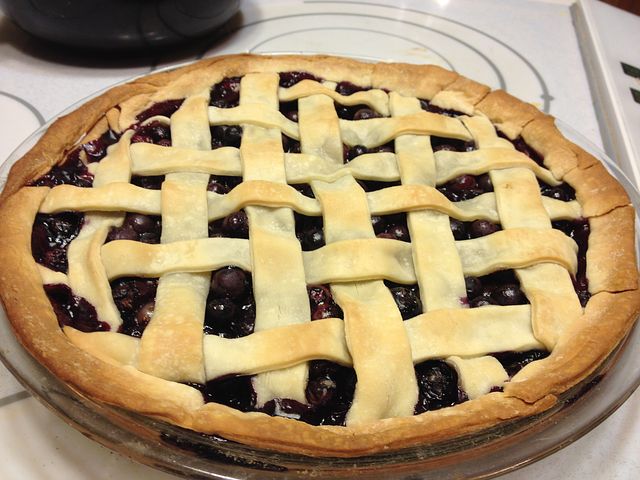
Pie is literally a part of my DNA.  My grandmother used to make delicious Cornish pasties, those hearty beef stew pocket-pies favored by generations of coal miners, each containing an entire meal within their flaky golden-brown crust.  My mother raised my brothers and I on the fruit pies her own mother taught her to make.  My favorites were cherry, peach, and mince; piping hot and a la mode (or in the case of mince, “a la hard sauce”).  I can still picture my mother adorning her creations with strips of dough – elegant top-crust latticework too pretty to consume.  She made it look easy as pie.

They say the signature of a great pie is its crust – ironic because history says pie crust was never meant to be eaten.  With the advent of flour in ancient Roman times, pie crust served a practical purpose: to contain and preserve the food within, especially for a soldier or sailor or some other kind of several-days traveler.  It wasn’t until bakers turned their attention to the crust when “real pie” was born.  Can you imagine the first time someone tasted a savory buttery crust, melded with hot fruit filling, cooled by the freshness of vanilla ice cream?  The whole is clearly greater than the sum of its parts.

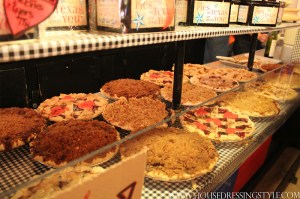
   Royer’s Round Top Cafe, Texas

Any Texans reading this post will likely direct me to the Hill Country in the southeast, to little Marble Falls or tiny Round Top.  Both towns boast of serving “the best pies in the Lone Star State”, be that the Blue Bonnet Cafe in the former or Royer’s Cafe in the latter.  Blue Bonnet has a “Pie Happy Hour” and a regionally-renowned German Chocolate Pie.  (My favorite cake as a pie?  Sounds like a slice of heaven.)  Royer’s has something called a “Texas Trash Pie” (pretzels, graham crackers and coconut) and I can get one with a few clicks of my mouse.  Don’t tempt me.

No nod to pie would be complete without saluting Hostess Fruit Pies and Kellogg’s Pop Tarts – staples of the American childhood.  Hostess enticed you with those colorful wrappers and the promise of “real fruit filling” (though my favorite was actually the chocolate).  No matter the flavor, you consumed a brick’s worth of glazed sugar, chewy crust, and gooey fruit filling.  It’s a wonder we didn’t sink to the bottom of our swimming pools and bathtubs.


Kellogg’s Pop Tarts were svelte by comparison; a deck of large playing cards.  My mother favored the non-frosted fruit variety to keep our pantry “healthy”, but she snuck the brown-sugar cinnamon tarts into the basket too.  I ate hundreds of those.  Someone needs to invent a brown-sugar cinnamon pie.

Any Hollywood-types reading this post would remind me the ultimate pie movie is “Waitress” (now a Broadway musical), or “Michael”, where in one glorious scene Andie McDowell surveys a table’s worth of pie and gleefully sings, “Pie, pie, me-oh-my, I love pie!”

Thanks to a new local restaurant, I don’t have to travel to Texas to find amazing pie.  3.14 Sweet & Savory Pi Bar is as inclusive as it sounds.  Choose from a dozen or more “Pot Pi’s” for your entree (my favorite is the Irish-stew-inspired “Guinness Sakes”); then sprint to dessert by choosing from over twenty temptations (hello “Blueberry Fields Forever” Pi).

For the record, cake gets its share of celebrations as well.  Last Wednesday was “Sponge Cake Day” and November 26th is “National Cake Day”.  For me, those days will come and go like any other.  Those who celebrate cake should eat some humble pie and admit which dessert deserves the higher praise.  But hey, no time to debate; a chicken pot pie is in the oven and calling my name.