In 1972, Billy Preston topped the Billboard Hot 100 chart with the catchy “Will It Go Round In Circles”. A year later, The Spinners spent five weeks at #1 on Billboard’s R&B chart with “I’ll Be Around”. More recently, Kacey Musgraves’ debut single “Merry Go ‘Round” won the Grammy Award for Best Country Song. All of which is to say, if I’m asked to celebrate “National Carousel Day” I have a great choice of theme songs for the occasion… played on endless loop, of course.
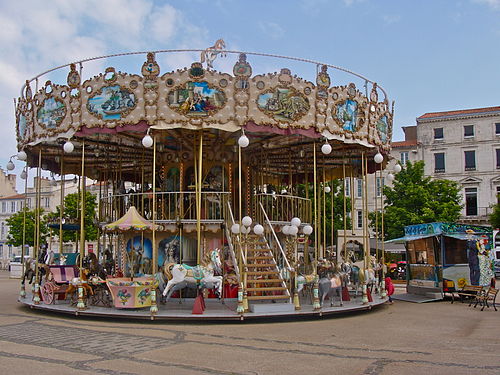
National Merry-Go-Round Day (I prefer “Carousel”) was this past July 25th, as it has been every year since 2014. Did you skip it like I did? The holiday claims to “celebrate the carousel’s history and joy, particularly marking the first U.S. patent by William Schneider in 1871.” And to celebrate, we’re meant to visit a local carousel, go for a spin, and post pictures of ourselves doing so online. So we drop everything we’re doing on July 25th and climb on a wooden horse? National M-G-R Day doesn’t even rate as a Hallmark holiday (and don’t waste your time trying to find a card to prove me wrong).
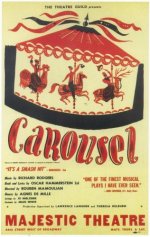 Contrary to my opinion about M-G-R Day, I think carousels are charming and a bit of innocent fun (other than those brass rings, which we’ll get to in a second). Carousels inspired memorable scenes in Mary Poppins and Big. Carousel was the Rodgers and Hammerstein musical that Time magazine deemed “the best of the 20th century”. The “Carousel of Progress” was (and still is) one of the more unique attractions at Disneyland. And of course, carousels led to those pipe and metal spinners we all played on at the park when we were kids.
 Carousel is derived from the French word for “little battle”, which hints at why we’re riding them at all today. In 17th century Europe, equestrian tournaments included “ring jousting”, where the rider attempts to spear a ring-on-a-string with his joust as he flies by. To practice this sport without wearing out the horses, a clever soul invented the carousel, complete with wooden horses on poles and a real horse to pull the device in circles. Eventually carousels made their way into carnivals, and then to the prominent locations where you find them today.
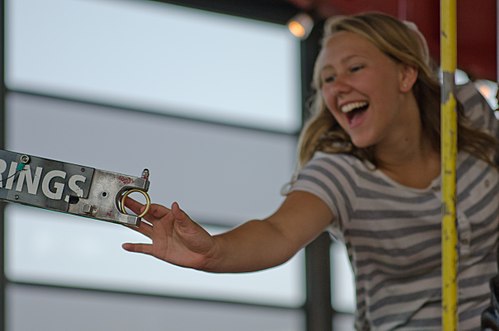
Now you also understand why early carousels had ring dispensers. They were a nod to ring jousting! The dispensers were filled with iron rings along with a few brass ones. If you were lucky enough to ride an outside horse and grab a brass ring (which is harder than it sounds as your horse goes up and down), you could exchange the ring for a prize or another loop on the carousel. For good reasons – safety being one – ring dispensers have been removed from most carousels today.
The people who came up with National M-G-R Day should’ve probably gone with “International”, because many of the world’s most distinguished carousels spin outside of the United States. The Carousel El Dorado in Tokyo, Japan, built in 1907, is the oldest amusement park ride still in operation in the country. The Lakeside Park Carousel in Ontario, Canada (1905) includes a self-playing organ that uses rolled sheets of music, rewinding one while playing the next. The Letná Carousel in Prague, Czechia (1892!) is one of the oldest in Europe, remodeled in 2022 but still housed in its original wooden pavilion.
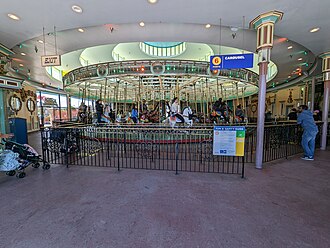
America has its share of prominent “gallopers” as well. The Looff Carousel in Santa Cruz, CA is one of the few remaining with a ring dispenser, and entertains with the music of three organs. The Over-The-Jumps Carousel in Little Rock, AR (1924) simulates the natural movement of a horse instead of just going up and down on a pole. And the Flying Horse Carousel in Westerly, Rhode Island (1876!) is exactly as advertised. The horses are attached to the center spindle instead of the wooden platform, creating a better sensation of flying through the air.
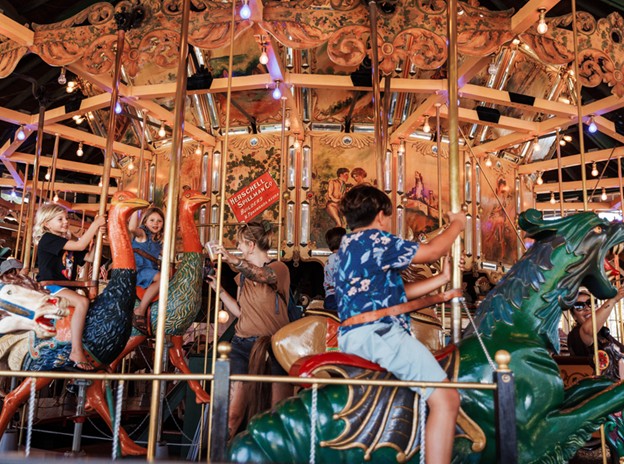
Okay, I have a confession. I had the perfect opportunity to celebrate National M-G-R Day just days after it happened this year. My wife and I traveled to San Diego with our children and grandchildren for a beach vacation and found ourselves in Balboa Park, home of the Dorothea Laub Carousel (brass ring dispenser!) If we hadn’t already worn out the little ones on a long walk through the Japanese Friendship Garden we might’ve made it to the wooden horses. But I’m not losing sleep about it. After all, National M-G-R Day will come ’round again next year.
Some content sourced from Wikipedia, “the free encyclopedia”.



 Life In A Word