Only In Iowa

If you’ve ever made graham crackers from scratch (which are miles better than the store-bought ones), there’s a step in the recipe where you have to get your hands dirty. Take a stick of butter, cut it into very small pieces, dump the pieces into the mixture of dry ingredients, and dive on in with your fingers until the dough starts to clump together. It may be the only time butter and my hands ever come in contact with each other. Which is also to say, I won’t be sculpting a butter cow any time soon.
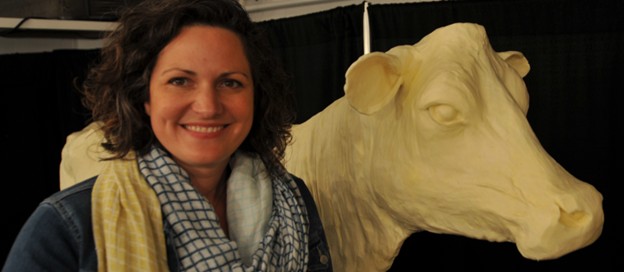
Sculptor, cow

Creating art out of food seems like an inevitable destination. I mean, back in Michelangelo’s day everyone was taking a block of marble and seeing what they could do with it. Then all but one of them quickly realized there was only one Michelangelo. The others probably turned to an easier material to work with like wood or clay. 1,000 years on, we’re sculpting food. Chocolate is a popular medium. Cakes are shaped into just about everything imaginable. But a cow made out of butter – what’s that all about?

A more fitting Hawkeye State image

We turn to Iowa to learn more about this oddity.  Most people prefer to fly over Iowa but since you’re reading and not flying, let me enlighten you.  On the list of 10 Things to Know About Iowa, there is no butter and there is no cow. There are a lot of pigs (the most of any state) and millions of acres of corn (also “the most”), and Iowa’s “Hawkeye” nickname is a reference to the birth of the red delicious apple (who knew?).  But none of this gets us to butter and cows.

The “10 Things…” list does mention the Iowa State Fair, and it is here that we find real cows by the hundreds… and a life-sized one made out of butter.  The Fair, whose 2025 edition wrapped up three weeks ago, has been making “buttered cows” since 1911, thanks to five Iowans who’ve passed the butter baton down over the years.  The latest, Sarah Pratt, has been making the cows for the last nineteen years, and only after apprenticing with the last sculptor fifteen years before that.  Some people blog; others make cows out of butter.

The 1911 original

Like papier-mâché, a butter cow is created on top of a frame built from wood, wire, and/or metal.  Then we heap on some fun statistics.  600 lbs. of “low moisture, pure cream, Iowa butter” is applied to create a cow that’s five-and-a-half feet tall and eight feet long.  The sculptor’s “studio” is a walk-in cooler set to 40ºF.  After the cow is displayed at the fair, all that butter is recycled for use on the next ten years of cows.  Unless you’d rather use it for toast, which would butter 19,200 slices.

Michelangelo didn’t stop sculpting after his famous David, of course, and neither does Sarah Pratt with her butter cows.  Also following tradition, she creates a “companion sculpture” to keep the cow company.  Sometimes the companion is an homage to Iowa, such as a John Deere tractor.  Most years the companion is a random anniversary, like the 40th anniversary of Neil Armstrong’s walk on the moon (totally random because Neil wasn’t born in Iowa).  This year the sculpture featured the characters from “Toy Story”, denoting the movie’s 30th anniversary.  You get the feeling Sarah enjoys sculpting butter so much that a life-sized cow just isn’t enough.

Woody, Buzz

For all of my research, I can’t figure out why a cow made out of butter and Iowa belong in the same sentence.  Nearby Wisconsin and Michigan are better known for dairy cows.  California tops the list of the five states producing the most butter (and Iowa isn’t one of the other four).  No matter, this tradition isn’t stopping anytime soon.  The butter cow even has a place in the Smithsonian Institution (thankfully, as a replica that will never melt).
I love butter, but more on top of baked goods and in graham cracker recipes than in the shape of a cow.  I will admit to buying my butter by the brick instead of by the stick.  But now that I know about Iowa’s annual creations, I’ll never look at my morning toast again without thinking, mooooooooo.

Some content sourced from the Iowa State Fair website, the U.S. News article, “10 Things to Know About Iowa”, and Wikipedia, “the free encyclopedia”.

Sweeter Than Honey

We all have favorite name-brand products, and crackers are no exception. I grew up on Nabisco’s Wheat Thins. Years later I developed a taste for the more sophisticated shredded-wheat Triscuit. When I first met my wife, she introduced me to Kellogg’s buttery Club Crackers. Each of these products is a little different (and today we prefer healthier versions of all three). But I think most would agree, there’s nothing quite like the taste of a graham cracker.

As I put graham crackers under the spotlight today I wonder what comes to your mind first.  For me, it’s two things.  First, I’m taken back to childhood mornings at Sunday school, where the preferred snack was honey graham crackers and pineapple juice.  I can’t think of another time or place where I ever had that combination of foods.  Maybe the sugar overload was a strategy to keep us awake during the Bible stories?  Second, I endlessly debate whether a graham is a cracker or a cookie.  If you’re at all familiar with the ingredients, grahams lean towards “cookie”.  They’re called a cracker, they look like a cracker, but nine out of ten stores stock them in the cookie aisle.

Graham cracker or “graham cookie”?

It’s appropriate my first memory of graham crackers is at church.  They’re named after Sylvester Graham, a nineteenth-century preacher whose constant message was temperance.  In Graham’s time, temperance was a movement against the consumption of alcoholic beverages, but also encouraged what may have been the first vegetarian diet.  Wheat was its cornerstone, and wheat (flour) is the primary ingredient in graham crackers.  To be clear, Sylvester didn’t invent the graham cracker (we’re not sure who did) but his preaching inspired its name.

“Blackstrap” molasses

The sweet ingredient in graham crackers used to be molasses, one of my favorite items in the pantry.  Inevitably, molasses gave way to processed sugar.  But as I discovered recently, honey is a key ingredient in today’s best-tasting grahams.

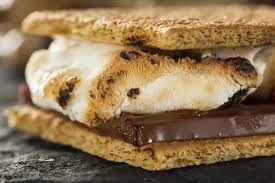
For you, maybe graham crackers taste best in s’mores (which I wrote about in Toasty of the Town), or the crust of a cheesecake, or even Moon Pies for you baby boomers.  But for me, grahams taste best all by themselves.  They play like a “cheat” to the more sugary options out there, and I can pretend I’m just snacking on a “cracker”.

I keep a stash of grahams in my office drawer to satisfy my occasional sweet tooth.  I only need a couple of the 2″x 5″s and I’m back on track.  The other day however, I pulled open the drawer to nothing but crumbs.  Horrors!  Grahams have been my go-to since the beginning of Lent because I’ve given up chocolate and “sweets”.  So I quickly added them to my store list and vowed to shop later in the day.

But as so often has been the case during the pandemic, I immediately paused and thought, “Wait a minute. Why buy graham crackers?  Maybe I can make them from scratch?

Here then, I present what is the best graham cracker recipe I’ve ever tried.  (Okay, it’s the only recipe I’ve ever tried but it doesn’t matter; I don’t need another one.)  Gemma’s Bigger Bolder Baking takes grahams to a way higher rung on the cookie ladder (including a helpful video if you’re baking-challenged like me).  I’ve eaten a million Honey-Maids yet it took me sixty years to realize grahams can be SO… MUCH… BETTER.  Why?  Because these contain a lot more of the good stuff and a lot less of the nasty chemical flavorings and preservatives.

You should expect these homemade grahams to taste better when you see the ingredients.  The ratio of flour to brown sugar is 2:1 (emphasis on the “1”).  Now add another 1/3 cup of honey.  That’s a lot of “sweet” for a cracker, er, cookie that looks like a thin cardboard rectangle.  But I’m talking delicious with a capital “D”.  Think chewy instead of crunchy, with a rich “graham” flavor lingering much longer than store brands.  They’re almost too good to be called a graham.

My grahams

Okay, let’s close the box on graham crackers with a quick review:

  1. They were invented as an alternative to unfavorable indulgences.
  2. They’re a cookie by definition but a cracker by name.
  3. They make you want to try Moon Pies (if you haven’t already).
  4. They satisfy a craving for sweets without being “a sweet” (disregard earlier comment about brown sugar and honey).
  5. They are unquestionably better made from scratch than store-bought.
Yum!

If I haven’t sold you on how much better the humble graham cracker can be, consider this.  They’re simple to make and you already have all of the ingredients you need.  So, what are you waiting for?  Go bake some crackers, Graham!

Some content sourced from Wikipedia, “the free encyclopedia”.

——————–

Lego Grand Piano – Update #10

(Read about how this project got started in Let’s Make Music!)

We worked entirely underneath the piano today, with the instrument flipped onto its back. Bag #10 – of 21 bags of pieces – contained an intimidating pile of tiny parts. I didn’t realize what I was even building until somewhat magically, pedals, legs, and castors appeared before my eyes.  That’s right folks, this baby-baby grand now rolls.

I also took a deep breath and tackled the “loose piece” I’ve mentioned with the last two builds.  Sparing you the heart-stopping details, let’s just admit I installed a tiny piece ninety degrees wrong.  Correcting meant removing all the piano strings and working in a deep, dark corner, with the assistance of an X-Acto knife, eyeglass screwdriver, and pliers.  Like I’ve said before, don’t get any part of this performance wrong.  It’ll cost you later. Dearly.

Elevated!

Running Build Time: 8.1 hours.  Musical accompaniment: Satie’s Gymnopidies 1, 2, and 3 (a deliberate choice to soothe me while I repositioned the loose piece). Leftover pieces: 3

Conductor’s Note: The tiny pedal to the right is called the “damper”. It’s used to sustain the notes you play after you take your hands off the keys.  Remarkably, the Lego Grand Piano has the same mechanical action you’d find with this pedal in a real piano.  Sit down at a keyboard some time, press the right pedal with your foot, and (with the piano lid raised) you’ll see just how many moving parts it takes to sustain notes.  You’ll find those same moving parts in the Lego Grand Piano.