
When we babysit our granddaughters here at the house, we tap into several items to make the job easier. A big basket of toys and stuffed animals sits in the corner of our living room. A dozen children’s books line the lowest shelf just waiting to tell their stories. Sesame Street is easily streamed on the nearby television. And at dinner time we roll out the high chair so everyone’s on the same level. So who would’ve thought a high chair would be my blog topic for today? Maybe you, if you know anything about cathedrals.

We’re almost there, loyal readers. I will lay the corner-block of my LEGO model of Notre-Dame de Paris next week. Why not this week, you ask? Because before we crack the seal on the giant box of pieces, we need to pay a little respect to the real Cathedral. I want you to know a few things about the stone and glass Notre-Dame before you witness the rising of the plastic one.

It’s a cathedral in the middle of Paris, Dave… what more do I need to know? Uh, a LOT more. To begin with, do you even know what a cathedral is? I didn’t (and I have a background in architecture, for gosh sake). It’s a big, giant church with stained glass and chapels and a raised altar, you say. Well yes, you’re right, but what makes a church a cathedral? Interestingly, it has nothing to do with the building itself. Instead, a cathedral is the seat of a bishop (the ordained clergy-person who presides over the surrounding parishes). For lack of a church this person could just as easily be in a small house and it would still be considered a cathedral.
Cathedrals really do have “high chairs” on their altars for the bishops (cathedra in Latin means “seat”) but Notre-Dame de Paris is much more than a place for furniture. First and foremost, it took a hundred years to construct (1163-1260). In that era the building evolved from the common Romanesque style of the period to the more elegant French Gothic. Notre-Dame feels unusually vertical and airy for a structure of its time and there’s a novel reason for this: flying buttresses.

Imagine Notre-Dame’s architect – Eugène Viollet-le-Duc – talking to the Paris city council in the twelfth century and saying, “Look guys, let’s think outside the box here… literally. The structural support for this church ought to be outside of the building instead of inside”. Why would the architect want this? Because the flying buttresses assume the structural load that was previously handled by short, thick interior walls. The result is taller, more dramatic spaces, filled with the light of high-up stained glass windows. In other words, flying buttresses allow Notre-Dame to “reach for the heavens” much better than its Romanesque predecessors.

There’s also more to this French “grande dame” than structure, of course. Notre-Dame has twenty-nine chapels surrounding the main sanctuary (that’s gonna take a lot of LEGO). It features three spectacular stained glass “rose” windows that would not be as large or as high were it not for those flying buttresses. Notre-Dame’s twin towers host ten massive bronze bells and they each have first names. “Emmanuel” (listen to his sound bite below) and “Marie” are so big they take up the entire south tower, while their eight ringing siblings all fit into the north tower.
Notre-Dame also has a central flèche, a spire not unlike the ones you see on more modest churches. This spire, however, is topped by a bronze rooster, which is not only the symbol of the French state but also a container for (supposedly) a small piece of the Crown of Thorns, worn by Jesus leading up to his crucifixion.
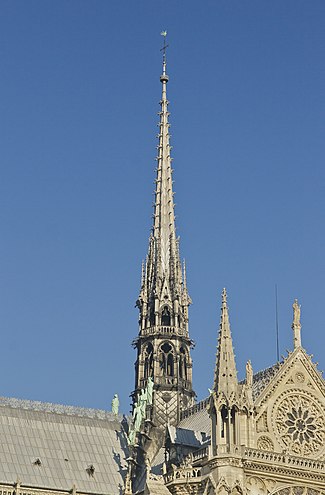
As you would expect, Notre-Dame de Paris hosts countless works of art, whether paintings or sculptures. Many of the sculptures are biblical scenes intended to educate the illiterate parishioners of the twelfth century. But my favorite sculptures may be those of the twelve apostles, way up high surrounding the base of the flèche and looking outwards towards Paris… all except one. St. Thomas – patron saint of architects – faces Notre-Dame itself, and was given the facial features of Viollet-le-Duc.
Okay, so now you know more about Notre-Dame de Paris than just the LEGO model. Considering there are over 500 Gothic cathedrals in Europe, it’s impressive to see Notre-Dame at the very top of at least one “Top Ten Cathedrals” list. We’ll visit some of those other “high chairs” in future posts, to add even more life to my pile of plastic pieces. In the meantime, my LEGO “church service” begins promptly at 10am next Thursday.
Some content sourced from Wikipedia, “the free encyclopedia”.
 Life In A Word