
With the U.S. Memorial Day holiday in the rear view mirror, the 2023 summer season is officially upon us. According to surveys from American Express Travel, sun-and-fun seekers prefer New York City, Las Vegas, and Los Angeles this year. Las Vegas raises an eyebrow (after all, summer in Sin City is broiler-setting hot) but notice something else: Florida didn’t make the top three. Maybe – no, probably – it’s because Seaweed Sarge is already wreaking havoc on the Sunshine State’s beaches.
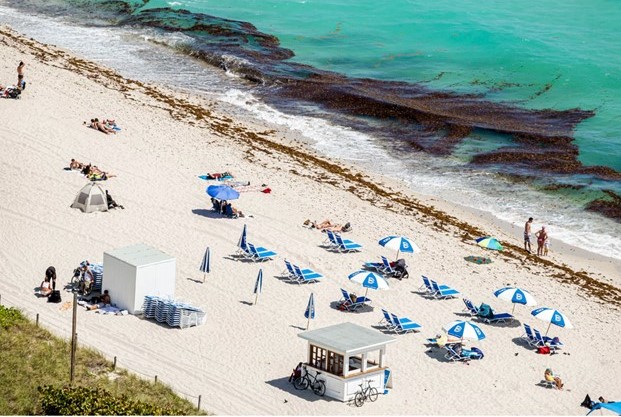
If you don’t know Seaweed Sarge, it’s because 1) you deliberately avoid the news these days – an increasingly popular trend – or 2) like me, you need a more creative label for sargassum, because it’s a weird name for the seaweed intent on taking over the world. Sarge is a little intimidating, if only for his size. Picture him as a belt of algae 5,000 miles long (I can’t picture anything 5,000 miles long, can you?) Now consider: Sarge will double in size by July, the peak of his “bloom season”.
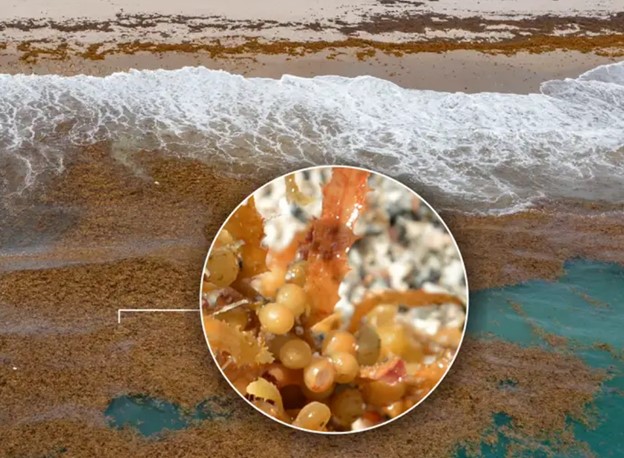
Sargassum is a particularly annoying form of seaweed. It’s rootless, which means it can reproduce while simply floating around on the ocean’s surface. Its rapid growth is bolstered by nutrients leached into rivers and oceans from land-based agriculture. Once it makes shore sargassum rots immediately, releasing irritating hydrogen sulfide and the stench of rotten eggs. And trying to remove countless tons of seaweed begs the question: where the heck do you put it all?
Florida’s gonna have to figure out the answer to that last question, and fast. Sarge is already littering beaches from Ft. Lauderdale to Key West and we’re just getting started. Come July and August it’ll be virtually impossible to walk along the shoreline.

My own visits to the beach have been blissfully Sarge-free. Most of my sun-and-fun takes place in San Diego, far from Sarge’s primary Atlantic Ocean residence. The only real nuisances on San Diego beaches are the occasional jellyfish or stingray, and a once-in-a-blue-moon shark sighting (which stirs up more anxiety than actual sightings). Admittedly, Sarge washes ashore in San Diego as well, but mostly just here and there as a remnant of off-shore harvesting. Seaweed does have its upsides, in foods, medicines, and fertilizers.
Ironically, I have fond memories of Sarge as a kid. He’s built with giant flappy leaves reminiscent of a mermaid’s fishtail. He’s got countless air sacs to keep him afloat, which make a popping sound as satisfying as squeezing bubble wrap. If I’d thought to take pictures back in the day, I could show you Sarge as an adornment to many a childhood sand castle.

An army of beach tractors could work all summer in South Florida and barely make a dent in Sarge. The seasonal maintenance of the single half-mile beach in Key West alone is in the millions of dollars. But a better solution may be in play. A prototype robot has been designed to do battle at sea. “AlgaRay” cruises slowly through the water, hooking tons of Sarge’s strands in a single pass. Once at capacity, AlgaRay drags Sarge underwater to a depth where all of those air sacs explode. No longer buoyant, Sarge sinks to the ocean floor; a “watery grave” if you will. AlgaRay has been likened to a weed-eating Pac-Man or a vacuuming Roomba. Either image works for me.
 Let’s have one more look at those tourist surveys. One in ten say they’d cancel or reschedule a trip to Florida if they knew Sarge was coming ashore. Maybe that explains why landlocked Las Vegas ranked #2 on this summer’s most popular U.S. destinations. Not that Vegas doesn’t have its own threats. Three years ago a swarm of locusts descended on the Strip, blotting out casino windows and streetlights. An annual migration of tarantulas passes by in the surrounding desert. So take your pick: hordes of flying/crawling bugs or a giant mass of inanimate algae. Maybe Sarge isn’t so bad after all.
Some content sourced from the NPR.org article, “Giant blobs of seaweed are hitting Florida…”





 Life In A Word