
Here in the South, the arrival of spring has been declared with aplomb. You can already watch the grass grow, and it seems to need cutting every other day. But even more apparent, the blooms are everywhere. Pink azaleas (a staple at last weekend’s Masters golf tournament) run rampant. The roses have never been redder. And the giant flower heads of white hydrangeas will soon spring forth. This Easter week therefore, it seems appropriate for this blog to pay a visit to another cathedral: Saint Mary of the Flowers in Florence, Italy.

My LEGO creation of the cathedral of Notre-Dame de Paris is quickly coming to a close, so I need to tour you through at least one or two more cathedrals before I’m done. The first, you may recall, was Saint John Lateran in Rome (read about that one in Tucked-Away Place to Pray). Today we’re a three-hour drive to the north, at Santa Maria dei Fiore. It’s no surprise my tour of the world’s prominent cathedrals continues in Italy. To be honest, the whole tour would do just fine if it never left the country.
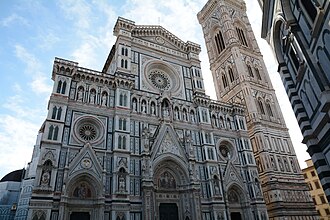
Florence is the capital city of the Italian region of Tuscany, known for its stunning landscapes, world-class wines, and Renaissance art and architecture. Approaching the city from any direction, you cannot help but notice Santa Maria dei Fiore. The cathedral is not only one of the largest in the world, but its exterior is finished with marble panels of pink and green, giving the structure a light, airy contrast to the surrounding buildings. The church is crowned by a distinctive dome, which captures your attention even before the church itself.

The architect in me wants to highlight Santa Maria dei Fiore for the remarkable engineering that went into this massive structure. I could spend an entire post talking about the design of the dome alone. Consider, its structure is actually one inside of another. The brick-clad concrete shell you see from the outside is connected to the one you see from the inside by “chains” of stone, iron, and wood. With this approach, Santa Maria dei Fiore doesn’t require the flying buttresses so prominent in Notre-Dame de Paris (a structural element the Italians regarded as “ugly makeshifts”). And the dome’s four million bricks – which might seem heavy-handed (ha) – are a much lighter material than stone or tile.
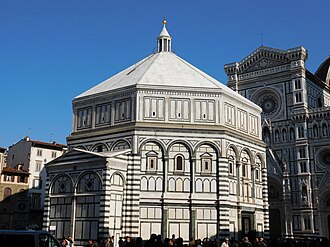
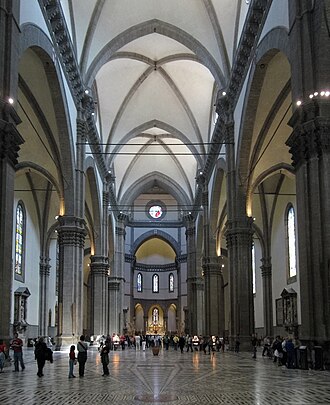 There’s more to this cathedral than its dome, of course. The plan, a traditional Latin cross, includes three rounded apses surrounding the altar, each used as a chapel. The nave (sanctuary) is the length of two football fields; a vast interior space with single aisles on either side. The structural arches soar 75 feet above the seemingly endless marble floor. And perhaps most unusual, Santa Maria dei Fiore is actually a complex of three buildings. You enter the adjacent octagonal Baptistry of St. John through sets of bronze doors (which are replacements for the famous originals now residing in a nearby museum). And the slender free-standing Giotto’s Campanile (bell tower) is a decorated work of art in itself. All three structures blend together with those distinctive pink and green marble tiles.
If you’re ever fortunate enough to visit Saint Mary of the Flowers, be sure to purchase the ticket to climb to the top of the dome. Filippo Brunelleschi – the architect -included a narrow staircase between the two shells so you can reach the uppermost cupola for a spectacular view of Florence and the surrounding countryside. Brunelleschi designed other structures in his lifetime; churches, chapels, hospitals, and such, but the Florence Cathedral is his crowning achievement. It’s no wonder you’ll find his tomb right inside the entrance, alongside the more prominent players in Santa Maria’s storied history.
LEGO Notre-Dame de Paris – Update #12
(Read about the start of this “church service” in Highest Chair)
Oh my stars, the build was challenging today! Bags 22, 23, and 24 – of 34 bags of pieces, focused almost exclusively on the west facade and the rising of the bell towers. We added the final rose window (above the west entrance) and reinforced the upper reaches of the nave in anticipation of adding the roof.

So here’s a detail I didn’t expect. In Notre-Dame’s towers, just below the uppermost structure (where the bells live – still to be built), you have – how else can I say it? – “stars on flag poles”. Forty stars on flag poles, to be precise. When I dumped out Bag 24, I thought, “What the…?” as the pile of magic wands you see here appeared. Did LEGO mistakenly add pieces from a Harry Potter model into mine? A Disney perhaps? Nope. Look at the final photo. Every one of those stars is planted at the west end of the cathedral like palm trees; most of them in the bell towers. Nice detail, Notre-Dame. As for installing them? It’s tough enough to push little poles into LEGO holes one-by-one-by one, but then you have to rotate the stars precisely forty-five degrees from the plane of the cathedral walls. The engineers at LEGO are having a barrel of laughs at my expense.

By the way, we’ve made it to the year 1245 as we build the bell towers, almost a hundred years after laying the first cornerstone at the opposite end. And we are almost done. By the numbers we have ten bags of pieces to go, but by the look of the model we’re closer than that. They must be small bags of pieces. Whatever. I just hope they don’t contain any more stars on flagpoles.
Running build time: 12 hrs. 01 min.
Total leftover pieces: 32
Some content sourced from Wikipedia, “the free encyclopedia”.
 Life In A Word