
Passing through another anniversary of the events of 9/11 this week, I was touched by a YouTube short of U.S. Marines demonstrating the proper method of folding the American flag. The video includes gentle background music but no words, lending reverence to the ceremony. Folding the Stars and Stripes the right way is not only a nod of respect to our nation’s banner, but also an example of (flag) etiquette.
 One of my favorite memories of my late mother was her ability to gently but effectively prod her sons to behave properly. She would sometimes say quietly, “Mind your manners”, which meant two things. One, something in our current behavior wasn’t in sync with how she raised us; and two, we would get a talking to later. “Please” and “thank you” barely scratched the surface of how my brothers and I were expected to carry ourselves back then.
I’ve always thought of manners and etiquette as one in the same, but the former is a subset of the latter. Etiquette is “the set of norms of personal behavior in polite society”, while manners are simply behaviors deemed “good” or “bad”. An example of both is the way we drive our cars. We’re taught the rules of the road, also known as “driving etiquette”. But when we blatantly ignore those rules by, say, refusing to let a car merge onto the interstate in front of us, we’re letting bad manners get the better of etiquette.
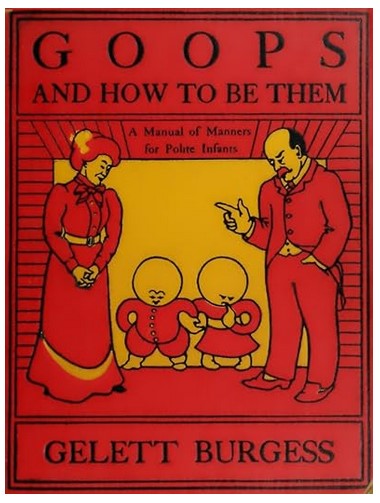 Manners always remind me of a book my grandparents encouraged us to read whenever we visited: Gelette Burgess’ 1903 classic The Goops (and How To Be Them). Here’s an example of Goop behavior in Burgess’ poetry, simply titled “In Table”:
Why is it Goops must always wish
To touch each apple on the dish?
Why do they never neatly fold
Their napkins until they are told?
Why do they play with food, and bite
Such awful mouthfuls? Is it right?
Why do they tilt back in their chairs?
Because they’re Goops! So no one cares!
My mother probably labeled us Goops at one time or another, because my brothers and I were all about fingering our food or talking with food in our mouths or rocking back in our chairs. It’s a wonder we developed any manners at all. Maybe it’s because our mother’s parenting was fueled by a finishing school of sorts: her college sorority, where a premium was placed on etiquette.


The undisputed authority on etiquette, Emily Post, wrote several books and newspaper columns on the topic. In the America of her lifetime (1872-1960) Post’s first etiquette book became a bestseller because it catered to “the country’s exotic mix of immigrants… eager to fit in with the establishment”. I suggest most of Post’s etiquette is as relevant today as it was back then… and a lot of us could use an extensive refresher.

Monday’s child is fair of face,
Tuesday’s child is full of grace,
Wednesday’s child is full of woe,
Thursday’s child has far to go,
Friday’s child is loving and giving,
Saturday’s child works hard for a living,
And the child that is born on the Sabbath day, Is bonny and blithe, and good and gay.
Google tells me I was born on a Monday. Darn it, so close. If I was Tuesday’s Child I’d be defined as “… agreeable, refined, and polite in manner or behavior.” In other words, demonstrating a solid understanding of etiquette.
 The next time you’re standing on an escalator, step to the right to let those in a hurry pass by. The next time you play golf, stay out of the line of sight when your opponent putts. The next time you’re at the movies, don’t utter a word until the final credits roll. And the next time you fold the flag, do it the way the Marines do. After all, you’d rather be credited with following the rules of etiquette than perceived as having bad manners.
Some content sourced from Wikipedia, “the free encyclopedia”.


 Life In A Word