Horses on Circular Courses

In 1972, Billy Preston topped the Billboard Hot 100 chart with the catchy “Will It Go Round In Circles”. A year later, The Spinners spent five weeks at #1 on Billboard’s R&B chart with “I’ll Be Around”. More recently, Kacey Musgraves’ debut single “Merry Go ‘Round” won the Grammy Award for Best Country Song.  All of which is to say, if I’m asked to celebrate “National Carousel Day” I have a great choice of theme songs for the occasion… played on endless loop, of course.
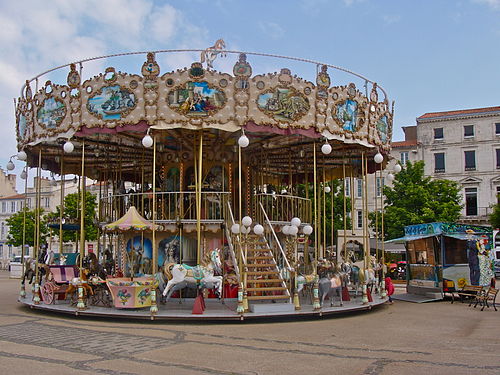
A double-decker!

National Merry-Go-Round Day (I prefer “Carousel”) was this past July 25th, as it has been every year since 2014.  Did you skip it like I did?  The holiday claims to “celebrate the carousel’s history and joy, particularly marking the first U.S. patent by William Schneider in 1871.”  And to celebrate, we’re meant to visit a local carousel, go for a spin, and post pictures of ourselves doing so online.  So we drop everything we’re doing on July 25th and climb on a wooden horse?  National M-G-R Day doesn’t even rate as a Hallmark holiday (and don’t waste your time trying to find a card to prove me wrong).
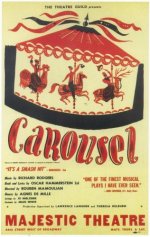
Contrary to my opinion about M-G-R Day, I think carousels are charming and a bit of innocent fun (other than those brass rings, which we’ll get to in a second).  Carousels inspired memorable scenes in Mary Poppins and BigCarousel was the Rodgers and Hammerstein musical that Time magazine deemed “the best of the 20th century”.  The “Carousel of Progress” was (and still is) one of the more unique attractions at Disneyland.  And of course, carousels led to those pipe and metal spinners we all played on at the park when we were kids.

Carousel is derived from the French word for “little battle”, which hints at why we’re riding them at all today.  In 17th century Europe, equestrian tournaments included “ring jousting”, where the rider attempts to spear a ring-on-a-string with his joust as he flies by.  To practice this sport without wearing out the horses, a clever soul invented the carousel, complete with wooden horses on poles and a real horse to pull the device in circles.  Eventually carousels made their way into carnivals, and then to the prominent locations where you find them today.
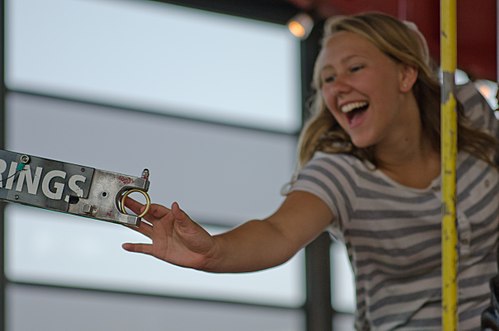
Care for a ring?

Now you also understand why early carousels had ring dispensers.  They were a nod to ring jousting!  The dispensers were filled with iron rings along with a few brass ones.  If you were lucky enough to ride an outside horse and grab a brass ring (which is harder than it sounds as your horse goes up and down), you could exchange the ring for a prize or another loop on the carousel.  For good reasons – safety being one – ring dispensers have been removed from most carousels today.

The people who came up with National M-G-R Day should’ve probably gone with “International”, because many of the world’s most distinguished carousels spin outside of the United States.  The Carousel El Dorado in Tokyo, Japan, built in 1907, is the oldest amusement park ride still in operation in the country.   The Lakeside Park Carousel in Ontario, Canada (1905) includes a self-playing organ that uses rolled sheets of music, rewinding one while playing the next.  The Letná Carousel in Prague, Czechia (1892!) is one of the oldest in Europe, remodeled in 2022 but still housed in its original wooden pavilion.
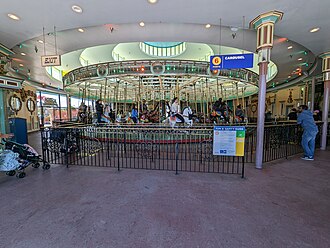
Looff Carousel (1911)

America has its share of prominent “gallopers” as well.  The Looff Carousel in Santa Cruz, CA is one of the few remaining with a ring dispenser, and entertains with the music of three organs.  The Over-The-Jumps Carousel in Little Rock, AR (1924) simulates the natural movement of a horse instead of just going up and down on a pole.  And the Flying Horse Carousel in Westerly, Rhode Island (1876!) is exactly as advertised.  The horses are attached to the center spindle instead of the wooden platform, creating a better sensation of flying through the air.
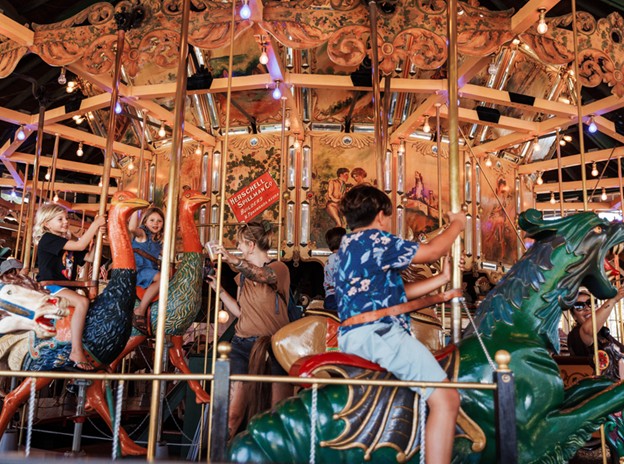
Dorothea Laub Carousel (1910)

Okay, I have a confession.  I had the perfect opportunity to celebrate National M-G-R Day just days after it happened this year.  My wife and I traveled to San Diego with our children and grandchildren for a beach vacation and found ourselves in Balboa Park, home of the Dorothea Laub Carousel (brass ring dispenser!)  If we hadn’t already worn out the little ones on a long walk through the Japanese Friendship Garden we might’ve made it to the wooden horses.  But I’m not losing sleep about it.  After all, National M-G-R Day will come ’round again next year.

Some content sourced from Wikipedia, “the free encyclopedia”.
Noble Neigh-Sayers

She’s only fourteen months and our granddaughter has already developed a keen interest and affection for our horses. As soon as she gets to the house she hightails it to the living room windows to see if our big boys are grazing in the nearby pasture. She calls them “Neigh-Neighs”; just about the cutest couplet of words you’ll ever hear from the lips of a small child. Makes me think she’d be utterly over the moon if she ever caught a glimpse of the Neigh-Neighs… er, horses at the Spanish Riding School in Vienna.

If you asked me to describe the nerve-wackiest moment of our Viking River Cruise last month, it would’ve been nine months beforehand when I went online to book the sightseeing excursions.  One of those tours – “Behind the Scenes at the Lipizzaner Stallions” – was, at least for us, the excursion of the entire trip.  If the Lipizzaners were sold out, well, there’s a good chance we would’ve a) cancelled the whole cruise, or b) emptied a nearby ATM of Euros, in hopes a couple of our fellow travelers would give up their reserved seats.  Lucky for us we didn’t have to do either.

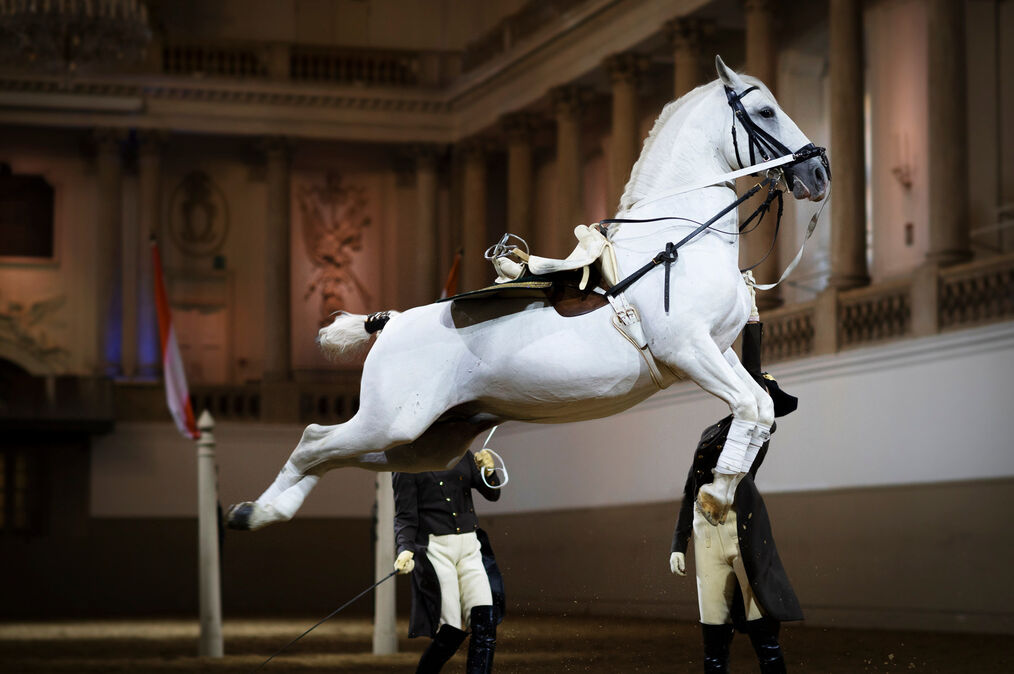
Maybe you’ve heard of them before.  The Lipizanners are a renowned breed of riding horse developed in sixteenth-century Austria.  All these years later they’re among the world’s most famous animals, both for their uniform look and unparalleled skill in the movements of classical dressage.  Five of these movements – known as “airs above the ground” – require horse and rider (sans stirrups) to completely leave the ground.  It’s a performance you’ll only see at prestigious academies like Vienna’s Spanish Riding School, and not in, say, the Olympic dressage competition later this month in Paris.

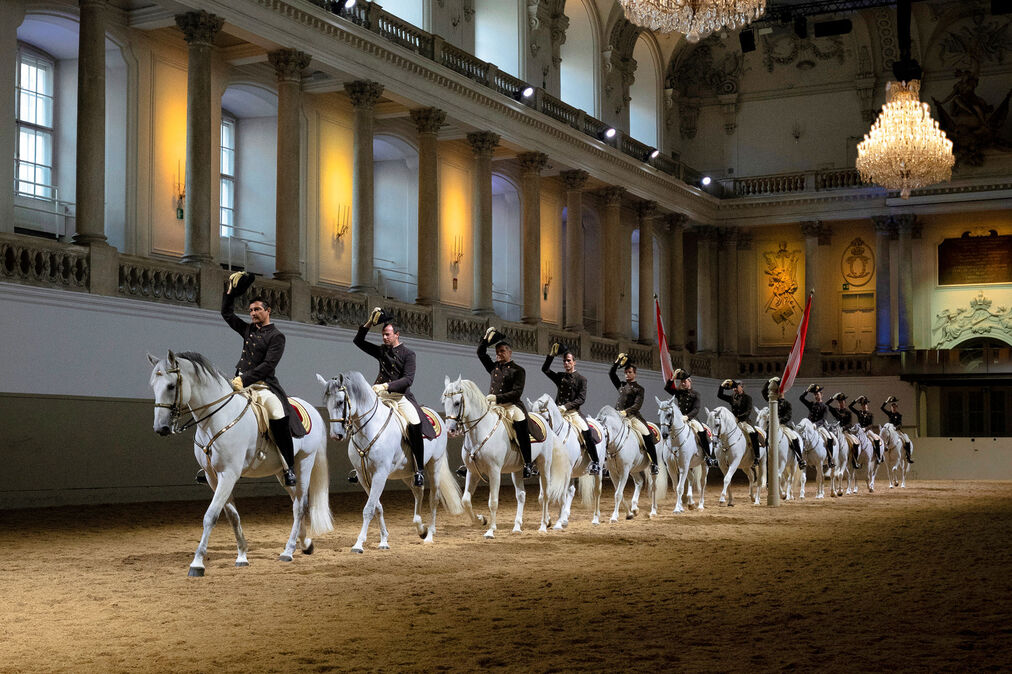
Spanish Riding School – central hall

So how was this remarkable performance?  I wish I could tell you.  We were in Vienna on a Tuesday and the Lipizzaners only show on Saturdays and Sundays.  But we knew this was the case heading into our trip.  The draw of the excursion was more about a behind-the-scenes look at the riding school facility, learning about the care and training, and of course, a peek at the horses themselves.  The Spanish Riding School is located in the former Imperial Palace of the Habsburg Monarchy, smack-dab in the middle of downtown Vienna.  Were it not for the smell of hay and manure you wouldn’t even know the stable was right through the stone walls adjacent to the sidewalk.

Tack room

But oh my, what a stable!  Each of the 68 resident stallions enjoys a roomy private stall (with a fancy nameplate), as well as outdoor courtyards for fresh air and exercise.  Those weekend performances take place in the spectacular sky-lit central hall, which still contains the royal box from the Habsburg era.  The tack room contains custom-made saddles, bridles, and reins representing a small fortune in leather craftsmanship.  And hay storage, manure removal, and other supporting aspects are somehow completely out of sight.  The Lipizzaners have it as good as we’ve ever seen for horses, at least in an urban setting.

Lipizzaner foals at the Piber breeding farm

Speaking of the Lipizzaners, the Spanish Riding School is just a part-time residence.  They spend a good portion of the year in nearby Heldenberg, enjoying the peace and quiet of the countryside instead of the hustle and bustle of the city.  Their breeding farm in Piber – even further removed from Vienna – is nicknamed “The Cradle of the Famous White Horses”.  And as you might expect, most of the young Lipizzaners go straight from Piber to the easy life in Heldenberg, without so much as a glance at the Spanish Riding School.  Only a select few achieve the look and confirmation worthy of this elite level of training and performance.

A couple weeks ago I described the Viennese Coffee House experience as an Element of Intangible Cultural Heritage.  So it is with the Spanish Riding School.  UNESCO has deemed the Vienna facility, the Lipizzaners, and their horse/rider performances as “an essential component… of [Austrian] cultural diversity and creative expression”.

Horses can fly?  Who knew?

I can understand why most visitors to Vienna would choose to see the Lipizzaners in their “Sunday best” instead of lounging in their stalls.  But I encourage you to see both.  A visit with these beautiful animals up close and personal is a unique experience (even if most tourists don’t seem to know how to behave around horses).  You’ll learn why the Spanish Riding School hosts one black stallion among the dozens of whites.  You’ll learn the historical significance of the trained movements of the Lipizzaners, as well as how to identify a rider’s ranking based on his uniform and equipment.  My granddaughter would have plenty of reasons to give this tour a “neigh-neigh”, but your own response is more likely to be “yay-yay!”

Some content sourced from the website of the Spanish Riding School, and Wikipedia, “the free encyclopedia”.

Horsing Around

My wife runs an equestrian facility on our property – boarding, training, therapy and recreational riding for those who enjoy horses.  It’s a lot of activity and it’s a whole lot of work to maintain.  When our barn help doesn’t show up, that’s where I come in.  I don’t ride but I can do the work.  I suppose you could say I’m a horse of a different color.  My wife and I knock out the myriad chores in about four hours (morning and evening combined), and I get a kick (hoof?) out of all of the terms and phrases that are uniquely “equine”.  Consider the five essential aspects of daily horse care:

78-myriad-1

Grain – Are you “feeling your oats” today?  That’s a reference to horses (of course!) and the boost of energy derived from their daily dose of grain.  “Grain” means a lot more than “oats” these days.  Grain is a general barn term to include the endless supplements for the specific needs of a horse (i.e. fiber boost, joint care, digest assist, immune system boost, metabolic stimulation).  Solid, liquid or “mash” (something in between the first two), grain is measured in bins, sacks, and baggies; scoops, cans, and cups, and even tiny bits like pinches, eye-droppers, and capfuls.  When all is measured and done – voila! – your horse has a complete pan to feast on.  So remember – grain is not just grain.  That’s putting the cart before the horse.

78-myriad-2

Grass – Have you ever been the recipient of a “haymaker”?  That’s a powerful, forceful punch (which means someone must’ve been really mad at you).  But a haymaker is also a machine that dries grass, thus creating “hay”.  And horses need a lot of hay.  You could start with a handful but your horse will probably demand a flake or a cube, and if he’s really hungry he will devour an entire bale.  But I’m talking the 50 lb. bale you see stacked in the fields.  If you want to seriously hay your horses (and take a two-week vacation), opt for large bales – round or square – which can weigh up to a ton.  Your horse will think he’s found an all-you-can-eat-buffet.

78-myriad-5

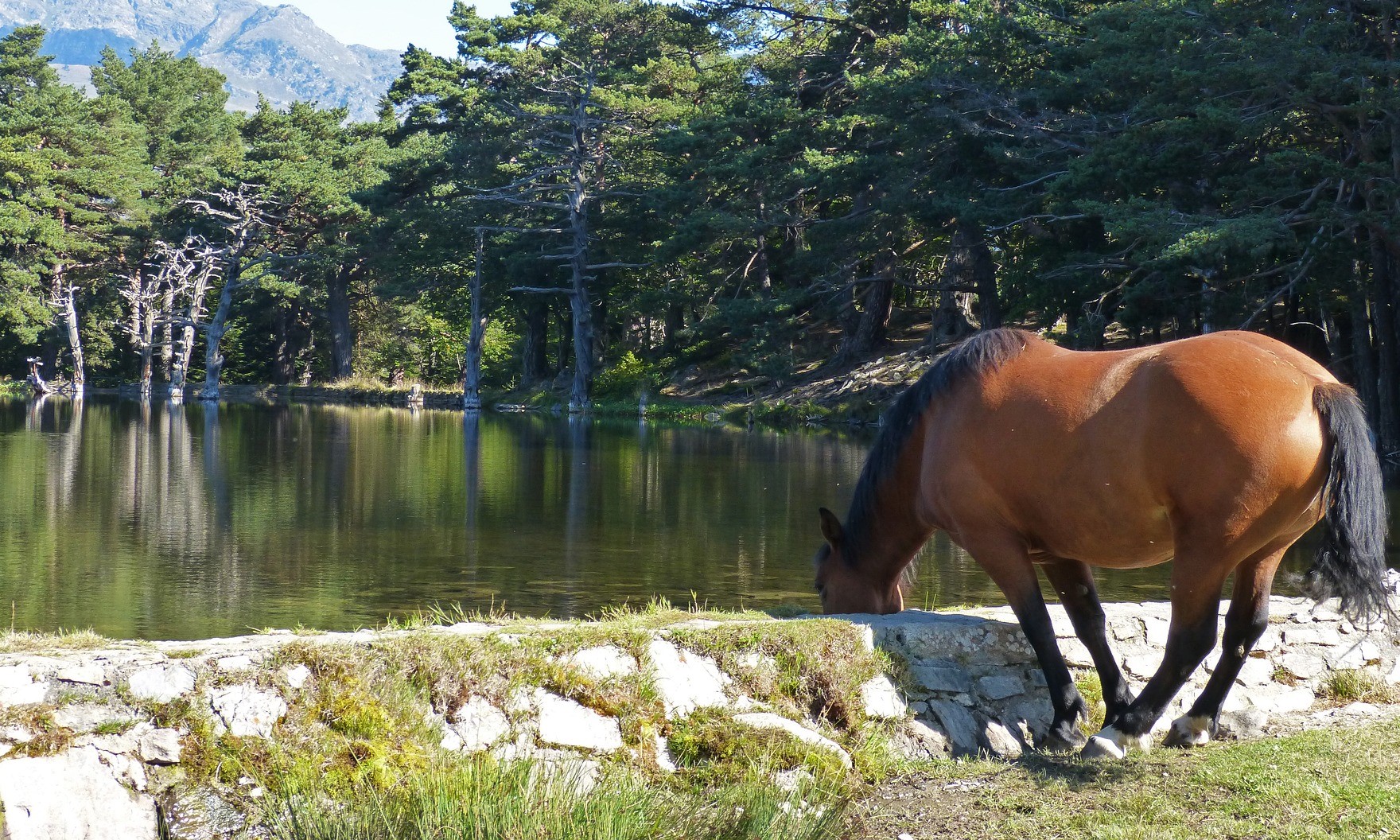
Water – You can lead a horse to water but you can’t make him drink.  When a horse does drink however, he’ll take in a gallon or more at a time; a glassful simply won’t do.  Watering horses requires everything from a hose to a pan to a pail to a bucket to a tank to a trough.  If you want to get really crazy you can even install a cistern (or a water tower) and then you never have to worry where your water’s coming from (even if your well dries up).  Finally, don’t forget the fishnet to keep the water clean.  Horses muck it up while they’re munching on hay.

78-myriad-3

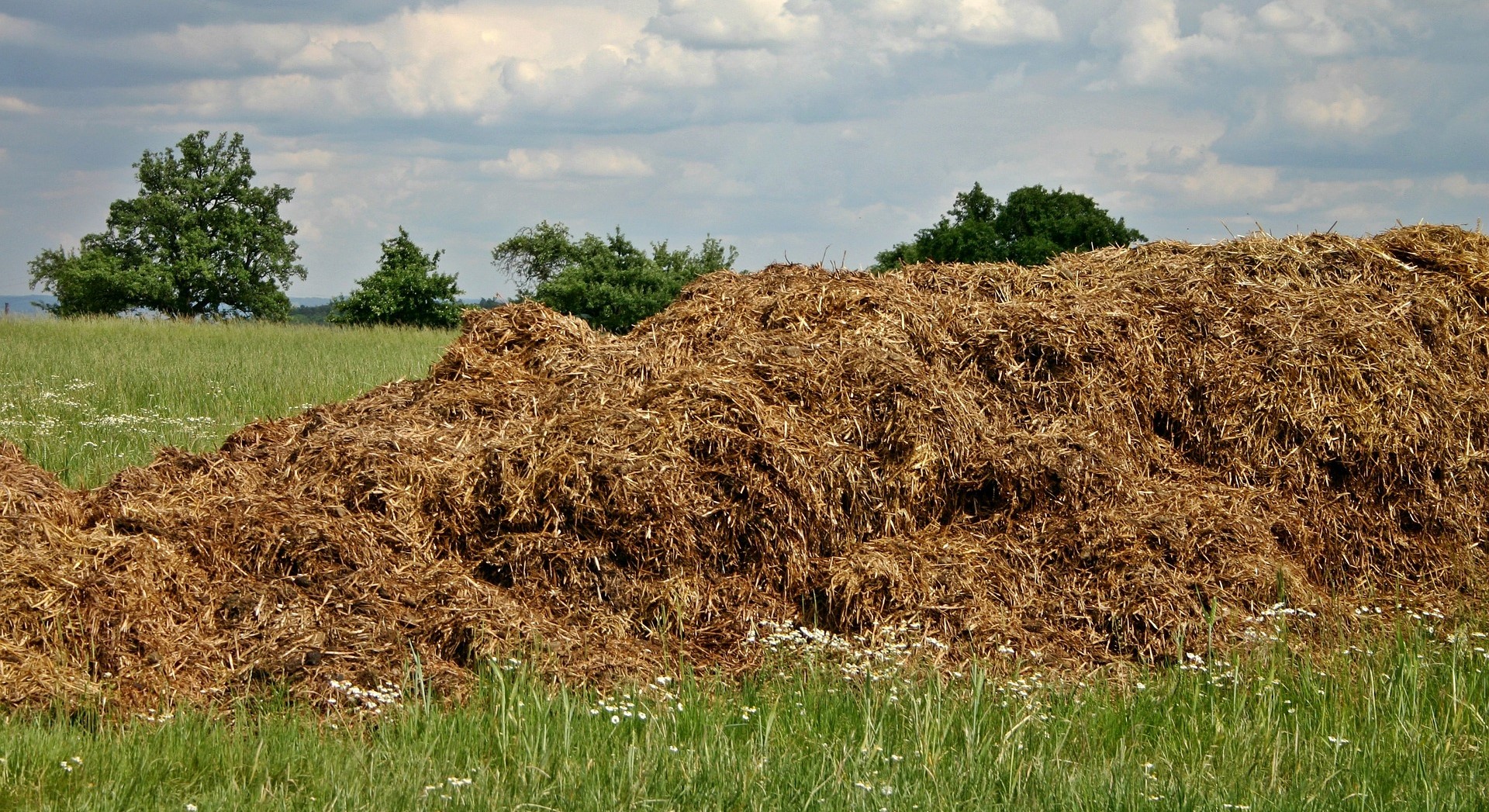
Cleaning – Speaking of mucking it up, are you a “muckety-muck”?  I hope not because that means you’re an arrogant, self-important person.  But come join me in barn chores and I’ll show you all the “muck” you could ever want.  A horse processes grain, hay, and water into a mountain of manure, and unfortunately for me a horse does his business wherever he pleases.  That means a lot of cleaning.  You’re going to need a muck rake for starters (and a hoe if it’s cold enough outside because then manure sticks to the ground).  You’re also going to need a muck cart – the wheels underneath the muck tub where you’ll deposit all of that manure.  Lastly your manure needs a final destination.  That would either be a manure pile (which is eventually removed by a manure hauler), or your pastures themselves, by means of a manure spreader.  Not to beat a dead horse, but your goal is to get all those “apples” as far away from the barn as possible.

78-myriad-6

Enclosures – If it came straight from the horse’s mouth, y0ur equine would demand to be put out on pasture and never ever brought in.  That’s because he wants to graze all day and night, which is almost never a good idea.  So a horse “comes in”, which means he retires to a pen or a stall.  If he’s really lucky, his stall has a run, and sometimes he can hang with other horses in a paddock before he’s moved back to pasture.  If he wants a place to go when he needs some alone time or gets tired of the rain he goes into a loafing shed.  And when he’s actually ridden he goes to an indoor or outdoor arena, or perhaps for a trail ride (which is sometimes just called “down the road”).

78-myriad-4

There’s a lot more equine-speak where that came from but it’s time I got off my high horse.  If you’re in the market for a horse I hope everything I’ve talked about here is enlightening.  To me it’s just horse sense.

Just Beyond the Spotlight

34.9 million people (including most of Jamaica) watched on Monday night as Usain Bolt claimed track and field legend at the Olympics by winning the Men’s 100m.  It was Bolt’s third straight gold medal in the event; remarkable considering he is eight years older now than when he won it the first time.  Like Michael Phelps and swimming, the hype leading up to Bolt’s latest victory was justified.  NBC covered every one of Bolt’s qualifying heats in prime-time, and delivered a good twenty minutes of back story before the final.  Bolt will be a household name if he is not already.

runner-311737__340_edited

The 100m run is one of several Olympic events I never miss.  It is a wondrous display of athletic power, and I’m always on edge to see who will become the “world’s fastest human”.  However, the prime-time Olympic spotlight need also shine on lesser known events and athletes.  Herein lies the oft-overlooked beauty of the Olympics: it is these “others” that emerge with the most inspiring stories.  They are not so much superstars, yet are still among the best at what they do.  A few examples for your consideration:

57 - wondrous 1

Charlotte Dujardin of Great Britain rode to a gold-medal performance in Individual Dressage.  Show Jumping may be the more popular Olympic equestrian event but Dressage is the more difficult (and defined as “the highest expression of horse training).  Dujardin and her Dutch Warmblood horse “Valegro” floated through an almost magical routine, completing one spectacular movement after another.  Dujardin and her mount were graceful, elegant, and significantly better – at least on points – than the silver medalist.  And her story became even more poignant when I learned Dujardin was engaged to be married shortly after receiving the gold medal, while Valegro has earned his last championship (of many) and will be retired from the sport.

57 - wondrous 2

Sanne Wevers of the Netherlands leaped to a gold-medal win on the balance beam in Women’s Gymnastics.  It was the first women’s gymnastics medal of any kind in her country’s history.  Wevers’ routine featured several jaw-dropping maneuvers I’d never seen before, including several spins while balanced precariously on one foot.  The judges were won over by Wever’s creativity and skill.  American television tried desperately to keep the spotlight on our own athletes (who were favored to win), but Wevers was clearly the humble star this night.  And her story was made even more poignant when the cameras turned to her twin sister Leika in the stands – also a member of the Dutch gymnastics team – as she reacted to Sanne’s upset win with tears of disbelief.

57 - wondrous 3

Molly Huddle of the United States ran what should have been a gold-medal performance in the Women’s 10,000m run.  Except she didn’t win the gold medal.  When a group of eight women broke away from the pack after several laps – most of them Kenyans and Ethiopians – Huddle broke away with them.  After twenty-five laps Huddle crossed the finish line in sixth place, breaking the American record for the event by almost nine seconds.  And her story was made even more poignant when I learned Huddle’s finishing time would have been good enough for the gold medal in three of the last four Olympics.

The Games continue for several more days.  More superstars will be at their best on prime-time television.  Just remember to look around and see what else is going on.  There are wonderful stories just beyond the spotlight.