
When I went to Sunday school many, many years ago, they taught us the little ditty “Here Is The Church” (… here is the steeple, open the doors and see all the people). You’d make a church with your hands pressed together as you sang, raising the steeple by extending and touching the tips of your pointer fingers. Today, sixty-odd years later, those same hands will build a cathedral – Notre-Dame de Paris. Granted my church is made from LEGO blocks and the entire model will be smaller than a cornerstone of the real Notre-Dame, but at least the steeple is made from more than fingers.
 So then, “Here Is The Cathedral”… in its purchased form. The cardboard box you see is not what I would call huge, but it’s an ample residence for 4,383 plastic pieces. These pieces dwell in thirty-four separate plastic bag communities, just begging to be liberated. Buried underneath all these subdivisions (in the crypt, if you will) is the brick of an instruction manual, a veritable phone book of almost 300 pages. C’mon, you didn’t think we’d raise this cathedral in a single blog post, did you?
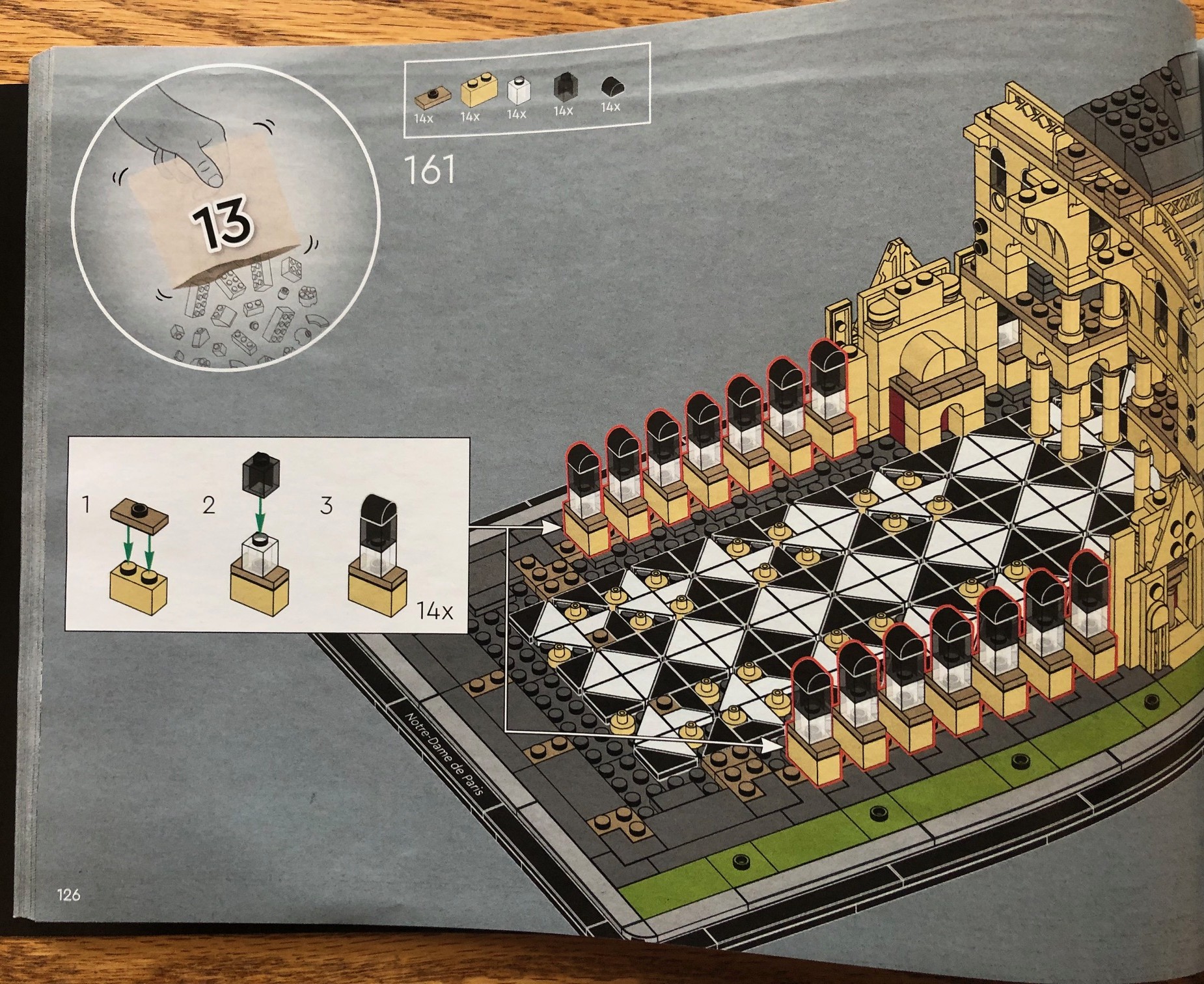
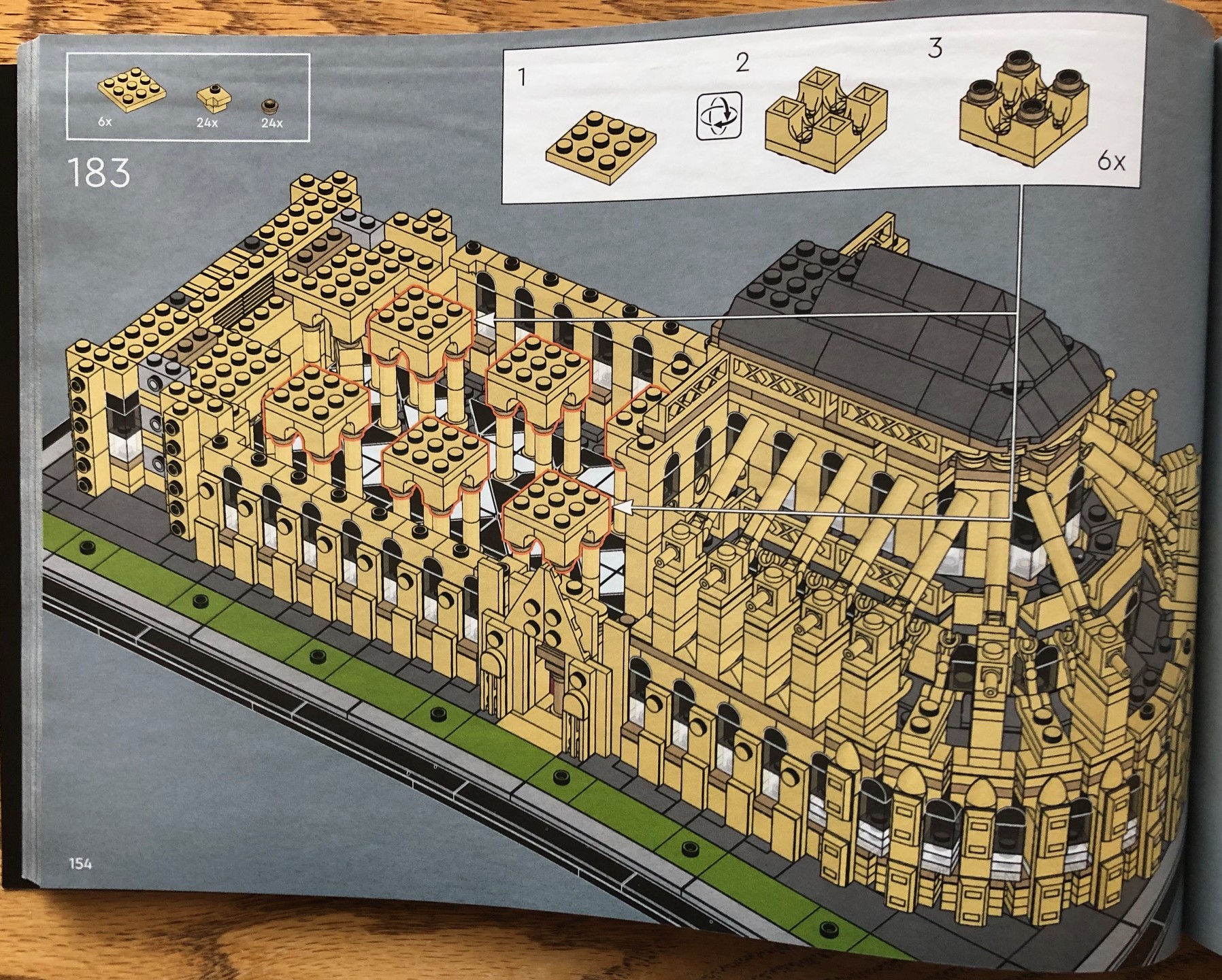 Mr. Instruction Manual could be called the mayor of this manufactured mess. He guides me on who gets together with who, when they get together, how they get together, and what it’s all supposed to look like as I go. Mr. Manual has pages and pages of impressive illustrations (like this one), but also some LOL ones (like the one below). I mean, check out the upper left corner. Am I really supposed to vigorously shake the bag out like that? The tiny residents will go running in all directions! We’re trying to create order from chaos here, people, not the other way around.
 I expect all of the same challenges I encountered when I built the LEGO Grand Piano. I’ll think pieces are missing until somehow they appear right in front of me. I’ll connect pieces incorrectly and have to backtrack several steps to get them right. I’ll be left with extra pieces every now and then, and forever wonder if they were really “extra” or perhaps “overlooked”. And I’ll police plastic piles around the meager real estate of my home office desk. Maybe I require a shepherd’s crook or a bullhorn? I mean, it’s me versus 4,383 others so you can see how one or two of them are bound to escape.
 Here’s a thoughtful aspect of LEGO Notre-Dame de Paris, and oh-so appealing to the architect in me. The model will be built in the same chronological order as the original was (instead of, say, from the ground up). The first twenty years of Notre-Dame’s construction produced only the rounded east end you see here, which served by itself as a functioning church. The next twenty years generated the full footprint but without the roof, towers, and other noteworthy exterior elements. The final sixty years brought everything across the finish line. So I’ll be building the LEGO model in the same order, only in a hundred days (or less) instead of a hundred years.

Before I snap Piece 1 onto Piece 2, let me dress down my many thousands of new plastic friends. Together they comprise nowhere near the largest of the LEGO sets. A model of Harry Potter’s Hogwarts Castle is over 6,000 pieces. The LEGO Star Wars Millennium Falcon is over 7,500 pieces. LEGO Titanic (er, before it sank): 9,000 pieces. And standing regally at the top of the LEGO podium (and just a twenty-minute bus ride from Notre-Dame de Paris): the Eiffel Tower, the only LEGO model to exceed 10,000 pieces. To each of these top-tens I say non. Notre-Dame will be challenge enough for this builder/blogger.
LEGO Notre-Dame de Paris – Update #1
Now that we’ve had the prelude (so to speak) it’s time for the church service to begin! Bag #1 – of 34 bags of pieces – houses the first 100 or so of the little guys. LEGO thoughtfully opted for a sub-community in Bag #1 for the tiniest of residents (some of which are just begging for tweezers).

Mr. Instruction Manual (who is multilingual by the way; he speaks English, French, and Spanish), warns me to “… avoid danger of suffocation by keeping this bag away from babies and children!” Mr. Manual also wants me to know my thousand of pieces were manufactured in five different countries: Denmark (of course), Mexico, Hungary, China, and the Czech Republic.

It’s fair to say I haven’t stood in the LEGO “pulpit” for awhile. I snapped pieces together incorrectly at least three times today. I also thought I was missing pieces twice, and I fretted over the fact I ended up with two leftovers. Let’s hope our church service is smoother next week! In the meantime, here is the build of Bag #1. Not much to look at but at least it’s the foundation of the east end of the Cathedral. In 1163 Pope Alexander III oversaw the first stone being set in place. In 2025 nobody saw me do the same.

Bag #: 1
Running build time: 25:38.
Total leftover pieces: 2



 Life In A Word