Dental Essential

When I filled a prescription at my supermarket’s pharmacy recently, the line of customers snaked down an aisle of toiletries. I surfed on my phone for a few minutes as I waited but eventually took note of the products on display around me. To the right, endless shampoos, conditioners, sprays, and other hair care items. To the left, nothing but rows and rows of toothpaste.

If you’re a Millennial or older, I’ll bet you’ve brushed a time or two with Crest or Colgate.  Both products have dominated the toothpaste market since their humble beginnings in the 1950s.  I was raised on Crest and saw no reason to change brands as a young adult.  But these days, like most anything I put into my mouth I’m a little more selective.

The shelves of toothpaste in my supermarket caught my attention for two reasons.  First, the options from a single manufacturer these days are daunting.  Crest may have only eight product lines (like “Gum Health” or “Kids”) but that translates to a total of fifty-seven unique tubes of paste.  Wow.  So you’re telling me you’d know which one would be perfect for you?

My second observation: there are surprisingly few players in the game for a product each of us uses at least twice a day.  Crest and Colgate dominate the shelf space; I’d put the number at 85%.  The other 15% – at least in my supermarket – goes to products from Sensodyne and Arm & Hammer.  Sensodyne targets those of you with sensitive teeth.  Arm & Hammer promotes, naturally, the perceived benefits of baking soda.

The truth is, there are dozens of toothpastes besides Crest and Colgate.  Just think of it like a chessboard: you have the two kings and then you have the rest of the pieces.  Those pieces include a few that make me nostalgic.  For a short time I had a “brush” with Pepsodent; its unique taste flavored with sassafras.  My dentist’s recommendations during my cavity-prone years included Mentadent and Aim (neither of which took hold).  And honorable mention goes to Pearl Drops, which I never tried but was the first product to add sex appeal to brushing your teeth.
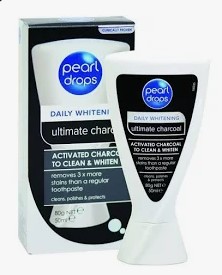
I don’t know anyone who uses Pepsodent or Pearl Drops anymore, but I also think Crest and Colgate are finally getting serious challengers.  Today’s generation (and those behind it) is more enlightened.  In fact, my own choice for my toothbrush – Earthpaste – has to be purchased at a specialty store or online.

I’ve talked about Earthpaste before, in Polishing the Pearls. That post was more about the ingredients in toothpaste than the products themselves.  But ingredients certainly matter.  Crest contains between fifteen and twenty (and some are better left in a science lab).  Earthpaste contains just five, including bentonite clay, salt, and essential oils.  I have no problem putting any of those in my mouth, including the “dirt” of bentonite clay.

The truth is, if you can stand the bitter taste you can just brush with baking soda.  It’s a short list of ingredient that actually benefit your dental hygiene.  And for me, the habits I’ve locked in besides brushing far outweigh the importance of which toothpaste I choose.  Daily flossing (at night).  Oral rinses.  Toothpicks for my close-together teeth.  Recent trips to the dentist would suggest I’ve got a good regimen going.

As for you Gen X, Y, Z and especially Alpha members, there’s a palpable point to this post.  99% of humans will continue to brush with toothpaste.  Crest and Colgate still dominate the market seventy-odd years after their debuts (at least in America).  It seems to me there’s room for another low-ingredient high-health product like Earthpaste.  I’d fire up that home chemistry lab before someone else beats you to it.  There’s potential prodigious profit in the production of paste!

Some content sourced from Wikipedia, “the free encyclopedia”.

The Senior Years

A human life has several stages, but exactly how many stages will probably cost you a Google search. Would you believe nine? Pregnancy, infancy, “the toddler years”, childhood, puberty, “the adolescent years”, adulthood, middle age, and “the senior years”. That’s a lot of stages (and I suddenly feel tired).  According to my age – 57 – I’ve battled Father Time through the first seven on the list and hover somewhere between the last two. And therein lies today’s question: What the heck defines “the senior years”?

In case I forget – as seniors are wont to do – allow me to wish you a very happy “Senior Citizens Day”!  No joke (and no Hallmark card – I checked), August 21st is the calendar date set aside “to increase awareness about the issues that face older adults”.  Well now, doesn’t that just call for a celebration?  No, it doesn’t.  In fact, my fingers feel a little more arthritic just typing about it.

Admittedly, I’ve been a senior before, back in a couple of those earlier life stages.  I was a senior in high school.  I was a senior in college.  In the Boy Scouts, I was a senior patrol leader.  If I’d thought to name one of my sons after myself, I could’ve been “Dave Sr.”.  Now however, wrestling with the idea of advanced middle age, I’m forced to confront the one, true definition of “senior”.  The word in that sense (especially senior citizen) – is a little daunting.  I prefer “older” or “more experienced”.  You know, the softer side of Sears.

Reagan

Blame former U.S. President Ronald Reagan if you’re looking for a scapegoat.  After all, he’s the one who – while in office – declared August 21st to be “National Senior Citizens Day” in America.  Reagan signed said proclamation in 1988 at the ripe (older) age of 77.  By all definitions, that made Reagan a senior citizen himself.  Isn’t that kind of like throwing yourself a party?

Speaking of definitions, for all my searches I can’t thumb a tack into the specific age one enters life’s final stage.  Consider the following takes on “senior citizen”:

  1. A polite expression for an old person.
  2. An older person, usually over the age of 60 or 65, esp. one who is no longer employed.
  3. The age at which one qualifies for certain government-sponsored benefits (i.e. Social Security, Medicare).
  4. The United Nations has agreed that 65+ may be usually denoted as “old age”.
  5. Being a senior citizen may be based on your age, but it is not a specific age (say what?)

The definitions get even vaguer, but you see the pattern.  No one – not the United Nations nor Merriam-Webster – wants to tag “senior citizen” with a specific age.  Well, I do.  I want my bedside clock to turn to midnight on the designated date, and instead of beeping the alarm it squawks, “Senior Citizen! Senior Citizen!”  I suppose, if someone held my aging feet to the fire and said, “Choose!”, I’d go with Definitions #2 and #4.  At least then I’m backing up my truck to “middle age”.

Perhaps your definition of senior citizen is more towards retail; as in, the age you start qualifying for discounts, freebies and such.  Sorry old man (old woman?), you’re just complicating the matter (and seniors don’t do “complicated”).  The shopping website DealNews just updated their article, “The 123 Best Senior Discounts to Use in 2019”.  That’s a lot of “bests”, DealNews.  But there’s even more homework for those nearsighted eyes.  You must also know which discount kicks in at what age.  Senior discounts ≠ senior citizen unless you need the following thirteen-year time frame to get used to the idea:

  • Hardee’s – age 52 (that’s me!)
  • McDonald’s – 55 (that’s me again!  But only for coffee and I don’t do McDonald’s coffee).
  • Applebee’s – 60 (may require “Golden Apple Card”.  Oooooooo)
  • Fazoli’s – 62 (and you get the “Club 62” discount menu.  Okay, that sounds cooler than a “Golden Apple Card”)
  • Taco Bell – 65 (plus free drink – ¡Olé!)
  • Wendy’s – “age and offer vary depending on restaurant location” (c’mon, Wendy’s!)

Atta boy, Norm!

Poets and playwrights try to soften the blow of “the senior years” with their eloquent quotes.  The Englishman Robert Browning said, “Grow old along with me!  The best is yet to be.”  The American Ralph Waldo Emerson said, “As we grow old… the beauty steals inward.”  Nice tries, noble poets, but I’ll go with positive thinker Norman Vincent Peale instead.  Norm simply said, “Live your life and forget your age”.  Take that, senior years!

Love Thee, Notre Dame

I used to love “back-to-school” nights in my elementary school days. My brothers and I would lead my parents through the gates of our asphalt-paved campus on the west side of Los Angeles, eager to show off the classroom projects and displays we prepared for their annual visit.  Mom & Dad would cram into our child-sized desks for talks from our teachers while we’d join friends for playground fun under the lights. Finally, we’d enjoy a KFC picnic dinner at the outdoor tables where we kids would have lunch during the day. Back-to-school night was equal parts adventure and pride, returning to campus at a time when we didn’t have to be students.

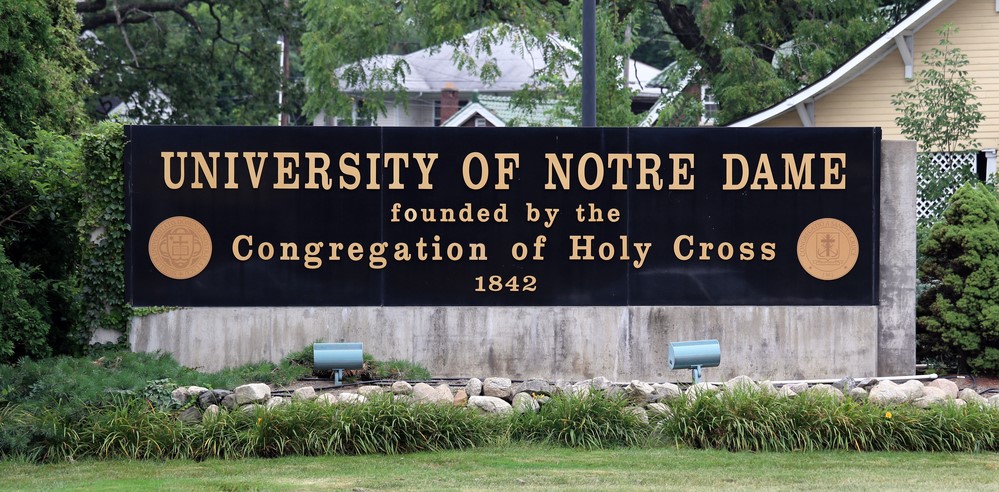
Such was the feeling this past weekend, visiting my alma mater in northern Indiana.  Notre Dame, that most Catholic of universities located near the south bend of the St. Joseph River – founded by Fr. Edward Sorin and his band of Holy Cross brothers in the mid-1800’s – drew me away from more convenient West Coast options like UCLA or Stanford (neither of which accepted me… details). Who was I, a Methodist from California, to attend a smallish Catholic school over 2,000 miles from home? Notre Dame’s admissions counselor did a heckuva sales job. Rather than own up to the humid months of the first semester or the penetratingly-cold months of the second, he focused instead on the promise of an outstanding faith-based education, coupled with small-dorm camaraderie, nationally competitive sports teams, and Midwestern hospitality.  When I graduated in 1985, it’s fair to say Notre Dame delivered on all of those.

Administration Building aka “The Golden Dome”, Central Quad

Thirty years later – this past weekend – I set foot on campus again, adding to only a handful of visits since my long-ago commencement. I won’t lie – returning to my college roots was a little daunting.  The Notre Dame of my years was by all definitions smaller, more modest, and less prestigious than the globally-renowned multi-campus university of today. My Notre Dame was an intimate cluster of buildings surrounding just three quads, one end of campus seemingly a stone’s throw from the other.  The student union was as small as a cracker box.  Two dining halls offered the modest sort of food – cafeteria style – I recognized from elementary school.  Diplomas were issued in just twenty fields of study. Four percent of the student body claimed a faith other than Catholic.  The clear majority of students came from Midwestern states, and only a handful chose to study abroad.

O’Shaughnessy Hall, South Quad

Thirty years later, my Notre Dame of yesteryear has been consumed by a property twice the size.  New quads and facilities cover the open fields that once hosted tailgaters before football games.  Another one hundred buildings have been added to the eighty or so of my day.  The new student union – opening just weeks ago – is the length of a football field (and in fact, co-located with the football stadium).  Today’s undergraduates choose from countless degree programs, with another fifty masters, doctoral, and professional programs to follow.  Add to the options, fifty foreign study-abroad opportunities in forty countries.

“Only” 80% of students are Catholic now (diverse by Notre Dame’s standards), and – speaking of diverse – almost 20% of the student body comes from outside the U.S.  Visiting one of the dining halls for lunch, it wasn’t the broad choice of foods (organic, ethnic, made-to-order) that impressed me, but rather the students themselves.  I witnessed a pretty good slice of the global pie at the tables around me.

Stairway to The Grotto and St. Mary’s Lake

Notre Dame’s mission statement includes the following: “In all dimensions of the University, Notre Dame pursues its objectives through the formation of a human community graced by the Spirit of Christ.”  Clearly that objective is reflected in the Notre Dame of today.  A school once known for little more than football is now an academic behemoth, built on an unwavering foundation of faith and service to God and fellow man.

“In Celebration of Family”

Notre Dame’s alma mater concludes with the following sentence: “…and our hearts forever, love thee Notre Dame.”  There may be a lot of “new” on campus today, but I still find the pathways of “my” years.  The Golden Dome, the Basilica of the Sacred Heart, and the Grotto will always form the heart of campus.  I maintain ties with only a handful of those who were in school with me, but we’ll always be proud members of the Fighting Irish family.  And every time I set foot on campus, I never fail to sense the memories of old, the encouragement of new, and the presence of the Spirit.  Indeed, Notre Dame is in my heart forever.