Oliver Twist

Because of the numbering system I use to save photos for my blog, I know last week’s dish on ice cream (ha) was my four-hundredth WordPress post. I’m not one to track statistics but unexpectedly, reaching this milestone begs the question: Will I make it to #500? Mind you, it’s not about staying in the game. Topics worth my exploration are endless and creative writing is a welcome escape. No, today begs a much more relevant question: What about artificial intelligence (AI)?

If I could meet you readers face-to-face in the Amazon rain forest I’d whisper a secret password for all to hear.  Then when I use that password in a post, you’d know it’s actually me, Dave, the human, and not some updated version of HAL 9000 doing the typing.  Surely you wonder, as I do, when will AI get so good at authoring documents, so genuine, you won’t even realize you’re reading something untouched by human hands?

“Hello, Dave.”

Before we go any further, I think “AI” sounds awfully impersonal.  I suppose impersonal is appropriate for a silicone wafer and a pile of circuit boards.  I just think we need a friendlier word for it; something we humans can better identify with.  How about “Oliver”?  Oliver is the third most popular boy name of 2023.  Oliver Twist was one of Charles Dickens’ most beloved characters (and AI will certainly be a twist on the way we ask for and receive information moving forward).  Let’s nickname it (him?) Ollie.

Wikipedia’s article on artificial intelligence (yes, there’s already an article) says one of Ollie’s primary goals is problem-solving.  Okay, that digests well.  But then you see goals like reasoning, learning, perception, and social intelligence and your stomach flips a flop.  My reasoning and perception are tools I use for this blog.  If Ollie develops those same tools, it’s only a matter of time before Dave 1.0 (me) is replaced by Dave 2.0 (machine).

Let’s go back to ice cream for a second.  Let’s say you want to read an opinion piece on ice cream.  If you have AI at your disposal, you could say, “Hey Ollie, write me a post about ice cream, 600 words or so, with arguments in favor of plain old ice cream over sundaes, bars, and other frozen treats.  Reference a few commercial ice cream brands, a few local brands, and finish by talking about the most expensive ice cream in the world.  Oh, and speak the page back to me in James Earl Jones’s voice.”  Then you’d hit the ENTER button and who knows?  Your screen might light up with something remarkably similar to my last post in Life In A Word.

Also consider, Ollie will have his own opinions on what you read.  After you ask about ice cream, he may spam you with posts on healthy lifestyle.  He also may counsel you about spending your time on more important topics.  Like world peace.  Newsflash, Ollie.  We’re all trying to figure out world peace.  How about you put your circuit boards together and come up with a post on that?

Here’s my point.  If you have Ollie you don’t need me.  In fact, you don’t even need the WordPress platform.  You could simply slip on a VR headset and ask for a post with just the right topic, tone, reading level, length, and restrictions. It’s like placing an order at the drive-thru of a fast food restaurant.  Seconds later, what you asked for is right there in front of you (no paper bag necessary).  And if Ollie “reads” all four hundred of my posts, he’ll write it pretty much the same way I would. 

At the rate I’m posting, I’ll publish blog #500 in about two years.  Two years.  Considering all we’ve covered today, how advanced will Ollie be in two years?  Enough to put WordPress out of business?  Enough to where you can generate your own Life In A Word posts by simply entering a handful of carefully chosen criteria?  I hope not.  I’m having a good time with you people (especially those of you who also write blogs).  Maybe all of us should pick up and move to the rain forest.  Then we could pass our handwritten pages around and keep this artificial intelligent party going.  Someone make sure Ollie doesn’t get an invite.

Some content sourced from Wikipedia, “the free encyclopedia”.
A Tale of Unwell Words

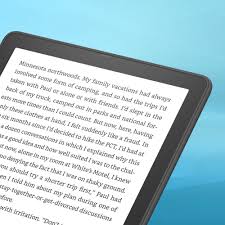
The symptoms started ten days ago. I was lying in bed, beginning Chapter 42 of Ruta Sepetys’ captivating WWII novel Between Shades of Gray when suddenly, a lower-case “a” popped out through my e-reader’s glass and just sat there on the surface. I casually brushed it away. Not two pages later, an entire “the” surfaced and slid sickeningly down the screen. I flicked that away too. But then a whole sentence coughed up and I knew I couldn’t ignore it any longer. A terrible thought entered my mind. Crud, my Kindle has COVID.

It’s not like my e-reader hasn’t been sick before.  One time it suffered a full reboot during the tense climax of Paula Hawkins’ The Girl on the Train.  Another time it simply powered down amid the juicy bits of an Alessandra Torre novel (which turned out to be a warning to me to stop wasting time on trashy novels).  But this recent bout had the makings of something more serious.  My Kindle has always been perfectly healthy.  I don’t even put a cover on it.  As for spitting up words and sentences?  Never.

Just to be safe, I got out of bed and quarantined my reader to the bathroom, closing the door softly behind me.  I didn’t want any of the real books on my bedroom shelves to get infected.  Early the next morning, I went to open the door to check on my little e-guy.  Only I couldn’t because the door wouldn’t budge.  I leaned in with a shoulder and it finally gave in, just enough so I could slip through.  Imagine my disgust when I saw the mess before me.  My e-reader barfed up at least four dozen books, piled all over the floor.  The poor thing’s screen looked paler than a Brightness of 2 and was uncomfortably warm to the touch.  The only image it could display was an Amazon Smile (encouraging, until I realized I was looking at it upside down).

It was time for professional help.  I threw on my clothes, tucked my e-reader-patient into the leftover cover of a previous model, and headed to the car.  But where to go?  Of course!  A brick-and-mortar Amazon Bookstore!  As soon as I walked through the door, an eager young lady (right-side-up Amazon smile on her nametag) came forward to assist.  I choked back tears as I explained the misery of the night before.  She opened my Kindle’s cover gently, took a knowing peek at the dimming screen, and said, “Okay, let me just confirm your extended warranty.”  I told her she wouldn’t find one, to which her whole demeanor changed.  Suddenly she didn’t want to help me at all, and backed away slowly.  I felt so… so… uninsured.  Last resort, she pointed me to a nearby display of gleaming new Kindles and said, “You’d be better off junking yours and buying a new one.”

I got out of there as fast as I could.  I mean, what sort of cruel, heartless person works at Amazon?  Junk mine and buy a new one?  Sorry, but all I could picture was my little e-reader flung carelessly into their alley dumpster; bookworms crawling all over it.  It felt like a scene from a modern-day Fahrenheit 451.

Without insurance, my only other option was the free-clinic library down the street.  A librarian is more of a specialist than an Amazon Bookstore employee anyway.  But the regulations on the library’s front door made me pause.  Yes, I keep my Kindle socially distanced from real books.  Yes, my Kindle wears a mask outside of the house (even if it’s an older cover).  But was my e-reader vaccinated?  Heck if I knew. I couldn’t tell you the last time it went through a software update. So I could see how this was going to go down already.  The librarian would check Settings and inform me my Kindle was several versions behind on its operating system. There’d be nothing she could do for me.  Dejected, I drove back to my house.

It’s been a few days now and my Kindle is still listless (er, book-less) but at least it seems more chipper after a dose of power.  It’s keeping down a few partial reads I’ve uploaded through “try a free sample”, as well as a Clippings doc in its library.  But don’t assume we’re out of the woods just yet.  I’m not ready to purchase any new books after that nightmare in the bathroom. I also neglected to mention my Kindle threw up its dictionary the night after I went to Amazon.  Talk about a loss for words.  I mean, dictionaries are bigger than almost any book, and a rich indulgence besides.  There’s nothing left in your stomach after you’ve lost your dictionary.

I’m gonna go glass-half-full here and say my little e-guy’s gonna be okay.  He’s up to a Brightness of 4 today.  He’s holding a fairly focused, slightly bold version of the Palatino font.  He retained my Ruta Sepetys novel and I’ve read some chapters without further hurled words.  I even cleaned up the mess of “read” books he left behind in the bathroom.  So learn from my experience, will you? Use an e-reader cover. Get a fresh software update. Keep the power boosted.  And for gosh sakes; keep a reasonable distance from the hardcovers and paperbacks.  E-readers are more susceptible to the bad stuff than you think.

Note: This is a work of fiction, pure and simple. Find nothing between the lines.

Lego Grand Piano – Update #1

The concert has begun! (my hesitant warm-up was captured in the post Let’s Make Music!)  Bag #1 – of 21 bags of pieces – assembles to this rather odd shape.  Imagine the keyboard running down the left side of the light-colored section, top left to bottom right. 

There were a couple of tense moments when I couldn’t find the right pieces because I’d already assembled them in the wrong places. Unassemble. Redo. All good.

Running build time: 60 minutes.  Musical accompaniment: Dvorak’s New World Symphony.  Leftover pieces: 1

Fine Print

I’ll never forget the first time I saw the movie, Jurassic Park. I’d read the Michael Crichton novel so I already knew the story, but I still couldn’t wrap my mind around that first dino scene, where a brachiosaurus casually munches on the uppermost leaves of a forty-foot tree.  The gigantic creature was so lifelike I thought, “Where’d Steven Spielberg get a dinosaur?” In my defense, computer-generated imagery (CGI) was brand-spankin’ new back then.  A ferocious T-Rex looking and moving like the real thing was still jaw-dropping in the 1990s. And I’m having the same reaction to the stuff rolling off 3D printers right now.

A “printed” toy tugboat

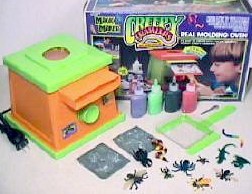
If you’re like me you haven’t paid much attention to 3D printing.  You see some of the items a 3D printer can generate and they seem like child’s play.  In fact, 3D printing reminds me of a 1970s toy called “Creepy Crawlers”.  You had these tubes of colored goop you squeezed into metal molds, and then the molds went into an electric oven.  The goop would grow from flat to 3D with heat, and suddenly the oven was spilling out all kinds of bugs and spiders you could drop on your friends.  (There was also consumable goop called “Incredible Edibles”; products to compete with whatever the girls were making in their Easy-Bake ovens).

But I digress.  Here’s my 3D printing naivete in a nutshell: I still think my 2D printer is the more impressive technology, cranking out high-resolution photos and perfectly addressed envelopes.  I mean, whatever would I need a third dimension for?

Yep, I am seriously naive about 3D printing.  The scope of this topic is mind-boggling if you really take the time to understand its potential. Here’s a good example.  Picture a printer as big as your living room.  Picture a printer cartridge of concrete instead of ink.  Now watch the printer build your living room, one horizontal layer at a time.  The printer can also build the rest of your house.  Just add plumbing and electric when it’s done.

“Printed” storage crates

Without getting too far into the weeds, let’s define 3D printing for what it really is: additive manufacturing (AM).  Here’s an easy way to picture the AM process.  When you build a log cabin you lay out the entire foundation of logs for the house – with breaks for the doors – before you add the next layer of logs.  You work your way up a layer of logs at a time, keeping those breaks for the doors, adding breaks for windows, pipes, and such, completing the structure with a sloping roof on top.  Perhaps you add a fireplace in the process; again, layering bricks on top of bricks until you’ve reached the top of the chimney.

That’s pretty much how a 3D printer works.  It “pictures” an object in horizontal layers and “prints” it from the ground up.  3D printing has been around longer than you think.  3D printers were developed as early as the 1970s (preceding your inkjet 2D printer!).  The early versions just had to be manually programmed.  Once we attached a computer and software, 3D printing really came into its own.

Watch the following video of a 3D printer confidently layering a basket weave – it’s mesmerizing:

https://upload.wikimedia.org/wikipedia/commons/transcoded/5/5d/Hyperboloid_Print.ogv/Hyperboloid_Print.ogv.360p.vp9.webm

The products speak for themselves, of course.  A shortlist of the more cutting-edge printed creations gives you an idea of where our world is heading:

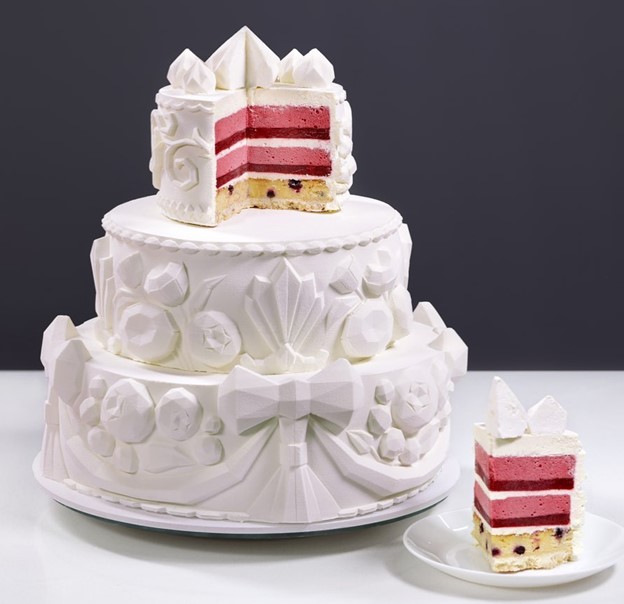
  • Cakes and pastries – The “ink” is baked goods in one nozzle and frosting in another.  Design it on your computer screen and then “print”.  It’s like the Easy-Bake Oven on steroids.  Only you don’t need the oven.
    3D-printed confectionery from Ukrainian chef/architect Dinara Kasko
  • Bones – No, not some plastic or other polymer designed to replicate bones, actual bones.  It’s called bioprinting – the fabrication of natural tissue using cells and other building blocks, and it’s coming soon to a clinic near you.  Don’t worry how long a broken bone will take to heal; just replace it!
  • Buildings – Forget about building that log cabin one layer at a time.  Your 3D printer will do the whole job for you (and it’ll still look like a log cabin).  Your printer can also build sturdier houses out of concrete.  This one’s on the market in Riverhead, New York, for $300K.
  • Vehicles – 3D printers have already created boats, kayaks, and most of the makeup of cars and trucks.  Long ago I was impressed with the robotics of the Ford Motor Company, employed on a long assembly line to build cars one part at a time.  A 3D printer can essentially do the same job standing still, no assembly line required.
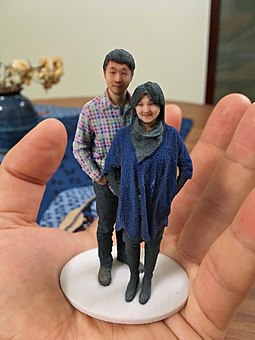
  • You – I could speculate on the potential for a full bioprint but let’s avoid that scary future for now and just say, a 3D printer can create a figurine to look exactly like you.  Think of it as printing a 3-D photograph.

If your mind is not blown by what you’ve just read, consider this: 3D is already passe.  That’s right, we’ve already moved on to 4D printing.  4D – at least with printing – refers to materials that can change shape with time, temperature, or some other type of stimulation.  A good example would be a printed window shade, sitting tight and virtually unnoticed at the top of the window in daylight but expanding to full cover as darkness falls.

Don’t know about you but this level of technology makes my head hurt.  When I’m done with this post I’m gonna push “print” and generate a nice 2D copy for my files.  Oh, and maybe watch Jurassic Park again.

Some content sourced from the 7/24/2020 Forbes article, “What Can 3D Printing Be Used For?”, and Wikipedia, “the free encyclopedia”.