The Game of the Name

When our youngest granddaughter was born last year, I wouldn’t have guessed her first name was the most popular among newborn girls in the U.S.  Olivia is the current front-runner (and Liam for boys), as it has been for the last six years. Emma sits firmly in second place (and Noah) – also on a six-year streak – while Amelia (and Oliver) takes third. It’s nice to see the use of “normal” names in this day and age because you’ve got to admit; some really odd ones float around out there.  But there’s another list of baby names you probably don’t know about: the ones you’re not allowed to use.

Two or three generations ago, the topic of baby naming wouldn’t have made for interesting reading.  Back then parents defaulted to monikers from their family tree or from the Bible.  In the decade of my birth for example (the 1960s), the most popular names for boys were Michael, David, John, and James.  Compare those to today’s “trendy” choices: Truce, Colsen, Bryer, and Halo. (Colsen aside, I’d be hard-pressed to guess the gender of any of the others.)

At least Halo is legal.  The U.S. Constitution protects a parent’s right to name their child, yet the courts still came up with a not-an-option list.  Including the following:

  1. King
  2. Queen
  3. Jesus Christ
  4. III
  5. Santa Claus
  6. Majesty
  7. Adolph Hitler
  8. Messiah
  9. @
  10. 1069

Right off the bat you can understand why most of these would cause problems.  If your baby’s name is “King” I’m looking for his bejeweled crown.  If your baby’s name is “Jesus Christ” I’m looking for a crown of a different sort.  As for Santa Claus, the courts in Miracle on 34th Street may have determined he and Kris Kringle were one and the same but let’s be honest: Nobody south of the North Pole should be named Santa Claus.

“III” and “1069” require a little more explanation.  Both are examples from real court cases where persons decided a numeral or number were preferable to their given name (seriously?)  But the courts denied both petitions, deciding numerals and numbers fall more appropriately into the category of “symbol” than “name”.  The same can be said of the @ sign, which better belongs in your email address than in your signature block.

U.S. federal guidelines seem sensible enough but the individual states add more rules.  Consider New York, where your first name can be no longer than 30 characters, while in Arizona it can be up to 45.  Rhode Island won”t allow you to put an accent above any character.  In New Mexico you can’t name your baby boy “Baby Boy” (nor your baby girl “Baby Girl”).  And in Arkansas you can’t name your child “Test” or “Void” because they wreak havoc with the state computer systems.

The game of the name is not unique to the United States.  Indeed, the lists of illegal names in other countries include some really creative ones.  Here are my favorites:

  • “Thor” – Portugal banned this one but only because they don’t consider Thor to be a word in the Portuguese language.
  • “IKEA” or “Ikea” – Banned in Sweden (of course!)
  • “Judas”, “Cain”, etc. – Switzerland doesn’t wish to promote the Bible’s bad guys.
  • “Fish” and “Chips” – New Zealand decided no child deserves either of these names alongside his or her twin.
  • “Spinach” – Australia said no to the green veggie, probably also warning the parents that just because spinach is good for you doesn’t mean your child will also be.

Considering what my granddaughter could’ve been named I’m glad her parents went with Olivia, even if she is one Olivia among many.  At least her name need not be contested in court… like the French couple who wanted their child to be named “Nutella” and were promptly denied.  They did settle on “Ella” – which is nice enough (and maybe her cutesy nickname will be “Nut”) – but if I were that crazy about Nutella I would’ve just gone with “Hazel”.

Some content sourced from the Parents.com website article, “32 Illegal Baby Names You Might Want To Keep Off Your List”, and Wikipedia, “the free encyclopedia”.

Highest Chair

When we babysit our granddaughters here at the house, we tap into several items to make the job easier. A big basket of toys and stuffed animals sits in the corner of our living room. A dozen children’s books line the lowest shelf just waiting to tell their stories. Sesame Street is easily streamed on the nearby television. And at dinner time we roll out the high chair so everyone’s on the same level. So who would’ve thought a high chair would be my blog topic for today? Maybe you, if you know anything about cathedrals.

Notre-Dame de Paris

We’re almost there, loyal readers.  I will lay the corner-block of my LEGO model of Notre-Dame de Paris next week.  Why not this week, you ask?  Because before we crack the seal on the giant box of pieces, we need to pay a little respect to the real Cathedral.  I want you to know a few things about the stone and glass Notre-Dame before you witness the rising of the plastic one.

West facade

It’s a cathedral in the middle of Paris, Dave… what more do I need to know?  Uh, a LOT more.  To begin with, do you even know what a cathedral is?  I didn’t (and I have a background in architecture, for gosh sake).  It’s a big, giant church with stained glass and chapels and a raised altar, you say.  Well yes, you’re right, but what makes a church a cathedral?  Interestingly, it has nothing to do with the building itself.  Instead, a cathedral is the seat of a bishop (the ordained clergy-person who presides over the surrounding parishes). For lack of a church this person could just as easily be in a small house and it would still be considered a cathedral.

Cathedrals really do have “high chairs” on their altars for the bishops (cathedra in Latin means “seat”) but Notre-Dame de Paris is much more than a place for furniture.  First and foremost, it took a hundred years to construct (1163-1260).  In that era the building evolved from the common Romanesque style of the period to the more elegant French Gothic.  Notre-Dame feels unusually vertical and airy for a structure of its time and there’s a novel reason for this: flying buttresses.

Flying buttresses

Imagine Notre-Dame’s architect – Eugène Viollet-le-Duc – talking to the Paris city council in the twelfth century and saying, “Look guys, let’s think outside the box here… literally.  The structural support for this church ought to be outside of the building instead of inside”.  Why would the architect want this?  Because the flying buttresses assume the structural load that was previously handled by short, thick interior walls.  The result is taller, more dramatic spaces, filled with the light of high-up stained glass windows.  In other words, flying buttresses allow Notre-Dame to “reach for the heavens” much better than its Romanesque predecessors.

North rose window

There’s also more to this French “grande dame” than structure, of course.  Notre-Dame has twenty-nine chapels surrounding the main sanctuary (that’s gonna take a lot of LEGO).  It features three spectacular stained glass “rose” windows that would not be as large or as high were it not for those flying buttresses.  Notre-Dame’s twin towers host ten massive bronze bells and they each have first names.  “Emmanuel” (listen to his sound bite below) and “Marie” are so big they take up the entire south tower, while their eight ringing siblings all fit into the north tower.

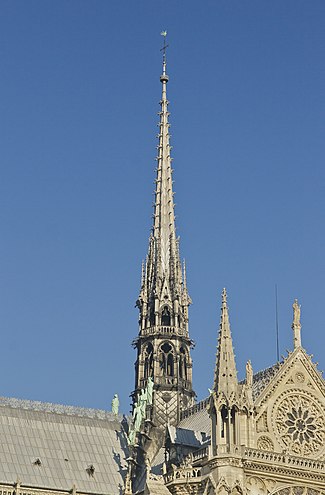
Notre-Dame also has a central flèche, a spire not unlike the ones you see on more modest churches.  This spire, however, is topped by a bronze rooster, which is not only the symbol of the French state but also a container for (supposedly) a small piece of the Crown of Thorns, worn by Jesus leading up to his crucifixion.

Rooster-topped “flèche”

As you would expect, Notre-Dame de Paris hosts countless works of art, whether paintings or sculptures.  Many of the sculptures are biblical scenes intended to educate the illiterate parishioners of the twelfth century.  But my favorite sculptures may be those of the twelve apostles, way up high surrounding the base of the flèche and looking outwards towards Paris… all except one.  St. Thomas – patron saint of architects – faces Notre-Dame itself, and was given the facial features of Viollet-le-Duc.

Okay, so now you know more about Notre-Dame de Paris than just the LEGO model.  Considering there are over 500 Gothic cathedrals in Europe, it’s impressive to see Notre-Dame at the very top of at least one “Top Ten Cathedrals” list.  We’ll visit some of those other “high chairs” in future posts, to add even more life to my pile of plastic pieces. In the meantime, my LEGO “church service” begins promptly at 10am next Thursday.

Some content sourced from Wikipedia, “the free encyclopedia”.

Forty Days and Forty Nights

Tuesday seems like weeks ago.  Some call it “Fat Tuesday” (esp. those pancake-bingers partying hard at Mardi Gras) but to me, it’s just the last day of my food free-for-all.  My wife and I decided to give up “flour” for Lent (more on that in a minute) so Tuesday night we overate at our favorite Mexican restaurant.  Chips and salsa (the chips a hybrid of corn and flour).  Enchiladas and tacos wrapped in big, fluffy flour tortillas.  Sopapillas fried from puffy flour tortillas, drenched in honey.  Big, frosty margaritas to wash it all down.  It was kind of a fiesta final before Lent.

Now it’s Ash Wednesday as I type and I’m already obsessing about my forbidden flour.  This morning’s breakfast was hardly a fiesta – coffee and a protein shake.  Not a tablespoon of flour to be found anywhere.  My upcoming fever dreams will be liberally dusted with flour.  I’ll have fantasies of consuming an entire bakery case (shelves and all), eating my way out of a gigantic loaf of bread, or parking my mouth below the pasta-maker while endlessly turning the crank.  I’m looking at all the snow outside my office window right now.  It looks exactly like white flour.  It probably IS white flour.  Hang on, I’ll be right back…

As of today, we’ve officially started the season of Lent again. The next forty-odd days and nights are gonna be the usual challenge. Did you know the Old English translation of “Lent” is “spring season”?  How that computes with all the flour I’m seeing outside my windows right now is beyond me.  More to today’s point, Ash Wednesday is the deadline to answer the question, “What am I giving up for the next seven weeks?”

Lent = “no mas”

Lent, as even non-Christians know, is the religious season of preparation leading up to Easter.  It’s the time to reflect inward, with more attention to prayer and the Good Book, less attention to “shortcomings” (sins, people), more charitable service to others, and finally, a cruel little something called “self-denial”.  Self-denial is anything you want it to be, but the idea is to subtract from your daily equation: something you don’t need but you’ll struggle to be without.  Consider seven popular choices for 2021:

  1. Chocolate.  Maybe this one’s popular because it’s the easy way out.  Chocolate’s often in my desserts, occasionally in my protein shakes, and every-now-and-then in my mid-afternoon pick-me-ups.  But I can certainly do without the sweet stuff for forty days.  C’mon, people used to give up food for Lent!  A little chocolate’s not really what the Big Guy had in mind.
  2. Meat.  Christians forego meat on Lenten Fridays anyway but some choose to give it up the whole way.  Not me.  If I’m giving up flour, I’ve got to have meat-and-potatoes to soften the blow of all my bread, pasta, and baked goods currently on hiatus.  For Pete’s sake, I can’t even have chicken noodle soup!  What was I thinking?
  3. Smoking or Drinking.  Maybe these are your vices but they’re not mine, so either would be a Lenten cop-out.  I enjoy the occasional glass of wine or a beer, sure, but putting them on the shelf for the next month or so? Hardly a stretch.
  4. Coffee.  Okay, we just shifted from first to fourth gear.  There is nothing – NOTHING – to fill the vast and infinite void left behind by my morning cup of joe.  I understand self-denial but don’t turn me into a raging lunatic.  Force me to give up coffee for Lent and I’ll have a newfound respect for the next option, which is…
  5. Sleeping In.  Normally this would be another cop-out for me because I’m one of those annoying morning people.  But deny me my coffee and I’ll gladly hibernate until early afternoon – every day until Easter.
  6. Social Media.  I dropped Facebook late last year.  I’m only on Instagram a couple of times a week.  I have no Twitter feed.  I get it – it’s 2021 – but this one’s a no-brainer for me.  I mean seriously, just give me a call.
  7. Speaking Poorly about Others.  I asked my sister-in-law what she was giving up for Lent and she said, “I’m going to be nice to others”.  That gave me a good laugh until I found this item on the list.  My sister-in-law has plenty of company.  So, consider: could YOU give up airing dirty laundry for forty days?

One more thing about Lent. Each of the liturgical seasons has a color, and Lent’s is purple.  You’ll see a lot of it in churches, cathedrals, and flower arrangements this month and next.  I like purple enough, but ask me to name purple items and all I come up with is eggplant (the nightmare vegetable of my youth), figs (the nightmare fruit of my youth), grapes (I prefer the green ones), cauliflower (yep, it comes in colors), and lavender and amethysts, both of which I have little use for.  Purple is about as smart a choice for Lent as giving up flour.

In conclusion, I could use your prayers as I endure my forty-day flour fast.  By late March my car tires will look like doughnuts and my paperback novel a nice, thick Pop-Tart.  Toss me a Frisbee and I’ll slather it in syrup and devour it like a pancake.  Put your pasta under lock and key.  Guard your pizza with your life.  I’m coming for your cupcakes.

Some content sourced from the Delish.com article, “7 Things To Give Up For Lent That Go Beyond Food”, and Wikipedia, “the free encyclopedia”.

Royal Beauty Bright

If I were more organized a couple of weeks ago I could’ve seen the Aurora Borealis. Maybe you’re familiar with this magnificent natural artwork: the waving colorful “northern lights” spreading across the sky like a wind-ruffled pastel blanket. The best seats for the AB are always to the north, like Alaska or the Arctic, but this year we had a similar instance just driving distance from our house in northern Wyoming. I missed it, darn it.  I’ll have to settle for a look at this week’s Christmas Star instead. Er, make that this week’s “Jupiter/Saturn overlap”.

The view from my house (directly above Pikes Peak!)

I’ve always been something of an astronomer wannabe. We have beautifully clear skies where we live and on most nights we can see more stars, constellations, and galaxies than we could possibly count. I’ve even invested in tripod-mounted high-power binoculars to get a better look at all things extraterrestrial. So I certainly didn’t miss the recent headlines about Wyoming’s “southern northern lights”, nor the nighttime blast of this week’s Christmas Star. Any astronomical event visible to the naked eye is worth noting in my iPhone calendar.

Courtesy of CBS News

Jupiter and Saturn aren’t really overlapping, of course (talk about an abundance of gas). They just look like they’re a single celestial object as seen from our Earthling vantage point. They’re still millions of kilometers apart in space, the same way stars in constellations aren’t all the same distance away from us. This blog post is a little late, as the best days to see “Jupiturn” were Sunday, Monday, and Tuesday, just after sunset and looking to the west.

Speaking of a little late, let’s talk about the Real Christmas Star (RCS). Surely you’re familiar with RCS, the singularly bright beacon from biblical times guiding the Magi to the birthplace of the baby Jesus (editor’s note: lots of “b’s” in that sentence, Dave). This star moved in a westerly path – as noted in the third verse of “We Three Kings” – like the oversized laser pointer of an invisible tour guide. This star was purported to have stopped directly over Bethlehem close to the events we celebrate on Christmas Day.  This star “with royal beauty bright” was…, was…, (spoiler alert) – well, this star wasn’t a star either.

Also not a star…

I know, I know.  We’re talking about events from over two thousand years ago.  Outside of the Bible and pure faith, how can we know the true identity of the RCS?  Well, we know because we have astrophysicists.  I’m never one to blend science and religion but I’m about to make an exception.

To keep this simple let’s address the basic questions:

  1. When did the RCS occur?  During the reign of King Herod and Emporer Tiberius.  Roman historians (and the Bible’s Book of Luke) give the approximate timeframe as 8-4 B.C.
  2. Who saw the RCS?  The Magi according to the Bible, but also Chinese astronomers according to their own records… which go back to (gulp) before 1000 B.C.
  3. What did the RCS look like?  A morning star, because it was rising.  Not a comet, not a nova, not even a supernova.  In ancient times those three were seen as indicators of negative events.  The Magi certainly wouldn’t have followed something negative.
  4. What was the RCS?  Ah, now there’s the question for the Powerball jackpot.  And that’s where our astrophysicists come to the rescue.  The RCS – like this year’s Jupiturn – was also the convergence of Jupiter and Saturn, only amplified by light from the sun, moon, and at least three other planets.  That’s putting a lot of “balls” into play, isn’t it?  Celestial alignments happen regularly over time so astrophysicists were able to project backward and offer this likely explanation of the Real Christmas Star.

The RCS alignment from two thousand years ago seems recent compared to its next occurrence.  You won’t get that kind of planet-star-satellite party again until the year 16213.  That’s fourteen thousand years from now.  You won’t be around by then.  Maybe Earth won’t be either.

I did look to the west after sunset to see the convergence of Jupiter and Saturn earlier this week.  It was bright – sure – but not as if looking directly at the sun.  And knowing it wasn’t a “star” took some of the shine off of it (ha).  Meanwhile, the Aurora Borealis is out there a little more often.  At least I’ll be alive to see its next performance.


Some content sourced from the University of Notre Dame article, “Royal Beauty Bright”.

Ever Eat a Pine Tree?

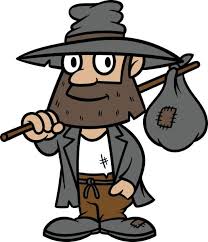
If I ask you to recall a catchphrase – a word or statement you heard repeatedly and probably won’t forget – you could come up with several examples. Movie quotes, for instance. (“I’m the king of the world!”)  Song lyrics. (“I get by with a little help from my friends.”)  And television commercials; where the product or “jingle” yields a branded catchphrase. Just this week I learned a new one: bindle stiff, which describes a homeless person through the bag of personal items (bindle) on the end of his/her stick. I’m no hobo, but Euell Gibbons once was. And Gibbons once uttered one of the most famous catchphrases ever.

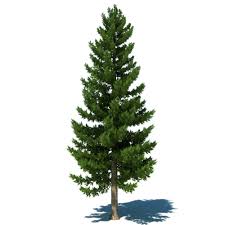
Who the heck is Euell Gibbons?  Any American kid growing up in the 1970’s would know.  Gibbons was the spokesperson for Post Grape-Nuts cereal, made instantly famous by a single television commercial where he uttered, “Ever eat a pine tree?  Many parts are edible.”  That statement was so bizarre – and laugh-out-loud to us kids – it spread like wildfire (and sold a ton of Grape-Nuts cereal). But it was only recently I learned Gibbons wasn’t just a hired bindle stiff, but a man ahead of his time.  He had a lifelong interest in foods foraged from “nutritious-but-oft-neglected plants” (surely learned from an impoverished and transient childhood).  He wrote several successful whole-foods cookbooks, including “Stalking the Wild Asparagus” (1964) and “A Wild Way to Eat” (1967).  In his later years, Gibbons and his wife joined a community of Quakers in Philadelphia, where he cooked the daily shared breakfast (of course he did).

“Many parts are edible.”

I love Grape-Nuts cereal, back to when I was a kid.  I’m not sure if Gibbons gets the credit, or because Grape-Nuts just tastes good (“…reminds me of wild hickory nuts…”, as Gibbons also said).  Admittedly, Grape-Nuts was a little off the beaten path of children’s cereals.  Very low in fat and sugar, Grape-Nuts looked and crunched like a bowl of light brown gravel.  Add in milk as a softener and sugar as a sweetener however, and something about the cereal just clicked with me.  After college I forced myself to give up Grape-Nuts, because I developed jaw pain from too many hard foods.  Maybe that’s why Post developed Grape-Nuts “Flakes” cereal, or Grape-Nuts “Trail Mix Crunch Cranberry Vanilla”.

GORP

Speaking of trail mix (convenient segue), Euell Gibbons comes back to the conversation.  Trail mix was introduced about the time Gibbons was born (1910), as a combination of dried fruit and nuts.  Trail mix was lightweight and therefore easy to carry on long hikes.  The carbs and fat created a quick energy source and an ideal snack food, and the mix became immensely popular to outdoors-people, especially sugared up with a few M&M’s or yogurt coverings (which Gibbons never would’ve approved of).  Yet it wasn’t always called “trail mix”.  In another word familiar to 1970’s kids, Gibbons coined the acronym GORP, which either meant “good ol’-fashioned raisins and peanuts”, or “granola, oats, raisins, and peanuts”.  Yep, I ate a lot of GORP in my childhood.  Might’ve even had my first taste at Hadley Fruit Orchards, a place in the California desert my parents like to frequent.  Hadley – alongside others – claims to be the “inventor” of trail mix.

Euell T. Gibbons

As if “Euell Gibbons” is not unique enough for an American, his middle name was “Theophilus”.  The only Theophilus I’m aware of lived in biblical times, when Luke wrote his Gospel (and the book of Acts) as letters to an individual by the same name.  Perhaps Gibbons should’ve lived in biblical times.  As God’s people sought the Holy Land he could’ve helped them with his foraging skills.  Or at least introduced them to Grape-Nuts.

Some content sourced from Wikipedia, “the free encyclopedia”.