Recycled Airbags

As I build the beginnings of this week’s blog post (three “b”s already for those keeping count) my screen distracts me with alerts for Cyber Monday deals. Laptops at 30% off retail. E-readers at 25% off. DNA tests at 70% off (which begs the question: do we really care about our ancestry anymore?) Cyber Monday is a sort of second chance for those who shunned the big box stores the Friday after Thanksgiving (good decision). But here’s what I wonder today. Why endure Black Friday or get distracted by Cyber Monday when you can shop through lost luggage any day of the year instead?

I’ve finally found a reason to visit Alabama.  A six-hour drive due west of my keyboard puts me in the little town of Scottsboro, of which an entire block is consumed by a business known as Unclaimed Baggage.  UB is exactly what you think it is: deep-discounted personal belongings made available to you by the traveling misfortunes of others.  Think of UB as one person’s trash becoming another person’s treasure only, of course, the original owner had no intention of throwing it away.

“Where’s my owner?”

Unclaimed Baggage is the kind of entrepreneurial enterprise I wish I’d thought up myself.  Consider the end-to-end process.  You and your luggage start at Point A, but sadly one of you doesn’t make it to Point B.  The airline (or the bus or the train) spends several months trying to reunite the two of you.  Failing that, they compensate for the loss (sometimes).  But what of your bag if it turns up later?  Dump it into a “Dead Luggage” office?  Actually, yes, and then Unclaimed Baggage comes a-calling.

Here’s an encouraging stat: 99.5% of lost luggage is reunited with its owner.  You wouldn’t think Unclaimed Baggage could make a business of the leftovers.  But those leftover are, on average, 7,000 items every day.  No wonder Unclaimed Baggage needs a city block to house all that it sells.  And the best part of the business?  UB never knows what it’s going to get because the airlines don’t (or aren’t allowed to) open the bags.  It reminds me of the show where bidders vie for contents of storage lockers without being able to raise the roll-up doors beforehand.

The most expensive item UB ever sold was a Rolex watch for $32,000 (50% of retail).  Visit the store today and you can purchase a diamond ring for $20,000 that surely appraises for more.  Some items are so strange they’re relegated to an area known as the “Museum Gallery”.  Wigs. Shark teeth.  A funeral casket key (?)  Items considered “unsaleable”, and items where you have to wonder why they were on an airplane in the first place. 

Treasures from chests suitcases

When I first learned about Unclaimed Baggage I thought, they have something of mine and I want it back!  No, I’ve never lost luggage.  Rather, I’m the passenger who keeps forgetting the little things in the seat back pocket right in front of him.  Reading glasses.  E-readers.  A rather expensive pair of noise-cancelling headphones.  Somehow my stuff gets left behind despite the pointed announcement from the flight attendant: “Please check in and around your seat for personal belongings, as you will not be allowed back on the aircraft after you deplane.”  Sigh…

Unclaimed Baggage has at least one example of an item unintentionally returned to its original owner.  At UB’s annual ski sale (which earned an LOL from me; I mean, just how many skis are left at baggage claim?), a shopper purchased ski boots for his girlfriend.  When he brought them home, she discovered initials on the inside of the boots – hers.  The airline had already compensated her for the lost boots so effectively, she re-owns her boots at a deep discount.

Time is cheap at Unclaimed Baggage

As you might expect, a good percentage of shoppers at Unclaimed Baggage are the same ones who troll garage sales and eBay for items they have no intention of owning.  They simply relist their wares online for purchase (and profit) from others.  It’s another enterprising way to make a buck but it’s not my cup of tea.  I’m the shopper who shows up at sales well after the best items have been picked over.

Unclaimed Baggage has cornered a lucrative market.  I don’t think they have any competition for the business of repurposing lost luggage.  I will say this: I’m less likely to leave my stuff on airplanes now that I know about UB.  I mean, do I really want some stranger buying my stuff for way less than I paid for it myself?
Final thought for the day.  Why don’t they call it Unclaimed Luggage?  Baggage?  Luggage?  Bag?  Lug?  Who the heck added two words into the English language when we only needed one?  The Oxford English Dictionary estimates we use 170,000 words these days.  I’m here to say that’s one too many.

Some content sourced from the CNN Travel article, “US travelers lose millions of suitcases every year…”, and Wikipedia, “the free encyclopedia”.
Small Fly

Whenever we travel to our favorite little town in South Carolina, we have the option of a connecting flight through Dallas/Fort Worth (DFW) or Atlanta (ATL) to get there. DFW is the fourth-busiest airport in the world, with five terminals, seven runways, and 164 gates. The airport property covers twenty-seven square Texas miles, with its own zip code, police, and fire departments. Meanwhile, ATL is merely the busiest airport in the world, hosting 300,000 passengers and 60,000 workers every day. One of ATL’s runways is so long they hold an annual 5k running race on it. DFW and ATL are mega-ports and can be mega-stressful to pass through, which is why landing in little Augusta, Georgia, our final flying destination, is like a breath of small-town fresh air.

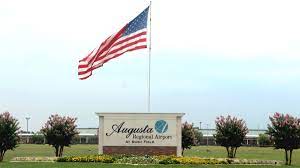
Augusta Regional Airport (“…at Bush Field”, or simply “AGS”) is the smallest airport in the world.  Okay, that’s not even close to true (especially if you consider landing strips in cornfields) but it sure feels like it.  AGS sits quietly on the banks of the Savannah River, just west of the Georgia state line.  It’s served by the smallest aircraft of Delta and American.  Its tiny terminal building is shaped like a capital “T”, with two little ticket counters at the top, followed by a quick stroll down the middle to a boarding lounge the size of an oversized living room.  If you average out the flight schedule, AGS has a single plane touching down every two hours.  They should hire the Augusta High School marching band to welcome each landing (“Go Orioles!”)

The first time I realized AGS was big-time-small was after a late landing on a weekday night.  Walking down the brief concourse the airport was noticeably dark.  The rental car counters were already shuttered for the night.  At baggage claim, the single attendant (literally, the only employee in the building) announced bags would be hand-delivered to the curb instead of circulating on the belt.  Yep, they just lined ’em all up by the waiting cars.

Watch the planes from the “front porch”

My other AGS big-time-small moment was the first time I saw the parking lot (free for 30 min, $8/day).  Half the lot was given over to rental cars.  Think about the number of rental car spaces you need for an airport where just a handful of planes land each day.  Now double the number.  That’s the size of Augusta Regional’s parking lot.

The design of AGS, boasting one-story red brick, proud white columns, and suburban landscaping, reminds me of the clubhouse of a golf course.  In fact, Augusta Regional bears the nickname “The Country Club Airport”, entirely fitting since The Masters professional golf tournament is held every April just twelve miles from its runways. 

Lounge outside (past security) before you board…

AGS reminds me of my first small airport experience back when I was a freshman in college.  Flying from Los Angeles (LAX – second-busiest in the U.S.), I deplaned in a modest midwestern town, and for the first time ever descended stairs onto the outside tarmac instead of through a jetway to the terminal.  I happened to be the first passenger off the plane, which meant leading a line of people to the glass doors of the boarding lounge.  Only I couldn’t open the glass doors.  They wouldn’t “push” despite my best efforts.  Several greeters on the other side of the glass (this was pre-9/11) gestured to “pull” instead of “push”.  Took me just a little too long to figure that out.  Believe I heard the words “city boy” as I was on my way to baggage claim.

When we landed in Augusta most recently, we were the last flight of the night.  As we sat on the park-like benches at the curb waiting for our daughter to pick us up, I watched one of the few remaining employees bring in the trash cans and turn out the lights.  She made sure we had a ride, then locked the terminal building doors.  Only one other passenger was waiting to be picked up.  It was a little strange to be among the last couple of people on the property.  I mean, most airports don’t even close.

… or play a little golf.

At Dallas/Fort Worth, you can rent private rooms at the “Minute Suites” for naps or freshening up right there in the airport terminal.  There’s even a full-service spa.  In Atlanta you’ll find a Starbucks in six of the seven airport concourses.  Augusta Regional? How about a soft pretzel at the one concession stand, or an overpriced unofficial souvenir from The Masters?  Doesn’t matter.  You can show up less than an hour before your departure, and you can take in the take-offs from a comfy rocking chair.  Yep, this little small-fly is a pretty sweet landing pad.

Some content sourced from the Augusta Regional Airport website.

——————–

Lego Grand Piano – Update #8

(Read about how this project got started in Let’s Make Music!)

Last week

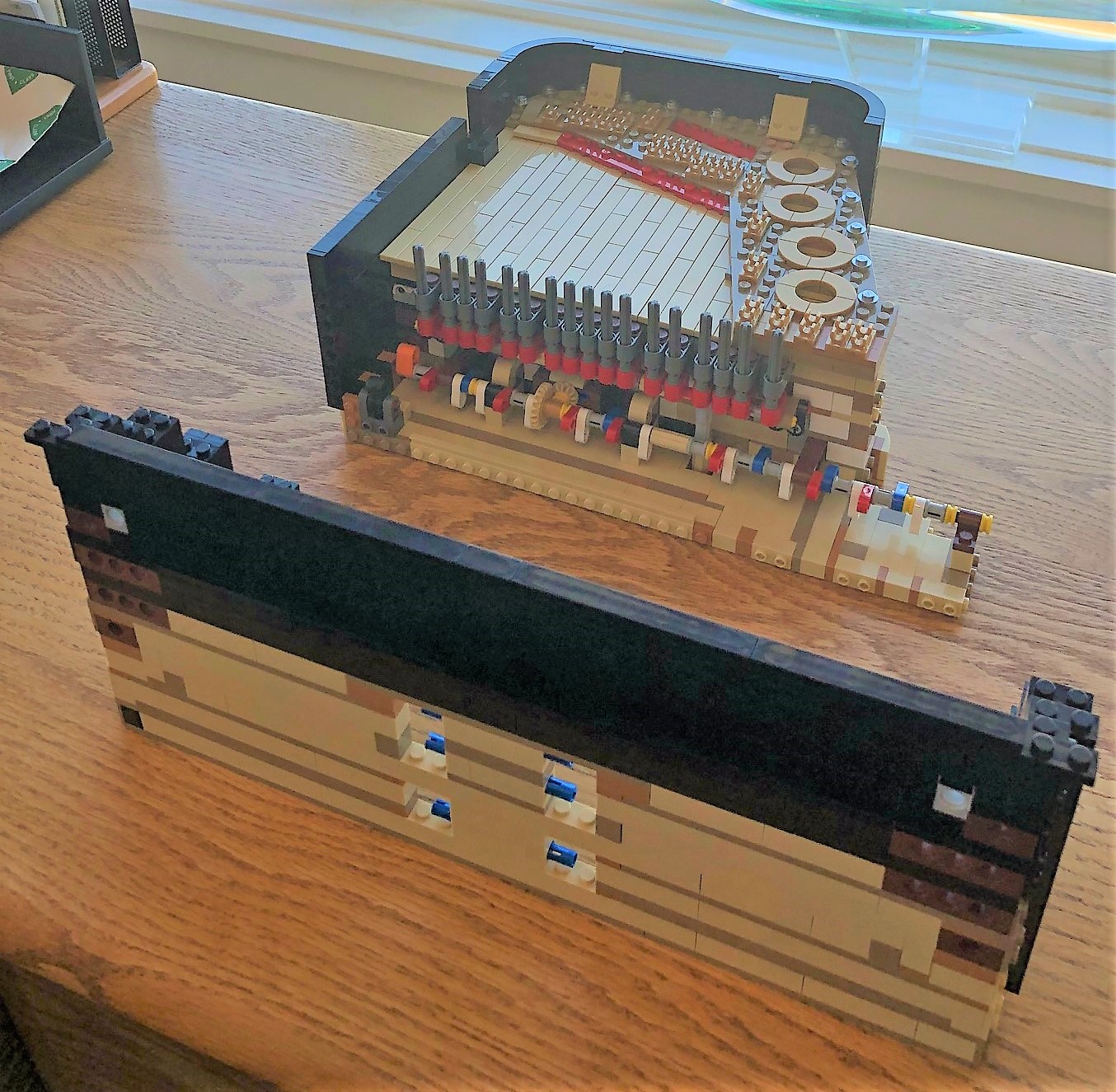
Our instrument really came together this week, as you’ll see in the second photo. Bag #8 – of 21 bags of pieces – not only connected both large pieces, but also added strings!  We now have enough of the black frame in place to where our little gem is finally starting to look like a piano.

I went with Haydn’s “Surprise Symphony” today because I completed this section in the early morning hours and needed the famous jolt the orchestra gives you at the end of an otherwise piano movement. (Yes, “piano” can be an adjective).  Haydn was famous for these little “jokes”, placed randomly the middle of his compositions.

This week

Running Build Time: 6.75 hours.  Musical accompaniment: Haydn’s Symphony No. 94 in G Major. Leftover pieces: 4 (including a couple of piano strings).

Conductor’s Note: We’re getting very close to boxing in the complex mechanics of the instrument… and I’m nervous.  We have a couple “loose ends” in there which must somehow attach so they’ll do something productive (like make music).  Hoping next week’s Bag #9 addresses this concern.

Bad Check

Last week I flew to Indiana for a conference, connecting briefly through Chicago O’Hare.  After finally touching down and exiting the tiny plane, I noticed a cluster of passengers right there in the jet bridge, waiting for luggage to be brought up the stairs.  I headed to the baggage claim area instead, where the rest of us watched the carousel lumber round and round.  The minutes passed interminably as the belt continued its relentless rotation; passengers leaving one-by-one with their bags.  Suddenly everything came to a grinding halt, and the carousel let out its big, mechanical sigh.  I found myself in the quiet and solitary confinement of an empty claim area.  My luggage?  Nowhere to be found.

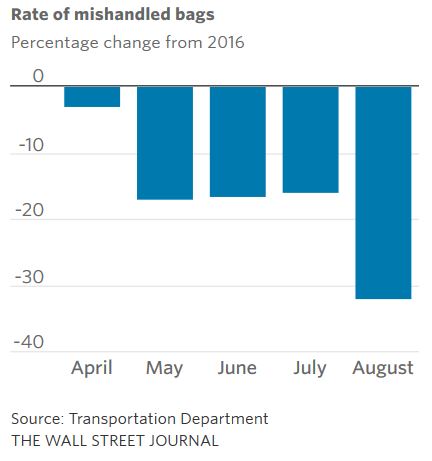
The airlines advertise a ton of performance statistics, but here’s a new one on me: rate of mishandled bags.  For every passenger who files a lost-luggage report, the carrier gets a ding.  That ding is well-deserved, representing the stress of lost luggage, the hassle of filing a report in one of those stuffy little offices, and the inevitable delay reuniting with your bag.  Not that it happens very often.  According to the following chart – part of a Wall Street Journal article – American Airlines reports a mere 2.8 incidents of lost luggage per 1,000 passengers.  But hold the phone, folks – there’s more to the losing than meets the eye.  Turns out American (and most other airlines) avoid a lost-luggage ding if they alert you to the “mishandled” bag.  Today’s smart tags make it easy to track the bag (even if it’s heading in a different direction than you are).  So that bit of information – proactively communicated in a text or email – avoids a bad stat.  And that’s why the chart below shows a dramatic improvement in August.  American Airlines started its proactive notification process the month prior.

I don’t choose my airline according to “rate of mishandled bags” (or any other statistic for that matter – it’s all about the ticket price), but I have observed the adjusted behavior of others.  Carry-on baggage is all the rage now, in brand-new shapes and sizes.  Look around next time you board a plane and count how many passengers violate the airline’s carry-on policy.  The person with the roll-y suitcase and oversized backpack is probably one bag over the limit.  The person with the valise slightly larger than the space “under the seat in front of you” probably should’ve checked it.  But chances are the flight attendant won’t make a fuss, at the risk of negative publicity.

Speaking of backpacks, the oversized versions seem to be all the rage these days; far surpassing the number of “wheelies” and “over-the-shoulder’s” so common with past generations.  It’s like everyone’s back in high school again.

Here’s another trend.  Passengers carry-on instead of checking, knowing there isn’t enough room in the overhead bins.  Once the bins are full, they surrender their bags at the end of the jet bridge instead, for attendants to tromp down the stairs and into the belly of the plane.  After landing, the process works in reverse (thus the cluster of passengers on my recent flight).  But credit to these travel warriors; they avoid $50 of baggage fees, as well as smashing bags into overhead bins (which always brings to mind square pegs and round holes).

One more trend.  Airlines are shifting the baggage-check process into the hands of travelers.  At self-check-in, the kiosk now dispenses a bag tag along with the boarding pass.  You attach the tag to the bag.  You haul the bag to the belt, where – in some cases – you place the bag on the belt.  Congratulations – you’re an airline employee working free of charge.  You might even be helping the airline avoid a mishandled bag stat.

My own lost-luggage story had a happier-than-expected ending.  At the baggage service office, the attendant took my tag into the back, reappearing moments later with my bag.  Turns out my suitcase flew on another plane, arriving at my same destination before I did (explain that bit of magic, please).  Crisis averted, but instead I lost my excuse to go purchase a suitcase of new clothes.