
Salzburg, Austria, a day-trip destination from our recent Viking River Cruise, is a popular draw for tourists. On most days you’ll find more internationals roaming Salzburg’s Old Town than you’ll find Austrians themselves. The compact city is famous for its historic buildings: churches, palaces, and fortresses dating back 1,000 years or more. Mozart was born here. But try as they might, Austrians will never be able to separate Salzburg from what attracts many to its streets: The Sound of Music.
 I can think of only one movie we forced our kids to sit down and watch while they still lived under our roof. Close to Christmas one year (an arbitrary connection because of the lyrics of “My Favorite Things”), the five of us spent three hours together in front of our not-so-big-screen TV watching the somewhat true story of the von Trapp family. I’ve lost track of the number of times I’ve followed Maria, the Captain, and those seven engaging children as they outwit the Nazis.
For all of the movies I’ve watched in my life (and I’ve watched quite a few), The Sound of Music stands alone. I’d describe it as a jewel you display in an elegant glass box on the shelf, taken down every once in a while to appreciate up close. The Sound of Music is a feel-good story – if not accurate – produced in 1965 at the end of the Hollywood’s Golden Age. It remains the most successful movie musical of all time (adjusted for inflation), but I question whether today’s movie-goers would appreciate it as much as I do.
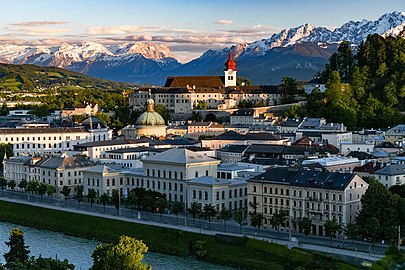
Most tours of Salzburg include references to buildings and locations included in The Sound of Music. Our own tour – cut well short because of the flooding of the Danube – was a brisk walk around the Old Town, with only an occasional mention of the movie. What surprised me was not how little of The Sound of Music was actually filmed in Salzburg (most was done on sound stages back in the States) but rather the Austrians’ utter disdain for the movie.
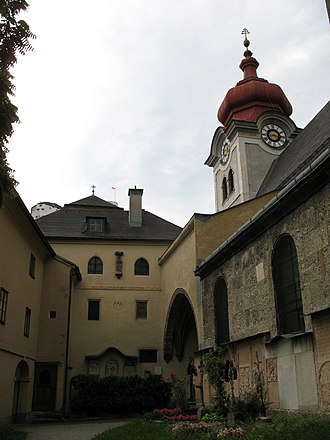
Consider, when it was first released The Sound of Music was only twenty years removed from the end of WWII. The Nazi overtones of the film didn’t sit well with citizens of Austria and Germany. Reviews (and box-office receipts) were not favorable in either country. Coupled with the liberties the producers took with the story, you can see why Salzburg residents don’t exactly “Climb Ev’ry Mountain” to claim the movie as their own.
You’ll find endless trivia about The Sound of Music at IMDB.com and elsewhere. Most facts are meant to point out discrepancies between the film and the actual story. Here are fifteen of “My Favorite Things”:
1) Julie Andrews was cast as Maria, of course, but only because Audrey Hepburn declined the part. Hepburn also denied Andrews the opportunity to play Eliza Doolittle in the movie version of My Fair Lady. Each played the opposite role in the original stage adaptations on Broadway.
2) Andrews kept getting knocked off her feet in the famous opening scene where she sings and spins in an Alpine meadow. She couldn’t keep her balance because the hovering helicopter used to film the scene generated too much wind.

3) Andrews’ hair was meant to be worn longer but a bad color job forced the pixie cut, which Andrews kept for most of her acting career
4) Christopher Plummer was not a fan of The Sound of Music. He reluctantly agreed to the part of Captain von Trapp and regretted every moment on set, especially those with the children. He described working with Julie Andrews as “being hit over the head with a big Valentine’s Day card, every day”. He nicknamed the movie The Sound of Mucus. Much later he acknowledged the film’s worldwide success, as well as the Oscar-nominated talent of Andrews.
5) Plummer regularly drowned his acting sorrows in Salzburg bars and restaurants. As a result his outfits needed to be resized towards the end of filming to accommodate his added weight.
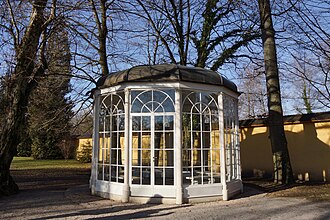
6) The von Trapp children are Rupert, Agathe, Maria, Werner, Hedwig, Johanna, and Martina… not Liesl, Friedrich, Louisa, Kurt, Brigitta, Marta, and Gretl. Also, none of the nine leads are Austrian (which certainly didn’t help the appeal of a film based in Salzburg).
7) Auditions for the parts of the von Trapp children included the four eldest Osmond brothers (not Donny), Kurt Russell, and Richard Dreyfuss.
8) Kym Karath, who played Gretl, the youngest of the von Trapp children, created her fair share of challenges. She had a cold during much of the filming. She almost drowned in the scene where the boat overturns in the lake because she didn’t know how to swim. And she ate enough sweets on set to where her weight was too much for Christopher Plummer. As a result, in the final scene walking over the Alps, Plummer is carrying a stand-in actress instead of Karath.
9) Nicholas Hammond, who played Friedrich, was not a natural blonde so his hair was bleached for the movie. The coloring process caused some of his hair to fall out, which is why you see him wearing a “Tyrolean Traditional Alpine” hat when he’s seen singing “Do-Re-Mi”.
10) The day after the real von Trapp family left Austria (by train to Italy and then to the U.S., not on foot over the Alps to Switzerland), the Germans shut down all of Austria’s borders.

11) The real Maria von Trapp is on screen at the beginning of the movie.
12) The real Maria also claims, if you can blieve it, her own personality was livelier than Andrews’ on-screen version.
13) The real Maria taught Julie Andrews how to yodel. Watch the lesson here.
14) The film’s production demanded 4,500 extras, including those in the sold-out theater for the music festival. The audience sings “Edelweiss” as if they know the song, but only because they spent time beforehand learning the words.
15) Despite the aforementioned Austrian disdain, The Sound of Music is played nonstop on the televisions of most Salzburg hotels.
 Maybe all of this trivia changes your opinion of The Sound of Music. Not mine. There are countless reasons this film includes the tagline, “The Happiest Sound In All The World”. The Sound of Music will always be that jewel in a glass box, waiting patiently to be enjoyed once more. Suffice it to say, I’ll never say “So Long, Farewell” to the adventures of the von Trapp family.
Some content sourced from the Internet Movie Database (IMDb), and Wikipedia, “the free encyclopedia”.




 Life In A Word