Lack’n Keys

Walking out the front door, I can count on one hand the items I typically carry. I always wear a watch, choosing between a stylish timepiece and a fitness tracker. I pocket a slim leather wallet on my left, containing a minimum of cards and ID. I stash a handkerchief on my right, an acquired habit to handle life’s unexpected messes. My cell phone goes in my back pocket, but really, I’m just shifting it from one location to another (house to car, car to office, etc.)  Finally, I pocket a ring of jingling keys… or should I say “key”… or should I surrender to: “remote transmitter”?
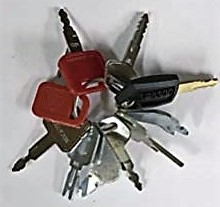
Before
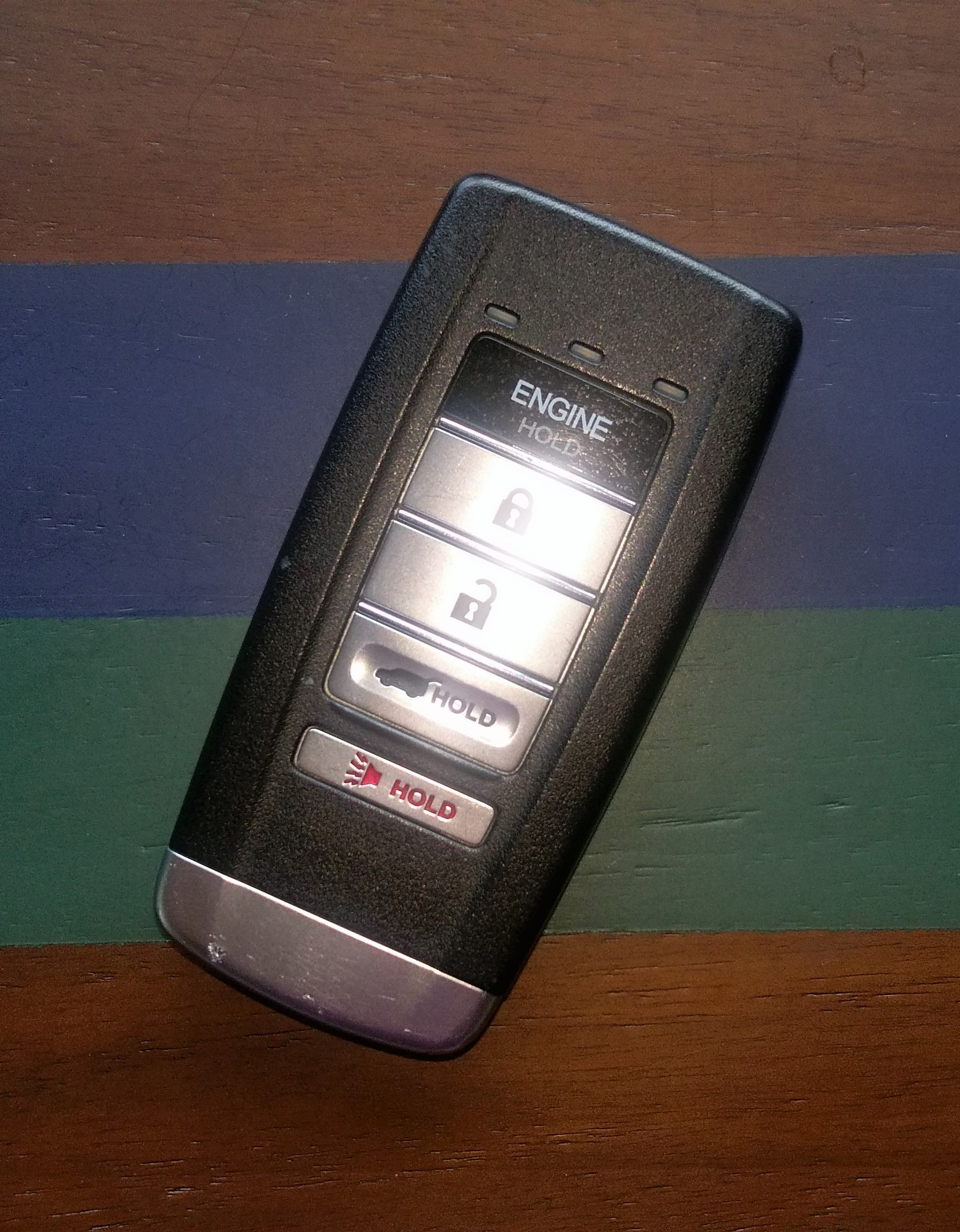
After

Key rings (or chains), still found by the eye-catching dozens at souvenir shops and car washes, used to be a symbol of status.  The more occupants on the ring, the more important the man.  Add on a colorful fob – perhaps boasting of a car brand or a sports team, and your key ring spoke volumes.

At the height of my own “importance”, I carried six keys: two for the cars (mine and my wife’s), and one each for the house door, office door, office file cabinet, and safety deposit box.  Each key had its own character, which made the collection even more interesting.  The house key contained a little light you could shine on the lock when it was dark.  The office cabinet key had a tubular shape.  The safety deposit key was flat and ancient (the senior member of the ring) and required a companion key from a bank teller to open the box.

First toy for our granddaughter

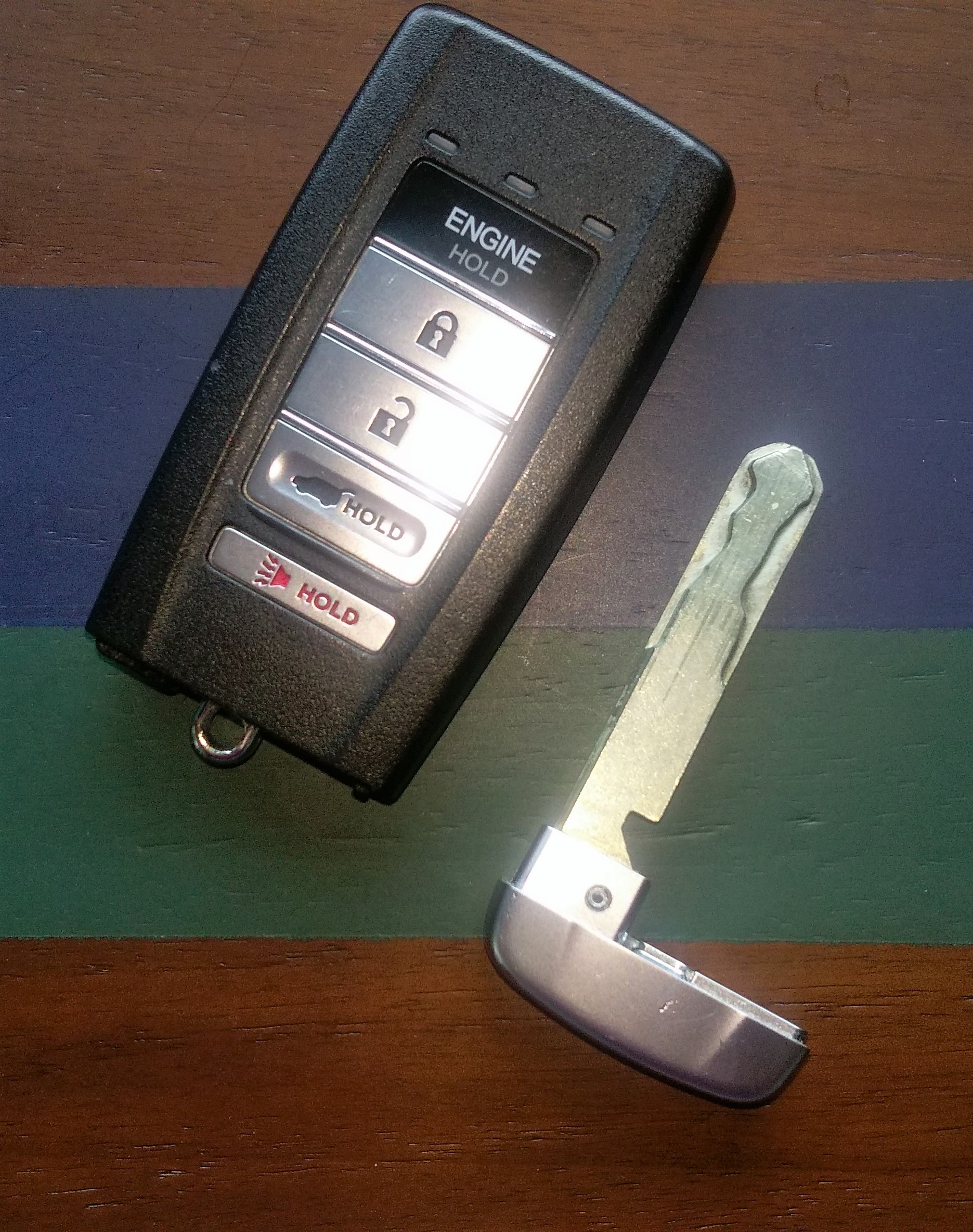
Alas, my key ring is now retired.  In its place is Mr. Remote Transmitter; technology’s answer to key-free cars.  The house door sports a lock with an electronic keypad.  Both office keys went away the day I began working from home.  My wife’s truck key shifted to a drawer in our foyer, in case hers gets lost.  And Mr. Flat-and-Ancient retreated to the home safe; a more prudent location than on a ring in public.

Keys carry a certain mystique in knowing they open something, which is why I miss them.  They also bleed a little nostalgia.  When I was a kid, I carried a tubular key for the lock securing the only vehicle I owned at the time – my bicycle.  When I practiced piano, eighty-eight black-and-white keys beckoned to make music.  When I played basketball, I never went far from the court “key”.  A childhood trip to Baltimore’s Fort McHenry taught me the origin of America’s national anthem…. and therefore about Francis Scott Key.

See why it’s called “the key”?

Keys also appeared in college.  Studying architecture introduced me to the keystone (the central block or other piece at the apex of an arch or vault).  Working architectural drawings always included a table-of-contents “key”, deciphering the symbols and acronyms on the greater page.

(Not-so-random thought: how did I never listen to the soul-filled R&B music of Alicia Keys?)

The “real” version requires Florida Key limes.

When I first met my wife, the keys kept coming.  Her family owned a home in the Florida Keys (small, low-elevation, sandy islands formed on the surface of coral reefs).  When she and I moved to Colorado, we flirted with the idea of a ski condo – in Keystone of course.  Our 25th wedding anniversary in Ireland included dinner at Dublin’s “Quays” Restaurant (pronounced, yes… “Keys”).  Also credit my wife for gifting me the most important key of all:

A lifetime of keys makes me a sad I’m “lack’n” them today.  But that’s not quite true, is it?  I spend most days clicking away on my computer keyboard, after all.  Even better, my remote transmitter contains – behind all that technology – a modest little back-up key.  Nice to know I’m still carrying.
Some content sourced from Wikipedia, “the free encyclopedia”.

Athens of the South

Ever been to Nashville?  It’s a lot to see and do in a city that still feels like a small town.  My brothers and I visited Music City for the first time two weeks ago.  We toured the historic Ryman Auditorium – the “Mother Church of Country Music” and former home of the Grand Old Opry.  We walked through the massive Gaylord Opryland Hotel.  We drove down “Music Row”, the area of town with hundreds of record labels, publishing houses, and recording studios.  We even sampled carefully-crafted moonshine (if you believe there is such a thing).

66-colossus-1Yet, none of these sights prepared me for another of Nashville’s attractions that frankly deserves more press.  Just southwest of the downtown area in Centennial Park, rising prominently on manicured lawns, you’ll find a full-scale fully-authentic reproduction of the Parthenon – that most famous of ancient structures on the Acropolis in Greece.  If one can laugh and be in awe at the same time, that was me.  A reproduction of a temple built in 438 BC?  That’s the last thing I expected to see in Nashville.

66-colossus-2Here’s what’s left of the original Parthenon (or “O-Parthenon” if you will) – which I spent significant time studying in architecture school.  It is considered the most important surviving building of the classical culture of Greece, and the finest example of Greek architecture.  It is a temple dedicated to the goddess Athena, whom the Greeks considered their patron.  If you visit O-Parthenon today you won’t see much of the original structure, thanks to a mid-1600’s explosion of a munitions dump inside the building.  Attempts to restore O-Parthenon have failed for lack of funding.  Ironically, back in its heyday O-Parthenon was used as a treasury.

66-colossus-3Nashville’s Parthenon (“N-Parthenon”) is the complete restoration, and it is a colossus.  N-Parthenon is 200 ft. x 100 ft. with a surround of 70 columns.  Inside its main space you’ll find a massive statue of Athena, rising 42 feet from the floor and gilt with more than eight pounds of gold leaf.  A likeness of the goddess Nike standing in her right had is fully six feet tall.  Pictures don’t do justice to the scale of N-Parthenon.

The origin of the Nashville Parthenon is almost as impressive as the building itself.  Nashville’s Centennial Park was the site of the 1897 Tennessee Centennial and International Exposition, a celebration of the state’s 100th year in the Union, including dozens of pavilions, restaurants, and large-scale carnival rides.  Prominent within the Exposition was the Parthenon, which was surely a nod to the “Athens of the South”.  Nashville earned that nickname in the 1850’s for the city’s establishment of several institutions of higher education.

The Exposition Parthenon was built of plaster, wood, and brick; not robust enough to last beyond the year of the celebration.  But the cost of demolition and its popularity drove a movement to reconstruct the building in concrete – authentic to O-Parthenon to the last detail.  N-Parthenon was completed in 1931.  Athena herself was added in 1990.  Appropriately, N-Parthenon contains a wonderful collection of photographs and descriptions from the Exposition.  Makes our county fair look like small potatoes.

66-colossus-466-colossus-5

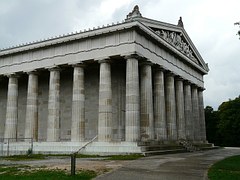
There have only been two other attempts to replicate O-Parthenon since its creation 2,500 years ago.  The Walhalla Memorial in Germany (above, left) was built in 1826, but the completed structure is merely a nod to the architecture of O-Parthenon and much more about the distinguished people in German history.  The National Monument of Scotland (above, right) was also built in 1826 – go figure – but abandoned three years later due to lack of funds.  Take your pick; I say N-Parthenon beats “G”-Parthenon and “S”-Parthenon in a runaway.

Any visit to Nashville should include some aspect of the city’s rich history and allegiance to the music industry.  But add the Parthenon to your agenda as well (especially if you think you’ll never make it to Greece).  Oh, and per the sign, leave the wheels at home.

66-colossus-6

Some content sourced from Wikipedia, “the free encyclopedia”.