Where The Buffalo Roam

In southwestern Alberta, Canada, there’s a historical landmark curiously named “Head-Smashed-In Buffalo Jump”. It’s the former location of a vast communal bison trap. Thousands of years ago native hunters would drive herds of the roaming animals over the plains and then right over the adjacent cliffs, in what is described as “the single greatest food-gathering method ever developed in human history.” The buffalo aren’t running in this part of Canada anymore. They’re no longer running in Boulder, Colorado either.

In case you missed it, the American college football season kicked off last Saturday… in Dublin, Ireland.  Kansas State played Iowa State in a converted rugby stadium in front of a sell-out Guinness-filled crowd.  A roving reporter took to the streets to ask locals what they knew about the American game and the answers were wonderfully ignorant.  How many points is a touchdown? (“4?”)  Name any American college football team (“Yankees?” “Dodgers?”)  And then my favorite: What is Kansas State’s mascot? (“A tractor?”)  Not a bad answer if you ask me.  I’d guess there are more tractors than wildcats in Kansas.

Ralphie’s run

Speaking of wild things, let’s get back to Boulder.  The University of Colorado (CU) boasts one of the few live animal mascots in college football: a full-grown snortin’ stompin’ buffalo named Ralphie.  Before each half of the home games Ralphie is released from her trailer on the sidelines (yes, Ralphie is a “her”) to run a horseshoe lap around the field at full speed, before her five handlers corral her back into the trailer.  It’s the stuff of rodeos, and more than a few handlers have eaten dirt in the process (but at least they earn a varsity letter for their efforts).

Ralphie is actually the sixth live buffalo to represent CU since the mascot was selected in 1934.  But Ralphie VI – aka “Ember” – has a singular distinction.  She’s just not into the run.  Whereas her five predecessors ran for at least ten seasons each, Ember decided to call it quits after just three.  The University officially called it “indifference to running” and cut Ember from the team so she could spend the rest of her days roaming in pastures.  Maybe Ember’s thinking she’s going to go over a cliff every time she runs.  Can you blame her for hanging it up?  No word on whether Ralphie VII is up for the task.

At least CU has a ferocious mascot, one a fan would associate with the Colorado surrounds.  Like Texas’s Longhorn or Florida’s ‘Gator, you want a mascot that speaks to your particular locale and does so with a confident puff of the chest.  But instead, a lot of America’s college football mascots have you thinking either lightweight or what the heck is THAT?

Don’t mess with Texas!

Cases in point.  If I pull up this year’s top college football teams, I guarantee I’ll find several to underscore my point.  And I am right.  Ohio State’s mascot is a buckeye (which is a tree, and not a very ferocious one at that).  Georgia’s is a bulldog, described as “loyal, gentle, and affectionate”.  Oregon’s is a duck (A duck!)  Alabama is known as “the Crimson Tide”, which was a reporter’s colorful spin on a long-ago game played in the mud (and not a mascot at all).  Finally, Arizona State’s is a Sun Devil, which better belongs on Saturday morning cartoons than Saturday afternoon football fields.

On the other hand, you have the Penn State Nittany (Mountain) Lions, the Michigan Wolverines (don’t mess with wolverines), the South Carolina Gamecocks (don’t mess with those either), and the Miami Hurricanes (not an animal, but points for ferociousness and local flavor). Any one of those deserves to stand side-by-side with a live buffalo.

Notre Dame’s leprechaun

As much as I’d like leave this topic with Ember the Buffalo and her chest-thumping buddies, I sheepishly include one more: my beloved alma mater Notre Dame.  We at Notre Dame are the Fightin’ Irish, because our football teams (at least those from the early 1900s) showed “the grit, determination, and tenacity characteristic of Irish immigrants”)  That all sounds great until you see our mascot: a leprechaun who looks like he’s taking a break from the Lucky Charms cereal box.  Is there anything less ferocious and less “state of Indiana” than that?

NOW we’re talking!

If it were up to me, Notre Dame’s mascot would be an open-wheeled, open-cockpit IndyCar (VROOM! VROOM!), the kind they race every year at the Indianapolis 500 just four hours south of campus.  An IndyCar toughs out a jigging leprechaun by a mile, not to mention an indifferent buffalo who’d rather roam than run.  I still say, good on you for choosing to head out to pasture, Ember.  I wish the Notre Dame leprechaun would tag along.

Some content sourced from the Athabasca University Press article, “Imagining Head-Smashed-In”, the CUBuffs.com article, “Ralphie VI retires”, and Wikipedia, “the free encyclopedia”.

Shark Attack!

Our annual summer vacations in San Diego have become a little more adventurous because of an increase in shark activity off the coast of California. I enjoy body surfing, but the thought of a pair of big, hungry jaws beneath the water’s surface gets my heart a-pounding. So imagine my shock when I really did have an encounter with a baby shark. Er, make those letters capitals. I meant to say “Baby Shark”.

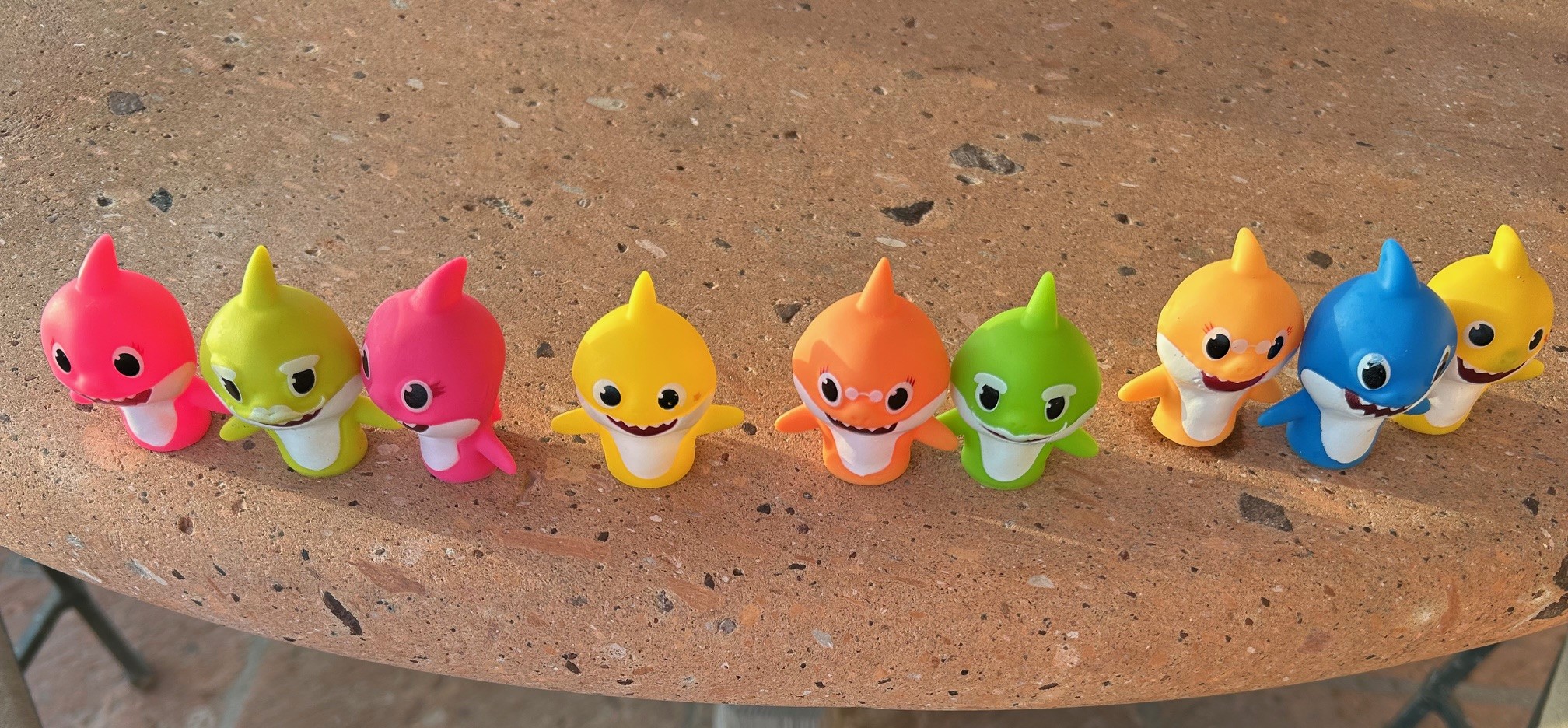
My adorable two-year old granddaughter is just beginning to take off with her vocabulary.  She can say “Mama”, “Dada”, and even “Chop! Chop!” when she wants us to hurry up.  She also says “Bayba Shawk”… constantly, because she wants an adult to play the song for the forty-thousandth time.  After three weeks on repeat I can’t get the darned thing out of my head.  I need brain surgery.

My granddaughter’s finger puppets

“Baby Shark” is the story of a little family of sharks hunting for fish.  The fish get away and… that’s it.  It’s not so much a story as an excuse to sing a verse about each family member: Baby, Mommy, Daddy, Grandma, and Grandpa.  The first time I heard it (forty thousand time ago) I wondered, Why doesn’t Baby Shark have siblings?  Where are his (her?) other grandparents?  Aunts?  Uncles?

Of course, it’s not really Baby Shark’s family that make the tune so addicting.  It’s the “doo’s”… as in doo doo doo-doo doo-doo.  You sing those six “doo’s” in every verse and that’s the part that gets into your head.  Add in the accompanying up-and-down arm dance (imitating the jaws of a shark) and you somehow have a hit.  More like a worldwide phenomenon.

If a children’s sing-song doesn’t get your attention, consider this.  “Baby Shark” is the most-watched YouTube video of all time.  I said of all time.  If your guess would’ve been something by Ed Sheeran or Katy Perry or Maroon 5 you would’ve also landed in the Top Thirty, but nowhere near the top of the list.  “Baby Shark” has been viewed over 16 billion times, more than twice the number as the runner-up.  And that’s only for the version from South Korea’s Pingfong.  The one by Cocomelon (a children’s YouTube channel) lands in twenty-third place with another four billion views.

The “Baby Shark Dance”

“Baby Shark” has been around longer than you might think.  It showed up somewhere in the late 1990’s in the public domain.  Then Pinkfong got ahold of it, created the 2016 video with cute little Korean kids, and the rest continues to be history.  Coincidentally, a lawsuit was settled just this month where an American songwriter claimed rights to “Baby Shark”.  He lost, but only because the song was still in the public domain when he created his version.  You can’t blame him for trying; “Baby Shark” has generated over $150M in revenue in the last ten years.

Of course, all that revenue comes from more than just a YouTube video (hence the “worldwide phenomenon”).  “Baby Shark” is showing up in places and with people that seem downright ridiculous.  There’s a children’s book and a television series.  There’s a video game.  It’s part of a tourism promotion for Singapore.  It’s used by certain professional baseball players as they walk up to the plate.  Or certain politicians as they walk up to the podium.  Finally, it’s the subject of a Kellogg’s breakfast cereal, a berry version of Fruit Loops with little marshmallows posing as sharks.  “Yum?”

My favorite use of “Baby Shark” comes out of West Palm Beach, FL.  Local authorities were desperate to clear a lakeside pavilion of homeless people, so they played the song over and over on loudspeakers until everyone left (running and screaming for the hills, no doubt).  If I’m inclined to run and scream myself, I can drive a couple hours north of here to see a production of Baby Shark Live, a 75-minute stage musical.  I’m not inclined.

The whole time I’ve been typing this post I’ve had doo doo doo-doo doo-doo on loop in my head.  If my hands and arms weren’t busy on the keyboard they’d be doing the Baby Shark Dance instead.  It’s maddening, and makes me want to body surf again with hopes I’ll be eaten by a real shark.  Instead, I’ll just hope I find another blog topic next week that consumes me more than “Baby Shark”.  I leave you with the video.  Guard your sanity.

Some content sourced from Wikipedia, “the free encyclopedia”.
Golden Recall

My wife and I go for massages once a month, which has turned out to be a solid therapeutic routine. As is the case with any spa, the air is diffused with pleasant scents as well as soothing instrumental music. They also overlay a soundtrack of birds, as if to place you in the out of doors. The sensations are designed to relax and they do their job; so well in fact I’d swear I was transported to the shores of a pond.  More on that in a minute.

Candidly, it’s not often I notice the background music in a spa. I focus on breathing deep and keeping my eyes closed instead. But I couldn’t ignore the music when “Bring Him Home” from Les Miserables started playing. Whatever playlist the spa chose included a simple rendition of that song; just piano and violin. It was beautiful, and suddenly I was back in the Broadway theater where we saw the show years ago. I would’ve put “Bring Him Home” on “repeat” if I could have.

But we’re not talking about Les Miserables today. We’re talking about a pond. “Bring Him Home” was followed by a nameless instrumental piano piece, and again my mind began to drift. Then I heard the birds. Piano keys.  Birds.  And there I went… back to “On Golden Pond”.

Several instrumental movie soundtracks will reside in my brain forever. Whenever their signature melodies play I’m immediately returned to the film itself. I’m not talking about the bold, orchestral works of John Williams (think Star Wars or Jurassic Park) but rather the simpler repetitive tunes that still somehow define the story on the screen. Chariots of Fire is a good example. Cast Away is another. Leap Year was a so-so movie but the soundtrack is wonderfully catchy. And the music of A Little Romance – Diane Lane’s debut film – was so well done it won 1979’s Oscar for Best Original Score.

So you see, this is how a massage becomes a trip back to On Golden Pond, a movie from almost fifty years ago. The piano plays. The birds sing (even if they aren’t loons). And there it is, that simple poignant story playing out in front of my closed eyes as if I’d just seen the film last week.

Was I ever a fan of Jane Fonda? Not really. I remember her more for her workout videos than her movies. But On Golden Pond was the exception because she’s on screen with Henry Fonda, her father in real life and her father in the movie. The movie is about the struggles of their father-daughter relationship, which surely echoed real life. Add in Katherine Hepburn as the mother character and the bar is raised well beyond the movie itself. The story is good enough, but who from my generation wouldn’t watch Henry Fonda and Katherine Hepburn in anything together?

Henry Fonda died less than a year after the filming of On Golden Pond. Katherine Hepburn made a few more movies but this was pretty much the conclusion of her career as well. So On Golden Pond is something of a swan song for both. If you have any recollection of the film, try this: Ask Alexa for instrumental piano music. Ask Siri for a soundtrack of birds at the same time. Then close your eyes and relax.  You may be transported back to a golden pond. It’s pretty cool.

Some content sourced from IMDB, the “Internet Movie Database, and Wikipedia, “the free encyclopedia”.

Tripping on Trips

I should pay more attention to the actual cost of things. A movie ticket is fifteen dollars… until you add in concessions, preferred seating, and online processing. A dinner out can be reasonable… until you add in the taxes and tip. And rental car companies add so many fees to the base rate it’s like you’ve just been bumped to a new tax bracket. With that in mind let’s visit the airport today, or more specifically, getting to the airport.

How do I get here?

Flying is expensive; always has been.  But it’s easy to overlook the cost of the airport itself.  Maybe you already know, a portion of the ticket you just bought goes to a landing fee (LF) – what the airline pays the airport for the privilege of pulling up to the gate.  Maybe you also know another portion goes to a passenger facility charge (PFC), which supposedly goes to improvement projects in the name of airport safety and security.

I don’t trust PFCs.  I think they really go to things like art exhibits, children’s play areas, pet relief areas, and smoking lounges.  I mean really, how much less would that plane ticket be if all you had for an airport was a ticket counter, some security and restrooms, and a gate to board your plane? 

You pay dearly for this space

The airport needs more than LF’s and PFC’s to pay its bills, of course.  It’s the reason you pay so much for parking.  I mean, think about it.  Once the parking garage is built it requires little to operate.  Mechanical systems and a few employee salaries yes, but certainly nothing in the neighborhood of say, $30/car/day.  Which brings me to my current conundrum.

By taxi? Cost-prohibitive

Most of you don’t have the following challenge.  When you fly, you’re close enough to the airport to where you can get a ride from a friend or take mass transit.  Me?  I have a choice of three major airports here in the South… but each of them is a two to three hour drive from my house.  Which begs the question, how does Dave get from his house to the airport and back for the least amount of money?

  1. Simple but Expensive.  Dave drives his car to the airport, parks, and drives his car back to his house after he gets back.  Works for short trips but what if I’m gone for three weeks (starting next Saturday)?  Parking at Atlanta-Hartsfield is $30/day (and that’s long-term). Throw in a tank of gas for the car and I’m north of $700 just for the airport to/from.
  2. Simpler but Even More Expensive.  This idea unexpectedly sent me in the wrong direction (financial, not travel).  I put in for a quote for car and driver from a service right here in our little town.  They got back to me almost immediately.  Little did I know my car is a limo and my driver wears a tuxedo.  My wife and I can “sit back and enjoy their ride” for $520 each way.  Gratuity not included.
  3. Slightly Less Expensive.  Here’s a fun option/comparison.  Drive to nearby (tiny) Augusta Regional Airport and fly to Atlanta.  The two round trip tickets plus parking?  Less than the cost of the drive and parking at Atlanta. If flights out of Augusta were ever on time I might actually consider it.
  4. Clever But… Drive to nearby (tiny) Augusta Regional Airport, rent a car, drive to Atlanta, and return the car.  Repeat the procedure in reverse when I return.  No.  The rental car companies want $300+ for Augusta to Atlanta.  Multiply that by two to get back home.
    By shuttle? “Cozy”
  5. Less Expensive but More Cozy.  We have shuttle services nearby; van companies where you share the ride to the airport with strangers.  $200 gets us the trip to Atlanta and back.  Okay, but now we’re driving our car just to get driven by a van just to get flown in a plane.  Seems like a lot.  And you leave when the shuttle service says you leave; not when you really want to.

Five solutions in and I still haven’t made it to Atlanta with any sense of fiscal satisfaction.  I’m starting to think I should just skip the airplane and drive all the way to our destination.  Or ride my bike with a pile of luggage on my back.  But wait!  There’s always 6. Entirely Less Expensive.  Convince local son-in-law to drive us to Atlanta (and back).  He can’t charge me more than the options I presented here, can he?  Er, not if he doesn’t read this blog post first.  I better call him… stat.

I’m All About Paul

Before another Independence Day celebration completely fades into the July of last week, I want to visit a story from early early American history. In 1973 I began middle school at Palisades-Brentwood Junior High, so named because it straddled the limits of both towns just outside of Los Angeles. But I never knew it as “Palisades-Brentwood”. A year after opening in 1955 it was rebranded Paul Revere Junior High. So Paul and I have a little something in common.  It’s like we’re compatriots, only separated by two and a half centuries. 

If you know nothing else about Paul Revere, you’ll recall his courageous “midnight ride”.  In the months leading up to the Revolutionary War in 1775 Revere took to his horse outside of Boston to alert “minutemen” of the approaching British troops.  Minutemen were residents of the American colonies trained to defend “at a minute’s notice”.  Revere himself was the notice, at least for what would become the early battles at Lexington and Concord.

Longfellow’s impression

Were it not for Henry Wadsworth Longfellow a hundred years later, Revere’s legacy would’ve faded as quickly as last Friday’s fireworks.  Instead we have the poet’s “Paul Revere’s Ride” as the chronicle, with these well-known opening lines:

Listen, my children, and you shall hear
Of the midnight ride of Paul Revere,
On the eighteenth of April, in Seventy-Five:
Hardly a man is now alive…

Thanks to Longfellow’s poetic license (lots of it), we have a skewed version of what Revere did and did not do in April, 1775.  For starters, he was one of three riders spreading the news that “The British are coming!  The British are coming!” (so why didn’t the other two riders get any poetic love?)  Further, Revere never said the words “The British are coming!” but rather some disguised version of the warning to fool the Redcoats already hiding in the countryside.  And the famous “one-if-by-land, two-if-by-sea” lanterns were put in place by Revere, not for him.

Boston, MA

Revere didn’t even own a horse.  He had to borrow a neighbor’s steed  (named “Brown Beauty”) to make the ride.  And instead of galloping all the way to Concord as the poem suggests, Revere and his horse were captured by British troops somewhere along the way.  Lucky for Paul, the capture turned into a release when the Brits realized they were about to be overwhelmed by the locals.  So they took Paul’s horse and fled instead.

Enough of the history lesson (real or poetic).  Why a West Coast middle school would go with “Paul Revere” is beyond me, but the campus culture certainly embraced the name.  A select number of boys (including me) were the “Minutemen” who raised and lowered the American flag each day.  A select number of girls – “Colonial Belles” – were responsible for some similar task.  The school yearbook was known as the “Patriot”, while the newspaper was labeled the “Town Crier”.  And students called “Silversmiths” did something-or-other, but it certainly wasn’t casting fine products in Metal Shop.

Our school even plagiarized Longfellow (and not very well), as in:

Listen, my children, and you shall hear
of the growing pride of Paul Revere.
On the twelfth of September in Fifty-Five
Our middle school began to thrive.
 
If all I can point to is my middle school’s name, it’s a weak argument to claim Paul Revere and I have something in common.  We have nothing in common.  Revere was a Jack Paul of all trades, dabbling in roles from military leader to dentist, artist, and silversmith, before finally settling on copper caster.  Revere became the best caster of church bells in all of young America before his midnight ride became his signature accomplishment.
 
You’d be better off saying Revere and I were polar opposites.  I never served in the military.  I’ve only been the patient of a dentist (too often at that), I have zero art skills, I don’t make the silver (I just polish it), and the only casters I’m familiar with are the ones under a couple of my rolling chairs.
 
“Revere Ware”
Thanks to the church bell thing, Revere Copper Company became a successful business which still exists to this day.  You may remember their “Revere Ware” products, most of which are considered collectibles today.  Maybe I should collect a few pieces myself.  They’d remind me of the guy I seem to think I have something in common with.  Or at least, they’d remind me of junior high school.
 

Some content sourced from the Paul Revere Charter Middle School website, the History Channel article, “9 Things You May Not Know About Paul Revere”, and Wikipedia, “the free encyclopedia”.

Here’s What’s Bugging Me

In the years we raised our family in Colorado we made a lot of friends and acquaintances… but none of them were bugs. Actually that’s not true; every now and then a spider would introduce itself; somehow enduring the region’s high altitude and low oxygen. But the other 99.9% of the world’s insect population flew south for the winter… and stayed there. Or rather, here. Right here on the property where we now live.  On that not-so-exaggerated claim let’s you and I make a deal.  I’ll happily take all of your cicadas, wasps, and fire ants in exchange for my countless gnats.

You-see-um?

A gnat may be the most annoying living thing you’ll ever encounter, (including every last one of your family members).  Anyone who’s experienced an out-of-nowhere cloud of these little dive-bombers knows what I’m talking about.  Gnats are so tiny instead of “now you see ’em, now you don’t” you just say no-see-um.  Gnats are so whiny you’ll swear your ears are being perforated by dozens of microscopic dentist drills.  Finally, gnats have such a sense of smell that once you give off your particular scent (i.e. sweat) they’ll happily follow you to the ends of the earth.

Here’s what a gnat looks like (blown up a million, billion times).  I’m not surprised to see they’re a relatively simple-looking creature.  After all, there can’t be much to something beyond microscopic.  In all fairness, a gnat’s virtual invisibility has to do with a preference for shade, nighttime hours and things that grow.  At least that’s my experience.  I’m out there walking the dog on a humid summer evening and it’s as quiet as the “g” in gnat.  Suddenly the little air force shows up out of nowhere and for the rest of the walk you’re swatting your head every time you hear a dentist drill.  And it’s not like you kill gnats with your swats (or maybe you do but they’re so small you have no idea if you did, so why bother?)

Entering this third summer of my newfound cloud of Southern friends, I decided it was time to go on the offensive.  My wife bought a stack of human-head sized mosquito nets.  These nets work great in that you’ll no longer feel that slightest of sensations when a gnat lands on your ear.  But the little sand grains still knock-knock-knock on the net with their dentist-drill buzzes.  You still swat and you still no-see-um.  Not to mention, a sweaty mosquito net is really uncomfortable.

A month or so ago we were at our local farm supply and came across this product at check-out.  The cashier was all about it, so I figured I’d give it a try.  Gnats don’t like particular botanicals: citronella, lemongrass, rosemary, and geranium, and No Natz has them all in a nice little spray cocktail.  Darned if the stuff doesn’t work!  You put it on like sunscreen, you smell like an entire can of Lemon Pledge, but the gnats keep their distance.  For a little while anyway.  Eventually you sweat off the No Natz and then it’s “mo natz” all over again.

Flower power

I might have to try a batch of pyrethrins instead (my new favorite word). Pyrethrins are compounds found in chrysanthemums which, conveniently, target the nervous system of a gnat.  Gets at ’em from the inside out.  The idea of a gnat spiraling out of control like a wounded helicopter is entirely appealing in my present state of mind.

Per Wikipedia, there is “no scientific consensus on what constitutes a gnat”.  Whichever ones are my new best friends here are harmless because they just buzz around your eyes and ears making their dentist-drill noises.  Other varieties prefer biting and blood so I guess I should be grateful.  Doesn’t make “Gnatus South Carolinus” any less annoying.

Maybe subscribing to the alleged origin of “no-see-um” will put me out of my misery.  The word is rooted in skeptical theism.  That is, if a human (me) thinks hard enough about a given thing (gnat) and can’t come up with a single God-justifying reason for permitting such an organism (nope, not one), AND considering said organism can’t be seen (they’re invisible!) then perhaps I should entertain the notion that a gnat doesn’t really exist.

Figment of my imagination?

Yes, let’s go with skeptical theism.  There aren’t any gnats in South Carolina after all (hooray!)  Ignore the previous 500+ words of this post.  My countless friends were all in my head.  Or uh, around my head?  Whatever.. guess I’m just hearing things.

Some content sourced from Wikipedia, “the free encyclopedia”.

There’s Something About Mary

Now that I have young granddaughters, the songs and nursery rhymes of my own toddling days bubble up from the long forgotten frontiers of my brain. Humpty Dumpty is together again and back up on his wall. The sky is unstable if Chicken Little is to be believed. And the debate rages anew whether “pease porridge” is hot or cold (even if it is forever nine days old).  The list goes on and on but none of these tiny tales holds a candle to the one bizarre question asked of Mary. So let’s ask her again, shall we?

I wouldn’t have remembered Mary were it not for the daily online puzzles of the New York Times. Two weeks ago they devoted an entire word search to the sentences of this odd nursery rhyme.  Which got me to thinking, just who was Mary, why was she “contrary” (other than a convenient rhyme), and what the heck was going on in her garden?

As the saying goes, be careful what you wish for.  As Google goes, be careful what you search for.  Jack and Jill really did go up a hill.  Old MacDonald had a farm.  There’s at least one itsy bitsy spider on the water spout.  But Mary and her garden?  She doesn’t belong anywhere near your grandchildren.

The first interpretation of “Mary, Mary” I came across was completely sanitized from the original.  It claims Mary is the Mary (as in, Jesus’ mother).  Mary’s garden is the growing Catholic church.  Silver bells are the same jinglers used in the church service to recognize miracles with “a joyful noise”.  Cockle shells refer to faithful pilgrims, as in the badges worn by those completing the Way of St. James.  And pretty maids are nuns, lined up for a life of devotion.

Badge of devotion

If we stopped right there, Mary would be heartily embraced by the rest of the kid-friendly characters in my granddaughters’ nursery rhymes.  But more likely we’re singing about “Mary I”, Queen of England in the 1500’s.  This Mary was no saint.  In her brief five-year reign she cleansed her country of heretics… by burning hundreds of them at the stake.  “Bloody Mary” – her apt nickname – somehow became a drink at the bar (which I will never order) and the subject of a child’s nursery rhyme.

Not-so-nice Mary

Mary I was at odds with her father King Henry VIII’s agenda; hence she was “quite contrary”.  Okay that’s fine, but I wish the rhyme stopped right there.  Her garden was likely a reference to a graveyard.  The silver bells and cockle shells describe torture devices of the time (and I won’t be using a Google search to learn more about those).  The maids were innocent women lined up for execution.

This is the stuff of nursery rhymes?  I’m trying to picture little girls back then, sitting around in a circle and coming up with short songs from what they see right in front of them.  Like Rosie and her ring, if some interpretations are to be believed.   As for Ms. Contrary, I think I’ll go with a garden similar to the one shown here.  But since the origins of her rhyme continue to be debated, I’m steering my granddaughters clear of her.  Instead, we’ll sing about the other Mary, the one with the little lamb.

Some content sourced from Wikipedia, “the free encyclopedia”.

Licking My Lips

I wouldn’t normally be drawn to a company whose products target women. I’m pretty well stocked when it comes to lip balms, lotions, and shaving cream. But here comes EOS (“Evolution of Smooth”), a newish company using organic ingredients and bright, colorful packaging to entice its buyers. Now I’m enticed too because EOS just came out with an orange product. Or should I say, a product in an orange. You could say it’s something that only comes ’round once in a blue moon.

Evolution of Smooth may be trying to target men as well.  Why else would they concoct a lip balm that tastes like Blue Moon?  If you haven’t had so much as a sniff of beer, Blue Moon is an everyday man’s brew produced by the Canadian-American conglomerate Molson Coors.  It’s a Belgian-style wheat beer: high on the wheat but not so much on the malted barley.  And now it’s a flavor of EOS lip balm inside of a plastic orange.

If you order a Blue Moon off the menu, the bottle or glass should arrive garnished with an orange slice.  It’s a nod to the orange peel component of the beer; an ingredient giving the witbier its subtle citrus flavor.  I should know because I’ve had more Blue Moons than any other beer out there.  When you live in Colorado as long as I did (almost 30 years) sooner or later you’ll tour the Molson Coors facility in Golden, just west of Denver.  They bus you around town first (a quaint holdover from the era of the Pikes Peak Gold Rush) before depositing you at the doors of the rather industrial-looking facility. 

Golden, Colorado

When you get down to touring – walking through the massive brewery, seeing the step-by-step production process, and sort-of-but-not-really believing the beer’s water content flows straight from the nearby Colorado Rockies – you’ll get a better appreciation of just how much effort goes into a single bottle.  But like most breweries a beer fan anticipates the final stop – the tasting room – where you’re offered brands and flavors not yet released to the public.  It was here I discovered Blue Moon, back in 1995 when it was just a concept beer.

Fancy homes boast of well-stocked, temp-regulated walk-in wine cellars with dozens of the finest bottles on display.  I boast of a 24″x 24″x 36″ below-counter drink cooler, purchased on sale at The Home Depot for $225.  I may not have dozens of the finest bottles on display, but in my house you’ll always find a half-dozen bottles of Blue Moon at the ready.

My “wine cellar”

To be clear, I’m any occasional beer drinker at best.  I can make a six-pack last a month.  The only time a beer really appeals to me is after an afternoon of hard, sweaty, gnat-filled yard work.  I’ll come back into the house after hours of that kind of fun and Blue Moon beckons. And even if I consumed more than a half-dozen bottles a month I certainly wouldn’t be put off by the price.  A six runs you $11.99 at Target.

I do know how good a beer can really taste.  Make your way to Dublin, Ireland sometime, tour the downtown Guinness Storehouse brewery (which trumps the Molson Coors experience in every way imaginable), and have a fresh pint in the top floor tasting room as you gaze out the floor-to-ceiling windows at the fairy-tale surroundings below.  You’ll never want to leave.  You’ll also realize that Guinness you’ve been having in America doesn’t measure up to the one you can have on Irish soil.

Dublin, Ireland

Any beer connoisseur reading this post is laughing at my reverence to Blue Moon.  It’s a product whose color, strength, and lack of history bears little resemblance to the storied lagers of the world.  It’s like the cosmopolitan offerings among the “real” alcoholic drinks on the bar menu.  Light on ingredients and better meant for women.

No, Blue Moon isn’t necessarily meant for women (I hope), but maybe EOS’ latest lip balm is a clever way to get them interested.  It certainly got my attention, and the thought of the taste of Blue Moon on my lips the entire time I’m working outside sounds amazing.  No bottle or glass to juggle while I run the lawn mower.  No garnish of an orange slice necessary.  $4.99 instead of $11.99.  Good call, EOS.  I’m in.

Some content sourced from the CNN Business article, “Blue Moon… is being turned into a lip balm”, and Wikipedia, “the free encyclopedia”.
The Game of the Name

When our youngest granddaughter was born last year, I wouldn’t have guessed her first name was the most popular among newborn girls in the U.S.  Olivia is the current front-runner (and Liam for boys), as it has been for the last six years. Emma sits firmly in second place (and Noah) – also on a six-year streak – while Amelia (and Oliver) takes third. It’s nice to see the use of “normal” names in this day and age because you’ve got to admit; some really odd ones float around out there.  But there’s another list of baby names you probably don’t know about: the ones you’re not allowed to use.

Two or three generations ago, the topic of baby naming wouldn’t have made for interesting reading.  Back then parents defaulted to monikers from their family tree or from the Bible.  In the decade of my birth for example (the 1960s), the most popular names for boys were Michael, David, John, and James.  Compare those to today’s “trendy” choices: Truce, Colsen, Bryer, and Halo. (Colsen aside, I’d be hard-pressed to guess the gender of any of the others.)

At least Halo is legal.  The U.S. Constitution protects a parent’s right to name their child, yet the courts still came up with a not-an-option list.  Including the following:

  1. King
  2. Queen
  3. Jesus Christ
  4. III
  5. Santa Claus
  6. Majesty
  7. Adolph Hitler
  8. Messiah
  9. @
  10. 1069

Right off the bat you can understand why most of these would cause problems.  If your baby’s name is “King” I’m looking for his bejeweled crown.  If your baby’s name is “Jesus Christ” I’m looking for a crown of a different sort.  As for Santa Claus, the courts in Miracle on 34th Street may have determined he and Kris Kringle were one and the same but let’s be honest: Nobody south of the North Pole should be named Santa Claus.

“III” and “1069” require a little more explanation.  Both are examples from real court cases where persons decided a numeral or number were preferable to their given name (seriously?)  But the courts denied both petitions, deciding numerals and numbers fall more appropriately into the category of “symbol” than “name”.  The same can be said of the @ sign, which better belongs in your email address than in your signature block.

U.S. federal guidelines seem sensible enough but the individual states add more rules.  Consider New York, where your first name can be no longer than 30 characters, while in Arizona it can be up to 45.  Rhode Island won”t allow you to put an accent above any character.  In New Mexico you can’t name your baby boy “Baby Boy” (nor your baby girl “Baby Girl”).  And in Arkansas you can’t name your child “Test” or “Void” because they wreak havoc with the state computer systems.

The game of the name is not unique to the United States.  Indeed, the lists of illegal names in other countries include some really creative ones.  Here are my favorites:

  • “Thor” – Portugal banned this one but only because they don’t consider Thor to be a word in the Portuguese language.
  • “IKEA” or “Ikea” – Banned in Sweden (of course!)
  • “Judas”, “Cain”, etc. – Switzerland doesn’t wish to promote the Bible’s bad guys.
  • “Fish” and “Chips” – New Zealand decided no child deserves either of these names alongside his or her twin.
  • “Spinach” – Australia said no to the green veggie, probably also warning the parents that just because spinach is good for you doesn’t mean your child will also be.

Considering what my granddaughter could’ve been named I’m glad her parents went with Olivia, even if she is one Olivia among many.  At least her name need not be contested in court… like the French couple who wanted their child to be named “Nutella” and were promptly denied.  They did settle on “Ella” – which is nice enough (and maybe her cutesy nickname will be “Nut”) – but if I were that crazy about Nutella I would’ve just gone with “Hazel”.

Some content sourced from the Parents.com website article, “32 Illegal Baby Names You Might Want To Keep Off Your List”, and Wikipedia, “the free encyclopedia”.
Up, Up and Away Birthday

One of my favorite lines from the science-fiction classic “Contact” (starring a young Jodie Foster and and even younger Matthew McConoughey) comes from one of the lesser-known characters. Foster’s Dr. Arroway discovers a communication stream from beyond Earth, while an anonymous millionaire funds the spaceship capable of traveling to the source of the signal. The donor then turns to Foster’s character with a smirk and says, “What do you say, Dr. Arroway… wanna take a ride?”  This year, the same question was posed by the (good) people at Goodyear.

Wingfoot Two is a “semi-rigid airship”

In a nod to my advancing age, the Goodyear Blimp turned 100 on Tuesday (or I should say, one of the Goodyear Blimps).  “Pilgrim”, Goodyear’s dirigible based in Akron, Ohio, took it’s first flight on June 3, 1925.  Now Goodyear can claim a hundred years of lighter-than-air travel, even if this noteworthy form of transportation never made it to the masses.

To be clear, Goodyear started with rubber, and then tires.  They manufactured tires for bicycles and carriages back in the day as well as horseshoe pads and poker chips, before Pilgrim first took to the skies.  Sure, you’ll find their products on vehicles everywhere but what comes to mind when I say “Goodyear”; tires or blimps?

The Goodyear Blimp of my childhood

I choose blimps.  I grew up just thirty minutes from Goodyear’s blimp airbase in Carson, CA.  The blimp I saw back in the ’60’s and ’70’s was named something like “Puritan” or “Reliance” or “Defender”, because Goodyear honored the sailboat winners of the America’s Cup.  Not today.  Thanks to a public naming contest the blimp down the street from my childhood neighborhood is named “Wingfoot Two”.  (I prefer the America’s Cup names instead.)

Maybe you also choose blimps because you drive on Michelins or Firestones.  More likely it’s because you’ve seen a blimp buoyant over the Super Bowl or other sporting event.  And speaking of football, if the Goodyear Blimp sets down on the field it covers 80% of the yardage.  That’s one big balloon.
“LZ 129 Hindenburg”

Goodyear’s flying machines of my childhood were literally balloons filled with helium, without any of the technology of today to make them easier to steer.  Coincident with middle-school history class, whenever I’d see the blimp I’d think of Germany’s Hindenburg, the Nazi propaganda passenger dirigible that, like the Titanic, is best known for its final flame-filled disaster, on approach to Lakehurst Naval Air Station in New Jersey in 1937.  Perhaps we should be thankful Goodyear never promoted its blimps as a form of mass transportation.

Also in my childhood, blimps offered a far more romantic image in the movie Chitty Chitty Bang Bang, where a colorful zeppelin traveled here and there over the fictional country of Vulgaria, carrying the villainous Baron Bomburst and his crew.  (And here’s my opportunity to distinguish between terms.  A zeppelin has more of a cylindrical shape, while a blimp looks more like a sausage.  A dirigible? Just a general term for an airship.)

Speaking of sausage, it was inevitable someone would open a sub sandwich shop named after the aircraft.  The Blimpie franchise (“America’s Sub Shop”) began in the 1960s, spread to locations around the world, and enjoyed a good fifty years of success.  Today most of the helium has left their balloon.  There are only about 25 Blimpie stores left in the U.S. (compared with almost 20,000 Subways).  IMHO Blimpie’s was the better product, at least the version I remember from the 1990s.

Oh how I wish I could’ve concluded this post with another wanna take a ride?  You and I missed the boat, er, airship on that opportunity.  Goodyear held a contest at the start of 2025 and leading up to Pilgrim’s birthday, where three lucky passengers won a blimp ride.  I say “lucky”, when in fact my fear of heights takes away any personal appeal to float up, up, and away.  No worries, because now I’m thoroughly distracted by hunger pangs.  Think I’ll hunt me down a “blimp sandwich”.

Some content sourced from IMDb,  “the Internet Movie Database”, and Wikipedia, “the free encyclopedia”.