It’s Thanksgiving Season (#3)

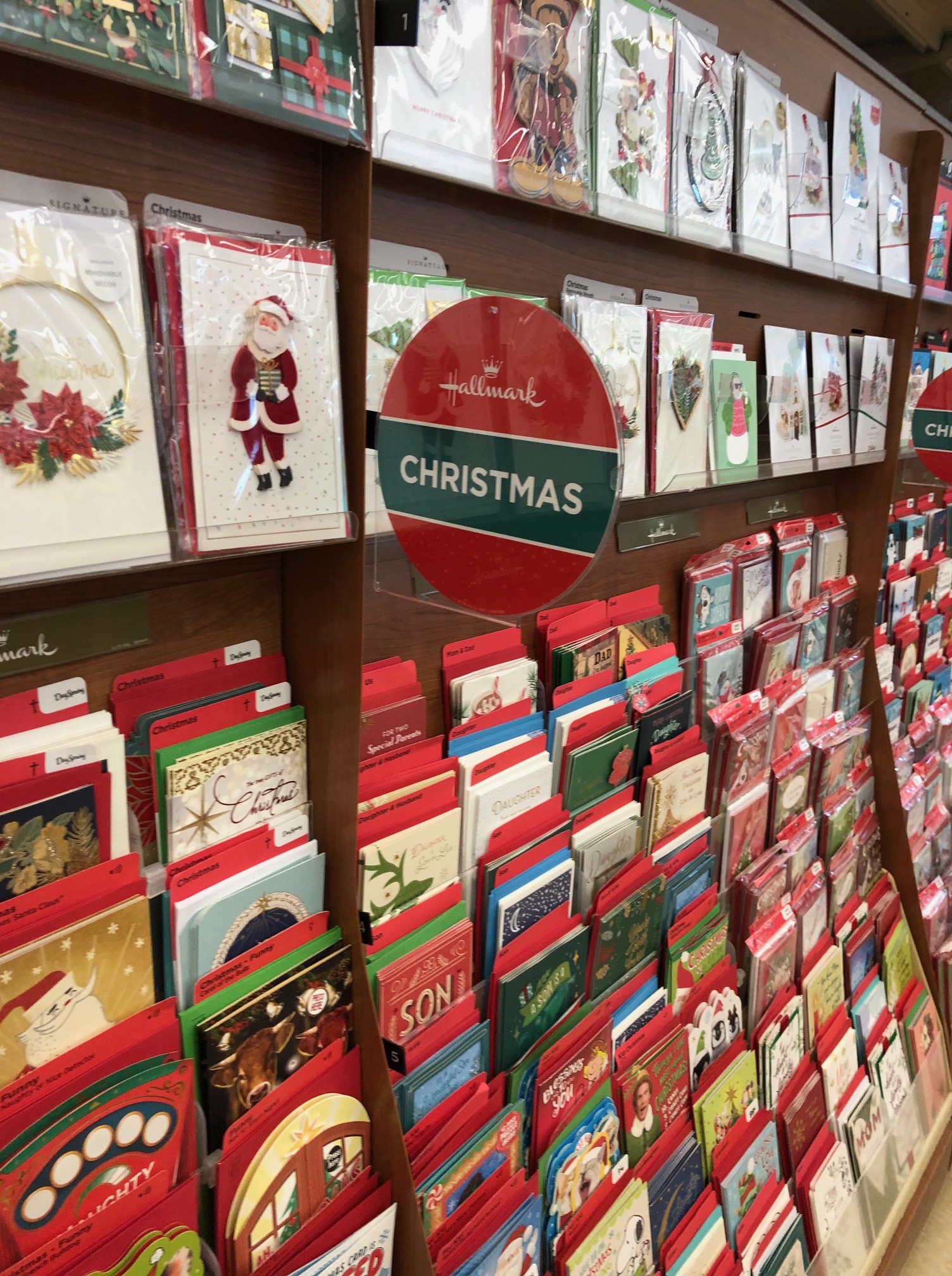
Earlier this week the first Christmas card arrived in the mail.  For heaven’s sake it’s not even November 25th, people.  Then we stopped by Chick-fil-A and my wife asked if they had their Peppermint Chip milkshake, which of course they did because it’s “Christmas season”.  Finally, we’re seeing strings of colored lights and decorations on houses already.  Am I losing the battle of the Thanksgiving season with a full week still to go?  Maybe I need a different tack with my campaign.

Let’s talk about Thanksgiving dishes today.  Are yours made of pottery, wood, metal, or glass?  Oh, you thought I meant food.  Well, yes, I do, but somehow we’ve stretched the definition of “any container used at the table” to also mean what’s in or on that container.  So let’s talk about that.  Have a favorite dish at Thanksgiving?  Of course you do; everybody does.  In fact, the better question is, if your Thanksgiving “dish” is a “favorite” then why don’t you serve it all year round?

Here are my three favorite Thanksgiving dishes for your consideration:

Stuffing.  Nine out of ten Thanksgiving stuffing recipes never made it into the bird in the first place.  Okay so I made that up, but I find it funny when a food that is “inside” by definition was never, ever inside.  Whatever.  Stuffing used to be that little pile of gently-spiced spongy material sitting benignly aside your helping of turkey.  I’d ignore it or push it around a little but most of this autumn pillow fluff never made it onto my fork.  Then I met my wife.  You could hibernate for an entire holiday season on my wife’s stuffing recipe.  It starts with ground sirloin and pork sausage and a whole lot of butter.  It ends with a ton of seasonings and spices, including sage and something called “parsley” (more on that later).  Forget the turkey… if a food ever deserved to be called “main course” it’s my wife’s stuffing recipe.

Cranberry sauce.  Is there a more wasted food on earth than cranberry sauce?  Seriously, this poor little enhancement sees the light of day only once a year, where it sits on your plate for the length of the meal before being scraped mercilessly into the kitchen trash.  How many people really make the perfect Thanksgiving “bite” – a combo of turkey, stuffing, and cranberry sauce?  Not many.  I think cranberry sauce was created to brighten an otherwise autumn-colored “dish”.  Chateaubriand has its Béarnaise sauce.  Lamb has its mint jelly.  Turkey seems to acknowledge cranberry sauce as a garnish at best: something ornamental instead of “food”.
worthless

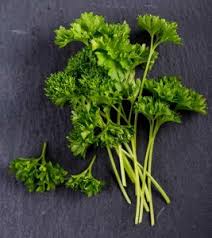
Speaking of garnishes, can we all agree parsley is the perfect example of one?  Yes, you’re adding color to the plate, but don’t you always wonder what you’re supposed to do with those little green trees?  Just like the colorful toothpicks you sometimes find holding your sandwich together, parsley is the first thing you remove (at least cranberry sauce rides out the plate for the entire meal).  Parsley is transported from wherever it invaded your plate (and what the heck is it doing in my wife’s stuffing, anyway?) to your bread plate, where it lays until its ultimate demise.  The relevance of parsley to the Thanksgiving meal (and to any “dish” for that matter) remains a mystery.  One I don’t have time for in this post.

Mince pie (AKA “heaven on earth”)

Mince pie.  We conclude my favorites with the most underappreciated, over-carb’d dessert of them all.  Mincemeat pie really did include meat back when the Pilgrims were celebrating Thanksgiving with swans and seals, but eventually someone (who deserves a medal) thought to remove the meat and add a whole lot of sugar to the chopped dried fruit, distilled spirits, and Thanksgiving spices.  The result is a pie that is scrumptious in some books (mine) and a veritable construction material in others (everyone else’s).  Seriously, this stuff is a brick.  It’s like pecan pie – or concrete – only ten times as dense.  And don’t forget to soften the blow with a little brandied hard sauce on top.  The spiked whipped cream is so good my wife skips the pie and has a dollop of the sauce instead.  But if you ask me, she’s missing out on the real dessert.

Your Thanksgiving dinner will no doubt include a favorite “dish” or two this season (glass? metal?) which should also make you wonder why you don’t eat it more often.  Is it because the Thanksgiving season is special, and you don’t want to dilute the magic by having your favorites year-round?  Yes, I think that’s the reason.  Thanksgiving deserves its own “dishes”… and it’s own season.  So c’mon, get grateful already!

Some content sourced from the Delish article, “50 Traditional Dishes You Need For The Ultimate Thanksgiving Menu” (mince pie is conspicuously absent from the list).  The parsley rant is a loving shout-out to my sister-in-law. 
It’s Thanksgiving Season (#2)

So here we are, nine days into the Thanksgiving season already.  Didn’t the time positively fly  (even with the extra hour last Sunday)?  Have you already booked your travel to visit loved ones later in the month? Have you already made pumpkin pie (because you can never have enough pumpkin pie, so why wait until Thanksgiving Day)?  Whatever you’ve done for the past nine days, I’ve already hinted at the three “F’s” of Thanksgiving: food, family, and friends.  Now let’s add a fourth.

Not football.  Not fun runs.  The most important Thanksgiving “F” is full; as in “full of thanks”.  You are thankful this season, aren’t you?  If you joined my bandwagon from last week’s post, you already have nine reasons (or nine people) to be thankful for.  Keep that list going until the big day, band-wagoner.

Now that you know the four (not three) “F’s” of Thanksgiving, let’s visit five facts you probably don’t know about the holiday.  Here’s a morsel for your taste buds: the very first Thanksgiving feast probably included lobster, deer, swans, and seals.  PETA and I struggle with those last two, but the list stands to reason because we’re talking pilgrims and Indians on the coast of Massachusetts, four hundred years ago, making merry for three straight days.  Those flavorful “entrees” were abundant back then, with nary a turkey to be found.

Too cute to eat!

Remember last week’s mention of Abraham Lincoln making Thanksgiving a holiday?  That was in 1863, declared as every last Thursday in November.  Seventy-odd years later, Franklin D. Roosevelt moved Thanksgiving Day one week earlier to extend the shopping season during the Great Depression.  But some states pushed back on Roosevelt’s pushback so in the 1940s you had several years with multiple Thanksgiving Days (more turkey for everyone – hooray!)  Eventually the compromise was made as we know it today: one Thanksgiving Day, the fourth Thursday of every November.

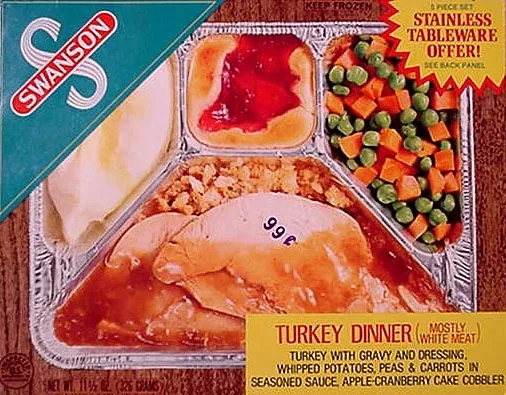
My wife and I love dinner in front of the TV, don’t you?  But have you actually eaten a TV dinner?  You know, the frozen full meal in a box, with the tiny portions of generic food in the partitioned aluminum-foil tray?  Well, you can thank Thanksgiving for TV dinners.  Swanson overestimated the demand for turkey one year, and in a totally give-that-person-a-raise move, converted 260 tons of leftover turkey into 5,000 hand-packed dinners, complete with dressing, gravy, peas, and sweet potatoes, at a mere $0.98 a pop.  A year later they’d sold ten million of them.  Voila – the birth of the TV dinner.

Trivia question: What teams always play football on Thanksgiving Day?  Trivia answer: the Dallas Cowboys and the Detroit Lions.  Better trivia question: What teams first played football on Thanksgiving Day? Answer: Yale and Princeton way-y-y-y back in 1876.  I didn’t even know football was a sport in 1876.  As for games played on Thanksgiving Day, I would’ve guessed they started like, a hundred years after that.

If your Aunt Betty spends a little too much time at the holiday punch bowl and thinks it’s funny to start gobble-gobble-gobbling at your kids, you might want to remind her females don’t gobble.  Er, female turkeys that is. The signature Thanksgiving sound is reserved for the males of the species.  Female turkeys have been known to purr and cackle instead.  This is good information for your Aunt Betty (the purr , not the cackle).

Pay it “backward”

Okay, enough what-you-didn’t-know fun for today.  Let’s wrap with another nod to being thank-full (or, if you will, having “gra-attitude”).  I love this time of year because Starbucks gives away free coffee.  Okay, so they’re not really giving away free coffee.  Instead, drive-thru patrons continue the seasonal tradition of paying for the car behind them (and driving off quickly so as to remain anonymous).  I go to Starbucks more often just to participate (as payer, not payee).  So, for whatever you are grateful for, share that happy feeling with the people behind you in line.  Not a patron of Starbucks?  Doesn’t matter; any drive-thru will do.  So c’mon, get grateful already!

Some content sourced from the October 2023 Town & Country Magazine article, “14 Surprising Facts You Never Knew About Thanksgiving”, and Wikipedia, “the free encyclopedia”.

It’s Thanksgiving Season (#1)

Listen carefully… hear the clock a-tick-tick-ticking?  Better hurry up!  You’re already a day (or more) into the Thanksgiving season and you have so much to do!  “No Dave”, you correct me, “Thanksgiving’s just one day (or at most a long weekend) way-ay-ay at the end of the month… I still have plenty of time to prepare!”  No you don’t.  Junk that perception, online friends, because the times they are a-changin’.  I, blogger Dave, hereby decree Thanksgiving to be three weeks… and the season’s already underway.  So c’mon – get grateful already!

It’s fitting I’m writing this post on Halloween, “… the conclusion of spooky season…” as Lyssy in the City referred to it.  And isn’t it true?  Just like Christmas, the air goes out of the holiday balloon the very next day.  Cinderella’s carriage turns back into a pumpkin at midnight (ironically).  There is no “residual” spooky season on November 1st.  Halloween died the night before.

Retailers are determined to steamroll Halloween and Thanksgiving with the Christmas season, of course.  The artificial trees and decorations were available for purchase at Costco and Lowes this year before the Halloween candy even colored the shelves.  As I said in Third-Wheel Meal two years ago, Thanksgiving is fighting an uphill battle between the ever-expanding seasons before and after.  It’s like a sandwich with two massive pieces of bread but not much in between.

Thanksgiving is not just another holiday in my book; it’s a uniquely American holiday.  It’s the one we’ve been celebrating in the U.S. for 160 years thanks to the persistence of one Sarah Josepha Hale (who also wrote “Mary Had a Little Lamb”). Hale, along with Abraham Lincoln’s stroke of the presidential pen, made sure the holiday was “permanent… an American custom and institution”.  Gives this juncture in the holiday season a little more respect, wouldn’t you say?

Day-by-day gratitude

Like an Advent calendar, I propose we take twenty-three days to be grateful for what we have.  Open the little cardboard door on any given morning of November and the question will always be the same: What are you thankful for today?  Surely you can come up with twenty-three things.  Or how about twenty-three people?  Wouldn’t it be something if you told one person how grateful you are to have them in your life… every day until Thanksgiving Day?

Already on the shelves, sigh…

As with Christmas, it’s not the wrapping; it’s the gift inside.  Thanksgiving goes way deeper than turkey and football.  If you’re planning a trip to America and don’t know much about Thanksgiving, VisitTheUsa.com is not helping my cause.  The website reduces Thanksgiving into turkey and pie, Turkey Trots, parades, football, the pardoning of a single turkey, “shop ’til you drop”, and the travel challenges of a four-day weekend.  Really?  That’s the meaning of America’s Thanksgiving?

It’s not about this…

Maybe it would help if moviemakers and songwriters joined my cause.  I mean, think about it.  Halloween movies come to mind without much thought (with some, like A Nightmare on Elm Street, approaching ten sequels).  Hallmark churns out Christmas movies faster than you churn out Christmas cookies.  But are there any movies about Thanksgiving?  Well, yes actually, just this year we have Thanksgiving (the movie).  But please, don’t seek out the trailer.  This garbage has nothing to do with gratitude and everything to do with gratuitous violence.

or this…

I was going to make the same case for music. Halloween has you dancing to “Thriller” and “Monster Mash”.  Christmas has you “Rockin’ Around the Christmas Tree”.  There is no “Thanksgiving carol”.  But then I remembered Amy Grant’s “‘Til the Season Comes ‘Round Again” (my wife’s favorite).  It’s a song about Christmas, make no mistake, but you could argue there’s a little Thanksgiving dressing mixed into the first verse:

Come and gather around at the table
In the spirit of family and friends
And we’ll all join hands and remember this moment
‘Til the season comes ’round again

Get what I’m saying?  Take the next three weeks and find the true meaning of Thanksgiving.  Like Halloween, the treats will still be there on November 23rd.  Like Christmas, you’ll still have the stress of travel and getting things done.  Those holidays are about finding your inner child.  This one’s about finding your inner adult.  So c’mon – get grateful already!

Some content sourced from Wikipedia, “the free encyclopedia”.

Not-So-Thruways

We live on a long, straight-run residential street, with the option to exit at either end to access the outside world.  Close by, a cluster of our neighbors live on a short, stubby lane, where you won’t get very far before having to turn around and go back the way you came.  A sign posted at their street’s entrance declares, “Not A Through Street”.  It’s what the French – and we Americans – call a cul-de-sac.

In a rather desperate effort to come up with something Halloween-related this week, I landed weakly on “dead-end streets”.  Of course, these tiny avenues are often very much alive.  Cul-de-sac’s host a quaint gathering of houses, with a few on the straight run and even fewer around the end circle.  The setup allows these neighbors to get to know each other easier.  And with so little traffic, the end circle encourages kids to do what their parents normally nix: play in the street.

But maybe I shouldn’t paint/assume such a rosy picture (especially with Halloween right around the corner).  What if your neighbor living right next door on that little end circle is someone you’d sooner see in a horror movie?  Or what if the statistics are true: even more people are struck by cars on a cul-de-sac because of the assumed safety of a quiet street?  Finally, consider the double-hyphenated phrase staring you right in the face.  Cul-de-sac – French translation – “bottom of bag”.  Suddenly your house feels like one of those throwaway candies you find deep down in your trick-or-treat sack.

I didn’t know “cul-de-sac” had such a negative connotation.  I found it rather quaint because it’s double-hyphenated (and French).  Curious, I went in search of other double-hyphenated words to see if I could find something more positive.  Know-it-allWord-of-mouth (which is often gossip).  Son-in-law.  Okay, that last one has potential.  I mean, he’s only been married to my daughter for year now, so…
Here’s a really nasty double-hyphenated for you.  Fer-de-lance.  It means “head of spear”, which isn’t so nasty until you realize it’s the name of a snake; an extremely poisonous viper who lives in the tropics.  The fer-de-lance was the killer (literally) in a 1974 movie by the same name.  A movie I never should’ve watched at the fairly innocent age of twelve.  Fer-De-Lance was the original Snakes on a Plane, only the plane was a submarine carrying a crate full of deadly creepy-crawlies.  How’s that for Halloween-scary?

Like Fer-De-Lance, Cul-De-Sac was also a movie (1966), about “a hermit living with his wife in a large dank castle on an island… terrorized by two escaped prisoners.”  Not exactly a romantic comedy, and no explanation of the film’s title, other than maybe this couple finding themselves at their ultimate dead-end.

Let’s circle back to the suburban version of the cul-de-sac (please!)  Two addresses ago we actually lived on one.  There were two houses on each side of the straight-run and four houses on the end-circle.  We lived on the circle.  Were we tight with our neighbors?  No!  Each of our driveways were long and steep so our houses were actually pretty far apart.  I still remember how we’d greet our neighbors faithfully only one day out of the year.  What day?  Halloween, when we’d accompany our kids to their front doors.

We need to end this more-Halloween-than-I thought post on a positive note, so I don’t have you thinking about poisonous snakes and escaped prisoners.  Cul-de-Sac is a locale on the beautiful Caribbean island of Saint Martin.  It was also the name of a 1990s alternative rock band.  And Cul-de-Sac was the title of “a light-hearted comic strip centered around a four-year-old and her suburban life experiences.”  Okay, now we’re talking.

Some advice before I close.  If you live on a cul-de-sac, I suggest you double-stock the candy this Halloween.  After all, trick-or-treaters who make it to your dead-end street may find themselves going round and round the end circle without realizing what they’re doing.  Keep an eye out for repeat customers.

Some content sourced from Wikipedia, “the free encyclopedia”.

Fuzzies and Buzzies

My granddaughter, almost six months now, adores her soft-stuffed black-and-yellow bumblebee.  Her little buzzy has a Velcro loop to attach to the car seat or stroller. In her first months, she fixated on Mr. Bee like a best friend.  Today she takes an interest in other things, but I told her mother to set the bee aside as a future keepsake.  Doesn’t everybody wish they still had their first stuffed animal?  Well, I sure do, and mine was more fuzzy than buzzy.

“Baa-a-a-a!”

Nope, not a bear.  Not a dog, not a cat, a fox or a tiger.  My one-and-only stuffed animal was a lamb.  An off-white fuzz-filled plush-soft domesticated farm critter, about 12″ head to hooves.  I named him “Lambie”.  We were inseparable for years.

I’m not here to revisit childhood memories (though it’s remarkable how a cherished wooly companion comes back to mind).  Instead, I want to give sheep their due.  I think sheep are one of the world’s most overlooked animals.  At the farm, everyone pretty much skips the bleating balls of fluff in favor of the more interesting horses, cows, and pigs.  At the zoo it’s the lions, tigers, and bears instead.  And I get it.  Timid, fuzzy herbivores just don’t inspire awe.  So how about instead, we take a look at what you don’t know about sheep:

“Hey! I like ewe!”
  • They have rectangular pupils.  I’ve always thought it was cool how horses can see to the left and right without moving their heads.  Sheep have it even better; a full 270 degrees of vision, meaning the only thing they can’t see is what’s directly behind them.
  • They’re more intelligent than you think.  Sheep can retain the details of fifty faces – human or otherwise – and recall them two years later (no idea how we know this).  They can also be led through a maze and then solve it on their own the second time around, probably because…
  • They have an excellent sense of smell, thanks to scent glands in front of their eyes and in their hooves.  Sheep can leave their scent behind as a sort of trail of bread crumbs while on the move.
  •  They self-medicate.  I’m not pulling the wool over your eyes here.  Sheep can identify plants and other substances having no nutritional value but with healing properties.  They also pass this information on to their offspring.

Now let’s change the channel to what you already know about sheep.  They are followers in every sense of the word (hence the label for like-minded humans).  They are timid, easily led, and never without their flocks.  Just watch this speedy video to see how our fuzzy friends stick together.

Sheep have little ability to defend themselves (how would they when they’re essentially balls of fluff on sticks?)  As a result, they’re in constant fear of their predators. In fact, sheep are so much “flight” versus “fight”, they sometimes die of self-inflicted panic attacks.

Care about them or not, sheep find their way into the narrative.  If not a lamb for a stuffed animal, you learned nursery rhymes like “Baa Baa Black Sheep” (have you any wool?), “Mary Had a Little Lamb”, and “Little Bo Peep” (has lost her sheep).  Maybe you’ve counted sheep (jumping over fences) while trying to fall asleep.  Or listened to Bach’s “Sheep May Safely Graze” while trying to relax.  Dodge’s best-selling truck is the “Ram” and  Los Angeles’s NFL team is the “Rams”.  Most noteworthy, in 1996 an ewe named “Dolly” became the first mammal of any kind cloned from a single cell.  Do sheep matter?  You bet your shears they do.

So if you’re sheepish I say, “Be proud to be so!”  If you’re something of a black sheep I say, “Consider yourself ‘outstanding'”!  And if you’re like me, a dyed-in-the-wool fan of fluff balls on sticks, choose fuzzies over buzzies every time.

Some content sourced from the BCSPCA article, “10 fun facts about sheep”, and Wikipedia, “the free encyclopedia”.

Fresh-Breath Foods

There was a time, not so long ago, when the Girl Scouts knocked on your front door instead of standing outside your local supermarket, selling their popular cookies. My wife would tease me because I never had the heart to turn down the cute little uniformed kids on my doorstep. But let the record show, I really do like Girl Scout cookies. And if I had the money to buy just one box, it’d be the Thin Mints every time.

Nature’s fresh-breath herb

I’ve been a mint fan as long as I can remember.  I’m not talking about foods (yet) so much as the flavor itself.  Peppermint, spearmint, wintergreen, or even a fresh sprig right out of the ground – they all speak to me with a sort of spicy vibe.  I find a food so “tasteful” when it’s freshening your breath at the same time.

For a hot minute I thought the Girl Scout Thin Mints were gone for good.  A recent headline teased the departure of a “cult-favorite” cookie flavor and I feared the Mints had run their course.  Instead, it’s the lookalike “Raspberry Rally” calling it quits.  No harm, no foul.  As long as I can still buy the Thin Mints (and an occasional Caramel Delite) I’ll happily fork over the $5 (now $6) a box.

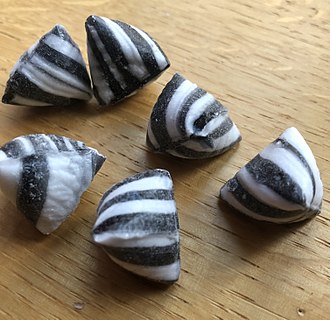
Mint-striped “humbug” candies

Had the Thin Mints really been gone for good, I needn’t look far to find other fresh-breath foods.  Who doesn’t like a scoop of peppermint or mint chocolate-chip ice cream?  A pack of Mentos?  Listerine?  Heck, I’ll even settle for that gritty peppermint paste the hygienist uses to polish your teeth.

Brach’s “Star Brights”

Minty consumables really do run the gamut.  You’ll find over fifty global brands of breath mints, including Altoids (my favorite), Breath Savers, Certs, Clorets, Ice Breakers, Tic Tac, and Velamints.  But put all of these together and you still wouldn’t come close to the Starlight Mint population.  The origin of Starlights is one of the world’s great mysteries.  Brach’s Candy claims their invention, but if so then why do they call them “Star Brights”?

If Starlights are too dime-store for your taste perhaps you prefer the softer texture of a “butter mint”.  Butters are often found, individually wrapped, in the lobbies of fine restaurants (gone are the days where you’d just spoon yourself a handful on the way out the door).  I’ve always thought a butter mint is caught in a quandary,  Does it identify more as “butter” or “mint”?

Mint julep

Speaking of a refined palate, minty liquors make for some mighty fine beverages.  The first drink my wife and I ever shared was hot chocolate and peppermint schnapps from a thermos at our college’s movie night.  A grasshopper (and my wife has a killer recipe for one) is a fresh-breath milkshake made with crème de menthe.  And the Kentucky Derby’s mint julep is more bourbon than mint but you’ll always find fresh sprigs garnishing the top.

If not the Starlights, my first introduction to mint was probably packs of Life Savers.  There used to be several mint flavors of “the candy with the hole in the middle” including Wint-O-Green, Stik-O-Pep, and Spear-O-Mint.  But when the trendier Mentos and Tic-Tac came along, Life Savers headed for the rear-view mirror.

Mistake-O-Mint

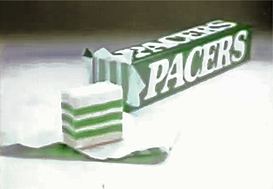
No mention of mint would be complete without a couple of failures (at least IMHO).  In the 1970s the makers of Starburst came out with a short-lived minty version called Pacers.  They never worked for me because I always expected those chewy little squares to be fruit-flavored.  Nabisco’s Oreo, which blossomed into 85+ varieties from their black-and-white signature sandwich cookie, include ones with green mint filling.  No, just no.  Oreos are meant to be the vanilla originals.  Food-color them orange for Halloween if you will but don’t change the taste.

[Side advertisement: The next time I fly overseas I’ll have to give Jet Blue’s Mint class a try.  Their individual “apart-mint” cubicles allow you to lie flat, with lots of cushions, a TV, and plenty of storage space for your carry-on items.  Fancy, huh?  All that’s missing is a chocolate mint on your memory foam pillow before you drift off to sleep.]

France’s “Monnaie de Paris” Mint

Here’s a chicken-or-egg question.  Which mint came first, the flavor itself or the stodgy industrial facility which manufactures coins?  I always thought it’d be cool to work in a mint.  You’re handling millions of dollars every day and if someone asked what you do for a living, you just say casually, “Oh, I make money.”  And If it were up to me I’d give all those coins a sweet-smelling scent on their way out the door so they’d be “freshly-minted” two times over.

Our Christmas celebrations used to include a box of Frango Mints, the melt-in-your-mouth chocolates you could buy at Chicago’s Marshall Field’s.  These days we go with Williams-Sonoma peppermint bark.  Our tree will always welcome a peppermint candy cane or two.  And if a Girl Scout should ever knock on my front door again, I’ll be happy to help her meet her quota, because the Thin Mints will always be a breath of fresh air.

Some content sourced from the CNN Business article, “The Girl Scouts are discontinuing a cult-favorite cookie”, and Wikipedia, “the free encyclopedia”.

Mom-and-Pop Music

Flip through the chapters of my life and you’ll find a bookmark at 1975. It was the year I became a teenager. It was the year I started middle school. But most importantly, 1975 was my first foray into Top 40 music. In those days, punk, funk, disco, and metal were just getting started; all too progressive for a kid taking his first dip into the pool of radio rock. Instead, my preference was to chew on something a little sweeter. Like bubble gum.

In the 1970s, I was way too young to witness the birth of rock and roll.  I also missed the advent of pop music.  But I was right on time for a musical genre known as bubblegum.  Bubblegum siphoned off pop music’s more catchy, upbeat tunes and marketed them to children and adolescents.  And what better way to market theses songs than kid TV?  Anyone who ever watched The Partridge Family, The Monkees, or the cartoon rock of The Archies on Saturday mornings enjoyed bubblegum music.

As for 1970s Top 40, it’s easy to look back on those weekly lists and find bubblegum.  “Love Will Keep Us Together” (Captain & Tennille), “Laughter In The Rain” (Neil Sedaka), and “He Don’t Love You, Like I Love You” (Tony Orlando and Dawn) are just a few examples from fifty years ago.  Like most things back then, music was more innocent.

Having said that, bubblegum wasn’t even specific enough to define my own tastes.  The industry standard Billboard Magazine generates a Hot 100 list at the end of every year based on sales and radio plays.  It’s fun to go through the 1975 list and recognize just about every song.  But I was looking for three names in particular and – no surprise – all of them made the list with multiple entries.  Hello again, John, Olivia, and Barry.

John Denver was only 53 when he was tragically killed piloting a single-engine plane above California’s Monterey Bay, yet he managed to create over twenty-five years of gentle hits before that.  When I first heard his voice he’d already landed top-ten’s like “Leaving on a Jet Plane” (from the movie Armageddon for you younger readers), “Take Me Home, Country Roads”, and “Rocky Mountain High”.  One of Denver’s biggest hits, “Annie’s Song”, was a love song to his first wife.  Another, “Calypso”, paid tribute to the late ocean explorer Jacques Cousteau.  I purchased most of Denver’s albums (cassette tapes!) with a good chunk of my meager teenage savings.

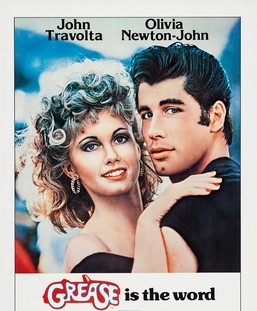
I was an Olivia Newton-John fan well before 1978’s Grease became a Hollywood phenomenon.  Newton-John and her sweet Australian accent were an instant teenage crush, with songs like “If You Love Me, Let Me Know”, “Have You Never Been Mellow”, and “I Honestly Love You”.  Then Grease came along and good-girl-turned-bad Olivia turned my teenage heat up several notches.  A testament to Newton-John’s popularity came in the form of 100 million records sold, fifteen top-ten singles, and four Grammy awards.  To this day, the soundtrack to Grease remains one of the world’s best-selling albums.

Barry Manilow and his music are more of a confession than the two we’ve already visited with.  It wasn’t at all cool to admit to liking Manilow’s “adult contemporary” music back then.  His hits were better suited for your parents, like “Mandy”, “This One’s For You”, and “Even Now”.  “Copacabana” was a dance number you couldn’t get out of your head.  “I Write the Songs” spoke to my inner-musician wannabe.  Manilow’s talents on the keyboard certainly captured my attention as I pursued the piano myself.  Unlike Denver and Newton-John, I purchased every Barry Manilow album as soon as it hit the shelves.  Somewhere in my attic I still have a boxed CD collection of his best work.

Like him or not, what is remarkable about Manilow is his enduring popularity.  He has been ensconced in Las Vegas for years now.  He just completed his 600th performance at Westgate’s Resort & Casino (an achievement which prompted this post), breaking a record held by Elvis Presley.  The one time I saw him in concert – at an outdoor venue in the Bay Area – I knew every song he performed.  Sure, almost all of his audience members are now graying at the temples, and his popular music is from five decades ago (!) but you still have to give him props.  The man has staying power.

Do I still listen to John, Olivia, or Barry?  No, but I can sing entire songs from memory.  There’s nothing like the music of those three to take me back to my teenage years.  Call it adult contemporary if you want, but this guy will always think of it as “Pop” music.

Some content sourced from The Atlantic article, “It’s Okay to Like Barry Manilow”, and Wikipedia, “the free encyclopedia”.

Map-Sap Goodness

A few months ago, authorities in New Zealand wrapped up a five-month sting where they confiscated the largest import of methamphetamine in the country’s history. Millions of dollars of the liquid stimulant were discovered in, of all places, a shipment of maple syrup jugs. Agents swapped out the drugs with water and let the jugs continue to Australia, where the recipients were quickly apprehended. Did this story captivate me?  Why yes it did, but not because of a million-dollar drug bust. I pretty much stopped reading at jugs of maple syrup.

With all due respect to fruit, I think maple syrup is the better example of “nature’s candy”.  After all, it’s essentially organic liquid sugar.  If you have the tree, the tools and the time (a lot of time), you can tap your own supply.  Simply drill a hole into the trunk of your sugar maple tree, hang a bucket below the opening, and let the goodness s-l-o-w-l-y flow.  After you’ve collected what you need, boil off the water, filter off the crystallized sugar, and your pancakes or waffles are set to be topped.

Sugar maple

If you prefer a more solid sweet, make snow candy like Little House on the Prairie’s Laura Ingalls did back in the day.  Pour boiling maple syrup into short lines on a fresh bed of snow.  Press Popsicle sticks into the lines.  Then roll the cooling syrup around the sticks and voila! – a sweet handheld-treat.  Last Saturday’s arrival of the fall season makes this confection seem extra appealing.

My very favorite doughnuts are maple bars

In the U.S., “real” maple syrup is not so common anymore.  Years ago at my childhood breakfasts I was already consuming imitators like Log Cabin, Mrs. Butterworth’s, or Aunt Jemima (more recently known as “Pearl Milling Company”).  These brands and countless others are known as “table syrups”, made from corn syrup and chemicals instead of anything found in a tree.  They can’t even use the word “maple” in their names because of a consumer protection law known as the Pure Food and Drug Act.

Maple sugar

Enough about the impersonators.  Maple syrup’s rich flavor and density should be the preference to table syrup’s as long as a) Your taste buds can be reeducated, and b) you’re willing to spend a few more pennies.  And maple syrup is just a step removed from some distinctive treats.  Maple sugar candy is compacted maple sugar formed into small squares or maple leaves (delicious!)  Maple taffy is what you get if you boil maple syrup past its liquid form.  And for the truly obsessed (me), you’ll also find maple versions of toffee, butter, and liqueurs.

Treacle tart

Let’s take a paragraph for a confection of honorable mention.  Ever heard of a treacle tart?  Yes you have, if you know the timeless children’s classic Chitty Chitty Bang Bang.  In the story, the evil Child Catcher in the fictional village of Vulgaria tempts young Jeremy and Jemima Potts with ice cream, candy, and treacle tarts (“and all for free!”)  Those tarts are small pastries filled with maple syrup, breadcrumbs, and a splash of lemon juice, served warm with a cream topping.  Yum.  Catch me if you can, Child Catcher.

If you know your flags, you can guess which country produces most of the world’s maple syrup.  Canada accounts for fully 80%, with most of the sweet stuff coming from the province of Quebec.  Vermont’s production is similarly dominant compared to other U.S. states.  Both locales are northern climates, where sugar maple trees thrive in the cold winters.  So as much as I’d like to channel my inner L.L. Bean by planting a maple tree and drilling a hole, donned in flannel shirt and snow boots, it’s never going to happen here in hot-and-humid South Carolina.  Guess I’ll have to settle for a store-bought jug of nature’s candy instead.

Some content sourced from the Deutsche Welle (DW) article, “Authorities find drugs worth millions hidden in maple syrup”, and Wikipedia, “the free encyclopedia”.

Living On The Edge

The state line between South Carolina (SC) and Georgia (GA) follows the twists and turns of the Savannah River. You know you’re heading into one state or the other whenever you cross the water. Driving from our part of South Carolina into nearby Augusta, GA is interesting. The interstate loops Augusta by starting in SC, touches a bit of GA, goes back to SC for a few miles, then continues into GA again as it follows the river. It’s an example of my life on the edge.

In California, W means “water”

Growing up on the coast of California, it never occurred to me the geography of my younger days was limited to only three of the four cardinal directions.  If I headed north I’d leave the urban stretches of Los Angeles for the more rural towns of the the central coast.  Head south and I’d parallel the beaches all the way to San Diego.  The only thing east of the city seemed to be the endless Mojave Desert.  As for the last of the four directions?  Not an option, at least not without a boat, plane, or a whole lot of swimming.  Horace Greeley would’ve never told me to “Go West, young man”.

South Bend sits where the yellow and red come together at the very top of Indiana.

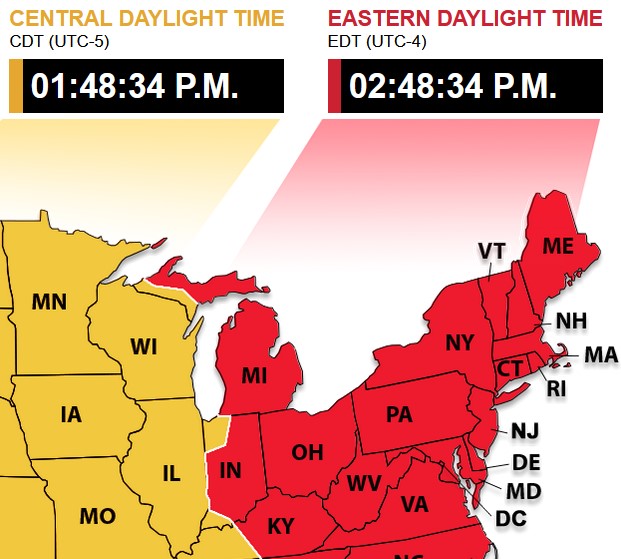
In my college years in South Bend, IN, I was a fifteen-minute drive from the line where the Central and Eastern time zones meet.  Back then you didn’t touch your clock for Daylight Savings, so half the year you were the same time as Detroit while the other half you were Chicago.  It was confusing, but not as confusing as someone who lived on one side of the line and worked on the other.  Imagine leaving the house at 8:00am, driving an hour, and arriving at the office at… 8:00am?  It’s a neat trick, pulled off by a lot of those who live on the edge of a time zone.

Raising our kids in Colorado Springs, we always knew which direction we were heading because the line of the Rocky Mountains lay immediately to the west.  Those peaks rose up like the Great Wall of China, just daring you to push through.  Sure, we drove the interstates into the Rockies for skiing, hiking, and such, but day-to-day we were down at the base, literally living on the edge.  Like California, we had one less cardinal direction at our disposal.

Grays Peak, on Colorado’s Continental Divide

The Rockies conceal another important edge, known as the Continental Divide.  The Divide is elevated terrain separating neighboring drainage basins.  Plain English?  The north-south line from which water flows either west to the Pacific Ocean or east to the Atlantic.  I always wanted to stop somewhere flat on the Divide and pour out a bottle of water.  Let’s see if it really flows both ways from the line, right?  It’s an experiment that to this day remains unconducted.

Football is a game of lines and edges

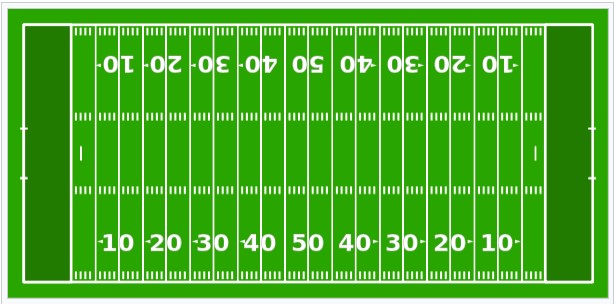
Football, one of my favorite spectator sports, is all about lines and edges.  One team faces the other, on an imaginary line defined by where the referee places the ball.  Cross that line before the ball is snapped and you’ll be flagged with a penalty.  Advance the ball ten yards past that line – to another imaginary line – and your team is awarded more play.  The sidelines of the field might as well drop off to a bottomless void.  Catching a pass outside of that edge is not allowed.  Running the ball outside of that edge brings the game to a halt.  But catching or running across the lines at end of the field?  That rewards you with a score.

$50 gets you a spot on “The Edge” sky deck

For all this living and playing on thresholds, maybe I should visit one of New York City’s newest high-rise attractions.  One hundred floors above the sidewalk, The Edge is billed as “the highest outdoor sky deck in the Western Hemisphere”.  Jutting out from its host building, The Edge allows unparalleled views of the city below, because the surrounding walls are solid glass, as is a portion of the deck floor itself (yikes!) If Spider-Man is your thing, you can go even higher by scaling the outside of the remaining floors of the skyscraper.  I have to say, this sort of thing draws a “fine line” between entertainment and, well, insanity.

I won’t be going to The Edge… ever.  I’m not good with heights, so anything above a pedestrian Ferris Wheel just isn’t my cup of tea.  Nope, leave me behind, comfortably grounded, where crossing the Savannah River from one state to another is plenty adventurous.  That’s my definition of life on the edge.

Some content sourced from Wikipedia, “the free encyclopedia”.

Tuesday’s Child

Passing through another anniversary of the events of 9/11 this week, I was touched by a YouTube short of U.S. Marines demonstrating the proper method of folding the American flag. The video includes gentle background music but no words, lending reverence to the ceremony. Folding the Stars and Stripes the right way is not only a nod of respect to our nation’s banner, but also an example of (flag) etiquette.
 
One of my favorite memories of my late mother was her ability to gently but effectively prod her sons to behave properly.  She would sometimes say quietly, “Mind your manners”, which meant two things.  One, something in our current behavior wasn’t in sync with how she raised us; and two, we would get a talking to later.  “Please” and “thank you” barely scratched the surface of how my brothers and I were expected to carry ourselves back then.
 
I’ve always thought of manners and etiquette as one in the same, but the former is a subset of the latter.  Etiquette is “the set of norms of personal behavior in polite society”, while manners are simply behaviors deemed “good” or “bad”.  An example of both is the way we drive our cars.  We’re taught the rules of the road, also known as “driving etiquette”.  But when we blatantly ignore those rules by, say, refusing to let a car merge onto the interstate in front of us, we’re letting bad manners get the better of etiquette.
 
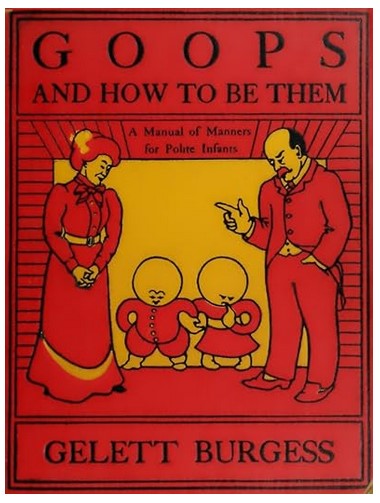
Manners always remind me of a book my grandparents encouraged us to read whenever we visited: Gelette Burgess’ 1903 classic The Goops (and How To Be Them).  Here’s an example of Goop behavior in Burgess’ poetry, simply titled “In Table”:
 
Why is it Goops must always wish
To touch each apple on the dish?
Why do they never neatly fold
Their napkins until they are told?
 
Why do they play with food, and bite
Such awful mouthfuls?  Is it right?
Why do they tilt back in their chairs?
Because they’re Goops!  So no one cares!
 
My mother probably labeled us Goops at one time or another, because my brothers and I were all about fingering our food or talking with food in our mouths or rocking back in our chairs.  It’s a wonder we developed any manners at all.  Maybe it’s because our mother’s parenting was fueled by a finishing school of sorts: her college sorority, where a premium was placed on etiquette.
 
Alpin Videmanette
Finishing schools, designed to “teach young women social graces as preparation for entry into society”, are something of an outdated concept now, at least in America.  You can still find a few “charm schools” in Europe, such as Switzerland’s prestigious Institut Alpin Videmanette – (whose teenage graduates included Lady Diana Spencer).  The Institut teaches young women to cook, make dresses, speak French, and even ski, but at its core, the curriculum is an education in etiquette.
 
Emily Post

The undisputed authority on etiquette, Emily Post, wrote several books and newspaper columns on the topic.  In the America of her lifetime (1872-1960) Post’s first etiquette book became a bestseller because it catered to “the country’s exotic mix of immigrants… eager to fit in with the establishment”.  I suggest most of Post’s etiquette is as relevant today as it was back then… and a lot of us could use an extensive refresher.

Always pass them together!
Besides the Goops, etiquette reminds me of an old poem teaching children the days of the week. “Monday’s Child” goes like this:
 
Monday’s child is fair of face,
Tuesday’s child is full of grace,
Wednesday’s child is full of woe,
Thursday’s child has far to go,
Friday’s child is loving and giving,
Saturday’s child works hard for a living,
And the child that is born on the Sabbath day, Is bonny and blithe, and good and gay.
 
Google tells me I was born on a Monday.  Darn it, so close.  If I was Tuesday’s Child I’d be defined as “… agreeable, refined, and polite in manner or behavior.”  In other words, demonstrating a solid understanding of etiquette.
 
The next time you’re standing on an escalator, step to the right to let those in a hurry pass by.  The next time you play golf, stay out of the line of sight when your opponent putts.  The next time you’re at the movies, don’t utter a word until the final credits roll.  And the next time you fold the flag, do it the way the Marines do. After all, you’d rather be credited with following the rules of etiquette than perceived as having bad manners.
 

Some content sourced from Wikipedia, “the free encyclopedia”.