Hello, I’m Veronica
The sky is not completely dark at night. Were the sky absolutely dark, one would not be able to see the silhouette of an object against the sky.


-
Sundance Man
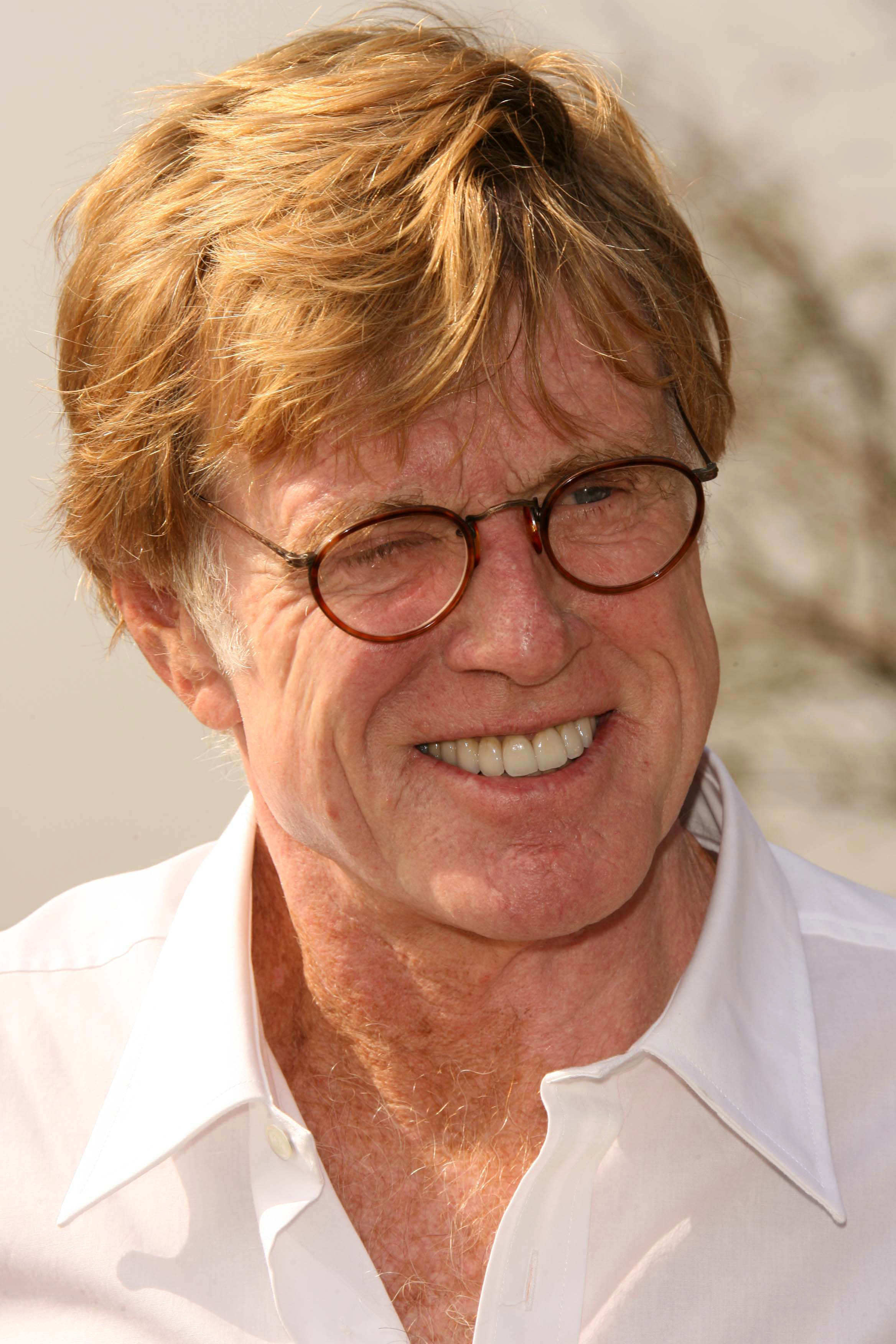
Two weeks ago we had a little excitement on the west side of town. A street and two houses were borrowed for a Netflix production called Our Souls At Night. For ten days cast and crew were hard at work while a few locals kept watch from lawn chairs across the street. Maybe I too would have grabbed a lawn chair if I’d known the film’s stars were Robert Redford and Jane Fonda.

I claim to be a Jane Fonda fan but really only for a handful of films; all between 1979 and 1981. In those years you had The China Syndrome, The Electric Horseman, On Golden Pond, and 9 to 5. On the other hand Robert Redford won me over for virtually every film he has acted in, produced, or directed. I would be hard-pressed to come up with a Redford movie I didn’t care for (and he’s made well over a hundred of them).
Robert Redford has worked with many of Hollywood’s greats. He made several films with Paul Newman for instance, including Butch Cassidy and the Sundance Kid, the earliest of Redford’s performances I can remember. When I consider how many Redford movies I’ve seen since his turn as the Sundance Kid, it’s remarkable I somehow missed The Sting – also with Newman and considered one of Redford’s best. Perhaps The Sting should be my “homework” for writing this blog.
Redford acted with Barbara Streisand in The Way We Were, with Dustin Hoffman in All The President’s Men, with Meryl Streep in Out of Africa, and with Brad Pitt in Spy Game. His leading ladies included Glenn Close in The Natural, Demi Moore in Indecent Proposal, Kristin Scott Thomas in The Horse Whisperer, Debra Winger in Legal Eagles, and Fonda in several other movies (including Barefoot in the Park, one of Redford’s first films).
Remarkably, three of my favorite Redford films are ones where he’s behind the camera instead of in front of it. in 1980 Redford directed Ordinary People, which won him the Oscar for Best Director (as well as Best Picture). In 1992 Redford directed A River Runs Through It and also narrated a good portion of the film. And in 2000 Redford produced The Legend of Bagger Vance, which proves that golf occasionally does make for good entertainment.
Redford is described as an “intelligent, reliable, sometimes sardonic good guy”. Nice to know he can laugh at himself. I also find it interesting he grew up in Van Nuys, CA (15 miles from my childhood home) and attended the University of Colorado (90 miles from my current home). Redford now lives near Park City, Utah, on several hundred acres he calls Sundance Ranch (home of the film festival by the same name). Redford once said, “I often feel I’ll just opt out of this rat race and buy another hunk of Utah”. I can relate to that.
Last week Robert Redford was awarded the Presidential Medal of Freedom, the nation’s highest civilian award. When asked to describe his body of work Redford said, “storytellers broaden our minds: engage, provoke, inspire, and ultimately, connect us.” Redford will soon be done with acting, but thankfully he will continue to direct. With that in mind I eagerly anticipate Our Souls At Night, and any other stories the man has yet to tell.
Some content sourced from Wikipedia, “the free encyclopedia” and IMDb.com
-
Little Jack Horner
Behold the Thanksgiving feast. Turkey and stuffing – a meal unto itself. String beans with mushrooms, dripping in butter. Crescent rolls (because you can never have enough carbs at Thanksgiving). Every side dish imaginable, or at least enough to fill up the empty spaces on the table. And then there’s dessert. Homemade cookies and cakes. Pies galore – pumpkin, apple, and cherry. And way over in the corner – completely overlooked like a little kid begging for attention – mince pie.

I love mince pie. It’s an exorbitance of flavors, provided you like the ingredients of course: raisins, dried apples, and molasses, blended with generous helpings of cinnamon, cloves, and nutmeg; topped off with two or three shots of brandy. For the spices alone – which were said to represent the gifts brought to Jesus by the three kings – mince pie is sometimes referred to as Christmas Pie. But early Americans didn’t celebrate Christmas, so mince pie made it to the Thanksgiving table instead.
Mince pie has a colorful history. The Brits get credit for the pie itself, but the Middle East gets credit for the fruits and spices, discovered by European crusaders on their travels and returned to their various homelands. Mince pie was originally a dinner pie – meat included – with the spices added to hide the sometimes “off” taste of meat without refrigeration. Over time the meat was left out entirely so only the fruit and spices remained. The pie literally morphed from savory to sweet (and from “mincemeat” to just “mince”). At one time mince pie was banned from dinner tables, frowned on as a religious symbol by Puritan authorities. I’m glad I don’t live in a time of Puritan authorities.
If you’re looking to salvage a few calories as you roam the Thanksgiving buffet, don’t go anywhere near mince pie. Were you to consume the whole pie you’d be talking 3,600 calories, and that doesn’t even include the essential topper of brandied cream (“hard sauce”). Were you to only eat the filling you’d still take in almost 400 grams of carbohydrate and 250 grams of sugar. But you’d take in no fat and almost no protein. It’s like consuming a concrete block. If someone threw you in the East River after a generous helping of mince pie you’d sink to the bottom in nothing flat.
More trivia about mince pie:
- An eating competition was held in 2006 where the winning contestant ate 46 mince pies (not 46 whole pies but rather the smaller tarts you see in the photo above).
- Mince pies were originally coffin-shaped (not round), but they just called them “rectangular” because coffins hadn’t been invented yet.
- Early versions of mince pie contained a total of thirteen ingredients – symbols of Christ and his disciples. Another reason those pesky Puritans considered the pie “forbidden fruit”.
Making mince pie is quite the chore. Take a pie shell, dump in a jar of mince filling, top with another pie shell, and bake at 425 degrees for thirty minutes. To be honest, the hardest part of making mince pie is finding the jar of mince. Your local supermarket may carry it but they usually hide it deep in the lowest shelves of the baking aisle (are they embarrassed to carry it?) One time I found a jar that looked dusty and dated, as if it had been back there since the last Thanksgiving. Another time the checker humiliated me by saying, “No one ever buys this stuff. Why would anyone ever buy this stuff.” Well, I buy this stuff, pal. Because I like mince pie.
Mother Goose rhymed: Little Jack Horner, Sat in the corner, Eating a Christmas pie. That’s me. I’m Jack on Thanksgiving. And I’m sweet on mince pie.
-
Patriot Games
Tomorrow a chessboard will be auctioned off in New York City, with an opening bid somewhere north of $75,000. For that kind of money you’d picture a one-of-a-kind treasure beautifully crafted from the finest materials; perhaps inlaid with gold. The chess pieces themselves would be intricately carved ivories or bronzes. On the contrary, the auction block chessboard looks like most others: alternating light and dark wood squares with nondescript wooden pieces. Not much to look at – unless you know its epic history.

In 1972, in what was later dubbed “Match of the Century”, American Bobby Fischer and Russian Boris Spassky met in Reykjavik, Iceland to play a total of twenty-one games of chess over a three month period. The match recognized history’s eleventh World Chess Champion, with Fischer emerging as the eventual winner. With the title Fischer claimed a purse that in today’s dollars would be almost $1.5 million. The chessboard in tomorrow’s auction was used in Fischer/Spassky games 7 through 21, replacing a stone board used for the earlier games.
The significance of the Fischer/Spassky match goes entirely beyond the crowning of another World Chess Champion. In the 1970’s the United States and its NATO allies, and Russia (then the Communist-ruled U.S.S.R) and its Eastern Bloc allies, were in the throes of a “Cold War” that defined the post-World War II tension between dominant world powers. The sociopolitical cultures of these “western” and “eastern” countries could not have been more different. Thus the chess match was seen as an allegory; especially with Fischer – the first American to ever compete for the title, taking on Spassky – the current World Chess Champion and one of five consecutive Soviets to hold the trophy dating back to the 1940’s. It was as if a feisty newcomer was speaking loudly for the first time. As former world champion Garry Kasparov described the outcome, “… the lone American genius challenges the Soviet chess machine and defeats it.”
The Fischer/Spassky competition attracted more worldwide attention than any chess match before or since. All twenty-one games were televised (though the third game had to be illustrated with move-by-move graphics since Fischer insisted on temporarily moving away from the cameras). In the years following the match, “Bobby Fischer Teaches Chess” became the best selling chess book ever published. The opening scene of the James Bond film “From Russia With Love” depicted a chess match with moves patterned after Spassky’s . Chess became supremely popular among American kids (maybe because Fischer was already playing in national championships at the age of fourteen).

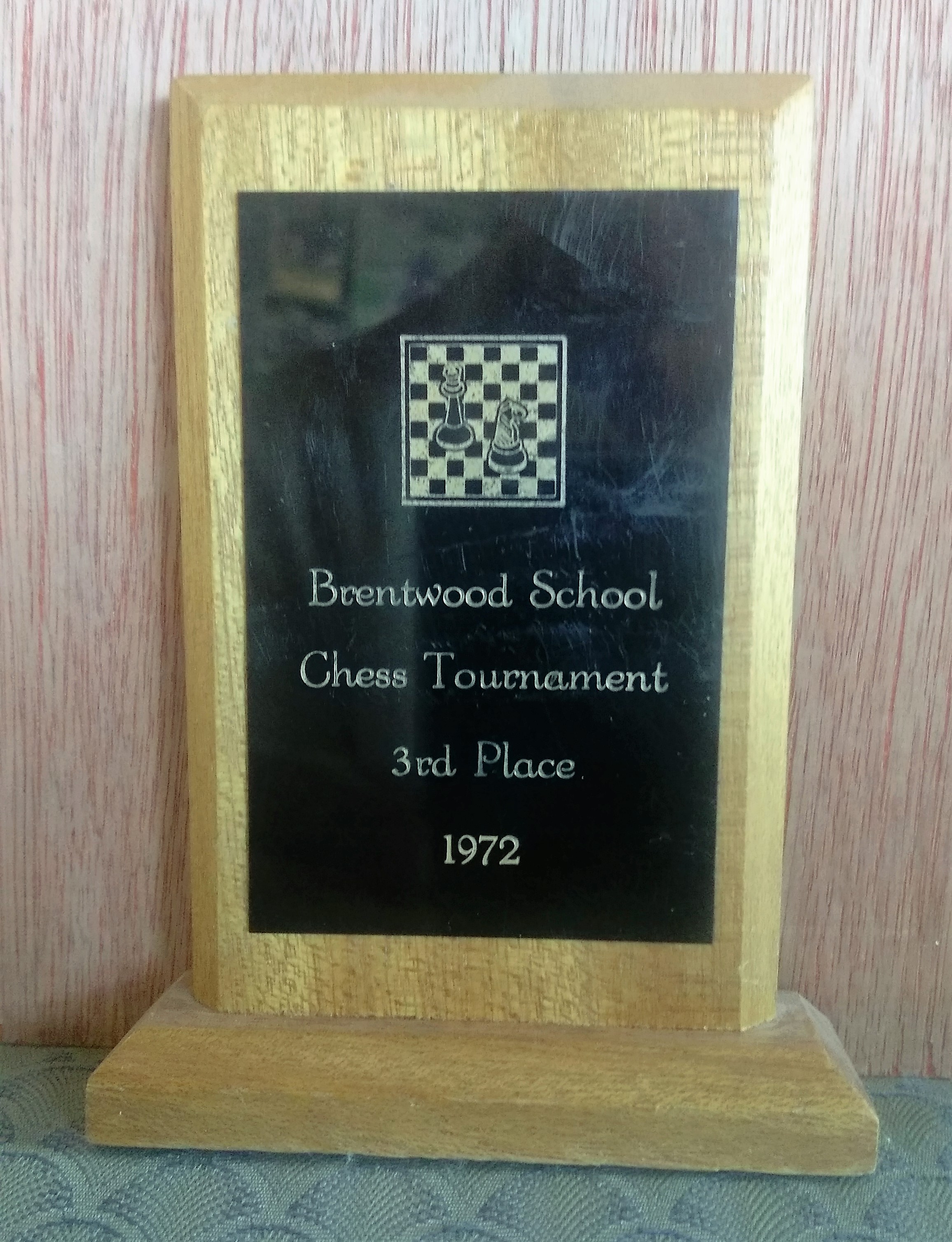
I have a personal connection with the Fischer/Spassky match, as shown in the photo above. I learned chess at an early age thanks to the determination of my grandfather. He insisted on a game every time we were together, and most times he beat me. Today I have one of his chess sets as a precious keepsake. But my grandfather also urged me to participate in a school-wide chess tournament, and the trophy you see was the result. From then on my grandfather teased me by saying he wouldn’t play anymore unless it was for the trophy.
Notice the date of the school tournament; inside the same year as the Fischer/Spassky match. By wonderful coincidence I was competing at a time when chess was most prominent on the world stage.
My chess game never really matured from those grade school years – and Fischer and Spassky likewise descended into relative obscurity – but a marked impression was made by watching their 1972 match on television. Now whenever I see a chessboard I’m reminded the game is not just kings and queens surrounded by their armies. The successful bidder at tomorrow’s auction will hold an emblem of history – from a time when the world’s chess pieces were as divided as never before.
Some content sourced from Wikipedia, “the free encyclopedia”.
-
America Makes the List
Last Friday’s celebration of the Chicago Cubs in the Windy City made headlines the following day. The fantastic turnout to celebrate a long-awaited World Series victory – from those lining the parade route to those further south at the rally – was generously estimated at FIVE MILLION people. That’s a serious confluence of baseball fans. But the number really gave me a jolt several days later, when someone ranked the gathering as the seventh largest in human history.
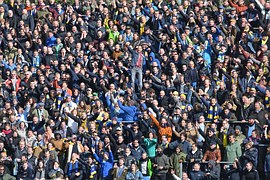
Five million. Hard to picture that many people in one location. The population of Chicago is only half as much so the suburbs must’ve emptied out as well (it was a record day for the Metra commuter rail service). Maybe I should’ve hired a helicopter or the Goodyear blimp and flown overhead, just to see all those human heads from a single vantage point.
Perspective? If you take the combined attendance to Major League Baseball games in the 2016 season – 73,159,044 fans watching 30 teams play 2,424 games – Friday’s crowd was almost 7% of that. If you only consider the attendance to the seven games of the World Series – 299,704 fans watching 2 teams play 7 games, Chicago’s party drew seventeen times that many.
Five million people live in Norway (though I challenge you to see every single Norwegian from one location). Five million people also live in the Russian city of Saint Petersburg, but how would you get them all to stand still while you counted?
I still can’t picture five million, but maybe the following will help. Dunkin’ Donuts just announced its “DD Perks Rewards” program exceeded five million members. Whirlpool just announced a recall of five million tumble dryers in the UK because of “blaze risk” (same technology as the Galaxy Note 7 phone?) A recent census indicated five million people have jobs in Switzerland. By the year 2020, a bunch of new robots will be added to the global workforce, thereby eliminating – you guessed it – five million jobs. Finally, here in Colorado the government’s ‘Project Baseline” built a vault to store all kinds of seeds for future experiments, in response to climate change and environmental degradation. Scientists have been collecting the seeds since 2012 and the vault now contains… five million of the little buggers.
Those are some fun facts but they don’t really paint the picture I’m looking for. Let’s consider five million another way. When someone says “seventh-largest gathering”, you want to know about gatherings one through six, don’t you? What would you guess – religious pilgrimage? Papal mass? State funeral? Correct, correct, and correct. Here are the top ten gatherings in mankind’s recorded history:
- Kumba Mela pilgrimage, India, 2013 – 30 million
- Arbaeen festival, Iraq, 2014 – 17 million
- Funeral of CN Annadurai, India, 1969 – 15 million
- Funeral of Ayatollah Khomeini, Iran, 1989, 10 million
- Papal gathering in the Philippines, 2015 – 6 million
- World Youth Day (also attended by the Pope), Philippines, 5 million
- Chicago Cubs World Series Celebration – 5 million
- Funeral of Gamal Abdel Nasser, 1970 – 5 million
- Rod Stewart concert, Brazil, 1994 – 3.5 million
- Hajj pilgrimage, Mecca, Saudi Arabia – 3 million
Thanks to the Cubs, America finally makes the list. But I’m no closer to picturing five million people than I was at the start of this post, and I’m running out of words. Tell you what. If the Cubs win the World Series next year (meaning the world comes to an end again), I’m heading to Chicago to be a part of the victory celebration. If I can’t picture the number, at least I can say I was “one in a million”. Or five million.
-
Let’s Do the Time Warp Again
Here we go again, time-travelers. This Sunday at 2:00am a good portion of the world will effortlessly move backwards one hour as we roll off of Daylight Savings Time (DST). It’ll be dark outside earlier (no more “summer nights”) and it’ll still be dark when most people wake up. Slam the door on summer – our days will feel shorter for the next eighteen weeks.
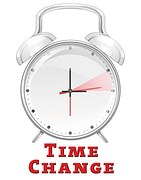
The rules of DST have changed over time (ha), at least here in the United States. The concept itself was borrowed from the Germans as a way of conserving fuel, and began in 1918; the same time the U.S. adopted “standard time zones” (Pacific, Mountain, etc.). At first it was a federal mandate in conjunction with wartime activities. Several years later DST was abandoned entirely. Then it was turned over to the individual states to adopt (or not). Finally, DST was given formal guidelines in 1966 as part of the Uniform Time Act.
DST still feels like an experiment with no satisfactory results. In 1974-1975 the U.S. tried DST for an entire year, but went back to the on-off approach when concerns were raised about kids heading off to school in the dark. In 1986 DST was extended from the half-and-half calendar to include the entire month of April. In 2005 DST was extended again to the first Sunday in November -to accommodate trick-or-treating on Halloween. That last modification was only eleven years ago, for a concept that has been around for a century. Any bets the rules of DST will change again?
Arizona (outside of their Navajo lands) and Hawaii may have the last laugh. Both states leave their clocks untouched while the rest of us move backward and forward year after year after year.
Whether or not DST continues, this much is true. On Sunday I will be resetting two alarm clocks (my wife’s actually auto-adjusts but doesn’t understand post-2005 DST), three wall clocks, three temperature gauges, two thermostats, two car clocks, and several appliances and watches. Any of these products could be designed to auto-adjust (like phones and computers) but maybe their creators don’t trust the DST rules won’t change yet again?
A word of advice about Sunday’s change. Proceed with caution when you head out on Monday. Not only will it be darker, but your body clock – which can’t be adjusted with a button – will be slightly out of kilter. Strange things happen the day after clocks adjust, including more accidents between cars and people (if certain Department of Transportation reports are to be believed).

Last thought. Today’s word is mnemonic, which refers to any means of making the retention of information in the brain easier. MNEMONIC is also an acronym for “Memory Needs Every Method Of Nurturing Its Capacity” (I like that). That brings to mind a couple other mnemonics. The Great Lakes can be remembered with HOMES (Huron, Ontario, Michigan, Erie, and Superior). The bass clef in music (the notes A,C,E,G) can be remembered with “all cars eat gas”. And of course, DST has its own mnemonic to determine which way the clocks adjust. Remember: “Spring forward, Fall back!”
Some content sourced from Wikipedia, “the free encyclopedia”.



About Me
The sky is not completely dark at night. Were the sky absolutely dark, one would not be able to see the silhouette of an object against the sky.
Follow Me On
Subscribe To My Newsletter
Subscribe for new travel stories and exclusive content.
 Life In A Word