
Hello, I’m Veronica
The sky is not completely dark at night. Were the sky absolutely dark, one would not be able to see the silhouette of an object against the sky.


-
Famous Dave’s
In church a few weeks back, the congregation sang “A Mighty Fortress Is Our God”, the popular Methodist hymn with such confident, faith-building lyrics. I’ve heard “A Mighty Fortress…” a hundred times over, yet try as I might to focus on the words I only ever seem to think: “Davey and Goliath”.

Davey and Goliath was an American clay-animated children’s television series produced by the Lutheran Church in the early 1960’s. The show was created by Art Clokey (better known for his characters on Gumby and Friends), and focused on childhood life lessons born out of Davey’s experiences alongside his dog Goliath. Davey always found himself in conscience-testing situations and Goliath brought the wisdom to steer him the right direction. Davey and Goliath aired on Sunday morning television for the better part of five years and I didn’t miss many episodes. So why the connection to “A Mighty Fortress…?” Because the hymn trumpeted behind the closing credits of every Davey episode. I can’t get that association out of my head.
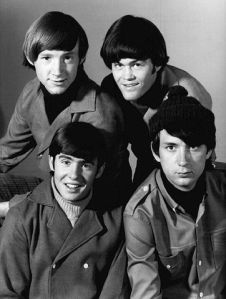
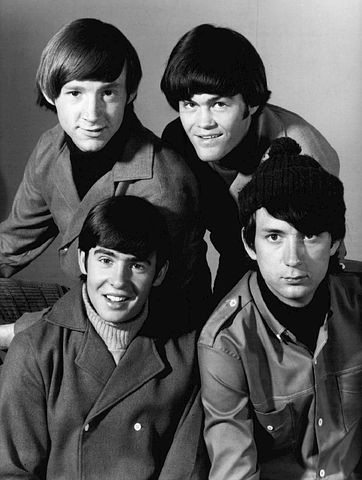
Memory association is a strange bird, as if there are kindred thoughts floating around out there just waiting to be connected. I associate a Methodist hymn with an old children’s television show, whereas your association might go down a wholly different path. Take it a step further for example. With Davey and Goliath on the brain what comes to mind next? You might think of the Bible story – the young and future king David bringing down the Philistine warrior Goliath with one pull of the slingshot. Me, I think of The Monkees – the manufactured American rock band of the 1960’s. The Monkees had the only other Davey I can think of – singer Davey Jones (lower left in the photo below).
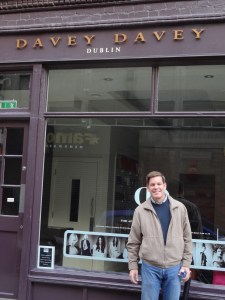
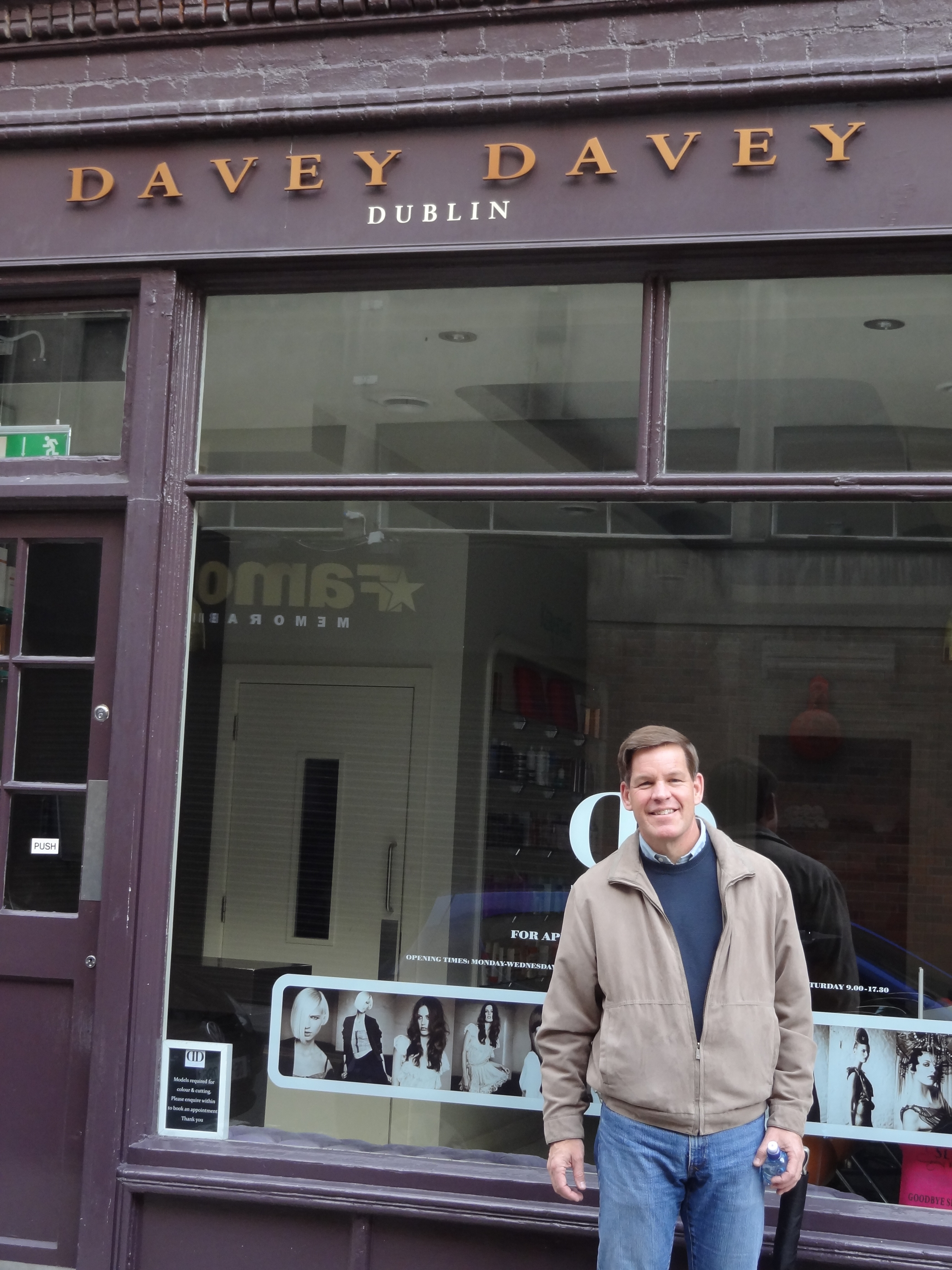
Now that I think about it (memory association at work again), I do have another Davey in mind, which you see in the below photo (not me – the shop). Davey Davey is a “top hair salon” smack dab in the middle of Dublin, Ireland. The owners – presumably brothers – have the surname Davey. That’s a rare find: a surname more commonly used as a given name.
The Monkees always make me think of The Beatles, and just this week The Beatles associate to “sensational” (intentional) misspelling: “Beatles” vs. “Beetles”. I never thought about it until my son brought it up but the “Beetles” became the “Beatles”, changing their name early on to associate more with musical beats than insects. How’s that for useless trivia?
The Monkees are also a memory-association “cul-de-sac” for me; that is, I came back to Davey Jones shortly after I left him. Davey Jones then memory-associates to several other David’s who made small but significant appearances in my life, as follows:
- David Cassidy – Alongside the Partridge Family (and The Brady Bunch), Cassidy occupied several years of my Friday night childhood television. Not one of my better life choices.
- David Lee Roth – Alongside Van Halen, helped develop my appreciation for American rock in the 1970’s (if not the current fashion trends). As Roth would say, “might as well jump!”
- David Robinson – Alongside his Navy teammates, helped develop my appreciation for the best in college basketball post players. Imagine, a class athlete and a class act. That was “The Admiral” in a nutshell.
- David Letterman – Reinvented late-night talk show for me and my fellow baby-boomers. In college I didn’t miss a single Letterman opening monologue (or Top Ten list).
- “David” – Michelangelo’s most famous sculpture, on display in Florence’s Galleria dell’Accademia near the Piazza della Signoria. (How “the David” came to be is a remarkable story – read Irving Stone’s biographical novel “The Agony and the Ecstasy”.)
- David Koresh – Alongside his Branch Davidian cult followers, showed me the horrors of brainwashing amidst the famous 1993 standoff with government officials in Waco, TX. (There had to be at least one “shame-the-name” on this list.)
- David Copperfield – Elevated magic to jaw-dropping larger-than-the-stage performances. My family and I saw him perform in Colorado Springs in the 1990’s. Copperfield was unquestionably one of the legends of his profession.
- David Schwimmer – Still can’t get “I’ll Be There For You” (or Rachel) out of my head.

The list goes on and on – dozens of David’s making their mark out there. Incidentally, the literal association of “David” is “beloved”, which also dates back to the Bible. Nice. But that’s not how my mind works. I just keep coming up with famous Dave’s instead.
Some content sourced from Wikipedia, “the free encyclopedia”.
-
Reinstating the “Swoosh-Curl”
The Associated Press (AP) recently posted an article: “Cursive Writing Makes a Comeback in U.S. Schools”. That caught my eye, because I didn’t know cursive writing went anywhere in the first place. I assumed most everyone – regardless of age – can sign their name in cursive. Turns out the broad adoption of Common Core curriculum standards in 2010 removed “handwriting” as an essential skill. The teaching time once used for cursive now goes to learning the keyboard. Ask today’s student for a signature and you’ll probably get block letters instead of “continuous flow”.

I still remember my grade-school days spending hours on paper, forming my upper and lower-case letters. Then I graduated to cursive, and the “swoosh-curl” of the loops as I progressed across the page without lifting the pencil. Cursive evolved from block-letter writing as a way to speed up handwriting. If speed were the only criteria, no wonder today’s generation prefers the keyboard. In the race between my cursive on paper and my daughter’s thumbs on the smartphone, she wins by a landslide.

Speaking of cursive, here’s an example of my very own. Hopefully you can read it.
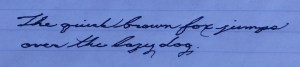
That’s right: The quick brown fox jumps over the lazy dog – a sentence I wrote over and over in cursive practice. It’s a pangram – a sentence using all the letters of the alphabet. The quick brown fox… is the most famous pangram but there are several others, including: Pack my box with six dozen liquor jugs!
The shortcoming of my own cursive writing is my speed – or lack thereof. It took me almost sixty seconds to write the sentence above. You could probably write the same sentence in half the time. But I have a couple of challenges working against me. One, I’m left-handed, which means I’ve developed a curious writing style where I curl my hand around the point where pen meets paper. This forces my hand to stay higher on the page and avoids ink smears, but I can’t go very fast. Two, I have essential tremor, where my hands shake slightly when held in certain ways (like writing). If I don’t go s-l-o-w, my cursive is downright illegible.

If cursive writing was born of block letters, then block letters were born of calligraphy. Calligraphy is writing elevated to a visual art, where the lettering is created with wide and narrow strokes and requires the use of a special pen. Today’s computer fonts try very hard to simulate calligraphy but there’s nothing quite like the handcrafted version. The finest examples – using the Latin script – are found in early copies of the Bible; the so-called “illuminated manuscripts” created before the advent of the printing press. Today you’re more likely to find calligraphy on wedding invitations, college diplomas, and other formal documents. I have an aunt who mastered calligraphy and I wish I’d kept some of her letters and thank-you notes. That kind of penmanship suggests a certain level of elegance and refinement noticeably absent in today’s writing.
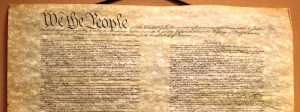
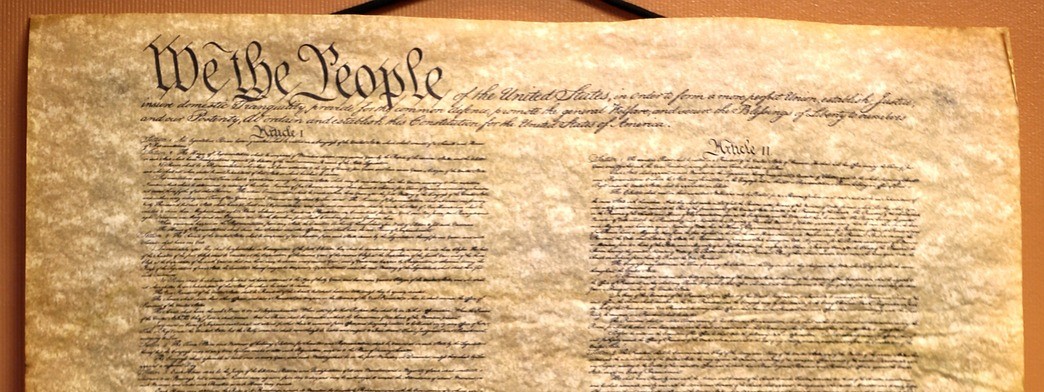
The AP news article claims fourteen states have reinstated cursive writing into their grade-school curriculum, so here’s hoping for more continuous flow signatures. But there’s still plenty of debate about the “usefulness” of the swooshes and curls when keyboarding is clearly king. To those who don’t see the value, consider this: our nation’s most important documents were written in cursive. If you can’t write the U.S. Constitution in cursive you probably can’t read it in cursive either. That would be a shame if you were ever lucky enough to see the original in the National Archives.
Some content sourced from Wikipedia, “the free encyclopedia”.
-
Bon Voyage!
Every now and then I come up with a topic for my blog, and then the topic somehow surfaces in the natural course of conversation later the same week. It’s a little unnerving – perhaps divine intervention – to watch someone bring up something you hadn’t thought about in years, or at least until a few days earlier.

Such was the case this week when I opted for a (virtual) visit to Mont Saint-Michel, the majestic island commune and fortified abbey just off the coast of Normandy, France. Mont Saint-Michel came to mind because I received a mailer from my alma mater advertising a ten-day trip to the region next summer. The itinerary includes a stopover in Paris, a base hotel in the historic seaport village of Honfleur, extensive tours of Normandy focusing on the events of World War II, and finally, a full day exploring the island of “St. Michael’s Mount.” Mon dieu, what an adventure!
Mont Saint-Michel has a remarkable history on top of its dramatic architectural elements (which you can read about here). Its buildings date to the 8th century, with the Romanesque abbey and monastery at the very top (“closest to God”), literally supported by a vast network of halls for stores and housing, and finished elegantly at the bottom – outside the walls – with individual houses for the handful of fishermen and farmers who live there. The church inside the abbey is partnered with an open-air cloister (a square covered walkway for reflection). A statue of the archangel Michael watches over the land from the very top of the church spire. Magnifique, no?
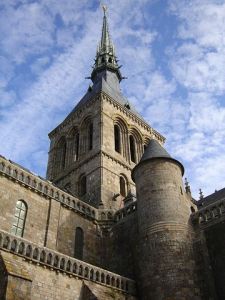

Here’s an interesting bit of trivia about Mont Saint-Michel. You may think the following photo is a distant view of the island. Au contraire. The Mont has a “sister” across the channel near Cornwall. England’s island of “St. Michael’s Mount” is much smaller, but it still shares the characteristics of Mont Saint-Michel, including the significant rise/fall of the surrounding tides, the conical shape of the island, and a chapel at the top.

In today’s world Mont Saint-Michel is a little touristy for my tastes, so perhaps it’s just as well I’ve never made the pilgrimage. 2.5 million visitors descend upon the island every year, hosted by only 25 full-time inhabitants (monks, nuns, and shopkeepers). Tourism is literally the only source of income. Besides a walk through the abbey and the spiraling streets, you’re channeled into the requisite shopping area, for food (including the famous to-go omelettes), and for purchases that can only be labelled as “tacky”. I actually have one of these souvenirs (below photo). Sacre’ bleu! Maybe if they’d left off the sailboat…

To further detract from the mystique of the Mont Saint-Michel, a permanent walking bridge was built three years ago, allowing round-the-clock access from the mainland car-park. Once upon a time you had to wait until low tide and then quickly walk across the natural spit of land before the water returned. Now you just cross whenever you want. Too bad, but apparently the channel was filling in with silt and a bridge was the only way to keep the island an island. C’est la vie.
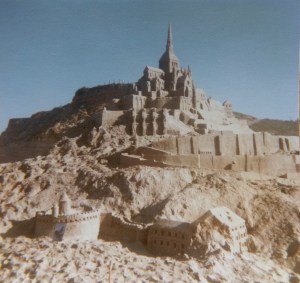
My first introduction to Mont Saint-Michel was forty-odd years ago on the shores of California, not France. San Diego County hosts elaborate sand-castle building competitions on its beaches, and one year I snapped the following photo of the winner.
To visit Mont Saint-Michel, you’ll need to drive four hours to the west of Paris, all the way to the coast of the English Channel. Unless you have a hankering for WWII history, there isn’t much else to draw you to the region. Which brings me back to the start, and my comment about topics resurfacing later in the week. Three days after I wrote this post, I was having a beer with some older friends and we got talking about the movie “Saving Private Ryan”. One of the guys said his dad served in WWII and he’d taken him back to the beaches of Normandy, where he’d spent part of his time as a medic. “Normandy?”, I said. “Yes”, he said. “You know, in the northwest of France near Mont Saint-Michel?” To which I almost said, “excusez-moi?”
Some content sourced from Wikipedia, “the free encyclopedia”.
-
You Can’t Walk and Chew Gum
In the local news this week, we learned Amy Wilson and her newborn – residents of our fair city – are in critical condition in a Salt Lake City hospital as victims of a head-on collision. Wilson and her newborn suffer brain injuries as they struggle to survive, while two of three teenagers from the at-fault car are dead. The heartbreaking interview with Wilson’s husband here in Colorado included loss of words as he tried to reconcile the happiness of a birth with the tragedy of the accident.
My reaction to this story – besides donating to the “Amy and Baby Wilson Support” GoFundMe campaign – was the teenagers must have been texting at the wheel. I wonder if they even left skid marks. Prayers be with them, Amy Wilson and her newborn will survive and their injuries will be short-lived. But the same cannot be said for the kids in the other car. As it turns out they were street-racing when they jumped the median. They might as well have been texting.

The victims on both sides of this accident will join the rising morbid statistics tied to “distracted driving”, which includes use of smartphones. We just can’t put them down, even with risk of life staring us in the face. By no coincidence, the Wall Street Journal published an article this week about rising insurance rates tied to use of smartphones while driving. 36% of State Farm customers admitted to texting while driving, up 5% from five years earlier. 20% admitted to taking a photo while driving; another 10% take videos. In those same five years smartphone ownership among drivers increased from 50% to 90%.
I will never understand the urgency to check a text while driving. Apparently I’m not as addicted as most. If I’m “late” in responding to a message, I can’t think of a better excuse than “I was behind the wheel”. When my phone rings or a text message dings, I will find a safe place to pull over if I can. More often I’m not going to answer until I get where I’m going.

Perhaps I’m more motivated than most, because my son caused a distracted driving accident several years ago in high school. As he fiddled with the car stereo leaving campus, he braked too late when he saw the red light in front of him, causing a chain-reaction fender-bender involving five cars. Thankfully no one was hurt, but even at school-zone speeds my son caused a lot of damage. Because of that incident I chastise my children any time I receive a text from them and realize they are driving.
Technology is trying to improve things, of course. Voice-activated control is a lot better than it was just a few years ago. But we’re not there yet. Until it is commonplace to conduct a stream of communication from start to finish hands-free, the senseless accidents – and the insurance rates – will continue to rise. Even if you perfect the technology, you still have the distraction.

Sure, you can walk and chew gum at the same time, but not so texting and driving. I looked at the photo above and thought, “what if you saw that through the windshield of the car coming towards you?”
The next time you’re on the road and you get that familiar ding, just keep going where you’re going. No matter the message, it’s infinitely less important than the safety of those around you.
-
Something Wicked This Way Comes
This April, a movie called The Circle will arrive in theaters, and it just might generate enough buzz to displace political headlines. The previews start innocently enough: a wide-eyed young woman “Mae”, who can’t believe her good fortune at being hired into the thoroughly glamorous Internet company “Circle” (a super-hybrid of Apple, Google, and Facebook). Predictably, things take a turn for the not-so-good when Mae realizes her new employer seeks a singularly “true” Internet identity for its consumers, revealing all there is to know about a person.
The previews for The Circle intrigued me enough to give the book a try, even though the reviews were mediocre at best. But no matter; the premise draws me in and keeps me reading. What resolution can possibly exist in a not-so-distant future where an individual’s “privacy” goes completely out the window? The Circle proposes an all-knowing (and therefore) all-exploiting Internet service; a corporate version of totalitarianism. I can’t imagine a happy ending, can you? As Ray Bradbury would say, something wicked this way comes.

Ray Bradbury authored countless short stories placing believable humans in not-quite-so believable circumstances, yet seeking a peek into a probable future. “Fahrenheit 451” is perhaps his most famous example, but I have my own favorites, including “The Golden Apples of the Sun”, “A Sound of Thunder”, “Skeleton”, and “The Veldt”. I own a collection of Bradbury’s “hundred best”, and find them just as compelling as when I first read them forty years ago. Why? Because they still aren’t quite believable. The presumptions and technologies and societies of Bradbury’s stories are still somewhere around the corner of the world of today. But I have no doubt they’re coming.
The same case can be made for the cult-classic neo-noir film Blade Runner, produced in 1982 but based on a book written decades earlier. Blade Runner made several far-reaching assumptions about a dystopian Los Angeles of the future: a) climate change, creating an environment dominated by darkness and rain, b) culture change, where its inhabitants, language, and food are decidedly Asian, and c) technological change, where “replicants” (robots) perform the mundane tasks humans no longer care to do. Blade Runner’s mystique is in the depiction of a familiar place transformed by radical changes; the kind that aren’t so unbelievable. Not now perhaps, but they’re coming. (Also coming: a sequel to Blade Runner later this year).
Here’s another example from Hollywood. Logan’s Run (which was an on-screen disaster just begging to be remade thirty years later), depicted a completely controlled, pleasure-filled world inside a giant, sterile dome – but only until age thirty, when its inhabitants were ceremoniously put to death (to conserve the resources of a supposedly dying planet). By default, Logan’s world is a society where everything is new and clean, everyone is “young”, and a day in the life is controlled by some behind-the-scenes, largely technological presence. “Logan 5” and “Jenny 6” (a delightful nod to the loss of individualism) are too dependent on the comforts of their world to ever acknowledge its limitations. Considering how technology shapes our actions and decisions today, perhaps Logan’s world is not so far-fetched anymore.
The appeal of Ray Bradbury, Blade Runner, and Logan’s Run – even today – is stories about worlds that are (still) not believable. We can enjoy them yet keep them at arm’s length, comforted by the thought “can’t really happen”. And that’s what makes The Circle a serious conversation piece (even if it’s a box-office flop): a taste of an all-powerful, all-knowing Internet – if governments and corporations let it get that far. Once we reach that point is there any turning back, or will “drones” more aptly describe humans than cool little flying machines? Terrifying foresight for sure, but hopefully not prescient thinking.
Okay, you’re done reading now. Back to your Facebook feed.














About Me
The sky is not completely dark at night. Were the sky absolutely dark, one would not be able to see the silhouette of an object against the sky.
Follow Me On
Subscribe To My Newsletter
Subscribe for new travel stories and exclusive content.
 Life In A Word