
Hello, I’m Veronica
The sky is not completely dark at night. Were the sky absolutely dark, one would not be able to see the silhouette of an object against the sky.


-
Education Opulence
At New York City’s exclusive Trinity School on the Upper West Side, kindergartners look forward to a year of “…building self-confidence, independence, and responsibility”, coupled with “forming friendships, dealing with a variety of social situations, and discovering the joy and excitement of learning…” Sounds like a solid choice for early schooling, until you consider the daunting application process and the need for financial aid. Your child’s chances of acceptance are only 1 in 5, and a year of Trinity grade-school will cost you $50,000.

Trinity isn’t in a class(room) of its own with its hefty private-school tuition. At least forty-five other independents in Manhattan carry a similar price tag, according to a recent Wall Street Journal article. Perhaps Trinity boasts of its 300-year history, evolving from noble roots “providing free education for the poor in the New Colony”. Certainly, Trinity basks in its high enrollment of graduates into Ivy League-caliber universities. But history and performance are not prerequisites for the high costs. The Upper East Side’s Wetherby-Pembridge School opened just two weeks ago with no tangible credentials. The cost of a year at W-P for a three-year old? $45,500.

Remarkably, fifty grand in tuition doesn’t even cover the full cost of a year of education. Many of NYC’s independent schools fund-raise and conduct aggressive capital campaigns. Without state-of-the-art facilities and salaries befitting doctorate-level educators, private schools risk losing students to the more “affordable” options in town.
Elite K-12 academies also find themselves in a moral dilemma. While their tuition costs rise faster than the rate of inflation (23% in just the last five years), their enrollment becomes inevitably less reflective of the society around them. The Bank Street School for Children “views diversity as essential to its academic program”, but struggles to deliver on that value when virtually all its students come from the top 1% of incomes. Even the rich are forced to compromise to keep up with tuition payments. Many forego vacations, club memberships, and expensive hobbies for the sake of their child’s top-dollar education.

When our kids were born in the San Francisco Bay Area almost thirty years ago, my wife and I had differing opinions on the best options for K-12 education. My wife graduated from a private Catholic high school in Chicago, while I graduated from public schools in Los Angeles. We had good reason to consider either option with our own kids. Our research included several independent schools, including the prestigious Menlo School in Atherton, and the (Catholic) Woodside Priory School in Portola Valley. Even then private-school tuition was beyond our reach, not to mention the implied commitments (tithing, volunteering). We moved to Colorado before we gave Bay Area schools a chance (and our kids graduated from Colorado’s public schools), but it’s safe to say they would’ve gone to public schools no matter where we lived. Today, Menlo and Priory cost $45,000/year.

With another nod to Manhattan’s Upper East Side, our daughter recently talked us into watching the television series “Gossip Girl”, which ran from 2007-2012 on The CW network. Gossip Girl explores the lives of New York’s upper-class adolescents, with most of the drama taking place in and around the “Constance Billard School for Girls” and “St. Jude’s School for Boys”. Gossip Girl’s story lines are hit or miss, but the characters’ appetites for the uber-wealthy lifestyle are on full display. Stretch limousines, lavish parties, jet-set European vacations, and top-dollar wardrobes would imply $50,000 for a year of K-12 tuition is a drop in the bucket. Gossip Girl may be a fictional world, but opulent education is real, and a gold ring lying beyond most of our grasps.

Manhattan’s private-school world is a little too ostentatious for my tastes. I received a perfectly good education in public schools, after all. Trinity School’s website includes a welcome from the “Head of School” who proudly claims, “students and teachers work together to create a dazzlingly dynamic mosaic of human excellence”. With that glittering generality, no wonder the five-figure price tag.
-
Knight Watchman
This week’s headlines are full of speculation about Apple’s soon-to-debut iPhone X. We’re still a month away from pre-orders, yet iPhone X headlines carry the weight of those for the hurricanes and North Korea.
 Images courtesy of www.apple.com
iPhone X’s new/improved features sound impressive: “”It’s all screen”, facial recognition, surgical-grade stainless-steel, water resistance, wireless charging, superior camera functionality, and an “A11 Bionic” smartphone chip capable of 600 billion operations per second. Sounds like a noticeable upgrade from the iPhone 7.

Despite this fanfare, my eye is still drawn to the iPhone’s most basic app: those numbers at the top of the “elegantly-rounded screen” silently telling the time-of-day.

I wear a watch. Always have. I wake up every morning, get dressed, pocket my wallet, handkerchief, and keys, and “wrist” my watch. It’s a habit I’ve had since college days. Granted, my wallet gets slimmer by the year, as the need for cash and physical cards dwindles. My key chain is no longer a chain; not even a set of keys (rather, a small fob controlling my car without ever leaving my pocket). Mercifully, my handkerchief hasn’t changed whatsoever (other than the purchase of a new one every couple of months).

My analog watch – though threatened by technology – remains steadfastly on my wrist. I started wearing watches when I was a kid, and several decades later I still have the first two I ever owned. My Snoopy watch was the wind-up type, telling time with its hours and minutes “paws”. My gold (colored) Pulsar was one of the earliest of its brand, and seemed to say, “time to grow up”.
Several years after my Pulsar I purchased (or received) another wristwatch, followed by another and another and another. At some point in the process my watches became too nice to part with, and “replace” became “collect”. Today, I choose from half a dozen.

Recently, I gave smartwatches a try. I figured, why not get my time and all those other time-saving applications on my wrist? But it just didn’t take. Like digital-display watches, I missed the elegant mechanics of a real analog watch. For a short time, I tried wearing an analog on one wrist and a smartwatch on the other. Also didn’t take (and probably drew a few curious looks in the process).
On yesterday’s commute talk-radio, the discussion was the iPhone X, and the host said, “anyone 40-and-older probably still wears a watch”. That statement applies to me (both age range and habit). I simply cannot forego my wristwatch for a smartphone. No knock to smartphones, mind you. In fact, with its $1,000 price tag, the radio host asked callers to predict whether the iPhone X would sell. All ten callers I heard said people would buy, just as they did at the $500 threshold. To anyone who thinks $1,000 is excessive, consider this: the smartphone has become a cultural necessity; a here-to-stay personal computer appendage (gather dust, ye laptops and desktops). And $1,000 is a reasonable price for a personal computer these days.

Here’s a more concrete argument for the $1,000 price tag. Make a list of the iPhone’s basic apps, and consider the cost of say, five years of physical materials to replace those apps. Note pads, address books, calendars, paper maps, wallets, cameras, telephones, stereos, calculators, newspapers, and postage stamps (a wholly incomplete list). Watches. Well, what do you know; you just spent a lot more than $1,000! Any further arguments?
No arguments from me either: the X will be a good and popular buy. But you’ll still find a watch on my wrist.
-
Carefree Highways
Here’s a connect-the-dots challenge, tapping what’s left of your road-trip driving fever from Labor Day weekend. Pull up Google Maps, pick two towns on opposite edges of the continental United States, and see if you can discover the longest driving trip. The only rules: you must start and end with U.S. cities, and your answer must be the blue line (not the grey line alternatives).
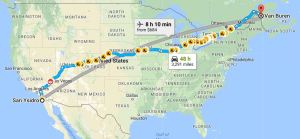
My first guess on Google Maps (above) is effectively the longest drive between the borders of Mexico and Canada. San Ysidro in California wouldn’t exist if not for the busy border crossing just to the south. Van Buren in Maine wouldn’t exist if not for a small group of Nova Scotia citizens exiled from Canada in 1785. As you can see, my southwest to northeast traverse gets me 3,291 miles of driving and takes more than two days (including a wealth of bathroom stops). In the process, I pass through ten U.S. states and three Canadian provinces. Label this trip a long-distance segue from “Ole!” to “Eh?”
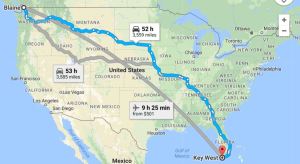
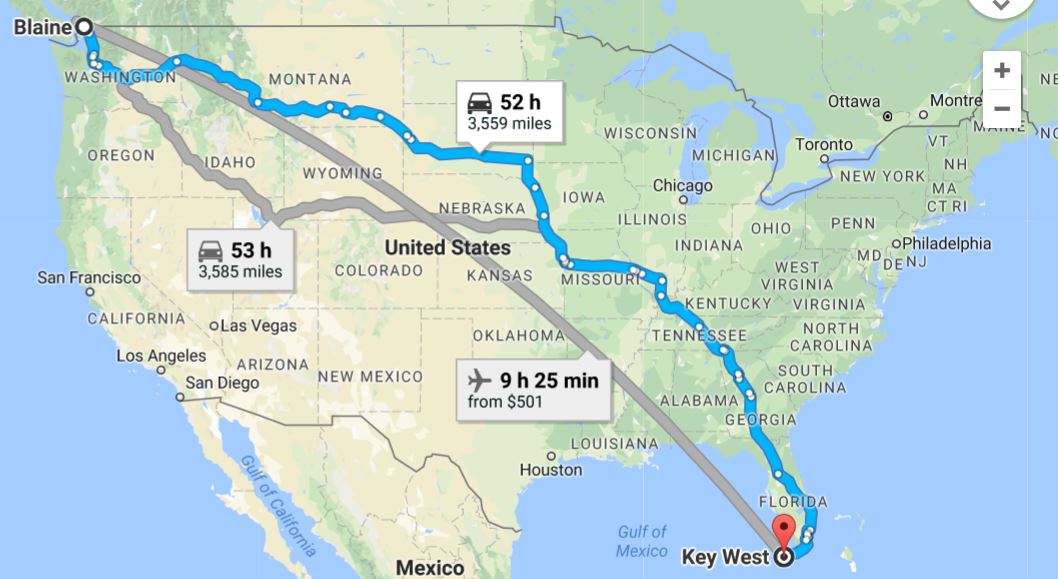
My second guess chooses a sun-starved soul north of Seattle, seeking some beach time in the Florida Keys (though someone named Irma would object right about now). Our friend finishes his oyster stew in tiny Blaine, WA; points his car to the southeast, and arrives in Key West, FL two-and-a-half days later, just in time for a twilight margarita with Jimmy Buffett. His drive also passes through ten states (like my first guess) but lasts 3,559 miles. If our friend finished in Miami he’d drive the same distance as my first guess, but Highway 1 – further south through the Florida Keys – buys him a 160-mile tiebreaker.
A recent Wall Street Journal article asserts we Americans are endlessly romanced by the allure of the open road (a “four-wheeled traipse” if you will), and the Labor Day holiday conveniently marks the end of the summer travel season. Thus, you get a lot of drivers on the first weekend in September – 600,000 in Colorado alone, or 11% of the state’s population. That translates to over 3.5 million road-trippers across the entire United States. Traffic jam, anyone?
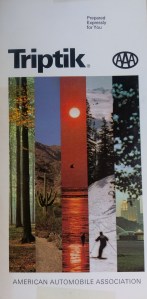
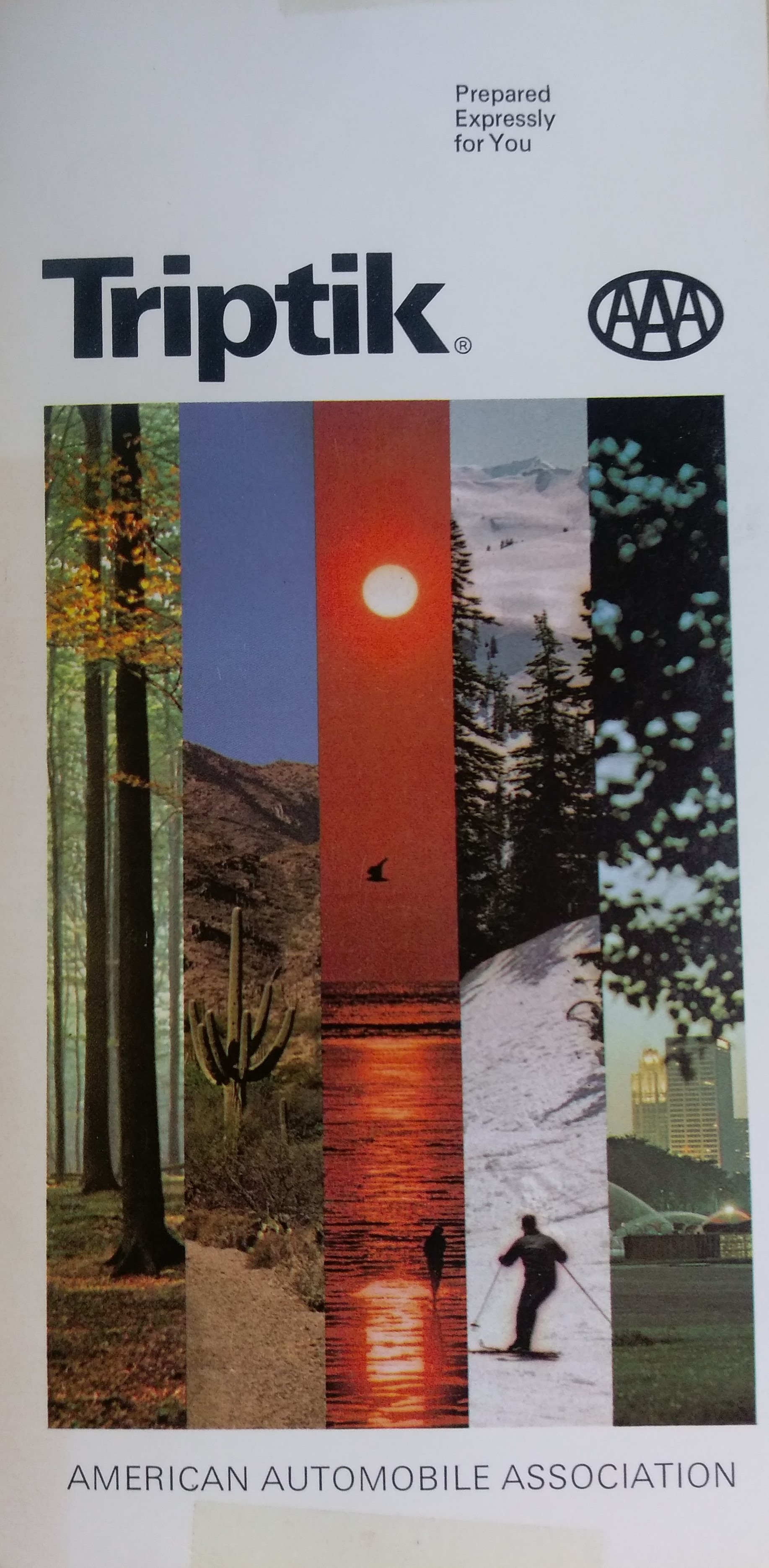
In the prehistoric times of street-corner pay phones and folding road maps (read: 1970’s), the American Automobile Association (AAA) offered a service called “Triptik”. Go to an AAA office, tell ’em where you want to go, and they’d hand you a step-by-step book of maps “prepared expressly for you”. My parents gave me a Triptik – and all the station wagon gas I needed – as a high-school graduation present. My buddy and I created a Western States round-trip starting in Los Angeles, driving as far north as Montana, as far east as South Dakota, and returning through the Southwestern states. Our aim was to hit as many national parks as possible. We spent a few nights in motels (on our own dime), but most nights in sleeping bags in the back of the station wagon. No agenda, no worries – just a couple of teenagers making a ton of memories on the open road.

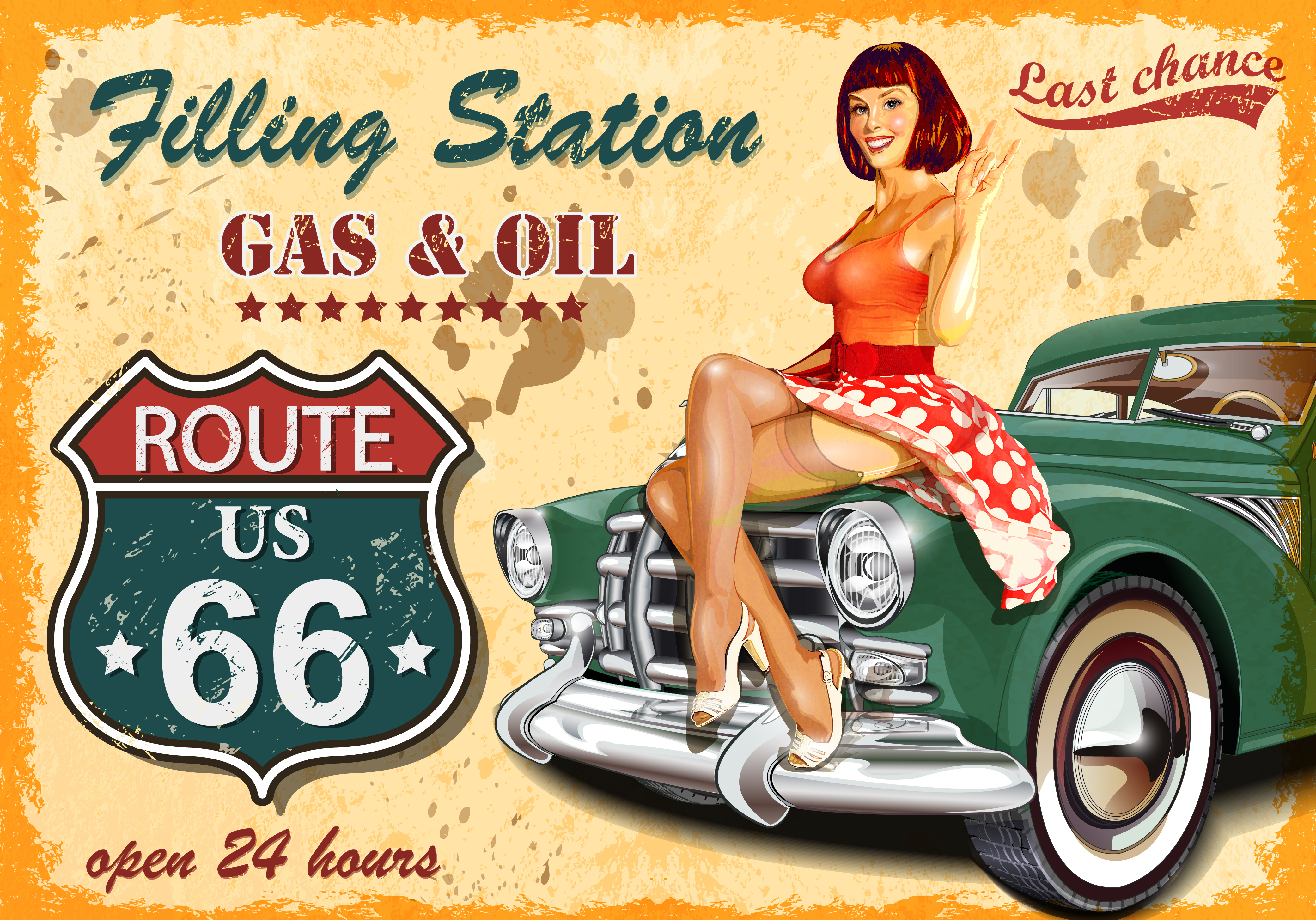
On the topic of road trips, I owe a nod to America’s beloved “Main Street” – U.S. Route 66. Though nowhere close to the longest road trip in the U.S., Route 66 is certainly the most renowned. Built in 1926, the “Mother Road” ran from Chicago to the Pacific Ocean west of Los Angeles – fully 2,448 miles. Early 1900’s migration to the Western U.S. owes some of its success to 66, and all those road-trippers “got their kicks” at the hundreds of restaurants and motels born along the highway. It wasn’t until 1985 – sixty years later – the last remnants of Route 66 were replaced by newer segments of the U.S. Interstate Highway System.
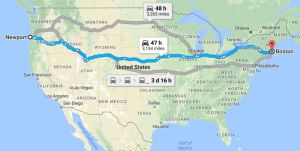
Now then; time to solve the Google Maps challenge (with a twist). The winner of the point-to-point American road trip is some nearby version of my second guess above: Washington to Florida. However, for my money I’d much prefer the drive from Oregon to Massachusetts (above). The twist? You can do it all on one ridiculously long highway! U.S. Route 20 – “The Big Daddy” – starts in little Newport, Oregon (pop. 10,000) and ends in Boston (pop. 673,000). You’ll cover 12 states and 3,154 miles before you hit the checkered flag. It’ll take you almost two days without stopping, but please stop. Along the way you’ll find the Idaho Potato Museum, Yellowstone National Park, “Carhenge” (a Stonehenge homage made entirely of autos!), Iowa’s Field of Dreams, Hall of Fame’s for RV’s/motor-homes, rock & roll, and baseball; and most importantly, the Jell-O Gallery Museum, your one-stop-shop + tribute to the jiggly dessert. C’mon, how you gonna top that road trip (with a dollop of whipped cream?)
Some content sourced from Wikipedia, “the free encyclopedia”.
-
Any Way You Slice It
Labor Day is right around the corner, but I call your attention to a couple of tastier holidays this time of year. Last Thursday was Peach Pie Day and a month henceforth will be Strawberry Cream Pie Day. October will usher in Pumpkin Pie Day, as well as Boston Cream Pie Day. In November, we’ll celebrate Bavarian Cream Pie Day. Next May we’ll celebrate Apple Pie Day (and that one should be designated an American holiday).

These pie-eyed celebration days come and go with little more than crumbs for fanfare, but any attention to pie is a good thing in my book. Whether sweet or savory, fruit or cream, single or double-crust, bite-size (“cutie pies”?) or multiple-serving-size; you can never have too many fingers in pie.

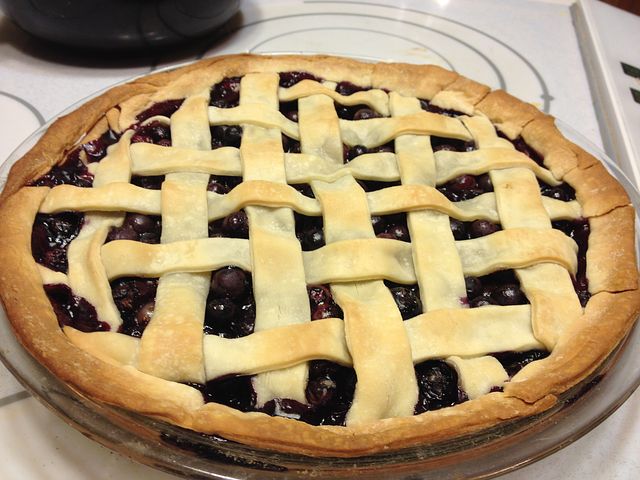
Pie is literally a part of my DNA. My grandmother used to make delicious Cornish pasties, those hearty beef stew pocket-pies favored by generations of coal miners, each containing an entire meal within their flaky golden-brown crust. My mother raised my brothers and I on the fruit pies her own mother taught her to make. My favorites were cherry, peach, and mince; piping hot and a la mode (or in the case of mince, “a la hard sauce”). I can still picture my mother adorning her creations with strips of dough – elegant top-crust latticework too pretty to consume. She made it look easy as pie.
They say the signature of a great pie is its crust – ironic because history says pie crust was never meant to be eaten. With the advent of flour in ancient Roman times, pie crust served a practical purpose: to contain and preserve the food within, especially for a soldier or sailor or some other kind of several-days traveler. It wasn’t until bakers turned their attention to the crust when “real pie” was born. Can you imagine the first time someone tasted a savory buttery crust, melded with hot fruit filling, cooled by the freshness of vanilla ice cream? The whole is clearly greater than the sum of its parts.
Any Texans reading this post will likely direct me to the Hill Country in the southeast, to little Marble Falls or tiny Round Top. Both towns boast of serving “the best pies in the Lone Star State”, be that the Blue Bonnet Cafe in the former or Royer’s Cafe in the latter. Blue Bonnet has a “Pie Happy Hour” and a regionally-renowned German Chocolate Pie. (My favorite cake as a pie? Sounds like a slice of heaven.) Royer’s has something called a “Texas Trash Pie” (pretzels, graham crackers and coconut) and I can get one with a few clicks of my mouse. Don’t tempt me.
No nod to pie would be complete without saluting Hostess Fruit Pies and Kellogg’s Pop Tarts – staples of the American childhood. Hostess enticed you with those colorful wrappers and the promise of “real fruit filling” (though my favorite was actually the chocolate). No matter the flavor, you consumed a brick’s worth of glazed sugar, chewy crust, and gooey fruit filling. It’s a wonder we didn’t sink to the bottom of our swimming pools and bathtubs.


Kellogg’s Pop Tarts were svelte by comparison; a deck of large playing cards. My mother favored the non-frosted fruit variety to keep our pantry “healthy”, but she snuck the brown-sugar cinnamon tarts into the basket too. I ate hundreds of those. Someone needs to invent a brown-sugar cinnamon pie.
Any Hollywood-types reading this post would remind me the ultimate pie movie is “Waitress” (now a Broadway musical), or “Michael”, where in one glorious scene Andie McDowell surveys a table’s worth of pie and gleefully sings, “Pie, pie, me-oh-my, I love pie!”
Thanks to a new local restaurant, I don’t have to travel to Texas to find amazing pie. 3.14 Sweet & Savory Pi Bar is as inclusive as it sounds. Choose from a dozen or more “Pot Pi’s” for your entree (my favorite is the Irish-stew-inspired “Guinness Sakes”); then sprint to dessert by choosing from over twenty temptations (hello “Blueberry Fields Forever” Pi).

For the record, cake gets its share of celebrations as well. Last Wednesday was “Sponge Cake Day” and November 26th is “National Cake Day”. For me, those days will come and go like any other. Those who celebrate cake should eat some humble pie and admit which dessert deserves the higher praise. But hey, no time to debate; a chicken pot pie is in the oven and calling my name.
-
American Tune-Up
Each of the fifty United States is represented by more than just a flag. America’s state symbols include animals, birds, trees, flowers, and songs. As a kid growing up in California I memorized these items, and years later I’ve still got them. The “Golden State” has the Grizzly Bear, the Valley Quail, the Redwood, the Poppy, and “I Love You, California”. Imagine my interest then, when Brooklyn Magazine took an updated stab at the state songs, publishing “The Musical Map of the United States”.
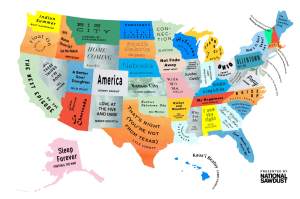 Image courtesy of Brooklyn Magazine, October 2016
Brooklyn Mag’s map is more than meets the eye (see here). It’s not a collection of easy ditties you and I might come up with: Beach Boys for CA, John Denver for CO, Frank Sinatra for NY. Instead, it’s a broad spectrum of lesser-known tunes, attached to the states by writers who chose them. Read their stories and listen to their song choices. It’s like 50+ blogs in one, plus a playlist if you want to shift the whole shebang to your smartphone.
Here’s a sampling of the Map’s creativity. The writers chose Kenny Knight’s “America” for Colorado, a “dusty, country rock gem” with lyrics befitting its patriotic title (even if the song itself twangs along modestly). For California, the writers needed two songs – Joni Mitchell’s “California”, and Dr. Dre’s “The Next Episode”. The former artist is Canadian; the latter raised in the gangland streets of Compton near Los Angeles. You’ll find Mitchell’s folk music as appropriate as Dre’s rap for such a diverse state.

As I studied the Map, I realized each of us possesses our own musical geography, accumulating map dots as we move through life. My own map began on the 8-track player of my father’s Cadillac in the 1960’s, crooning along with Perry Como as he claimed, “the bluest skies you’ve ever seen (are) in Seattle”. By the 1970’s, I’d moved on to a hard-earned collection of 45-rpm records (“singles”), focusing on Top 40 bubble-gum one-hit wonders like Paper Lace’s “The Night Chicago Died” and Terry Jack’s “Seasons in the Sun”. Also in the 70’s – courtesy of my brother’s extensive LP collection (and a stereo capable of a sonic boom) – I mapped to all kinds of rock, including Emerson Lake, & Palmer, The Eagles, Elton John, and Linda Ronstadt.
By the 1980’s, I’d graduated to cassette tapes and the easy-listening music of John Denver, Olivia Newton-John, and Barry Manilow (to which some would say, two steps forward three steps back). Later in the ’80’s, I embraced compact discs with a budding affection for country music (Alabama), continuing to this day (Thomas Rhett).
Throw in a handful of downloads from my kids (Katy Perry, Meghan Trainor), sprinkle the whole mess with classical symphonies and concertos – a carryover from childhood piano lessons – and you have my musical map. I’ll bet yours is wildly different.

Even the world of sports has a musical map, as Steve Rushin wrote in an excellent piece in this week’s Sports Illustrated (“Cheer and Trebling”). You can’t hear the whistling of “Sweet Georgia Brown” without thinking Harlem Globetrotters, just as you can’t make it through baseball’s seventh inning without singing “Take Me Out to the Ballgame”. You won’t leave Yankee Stadium without Sinatra’s “New York, New York”, just as you won’t hear John Williams’ spectacular “Fanfare” without thinking Olympic Games. Moments of silence at sporting events are literally reserved for the dearly departed. Otherwise it’s all marching bands, pipe organs, and loudspeaker instrumentals.

My now-home state Colorado has a set of symbols like California. The “Centennial State” has the Bighorn Sheep, the Lark Bunting, the Blue Spruce, the Columbine, and John Denver’s “Rocky Mountain High”. But the song could just as easily be Katharine Lee Bates’ “America the Beautiful”, inspired by the Rocky Mountain peak I can see as I type. The song could also be Kenny Knight’s “America”.
You listen. You choose. There are no right or wrong answers here. Remember, even Google Maps gives you several options as you navigate your way.












 Royer’s Round Top Cafe, Texas



About Me
The sky is not completely dark at night. Were the sky absolutely dark, one would not be able to see the silhouette of an object against the sky.
Follow Me On
Subscribe To My Newsletter
Subscribe for new travel stories and exclusive content.
 Life In A Word