
Hello, I’m Veronica
The sky is not completely dark at night. Were the sky absolutely dark, one would not be able to see the silhouette of an object against the sky.


-
Failing Asleep
I’m almost done with Dan Brown’s latest novel, The Secret of Secrets. The tagline on the front cover: “Author of The Da Vinci Code” was a good add, because that romp through Europe was written over twenty years ago. This romp, alas, is not really much of one. The story ping-pongs relentlessly between explanation and action – making for restless reading – but at least the premise is intriguing. What if the human conscience could operate outside of the human body? What if “you” could exist in both a spiritual and a physical form at the same time? Well, maybe I do, at least when I’m trying to fall asleep.
 When you get to be my age – somewhere between “middle” and “senior” – you wake up at least once a night. Not for an outdoor stroll under the stars and not for a midnight snack. You wake up “to take care of business”. It’s an inevitable phenomenon as we get older, especially for us guys. And when I stumble out of the bathroom I also grab a quick drink of water. That one-two punch wakes me up, at least enough to get the gears turning and thoughts churning. Getting back to sleep can be a real challenge. There are nights I log many minutes memorizing the look of our bedroom ceiling.
 Counting sheep has never been my thing, nor the “white noise” of those bedside appliances, but some new strategies have been an interesting experiment. The first is known as cognitive shuffling. It’s word play, where you take the letters of a word and spin off new words on each letter for a few seconds. I start with “piano” (my Wordle starter!) and then go “pepper, portray, people, ponder”, “illuminate, inch, icicle, ignite”, and so on. What does this do? It puts the mind in a random state, where you can’t concentrate on stressors like paying bills or fixing stuff.
 The next sleep strategy is called “sensory grounding”, which means coming up with lists of things you can smell, touch, taste, hear, and see. It’s kind of like cognitive shuffling so I’ve never given it a try. Nor have I tried the breathing techniques, the calming playlists, or getting out of bed and writing down my thoughts on paper (to “release them from my mind”). All of those seem like a lot of effort just to fall asleep again.
 Finally though, there’s a technique called “mental walk-throughs”. This one is more fun than word games and works pretty well for me. Think of somewhere you’ve been, preferably a long time ago. Maybe the neighborhood you grew up in, a house you lived in, or a store you enjoyed spending time in. Now take a virtual walk through one of those (and here’s where I sense my mind separating from my body). Look in several directions to see what surrounds you. Think about how you feel as you’re taking it all in. Trust me, it’s nostalgic, it’s calming, and it’s calming enough to put you back to sleep.
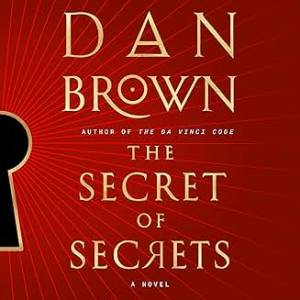 I read somewhere that The Secret of Secrets is already being made into a movie. That was fast. The ink hasn’t even dried on the critic’s reviews, but I guess having the The Da Vinci Code in your back pocket promises another profitable venture. Maybe I’ll buy a ticket and go see the show. It’d be another effective strategy to help me fall asleep.
—————-
LEGO Trevi Fountain – Update #5
(Read about the start of this build in Brick Wall Waterfall)
LEGO decided I needed a big helping of humility this week. Bag 9 – of 15 bags of pieces – brought me to my knees in one heart-pounding moment. Just as I was cruising to the final steps of the build (in a brisk forty-five minutes), my pulse went into overdrive as I realized the module I’d just constructed wouldn’t attach to its rightful place on the fountain. It just wouldn’t click in. In the land of LEGO this is very bad news. You might as well unfurl a big banner saying: Start over, Dave.

Today’s challenge If you’ve built IKEA furniture, you know those do-it-yourself sets are engineering marvels. Everything goes together perfectly; not a piece out of place. So it is with LEGO. If one part of the model doesn’t “click” comfortably with another, you’ve done something seriously wrong and that, my friends, summarizes today’s build in a nutshell. The pile of parts above resulted in the module you see below… only it’s wrong… just slightly off from the way it’s supposed to look. My penalty: disassemble all those pieces back to the first step to figure out where I’d gone astray.
 Just like the second time through Antonio Salieri’s Sinfonia in D Major, I took another forty-five minutes to reconstruct what I’d already built. The scene at my desk was an interesting disharmony of orchestral beauty, pinched fingers, and nasty thoughts. Thankfully (and with no surprise), once I got the build exactly as it was supposed to be, everything clicked together the way you see it here.
 Bag 10 had to be laughing at me from inside the box. Bag 10 was scheduled to be opened and completed along with Bag 9 today Then it watched me fumble the football early on in the build. Yo, Bag 10, why didn’t you say anything? You’re a mean one (just like Mr. Grinch) but “I’ll get you my pretty”. Your time is coming… er, just next week instead of this one.
Running build time: 4 hrs. 33 min.
Total leftover pieces: 25
Some content sourced from the CNN Health article, “If worries keep you from falling back asleep, experts know what to try”.
-
An Unhealthy Modern Phenomenon
Somewhere in the wee hours of Tuesday morning I had a bizarre dream; one I retained well into my conscious hours. I was on some sort of overseas sightseeing excursion with others, and our group stopped for lunch at a historic convent. Egg salad sandwiches were handed out by the nuns and I promptly dropped mine onto the cobblestones. The dream only gets more disconnected from there but I’ll share one more noteworthy detail. My traveling companion was the actress Mary Stuart Masterson.
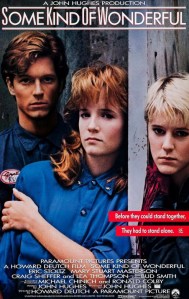
“Watts” on the right Got all that? Okay, now forget about everything except Mary Stuart. Masterson has had a respectable (if not award-winning) career as an actress. She was only ten years old when she first appeared on the silver screen, in the original version of The Stepford Wives. She went on to play colorful characters in Fried Green Tomatoes and Benny & Joon. But her most enduring performance – the one she will forever be linked with – was as “Watts”, the companion/tomboy of “Keith” in the high school rom-com Some Kind of Wonderful. Masterson’s turn as the loyal friend who quietly wanted to be more absolutely stole the show.
 As if nuns and egg salad sandwiches aren’t enough, you’re wondering why Mary Stuart Masterson was sitting next to me in my dream. Actually it wasn’t Masterson herself; it was her movie character Watts. Which brings me to the Cambridge Dictionary’s 2025 Word of the Year. Would you believe Cambridge added 6,000 new words to its big book this year? 5,999 of them were runner-ups to parasocial, a word “describing a connection people feel with someone they don’t know (ex. celebrities, influencers, and other online personalities)”.
Blogger’s Note: WordPress needs to get on the ball here. “Parasocial” is underlined here in my draft post as being an unrecognized word.

Taylor & Travis Parasocial’s win as Word of the Year has everything to do with Taylor Swift. Her engagement to NFL star Travis Kelce generated countless claims of “heartfelt feelings toward a couple the vast majority had never met”. The same applies to Watts. I don’t know the first thing about Mary Stuart Masterson herself, but I know everything about Watts from watching Some Kind of Wonderful a dozen times or more.
“Parasocial” has actually been around since the 1950’s. In that era it referred to the innocence of television viewers connecting to television characters (or in my case, movie viewer to movie character). But today’s version of the word is described as “an unhealthy modern phenomenon”. Why? Because of social media. Because of artificial intelligence.

Ms. Masterson today My example of Watts is one movie and one instance. I’ll finish this post and the “encounter” will fade into my memory forever. But social media – which brings the viewer constant feeds about the “viewed”, and artificial intelligence – which creates a sense of connection where there really isn’t one, makes it clear why there’s reason to be concerned. Are we really so desperate as to develop foundation-less relationships with strangers?
 AI has already found its place on Spotify. Search for Xania Monet, the first artificially intelligent singer to grab a ranking on a Billboard chart (Adult R&B). Everything about Xania was created on a keyboard. But her face, her social media profile, and her voice suggest she’s a living, breathing human somewhere out there in the world. I wouldn’t be surprised if you can even chat online with Xania. If so, you’re developing a one-sided relationship (you) with someone who isn’t real whatsoever (a computer). Seriously, who has time for this nonsense?
“Xania Monet” Coincidence or not, one of the Cambridge Dictionary’s runner-ups for Word of the Year was “slop”, which in this day and age means “content on the internet that is of very low quality, especially when created by artificial intelligence”. Let’s declare “slop” a lot of what’s going in parasocial relationships as well.
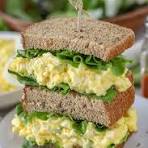 The real message of this dictionary winner is clear. We need to remove the “para” from parasocial and focus on simply socializing with our fellow humans. It’s the only path to truly fulfilling relationships. Having said that, for some reason I’d love an egg salad sandwich right about now.
—————-
LEGO Trevi Fountain – Update #4
(Read about the start of this build in Brick Wall Waterfall)
The travertine is stacking up quickly as we continue our work on the LEGO Trevi Fountain. Bags 7 and 8 – of 15 bags of pieces – came together like the Domenico Scarlatti piano sonatas that accompanied them – seemingly simple on the surface but more intricate and involved the further we dove in.
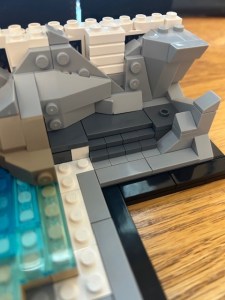

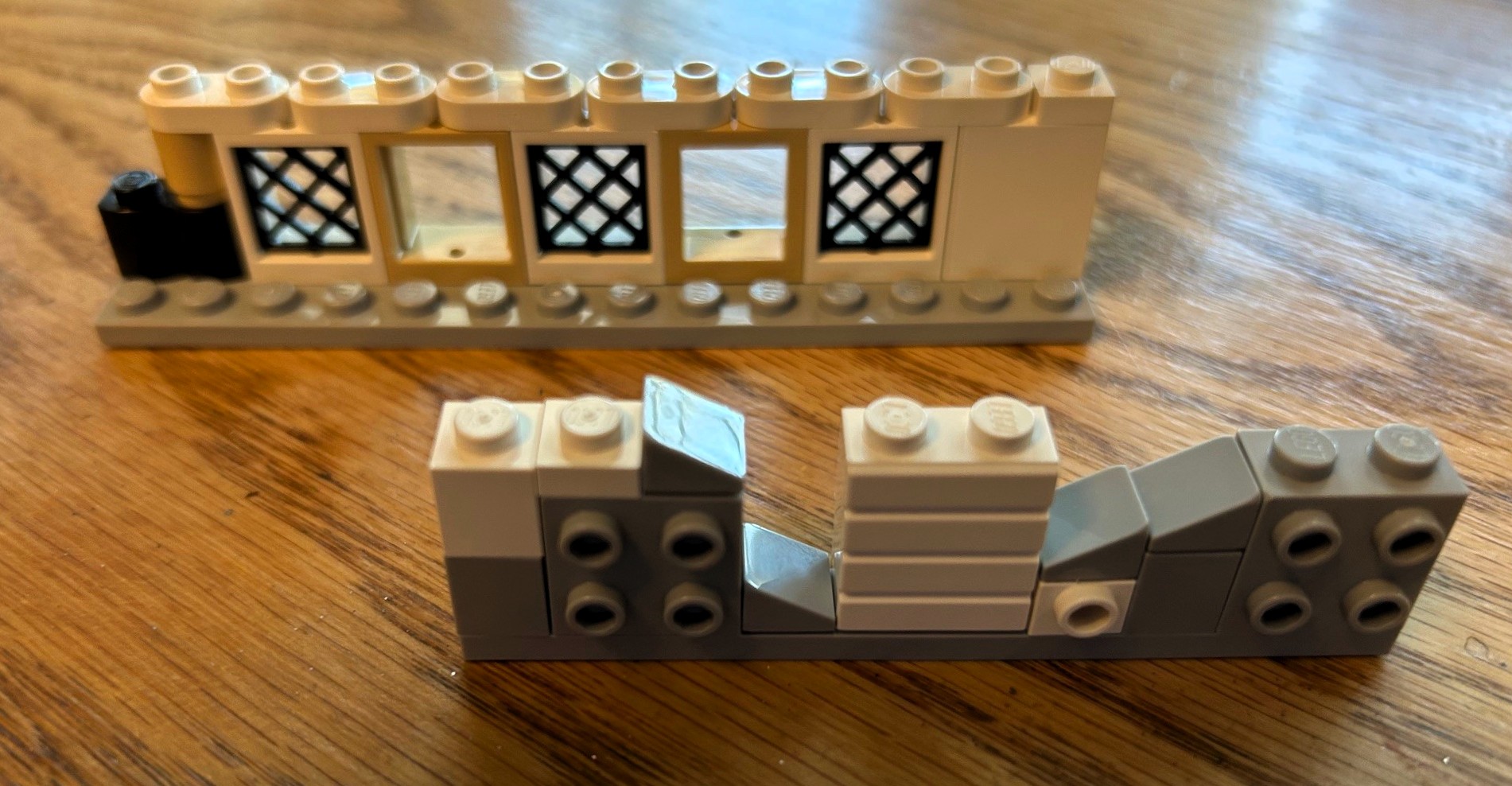
The Trevi Fountain has some strange elements, made even stranger when represented by chunky LEGOs. Check out the shapes I assembled today (and don’t ask me what they’re meant to represent). Little LEGO pieces positioned in just about every point on the compass. My singular mistake this round – realized well after the fact – was putting the right piece in place, only the wrong color. Then when I came across another “right piece wrong color” I knew I had them transposed. Took a little disassembly to get everything correct.

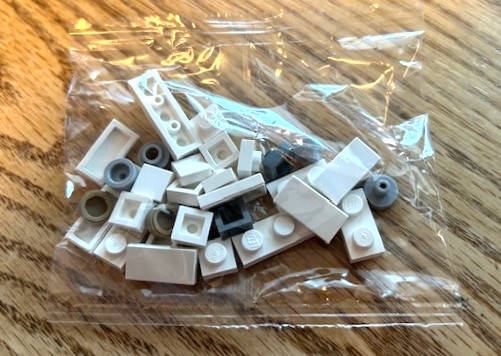
Bag within a bag A continuing mystery of LEGO sets is bags within bags. When I opened Bags 7 and 8, each came with a smaller bag of pieces like you see here. It’s not like the smaller bag represents its own unit of the fountain. You just tap into those pieces every now and then as the instruction manual demands. Yes they’re tiny, tiny but you also find tiny pieces in the bigger bag. Maybe someday I’ll tour the LEGO factory and solve this packaging mystery.
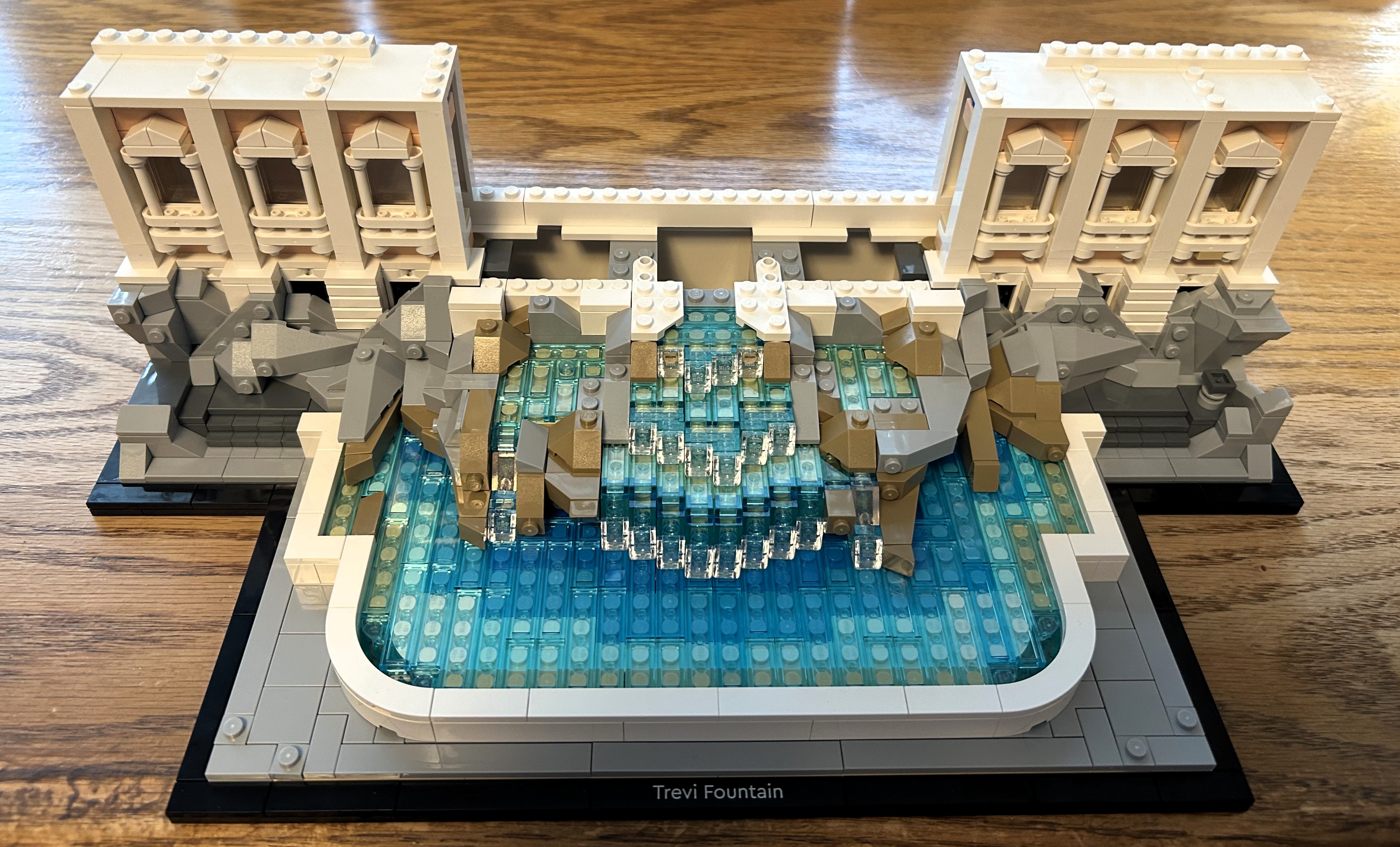
 We worked with some surprisingly large pieces of travertine today – the entire wall of white you see behind the fountain and the white surround you now see defining the entire front of the main pool. Would’ve taken a dozen Italians to put these monster pieces in place on the real Trevi. And don’t miss the pink accent strips to the left and right of center (pink!) This fountain is turning out to be more colorful than I expected.
 Running build time: 3 hrs. 5 min.
Total leftover pieces: 23 (10 more extras today!)
Some content sourced from the BBC.com article, “Parasocial is Cambridge Dictionary Word of the Year”, IMDB, “the Internet Movie Database”, and Wikipedia, “the free encyclopedia”.
-
Cold Brew
Seemingly overnight, a new drive-thru named 7 Brew showed up next door to our local supermarket. A quick glance as I drove by suggested their slogan: “Come for the coffee, come again for the people” is on the mark, with more employees dancing around the drive-thru lanes than making drinks in the petite building itself. 7 Brew advertises an “experience” as much as it does a menu of coffee and energy drinks. It’s just the latest concept to steal market share from Starbucks.

7 Brew Did you know today is “Red Cup Day” at Starbucks? Red Cup Day is the coffeemaker’s nod to the beginning of the holiday season. Buy a Starbucks “holiday” drink and you’ll also receive a festive reusable cup – more distinctive than the usual white ones. The red cups suggest Christmas comes early this year, and encourage the purchase of peppermint mochas, eggnnog lattes, and iced gingerbread chais. Somewhere in all that there might even be coffee.
 I admit, the Starbucks Chestnut Praline Latte really is Christmas in a cup. The drink tastes of the same spices you’ll use with Grandma’s cookie recipes this season. And on a recent trip through Chicago O’Hare, my wife and I caved to a couple of Starbucks’ ever-popular Pumpkin Spice Lattes. But here’s my point. Starbucks is no longer my go-to for coffee drinks. It never was my go-to either, but there were plenty of morning commutes when I couldn’t pass up a Flat White and a couple of egg bites. Now I drive by without pause, the same way I’ve done so with McDonald’s for decades. It begs the question: has Starbucks become passé?
There are signs suggesting we’ve already put Starbucks in the rear-view mirror, even if 38,000 locations still dot the globe. Like 7 Brew, Starbucks has always tried to deliver an experience as much a drink. Come on in. Hang out for awhile. Even if you don’t, peruse all the “merch” while you’re standing in line. Chances are pretty good you’ll spend more on logo items and baked goods than coffee.
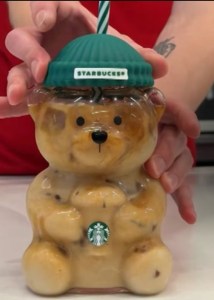 This year, Starbucks features a 20-oz. “Bearista” cup. It’s a refillable glass ontainer with a straw and it’s being marketed as a collectible. You’ll find these bears at your nearest Starbucks for $29.95. Or maybe you won’t, because they seem to be disappearing as fast as they’re put on the shelves. If you’re a little desperate, find one on eBay for $500 or more (coffee not included).
To me that’s a good way to describe Starbucks these days… a little desperate. They’re closing stores without drive-thru lanes, which suggests they’re trying to reduce the money they spend on leases. They’re laying off retail and non-retail employees, the typical corporate strategy to try to do more with less. And they’re coming up with bear-shaped cups the size of a Starbucks “Venti”, so you’ll purchase their largest coffee when you wouldn’t have done so with a regular cup.
 If you think the “bearista” is cute – and would pay $29.95 for it – how about “Hello Kitty” products? Coming soon, you can buy a “plush” wearing a Starbucks green apron, and any one of five Hello Kitty containers, from water bottles to ceramic mugs. Each of these runs you $30 or more (again, without the coffee). Cats and coffee? It’s a
 desperatestrange marketing strategy, perhaps aimed at a generation of consumer that seeks something more trendy than coffee in a red cup. This year, the Pumpkin Spice Latte showed up on the Starbucks menu on August 26th; hardly what I’d call “fall”. Their Christmas-y drinks debut today, fully two weeks before Thanksgiving. That’s stretching the seasons a little. But let’s say I still splurge for a Grande Flat White, a couple of Egg Bites, and a slice of Iced Lemon Loaf. I’ll pay $20 before I even consider the purchase of a “bearista” or a kitty. It may be time to move on from the red cups. Maybe I’ll give 7 Brew a try instead. $7 gets you their smallest size… even pricier than Starbucks. No guarantee you’ll find any coffee in that cup either.
(Coming next week: more updates on the LEGO Trevi Fountain!)
-
Swimming Upstream
I can think of a dozen name brands I gotten hooked on for years, only to see them suddenly disappear from the shelves, never to return. Breakfast cereals. Hair spray. Cars. And what do we do when this happens? Simply find another brand and get used to it – easy-peasy. But when your streaming television service drops an essential channel, you can’t just jump to the next provider. Try that and you’ll hit your head on the cage they have you securely locked into.
 Even if you’re not a sports fan, you’re probably tuned into my topic today. YouTube TV – which provides me the five channels of streaming television I care about (and 95 forgettable others), dropped ESPN from its lineup. It wasn’t like they warned us months ago they were renegotiating with Disney (ESPN’s parent), and that these talks weren’t going so well. Instead they alerted us last Thursday just before midnight – with an email coyly titled “An update on our partnership with Disney”. Then, the following morning, ESPN was gone. On Halloween. How fitting.
 Without going into the weeds on why ESPN was dropped, let’s just call it the proverbial contract dispute. Disney wants one number. YouTube TV wants another. A stalemate akin to what we’re seeing in Washington right now. Yes, what D.C. is blocking is so much more important than a television sports channel. But when you’re a die-hard college football fan you can relate to losing an “essential service”.
Getting my ESPN back is not like choosing another breakfast cereal. If only it were that easy. Instead, we have to shift to an entirely different grocery aisle. Make that an entirely different supermarket. As soon as YouTube TV dropped ESPN, Disney was only too happy to promote its own streaming service. Sign up for Disney+, including ESPN and Hulu!!! Only $29.95 per month – a savings of $5/month!!! Only twelve months of subscription required!!!
 All those exclamation points are a ruse, as if this is a service I can’t live without. Disney Channel? Not my thing. Hulu? I’m already getting enough entertainment on Netflix. I just want ESPN please. And apparently I should be happy to pay a minimum of $360 for it, in addition to my monthly $80 for YouTube TV.
Bless our tech-savvy children. We turn to them for all things electronic. I checked in with one of my sons – who is every bit the college football fanatic I am – and he came to my rescue. Fubo – a streaming service looking like a twin to YouTube TV – offers a free one-week trial that includes ESPN. It’s kind of like Congress signing a stopgap spending bill to keep the government open. Now I have another seven days to figure out what to do.
 YouTube TV promises a credit if the lack of negotiations with Disney continues long enough (sorry, the same does not apply to our government). But I can’t necessarily wait for that credit. In one week I’ve got to decide if I’m a YouTube TV guy or a Fubo one. Can’t have both (at least, according to my budget).
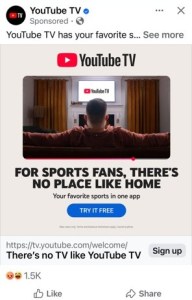 Of course, it feels almost inevitable that Fubo will run into a contract dispute with Disney as well. So even if I go that route I could lose ESPN again. Maybe I’m getting forced into a Disney+ subscription after all? But another $360/year? No way. I’d sooner get on a plane and go watch my college football games in person. Er, assuming the FAA doesn’t cancel my flights. Swimming upstream indeed. Sigh…
—————-
LEGO Trevi Fountain – Update #3
(Read about the start of this build in Brick Wall Waterfall)
We resumed our fountain build this week with more confidence than the last, accompanied by the merriment of Paganini’s Violin Concerto No. 1. Bags 6 and 7 – of 15 bags of pieces – were filled with tiny, tiny finger-numbing LEGOs, and at times I wondered just what the heck I was putting together. Didn’t look like the makings of a fountain to me.

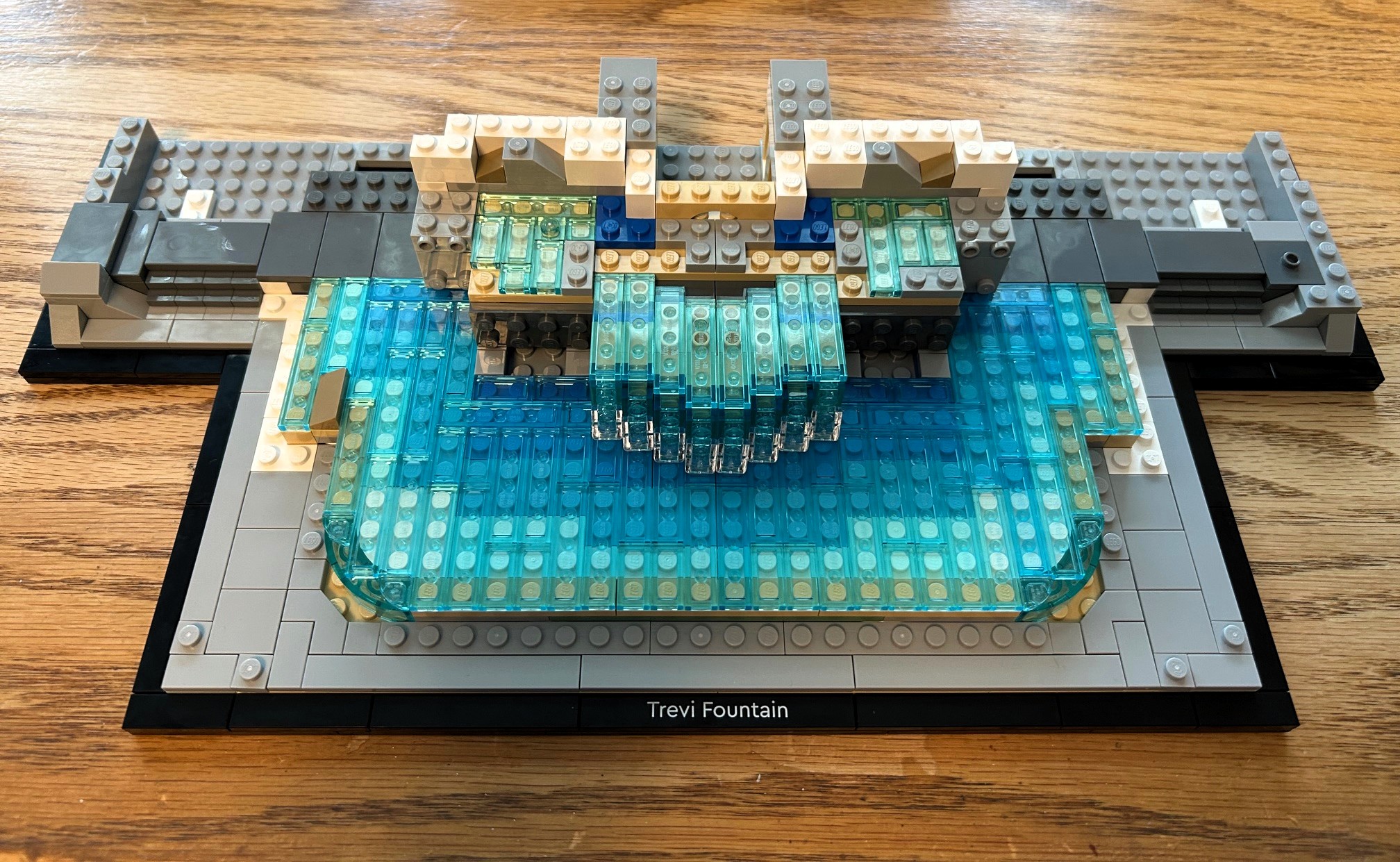
Tiny, tiny! According to LEGO, water is white and blue. I suppose the white is meant to be rushing water (as in “waterfall”) while the blue is calm water (as in “pool”). We shall see. But check out the look of the fountain in the final photo. Anyone else see a monster’s mouth with white teeth?

Strange creations Since this is my fifth LEGO model, it’s high time I make the following proclamation: LEGO never leaves out a piece. Never. I still have moments where I’m searching through a pile of pieces in vain for the one I need. I almost get to the feeling of “it’s not here”. But suddenly there the little guy is, staring up at me as if to say, “What took you so long?” Some day I’d love to see how LEGO pulls this off. Thousands of pieces in every box, not a single one of them left out. That’s some logistical magic going on there.
 I’m proud to say I made zero mistakes on the build this time around, a dramatic improvement from a week ago. Okay, that’s not entirely accurate. I left a piece off the back of the fountain, but immediately discovered my error when I added a section and realized there was nothing to support it. Fixed in a jiffy, but the merry instruments on Paganini’s violin concerto sounded even more gleeful as they saw my confidence take a hit.
Running build time: 2 hrs. 27 min.
Total leftover pieces: 13
-
A Bowl of Snowflakes
Part of the appeal of Halloween – at least for us baby boomers – is the thought of innocent days (and nights) from our distant past. Not only were we kids back then, we cavorted in full costumes through our neighborhoods without a parent in sight. Every house left a light on or a door open to welcome trick-or-treating. Every street seemed safe and inviting. And the treats were often as homemade as they were store-bought. Cookies. Lollipops. The odd neighbor doling out little sausages hot off the grill from his front yard (BBQ sauce optional). And the occasional popcorn ball.
 Who doesn’t love a good popcorn ball? Me. I don’t. Popcorn balls may be a nostalgic Halloween memory but they’re also an insult to popcorn. Whoever invented them turned a savory snack into a sickly sweet one. We’re not talking caramel-, chocolate-, or even kettle-corn sweet here; just liquid sugar designed to act as glue to make popcorn a convenient handheld. Awful.
I admit it, I’ve become a popcorn snob the way some people are about coffee. There’s a way to enjoy popcorn and there’s a dozen ways not to. It’s a snack that deserves to get it right, because getting it wrong is anything but a “treat” (like popcorn balls).
Popcorn eased its way into our after-dinner desserts by necessity. One day (night) my wife and I sat there after the evening meal and realized we were having dessert way too often. It was always ice cream, cookies, or whatever else we could find in the pantry. Somehow a savory dinner necessitated a sweet dessert. Bad habit – very bad. Instead, make the dinner healthy enough, eat it early enough, and keep yourself off the couch watching TV. Then dessert rarely enters the conversation. Yeah, uh, we’re still working on that. The dinners are healthy, but we can never get them on the table – er, couch – before 7pm.
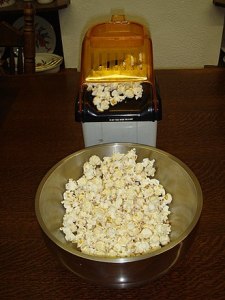 Popcorn to the rescue. It’s a dessert that doesn’t feel like a dessert. It’s not sweet, and with an air popper it’s all of three ingredients. Popped corn, topped with butter and salt. Make those first two “organic” and the last one “Celtic sea”, and it sounds like something that’s actually good for you.
Popcorn belongs in a bowl, not in a ball. We take the largest bowl in our kitchen, fill it almost full with popped corn, and call it dessert. Oh, right, but that’s just for me. Then we take the second-largest bowl in our kitchen and pop a similar serving for my wife.

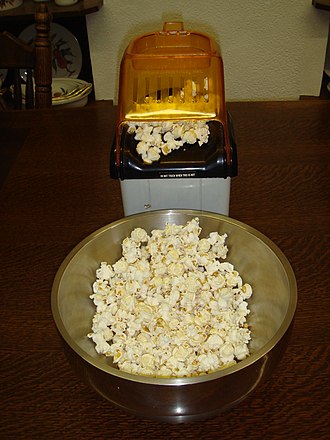
Before… Since I always aim to educate a little, here’s popcorn trivia worth remembering. One, the corn used for popping is not the same as the kernels on the cob (so don’t get any ideas). Two, when the kernels burst – literally inside out – you get one of two shapes; snowflakes or mushrooms. Snowflakes are what we have at night for dessert, and what you find severely overpriced in movie theaters. Mushrooms are what you find in a box of Cracker Jack or Fiddle-Faddle. Think teeny-tiny popcorn balls. As for the kernels that don’t pop? They’re called “old maids”. In the world of popcorn at least, you’d rather be a snowflake than an old maid.

After… Some more fun facts. Popcorn displaced movie candy during the WWII years because there was a shortage of sugar. Years later it’s still the more popular concession at the theater. On average every American consumes 58 quarts of popcorn every year. Picture those red/white striped cardboard containers you see when you purchase popcorn from a cart. Multiply by 58. You eat a lot of popcorn. But why shouldn’t you? It’s convenient, easy-to-make, and healthy as long as you use an air popper. Really healthy if you substitute olive oil for the butter, which a lot of people do these days. But I say ewwwwwww to that. Leave olive oil to the Mediterranean diet instead.
All this talk of popcorn has me thinking it’s time for dessert. It’s easy to forego the sweet stuff when savory snowflakes beckon. Just remember, it’s not a ball of popcorn, it’s a bowl. A proper presentation precedes perfect popcorn.
—————-
LEGO Trevi Fountain – Update #2
(Read about the start of this build in Brick Wall Waterfall)
Let it echo throughout the streets of Rome, Dave is no Michelangelo (and yes, I know Michelangelo didn’t design the Trevi Fountain but he could sure sculpt). In today’s effort to rise the LEGO fountain from its foundation, I made countless placement mistakes. I got four steps into Bag 4 – of 15 bags of pieces – and realized I’d placed everything just a little bit off on the foundation. That meant breaking it all down, going back to the first step, and starting over. Can you imagine my fate if I made this mistake with the real Trevi? Placed and set the travertine just a little bit off? The foreman would have my head! (which is no joke, at least not three hundred years ago).
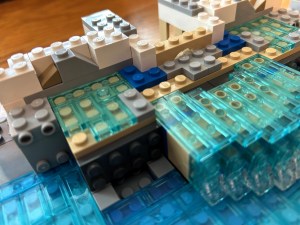
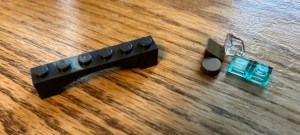
“Building” water is not that easy Frankly, everything seemed off today. I kept getting the piece placement slightly wrong, as if I refused to learn from my last mistake. At one point I turned two pages forward in the instruction manual instead of one, skipping a full two steps in the build. And the below photo is what “broke the camel’s travertine”. Tell me reader, what’s wrong with this picture? Five little leftover pieces and one BIG piece, that’s what. LEGO never throws in big leftover pieces. Sure enough, I paged back through the manual, and there it was. I’d overlooked the step where you place that arch. Never mind that it’s buried under “pieces” of blue water now. Leave it out and our beautiful fountain might collapse into a pile of very expensive rubble.
 You know who’s laughing about all of my missteps today? The singers in the music I chose for my accompaniment: Rossini’s The Barber of Seville. His opera may be about money, disguises, lovers and all that, but it sounded more like getting scolded over and over through song. You got overconfident, Dave (tra-la-la). You’re no sculptor, Dave (la-ha-ha). Maybe LEGO isn’t for you after all, Dave (wha-ha-ha-HA!)
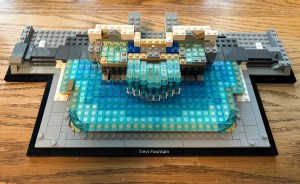 The gleeful singing in “The Barber of Seville” is all in Italian, so for all I know they really did change their tune to berate my amateur building efforts. I took that to heart. Bags 5 and 6 are gonna have to wait until next week. I sure hope the foreman won’t look at this decision as “getting behind schedule”. He might have my head!
Running build time: 1 hr. 44 min.
Total leftover pieces: 10
Some content sourced from Wikipedia, “the free encyclopedia”.























About Me
The sky is not completely dark at night. Were the sky absolutely dark, one would not be able to see the silhouette of an object against the sky.
Follow Me On
Subscribe To My Newsletter
Subscribe for new travel stories and exclusive content.
 Life In A Word tv