Hello, I’m Veronica
The sky is not completely dark at night. Were the sky absolutely dark, one would not be able to see the silhouette of an object against the sky.


-
(Not) Paying the Piper

One player, many pipes Our church is weighing creative approaches to conducting in-person services next month. Pastor Bob sent out a survey recently asking we-the-congregation to consider options like outdoor church, weekday church, and evening church – all in the name of social distancing. We’ll also be shaking up the service “touchpoints”, like sharing the peace, passing the (offering) plate, and partaking in communion. The Big Guy doesn’t care about the where’s, when’s, and how’s, of course – just that we have church. On the other hand, He (She?) might have something to say about the music. After all, how does a church organ sound after a three-month absence from tuning?
 It’s bad enough our congregation is gloriously inharmonious when we bellow out the hymns (no choir of angels are we), but add in a fully discordant church organ and you have a complete mess. Organs need tuning like the human back needs a chiropractor: maintenance is key. When dust accumulates and seasons change, organ pipes sound noticeably different than they’re supposed to (hence the term “off-key”). Imagine the pitch-perfect tones of a bass saxophone, but instead you get more of a sour wail. That’s an organ pipe sans “tune-up”.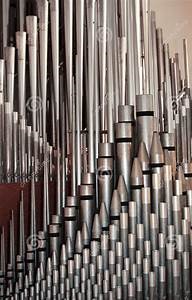
Every one needs tuning Tuning organ pipes is serious business and can run thousands of dollars per visit. Consider, the biggest organs have as many as 25,000 pipes. The booming bass pipes can be thirty feet long and two feet in diameter, while the little pixie sopranos look more like metal soda straws. Each pipe must be individually tested and tuned no matter how big or small. Tuner A presses a key on the (up to four) keyboards down below, while Tuner B adjusts the pitch of the pipe up above (sometimes on a ladder, sometimes on a suspended platform). It’s hours and hours of monotonous – and in the case of cathedrals, death-defying work, one demanding pipe at a time. Better love what you do.
Here’s another reason organ tuners deserve hazard pay. Imagine you’re suspended hundreds of feet above the sanctuary floor on a swaying rope-suspended platform (I’m already saying “no”), virtually floating like the angels, and as you reach over to adjust the pitch of a mid-sized pipe, bats fly out. Yep, that’s the kind of critters tuners encounter when an organ wants for too long (or a single pipe sounds suspiciously out-of-tune). Squirrels even make their homes in the pipes – though don’t ask me how they don’t go plummeting to their death the moment a note is blasted from the keyboard. Maybe they’re flying squirrels?

The view from above In the land of COVID-19 there are no organ tuners (or very few). Those Peter Pipers are being denied access to their church-bound “patients” because a) COVID may reside on a surface like, say, a keyboard, and b) no congregation means no offering plate means precious few payments to the Piper. So what do stay-at-home tuners do instead? Why, they tune their pianos of course! Then they play those pianos hours on end. We may come out of COVID with a whole new genre of classical music called “tuner tunes”.
 Talk about a sprint from feast to famine. An organ tuner’s busiest weeks are those leading up to Easter, often requiring extra staff and longer hours. COVID downpoured on that parade. Demand for pre-Easter tuning disappeared faster than Mr. Bunny himself. In the case of one tuner – profiled in the Wall Street Journal – 100 contracts withered to less than a dozen inside of two weeks. He furloughed his entire workforce, worried instead over simply paying the rent on his shop.
One day soon, we faithful will walk away from our laptops and wander back into church sanctuaries instead. We’ll spread out over more services. We’ll wave hands instead of shake hands. We’ll drop the offering into the plate from a “safe height”. We’ll bypass communion servers and help ourselves to the bread and wine instead. The organist will play and the congregation will sing; both noticeably off-key. And when that happens give a nod to the organ tuners, who will someday get the pipes pitch-perfect again.
Just hope they don’t need an exterminator as well.

Some content sourced from the 3/25/2020 Wall Street Journal article, “As Coronavirus Shutters Churches, an Organ Whisperer Changes Key”, and Wikipedia, “the free encyclopedia”.
-
Vicious Circles
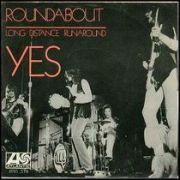 When I was ten years old, the progressive rock band “Yes” released an unforgettable song called “Roundabout”. The lyrics included trippy phrases like, “… mountains come out of the sky and they stand there…”, and, “… go closer hold the land feel partly no more than grains of sand…” The words made no sense but the melody hooked me with its driving beat and wandering synthesizer. “Roundabout” and “Stairway to Heaven” – both released in 1971 – are perfect examples of my rock music baptism.
Turns out, “Roundabout” was not a metaphor for the song’s underlying message nor even a made-up word. The lyrics really were spawned from an overdose of traffic circles. Yes was on tour and traveling from Aberdeen to Glasgow when its lead singer Jon Anderson says their van passed through “maybe 40 or so” roundabouts. Anderson promptly teamed up with guitarist Steve Howe to produce one of Yes’s biggest hits. Wikipedia dedicates an entire article to “Roundabout” here.

A “roundabout” (in the UK, of course) Fifty years forward, roundabouts are more prevalent than ever on our city streets – and in some setups, as mind-boggling to navigate as a Yessong lyric. In a neighborhood near my house, I pass through three consecutive roundabouts to get to a friend’s house. Each has two lanes entering and exiting the circle from four directions. If I’m not conscious of the lane I’m in when I enter a circle, I’ll find myself going round and round before I remember it’s safe to exit from both lanes. If I lose track of which circle I’m in (all three look entirely alike), I’ll exit onto a street nowhere near my friend’s house.
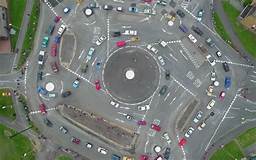
A “rotary” You’d think we’d have them figured out by now since roundabouts first appeared in 1966 and have proliferated ever since. (By definition, we’re talking about circles tight enough to induce centrifugal force, not the more leisurely curves of an urban “rotary”.) The Wall Street Journal reports traffic authorities still toy with public awareness campaigns, signage, and modified roadway designs in an almost desperate effort to reduce roundabout fender-benders.
Here are two lingering oversights with the rules of roundabouts. First, drivers entering the circle sometimes assume they have the right-of-way over drivers already in the circle. Second, drivers approaching a two-lane roundabout don’t check signage to see whether one or both lanes also exit the roundabout. On the latter problem, I admit to several instances where I had to quickly change lanes while circling, just to exit where I needed to. Changing lanes in a roundabout ranks among the scariest driving maneuvers of them all.

Not in this lifetime Roundabouts really do make a lot of sense, even if drivers never, ever figure them out. They eliminate electronic signal systems or stop signs. They create a safer environment for pedestrians (who only have to look one direction for oncoming traffic instead of three). They force vehicles to slow down, and statistics show a dramatic reduction in the number of T-bone and head-on collisions. Finally, roundabouts require less asphalt to create a new intersection, and are sometimes enhanced with an eye-pleasing landscaped island in the center.

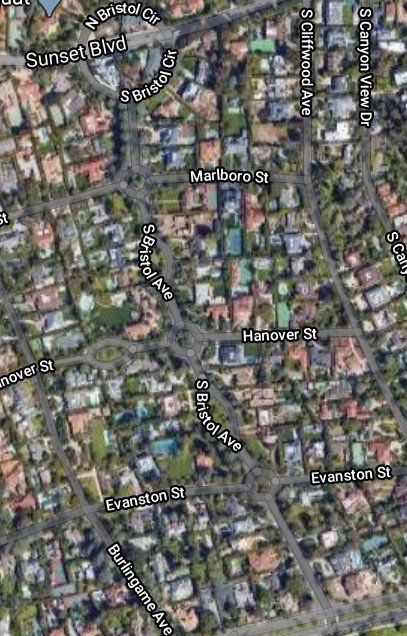
Look closely and you’ll see (all four) Bristol Circles The first time I ever drove in circles was in West Los Angeles. A street known as “Bristol Avenue” earned the nickname “Bristol Circles” by teenage drivers in the neighborhood. That’s because Bristol’s four rotaries allowed for a lively game of “car tag”, where my friends and I would zoom around trying to “tag” each other with the headlights of our cars. If we were really daring (i.e stupid), we included the topmost of Bristol’s four circles, which is bisected by busy, unpredictable Sunset Blvd.
Cities in the northeastern states of the U.S. have some pretty good-sized rotaries these days but for the really daring, it’s hard to beat the giant urban circles in France or the tighter many-tentacled roundabouts in the UK. Paris’s Arc de Triomphe rotary may deserve the title “most vicious circle”. Watch the following video and see if you don’t agree. This rotary may be the genesis of the term “distracted driving”. Note to viewer: no lanes. Note to self: no thanks.
Some content sourced from the 3/14/2020 Wall Street Journal article, “Car Crash Mystery: Why Can’t Drivers Figure Out Roundabouts?” and Wikipedia, “the free encyclopedia”.
-
Edgy Veggies
Thanks to several weeks of mandated “stay-at-home” here in Colorado, my wife and I limit our trips to the grocery store to every ten days or so. In turn, we’re digging deeper into our freezer, discovering a rather exotic world of forgotten foods. We found a box of gourmet croissants the other day that hadn’t quite earned their expiration date (score!) We also found ingredients to a “healthy” dog food recipe, which will probably never become dog food. But mostly we’re unearthing frozen vegetables; the ones passed over for months (years?) in favor of peas and carrots. And now that we’re out of peas and carrots? Suddenly we’re eating more cauliflower. Cauliflower?

flower power Here’s my earliest
nightmarememory of cauliflower; maybe yours too. 1) steam the florets fresh in a big pot. 2) sprinkle a little Parmesan cheese on top. 3) call it good. News flash: cauliflower isn’t good that way – not at all. It’s just colorless and tasteless, and I remember thinking what in God’s name am I eating here – tree roots? In my childhood evaluation, cauliflower rated below spinach and broccoli. Miles below peas and carrots.Today’s cauliflower is a whole different animal (er, vegetable). It’s being described as “the new kale”. You see, someone discovered how to “rice” cauliflower a few years ago and suddenly it’s a trendsetting side dish. Someone else discovered how to make crust out of cauliflower and suddenly it’s an option for pizzas. Cauliflower’s popularity surge is probably because of what it doesn’t offer. 85% fewer calories than white rice. 23 times fewer carbohydrates than a wheat pizza crust. There’s even a vegan form of Gruyère cheese out there, with cauliflower as the main ingredient. Keto and Paleo fans are flocking to this great imposter.
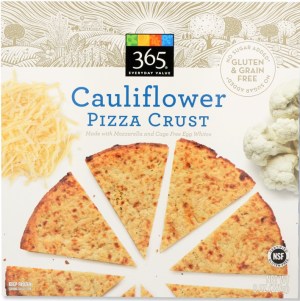 The data backs up the newfound power in the flower. Sales of cauliflower are up 40% in the last four years. We’re now buying less cabbage and garlic than cauliflower (in my case, way-y-y-y less cabbage). Cauliflower’s green leaves are the latest addition to salad bars. Aldi, the German company with a delicious cheesy-cauliflower rice (more cheese, less flower), claims it’s now its top-selling product. Aldi capitalizes on this volley of cauli with other products, like tortilla chips and gnocchi. Tortilla chips made out of cauliflower? Now that’s just wrong, people.
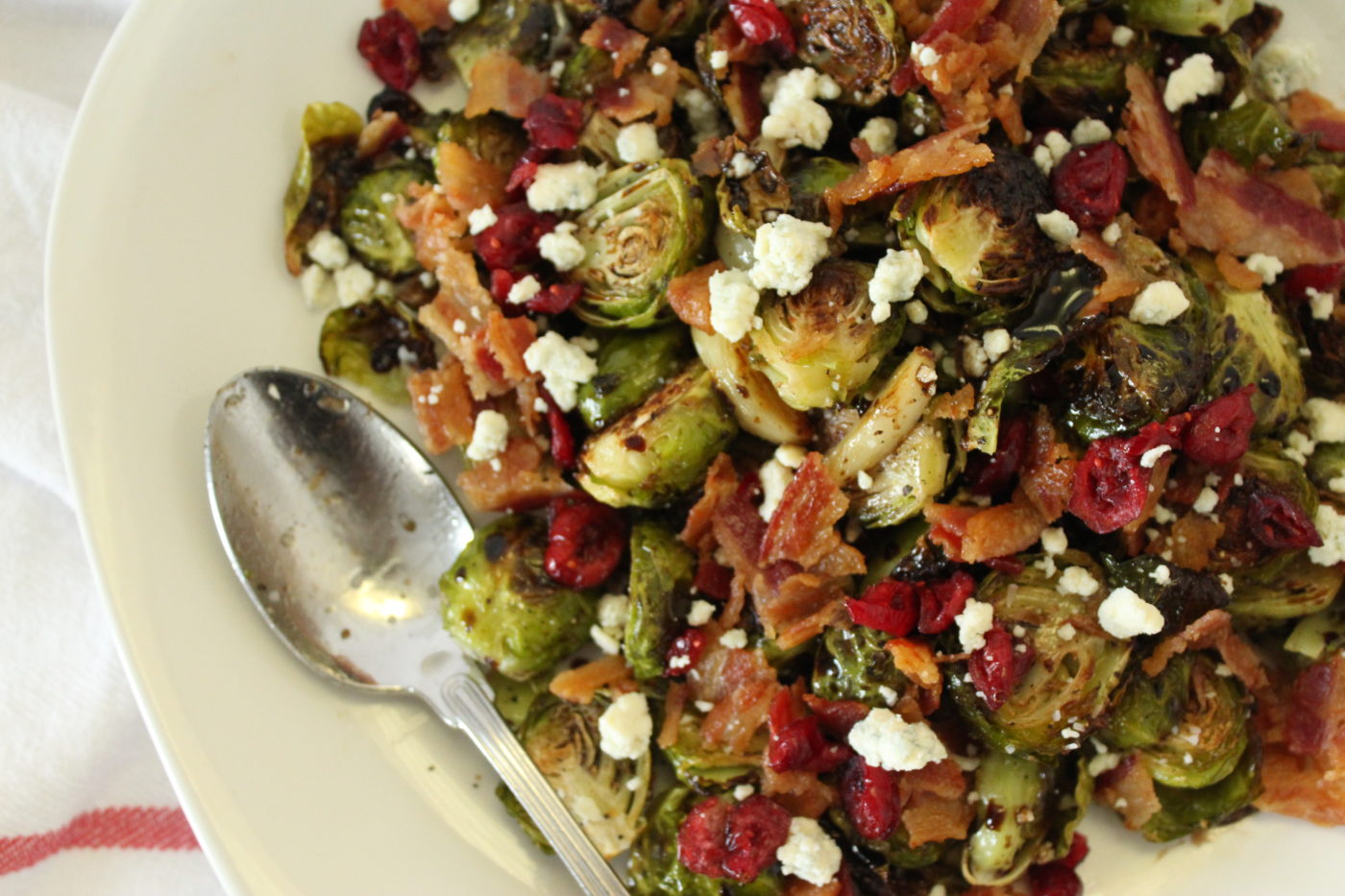
THIS is how you eat Brussel sprouts Cauliflower falls under the same veggie species as the Brussel sprout (as well as broccoli, cabbage, and kale), and I think those little green buds deserve a debt of gratitude. Brussel sprouts may be the original edgy veggie. Back in the day, Mom prepared them the same way as cauliflower (and the same way she prepared every other legume in the world) – steamed with a sprinkle of canned cheese. They were awful. But years later we have sliced and diced Brussel sprouts buried within liberal helpings of grilled bacon and onions. Genius. It’s like you’re only eating bacon and onions, with a slight aftertaste of Brussel sprouts.
 Taken the same way, cauliflower now lands on my “consumables” list. I prefer the riced version with cheese (cheese makes everything better). The hybrid pizza crusts aren’t too bad, like cauliflower with cornmeal. Maybe I’ll even give the vegan Gruyère a try. In other words, as long as cauliflower is an ingredient – not the whole enchilada – I’ll bite.
 Kale may now be passé, with white becoming the new green (although cauliflower also comes in orange, green, and purple). Take your pick: roasted, grilled, fried, steamed (aka boring), pickled, or raw. Plant cauliflower seeds in your garden and you’ll have full heads in 30 days or less. With all this demand for stand-in veggies, your next bite may beg the question, “is it flour or is it flower“?
Some content sourced from the 3/4/2020 Wall Street Journal article, “‘The New Kale’”: Cauliflower Becomes a Bestseller”, and Wikipedia, “the free encyclopedia”.
-
Climb Ev’ry Mountain
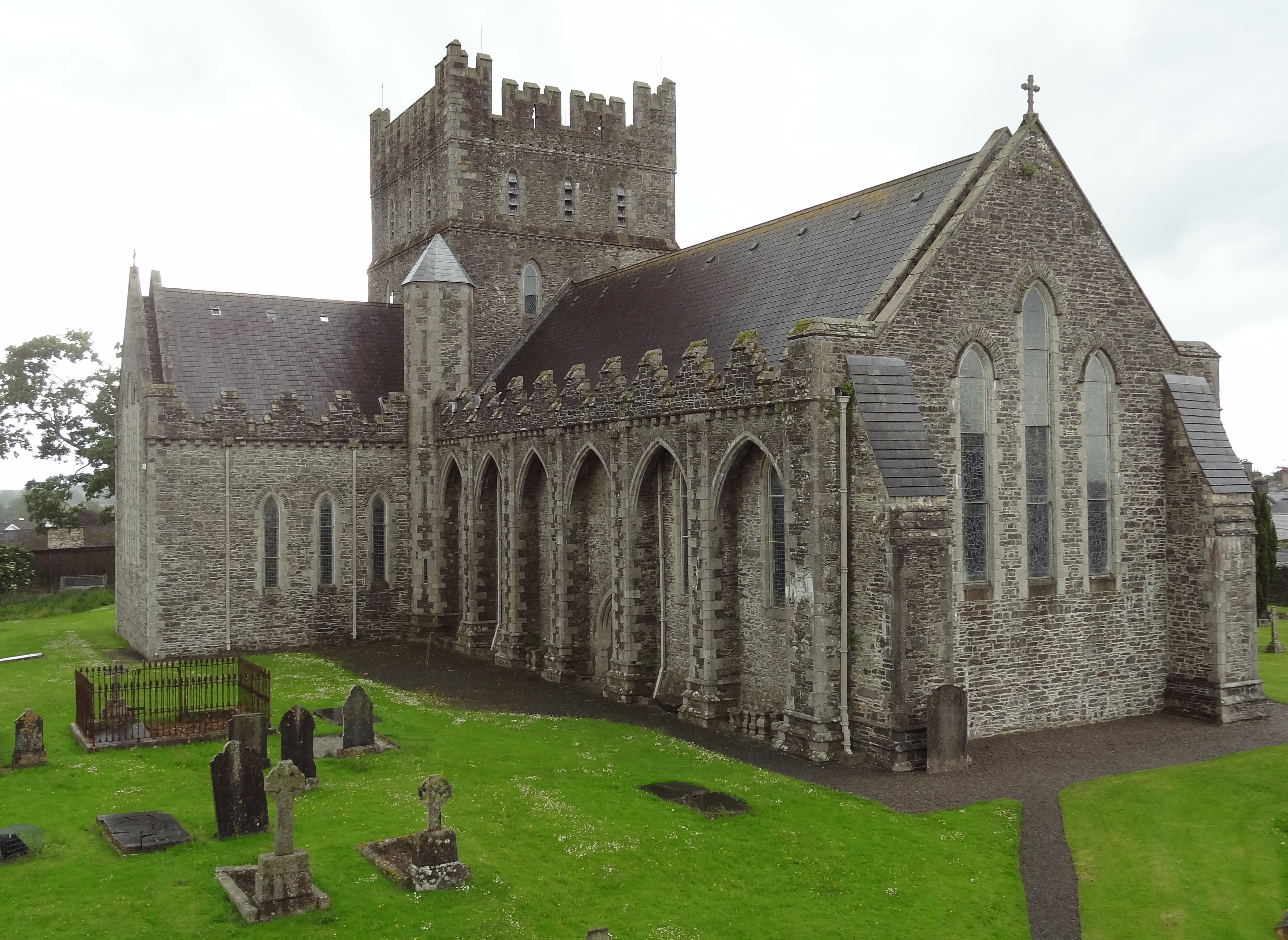
 St. Brigid’s Cathedral dominates the quaint urban landscape of Kildare Town in central Ireland. The centuries-old stone church beckons the short walk up the hill from the village square, for a tour around Brigid’s domain. And while you’re on the grounds, you’ll be tempted to climb the adjacent tower for a bird’s eye view of the surrounding county. I assure you; the vistas are breathtaking.
A bird’s eye view from my own locale would be just as breathtaking right about now. In the last ten days, I’ve ventured beyond my driveway once, for a mundane grocery shop at the local market. For all I know, nearby Colorado Springs has been erased from the map. For all I know, all my neighbors in the surrounding county traveled to a tropical island where they’re making merry, while I’m left to keep an eye on things back here at home. Who nominated me for that job?
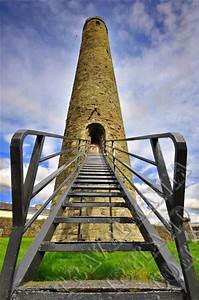
Proceed with caution! 
The tower “stairs” No kidding, the view from the tower at St. Brigid’s is spectacular. Not only do you see all of Kildare Town below, but you’ll be mesmerized by the lush green acreage of the adjacent Irish National Stud (and its countless roaming thoroughbred horses). When my wife and I visited several years ago, targeting Kildare Town to see the cathedral of her namesake saint, I figured light a few candles and say a few prayers; not climb a ten-story tower. I have a mild fear of heights so you can imagine my trepidation. And here’s the kicker: there’s no code-sanctioned, easy-to-navigate stairwell within the tower. Instead, you hand over a couple of Euros for the privilege of climbing a dozen ladders to the top. I almost called it quits after the first few rungs.

My longing to “rise above it all” today is not just inspired by the pandemic, nor even my acrophobia-be-damned adventure up the tower at St. Brigid’s. I also think about nearby Pikes Peak, the highest of the Rocky Mountains in this part of Colorado. “America’s Mountain” tops out at 14,115 feet, and I’ve hiked to the summit several times (the trail begins at 6,000 feet). You begin the journey on a series of easy switch-backing trails, which then give way to a remarkably gentle incline through a forest of Ponderosa pines. For several miles under the treetops, you have no orientation to suggest you’re even climbing a majestic mountain. But once you hit the tree line, everything upwards is a moonscape: rocks and dirt and scrub brush all the way up to the summit. The view is stunning; as if you’re looking down from space. You can see clear to Wyoming to the north and Kansas to the east.

Pikes Peak, through Garden of the Gods I could use a mountain (or a ladder-filled tower) on my property right about now, just to connect with the world around me. Oh sure, rural living means the stay-at-home rules are a minor inconvenience, but it’d sure be nice to confirm someone else is out there. The local news shows human interest stories every night on TV, but c’mon, how many of us trust the media these days?
Here’s my very favorite climb-ev’ry-mountain memory. I grew up in a narrow canyon on the outskirts of Los Angeles; so narrow in fact, some stretches could only accommodate a single row of houses on one side of a winding two-lane road. Biking with the cars was taking your life in your own hands, as was scaling the canyon trails into the domains of rattlesnakes and other wildlife.
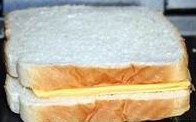
 Lucky for me, a steeply rising network of paved residential streets branched off the canyon floor less than a mile south of our house. On foot, those streets became a kid’s adventure up and out of the isolation. I’d stock a daypack with cheese sandwiches, Pop-Tarts, and anything else I could pilfer from the pantry. Some days I’d go it alone; others I’d drag my brother with me. Up, up, up we’d climb, rising breathless until we could peer almost straight back down to the canyon floor below. The final stretch of the topmost street – with houses perched precariously along on its edges – afforded a view of Los Angeles and the nearby Pacific Ocean like none I’ve seen to this day. There I’d sit, munching snacks, wondering what all I was missing down there in the big city.
 Today it’s the same feeling, only different. What am I missing out there in the big city? Is Wyoming still to the north and Kansas to the east? Are cadets still at the Air Force Academy, anticipating this weekend’s socially-distanced graduation ceremony? Have the majestic red rocks of Garden of the Gods finally crumbled? Truthfully, I can’t answer any of these questions, not while I’m stay-at-home. But at least I can see the summit of Pikes Peak from here. At least I’m confident St. Brigid’s Cathedral still stands in Kildare Town (Notre Dame in Paris, maybe not so much). And at least I can revisit fond memories, the kind I never thought I’d yearn for again. On that note, think I’ll make a cheese sandwich.
-
Merry-Go-Round Mayhem

The Safari Park’s merry menagerie In the midway of the wonderful San Diego Zoo Safari Park in California, you’ll find a colorful attraction called the “Conservation Carousel”. Unlike traditional carousels teaming with horses, the Safari Park merry-go-round boasts giraffes, rhinos, zebras, cheetahs, and other “rare and endangered creatures”, just waiting to be taken for a spin. It’s a full-on circle of animals. It’s like riding a zodiac.
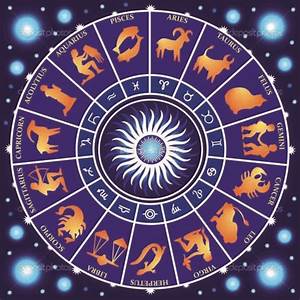
Wheel of Fortune Speaking of the zodiac, what’s your sign? I’m an Aquarius (born in late January), which makes me water-bearer to the gods. As much as I don’t subscribe to horoscopic astrology – a visual representation of the heavens to interpret the inherent meaning of life – I can’t deny water’s played a significant role in my world. I spent childhood summers in the Pacific Ocean and the backyard pool. I lazed away hours in Northern California’s Lake Tahoe, swimming and water-skiing. I enjoy a lively display of water, whether Niagara’s Horseshoe Falls or the fountains of Vegas’s Bellagio Hotel. A gentle rain is nature’s therapy.

He’s not as great as he looks… But then there’s the hell-or-high-water side of things. Literally since our wedding night (when my bride and I awoke to dripping from the bed-and-breakfast room above us), the two of us have endured all manner of water problems. A fully flooded basement. A backed-up septic system. Drinking water with a PH so out-of-whack we had to install a conditioner and a neutralizer. Our well water quit pumping one time – for days – when a squirrel chewed through the electrical connection. It’s like those gods have nothing better to do up there than play games with their little water-bearer down here on Earth. If it were up to me I’d spin the zodiac wheel and land on another space instead.
Turns out my wish may have already been granted. According to the Wall Street Journal, the earth maintains a wobble in its orbit around the sun, caused by gravitational pull on its not-so-perfectly-round midsection. That wobble (called “precession”) – projected over the last several thousand years – shifted the alignment of the Earth with the zodiac constellations as the Sun passes through them. Long story short, everything astrological advances one month on the calendar. In other words, you rams out there (Aries) are actually fishes (Pisces). You maidens (Virgo) are now lions (Leo). And us water-bearers (Aquarius) – mercifully – are now mountain goats (Capricorn).

… but they don’t fall down. With more passing of time, the earth’s Weeble-wobble will redefine basic astronomy as we know it today. Take Polaris, the “North Star” at the end of the Little Dipper, and the starting point to locate the more distant constellations. A few thousand years from now, Polaris will give up its position to Vega, another bright star. All because our planet is a little fat in the middle.
With talk of a “changed world” after a curbed pandemic, I think it’s high time for me and you to adopt our newfound zodiac signs. Goodbye Aquarius. Hello Capricorn. To preview my new persona, I looked at today’s horoscope in the local paper: A conversation with a female acquaintance will be important to you today. This is a good time to share your hopes and dreams for the future with someone to get his or her feedback. Bless my lucky stars – I’m to check with my wife before moving one position on the astrological merry-go-round. Seriously? What does she know, holding court from under the sign of Cancer? Whoops – make that under the sign of Gemini instead. Either way, she can finally refer to me as, “you old goat, you”.

Some content sourced from the 2/21/20 Wall Street Journal article, “You’re a Scorpio? Why the Earth’s Wobble Means Your Zodiac Sign Isn’t What You Think”, and Wikipedia, “the free encyclopedia”.










About Me
The sky is not completely dark at night. Were the sky absolutely dark, one would not be able to see the silhouette of an object against the sky.
Follow Me On
Subscribe To My Newsletter
Subscribe for new travel stories and exclusive content.
 Life In A Word