
Hello, I’m Veronica
The sky is not completely dark at night. Were the sky absolutely dark, one would not be able to see the silhouette of an object against the sky.


-
Media Mainstream
Back when my wife and I raised the kids, we made sure to teach them the importance of good manners. “Don’t speak until you’re spoken to”, “respect your elders”, and all the other kiddo commands. We also taught them to use the good words often (“please”, “thank you”) while avoiding the bad ones entirely (esp. the four-letter kind). But the two words with the most challenge back then – ironically – are the ones we still wrestle with today: instant gratification.
 “Dad, I want one now-w-w-w-w!” I can’t tell you how many times I fielded a version of that phrase from my kids… then replied with the best defenses. “You only want a <insert item here> because your friend just got one”, or “It’s not Christmas or your birthday, is it?”, and (perhaps the most effective), “You don’t have the money in your savings account to buy one.” Whatever the reason, we did a pretty good job shifting gratification from “instant” to “delayed”.
 Oh, if my kids could see me now (er, they can see me – I’m about to be called out on the hypocrisy of this post). For you see, I’m a fairly recent Netflix subscriber. My wife and I finally entered the tunnel to the arena; the one with the overhead sign blinking “Streaming Here”. And boy is that arena vast, addicting, and instantly gratifying. You can lose an entire week of your life in there (all you need is a pandemic).
 Netflix is a revelation, especially for dyed-in-the-wool cable peeps like my wife & I. “Cable” has a double-meaning here: a) a monthly subscription of a hundred or more channels (of which we watch like, four), and b) the hard-wired aspect of every one of our components. But then we connected Apple TV and the streaming clouds parted. Our son granted temporary access to his Netflix subscription (which became kinda-sorta permanent access until guilt drove us to our own account). Amazon Prime reminded us our payment for free shipping included a bounty of movies and television. And lately, we’ve been sampling several other apps – the ones that may finally, satisfyingly, get us to cut the cord on satellite tv forever.
 Back to instant gratification and Netflix. We never saw the addiction coming until the drug had long taken its nightly hold. At first we tried a few movies – the one-and-done approach you could call no harm, no foul. But then we tried a series (Heartland) and entire evenings suddenly disappeared in smoke. After watching The Crown, we woke up one morning and realized winter had become spring.
Ultimately, I blame whoever recommended Outlander for our full-on succumbing to streaming. Outlander (the violent/racy/but-oh-so-good time-travel romp through 18th-century Scotland) boasts five seasons of sixty-plus episodes; each an hour or more. We became so invested in Outlander’s storyline and characters we started second-guessing any commitment threatening our nightly window (okay, binge) of episodes. When we weren’t watching the show we were talking about it. When we weren’t talking about it I was reading about it online. Not gonna lie – Outlander was a full-on obsession. The producers will eventually drop the sixth season and when it does, we’ll be at the front of the line ready to push “play”.
 Five signs you’re watching too much Netflix:
- Every show Netflix recommends gets a “+ sign” move to “My List”.
- Your dinner-to-bedtime timeframe is a math problem, solved by: “number of episodes” x “length of episode”.
- Unlike New Year’s Eve, you’re not watching and waiting for the clock to strike midnight; it just gets there more often than you’d care to admit.
- You won’t watch the newer shows; the ones with only one season, because, well… there’s only one season.
- Your television screen frequently displays the message, “Are you still watching?” (meaning, you haven’t touched the remote for like, six episodes).
 Binge is a bad word by any definition, especially in these pandemic times. Maybe that’s why creative minds now label your Netflix habit an “experience”. And that experience is getting more and more tailored to instant gratification. The commercial pauses have already been removed. Now take away the recap of the last episode and take away the credits. You’re talking about a pure dose of entertainment, rolling from one episode into the next, one season into the next. You want it now and Netflix is only too happy to oblige. Sounds like a drug, doesn’t it?
Man, I gotta get out more.
-
Tough Nuts to Crack
My wife and I live on horse property here in Colorado: flat, open acreage with high-desert grass in all directions. When you’re out in the pastures it can feel like you’re alone on top of God’s green earth. But make no mistake; there’s a bustling world just below the surface. Every day it seems, one or more of our eight billion ground squirrels darts out of a hole, stands at attention, and gives me the cold-eyed stare down, as if to say, “you think this is your property, huh?”
 Okay, so eight billion ground squirrels is a bit of an exaggeration (let’s go with seven billion). And they’re not really our ground squirrels (although some definitions of real estate would disagree). The fact of the matter is, we’re cohabitating with tons of rodents, and I often wonder which of us is in charge.
“Admit it – you think I’m cute.” To be clear, we’re not talking about prairie dogs (the larger members of the squirrel family) nor chipmunks (the smaller), but rather those gregarious in-between’ers with the bold racing stripes down the back. Ground squirrels have short tails, beady eyes, and perky little ears on top of smallish heads. They forage for nuts and seeds (of which we have precious few) or insects in a pinch, and they can dig holes like champs. Ground squirrels rise up on their hind legs in an instant when they sense danger, standing straight as a board and totally aware (an annoyingly cute habit). They vanish into the earth with an alarming screech when they sense the slightest movement.

“Ah-ten…TION!” But I digress. I’ve seen enough of these little furballs to know who’s responsible for the Swiss cheese look of our land. I saw one of them disappear down a hole once, then pop up fifty yards away mere seconds later. And damn these little critters are bold. One time I was looping the lawn on my John Deere ride-on mower when a squirrel stared me down from right there amongst the blades until I practically ran him over. Picture that famous photo of the Tiananmen Square protestor in China; the one who refused to back down from the approaching tank. That was me and the squirrel.

Bring it… We have an understanding, the groundies and I (or so I thought). I willingly cede them the pastures while they keep a distance from the lawn and patio. Their holes are too small to cripple the horses, and it’s not like we have a grove of walnut trees just beckoning them to the buffet. But the lawn? Now that’s sacred territory, friends. I used to think my lawn had a force field around the perimeter, keeping the ground squirrels at bay. No longer. I recently discovered two of their holes smack dab in the middle of the green. In an instant I was thinking, “payback time, you, you rodents, you”. I grabbed a big coil of garden hose, thrust the nozzle down one of the holes like a big ol’ snake, and turned on the water full-blast. Then I watched the other hole with a smirk, waiting for my little traitor to come flying out atop a geyser of water.
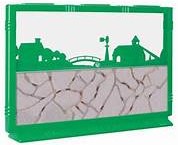 Alas, Old Faithful never happened, not even like you see in cartoons. Thirty minutes of fill-‘er-up and then I gave up and turned off the water. Not only did I not flush out a ground squirrel, I didn’t even fully flood wherever those holes led to. Which got me to wondering, just how big is this underground Habitrail? Can you picture one of those sand-filled ant farms you used to get as a kid? Is the foundation of our house resting precipitously on a network of squirrel tunnels and my water-dousing only accelerating its collapse? Let’s hope I don’t tumble out of bed one night and wonder what just happened. I will admit to this: a little while after me and the garden hose, I was at the kitchen sink when a groundie popped right up from one of those holes in the lawn. He didn’t even look wet, but boy did he look pissed. He stared right at me through the window with his beady little eyes, as if to say, “YOU. You killed my family”. Nah. More likely he was saying, “nyah, nyah, nyah – you didn’t get me”. Probably stuck out his teeny-tiny tongue while he was at it.
 I’m not one to take up arms, but ground squirrels have me thinking about a BB gun. I’m just an average shot but the little critters make easy targets with their stand-and-freeze habits. Maybe I could fashion a coat out of several dozen squirrel pelts and parade around the(ir) pastures. But seriously now, how many BB’s would it take to make a dent in our Chip ‘n Dale population? Ten thousand? Twenty? For crying out loud, that’s less than one-quarter of one percent (of seven billion). The squirrels seem to be winning.
 I’m going about this all wrong. I need something stronger. Do they sell nuclear bombs at Wal*Mart?
Some content sourced from Wikipedia, “the free encyclopedia”.
-
Come What Mayo
When I was a kid, I had this inexplicable obsession with cheese sandwiches. Maybe it was the popular Wonder Bread of the time (a slice of which could be reduced down to a compact dough ball with minimal effort). Maybe it was fondness for the Tillamook cheese my mother always had on hand; the sandwich merely serving as an edible container. Surely it was because they were super-simple to make. Whatever the reason, cheese sandwiches would’ve been utterly dry-mouthed and unappealing without the essential third ingredient: mayonnaise.

Tartar sauce or mayonnaise? The easy guess here is you have mayonnaise in your refrigerator. Go check. Even if you don’t, you have the ingredients to make your own: eggs, oil, and vinegar or lemon juice (blended together at high speed and allowed to set). The fancier versions of mayo add in some spices. Your particular brand probably lives quietly in the refrigerator door or towards the back of one of the shelves, alongside several other condiments. But the more I learn about mayonnaise the less inclined I am to group it together with the basics like ketchup and mustard.
 West of the Rockies where I grew up, the standard brand of mayonnaise was always Best Foods. When I moved east of the Rockies later in life, the name changed to Hellmann’s but the label, the jar, and ingredients were exactly the same. That was always an oddity to me – until I learned Best Foods acquired Hellmann’s after both brands were solidly established. Rather than drop one
  for the other Best Foods just kept them both. Same product, same packaging, different name. [Note: those of you in the southeastern U.S. may prefer Duke’s Mayonnaise – a distant third in sales. At least Duke’s tastes distinctly different than these fraternal twins.]
The essential ingredients Mayonnaise has one of those prolonged evolutions you could care less about, including its debatable origins. Several moments in European history claim ties to its invention. The most credible story (or the most romantic – take your pick) has the French winning the Seven Years’ War in 1756, and the victory dinner including a fish course, but no cream to make the tartar sauce. The chef improvised with eggs, oil, and garlic instead, and voila: mayonnaise. Further, the dinner took place in the Spanish port city of Mahon, so the sauce was dubbed “mahonnaise”. Elegant name, no?

On French fries – seriously? But for a few uses I can take or leave mayonnaise. In addition to my childhood cheese sandwiches I only use mayonnaise for tuna salad, potato salad, or cole slaw. I never put mayonnaise on a burger (do you?) It’s ketchup on my French fries not mayonnaise (apparently that’s a “thing” with some of you). It’s drawn butter on my artichokes (again, not mayonnaise). And speaking of the cheese sandwiches, I recall my mother packing school lunches with bologna-and-mayonnaise sandwiches. Meat and mayo on the bread – that was it. No Tillamook cheese, no lettuce or tomato, no pickle on the side. There’s a harsh simplicity to bologna and mayonnaise. In other words, I hated the combo (and maybe that’s why mayonnaise only gets “a few uses” in my world now).
 After my wife and I met, I discovered another refrigerator regular besides Hellmann’s: Miracle Whip. You could say Miracle Whip masquerades as mayonnaise (same look, same wide-mouthed jar) but the taste is decidedly sweeter. Check out MW’s ingredients and you’ll discover a clone of mayonnaise… but with a healthy dose of high fructose corn syrup (sugar). I like the tangy taste of Miracle Whip but I can’t help thinking mayonnaise is the healthier alternative. Credit Kraft Foods though, who debuted their “less expensive alternative to mayonnaise” at the Depression-era 1933 Chicago World’s Fair. Almost a hundred years later MW’s a staple condiment, and the Miracle Whip-or-mayonnaise debate lands in the same conversation as Coke vs. Pepsi, Uncle Ben’s vs. Minute (rice), and Aunt Jemima’s vs. Log Cabin (syrup).
“Mayo-nnaise…” If you’re like me, at some point in this post your sub-conscience drums up the 1982 romance “An Officer and a Gentleman” (If not, you’ve missed a great film). If you’ve been to Ireland you probably know County Mayo in the northwest corner of the country. Better yet, go visit the town of Mayo on the northeast coast of Florida. A few years ago Mayo changed its name to Miracle Whip as a publicity stunt. Okay, that tops all other “mayo” references I can come up with.
As little as I dip into my mayonnaise jar, I’ve seen plenty of expiration dates. It might behoove me to make my own instead. Eggs, oil, and vinegar, with a little salt to taste, whipped at high speed. Sounds American easy-as-pie. But call it mahonnaise, okay? Then you’ll have something sounding more like what the French cooked up all those years ago.
Some content sourced from the 7/9/2020 Wall Street Journal article, “The Delicious Evolution of Mayonnaise”, and Wikipedia, “the free encyclopedia”.
-
Watch Your Steps!
The punk rock duo The Proclaimers are Scottish twins Craig and Charlie Reid. Now 58, the Reid’s were born just a month after I was, back in 1962. Even though The Proclaimers produced eleven albums and sold five million copies, I only know them for their 1988 chart-topper, “I’m Gonna Be (500 Miles)”. It’s the song thrumming in my head every time I’m close to getting my 10,000 steps for the day.
 5,514. Good Lord, I’m only halfway to my 10,000 steps today and it’s already two in the afternoon. I need to get moving. I even worked out this morning (lifting doesn’t get you many steps). As usual, I strapped on my (Fitbit) tracker immediately after waking up but I’m usually further along by now. I’m gonna have to go long with the dog tonight if I have any shot at making the magic number.
 Magic number? 10,000 steps? Who made this the “minimum for good health”? A Japanese pedometer company; that’s who. In 1965, they nicknamed one of their trackers the “10,000 step meter” and the number stuck all these years later. Not that 10,000 steps has any significance when it comes to health benefits. It’s all relative to whatever number you normally walk. For that reason, we Americans can go less than half the 10,000 and still lower our mortality rate in a big way.
If you’re reading this post and you’re Amish, you’re already pooh-poohing 10,000 steps. You and your people average 14,000-18,000/day just by removing motor vehicles from your world. If you’re Australian or Swiss, 10,000 is just another day in the outback or the Alps (yodelayheehoo!). Even the Japanese find a way to average 7,500 steps/day inside a small island nation. Bringing up the rear? The Americans, of course (drum roll, please…). We clock an average of 4,800 steps a day – downright pathetic for residents of the fourth largest land-mass country in the world. Is it any coincidence the U.S. makes and sells more vehicles than any other country besides China?
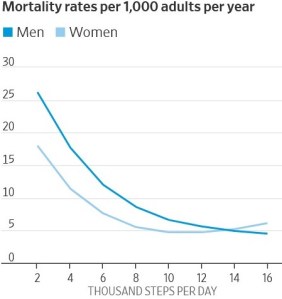
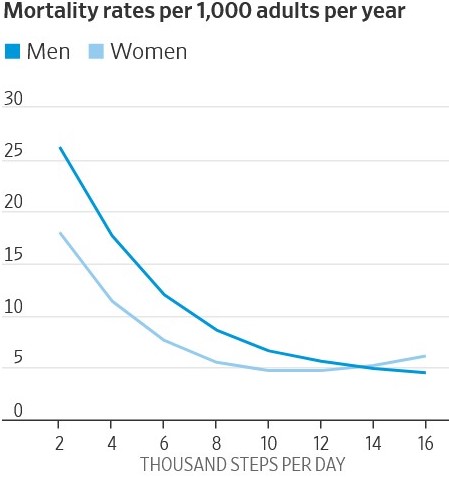
Source: Pedro F. Saint-Maurice, National Cancer Institute Back to the “magical” 10,000 steps. Let’s diminish the facts, shall we? A recent collaborative five-year study of 15,000+ participants determined as few as 4,400 steps a day associates to a 40% reduction in mortality rate (when the norm is more like 2,700 steps). Make it to 7,500 steps and the mortality rate drops by 65%. In other words, you’re doing your body good well below 10,000 steps. Unless you’re Amish, Australian, or Swiss. Sorry, you people have to keep going.
Alas, no collaborative study nor determined blog post is going to change the world’s obsession with 10,000 steps. The U.S. Department of Health and Human Services instead recommends five hours of moderate exercise a week (or half that much in “vigorous” exercise). Doctors prefer a rather vague recommendation of “about 2,000 steps more than you normally walk”. But none of that shuts down tracker production: 33 million devices shipped in the first quarter of this year alone. You know who you are; doing mindless laps in the kitchen late at night just to “close your rings”. 10,000 steps remains the benchmark no matter the expert advice.

Close those rings! Speaking for Americans at least, the magic number really is burned into our culture. We’ve switched out our most glam watches for fitness trackers (because even a Rolex can’t count steps). We download apps, print out weekly results, and obsess over “rings”, consecutive days, and “personal bests”. We get cheap thrills when our tracker vibrates 10,000 and those little digital fireworks shower the screen. Companies offer employees financial incentives if they can demonstrate extended habits of 10,000+/day. We are beguiled of time and money for this fairly arbitrary number.
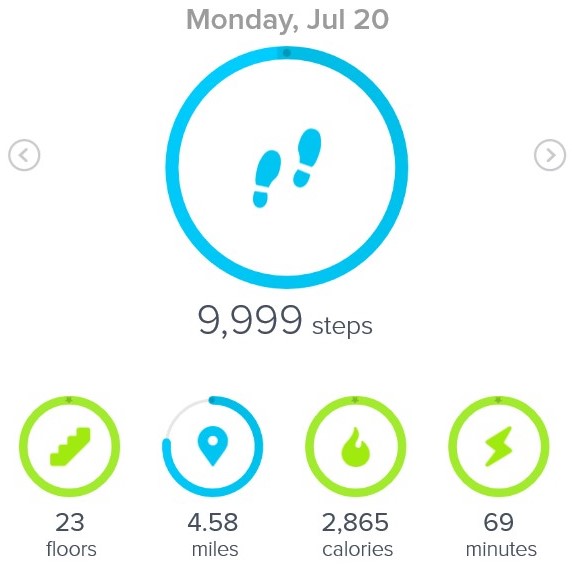
[Side note: The other day I woke up and checked my Fitbit history, only to discover I’d hit 9,999 steps the day before. Didn’t bum me out; still strapped on the tracker and started a new day. Kinda proud of that. On the other hand, one time I strapped my tracker to my ankle to try to get “steps” out of a cycle class. Didn’t work. Not so proud of that.]
 The pertinent lyrics of The Proclaimers’ “I’m Gonna Be” go like this: But I would walk 500 miles, And I would walk 500 more, Just to be the man who walks a thousand miles, To fall down at your door. No wonder I’ve got that song on the brain. I don’t think I’d walk a thousand miles, even for my girl. But I would walk five miles (about 10,000 steps) to hit my daily tracker goal.
Some content sourced from the 6/12/2020 Wall Street Journal article, “10,000 Steps a Day Is A Myth. The Number to Stay Healthy Is Far Lower”, and Wikipedia, “the free encyclopedia”.
-
Saving (the) Daisy

“Daisy” the St. Bernard (photo courtesy of Wasdale Mountain Rescue Team) Let’s visit the dog days of summer; specifically, a day in the middle of last week. In England, on the highest mountaintop in the land, a group of sixteen rescuers carried an ailing dog down to safety – a rescue operation of more than five hours. These heroes didn’t rescue just any dog; they rescued a full-grown St. Bernard. Put that image in your head for a moment. People coming to the rescue of a St. Bernard. That’s “Role Reversal” with capital R’s.

(photo courtesy of Wasdale Mountain Rescue Team) “Daisy” – the St. Bernard in our story – was descending England’s Scafell Pike last week (owners in tow, presumably) when she experienced pain in her rear legs and refused to go any further. Rescuers consulted a veterinarian before administering meds, food, water, and treats (lots of treats). Then they loaded the 121-lb. doggie onto a stretcher and eased their way down the mountain, navigating several steep stretches, rocks, and a waterfall. Daisy was the model patient the whole way down and it turns out this was her second rescue. Her first was by her owners, from a relatively “hard life” into a better one just a few months ago.

“Remy” in idle gear Saving Daisy strikes a chord with me not just because she’s a feel-good story (and we need plenty of those these days), but also because my wife and I own a St. Bernard ourselves. “Remy” is six years old and lives with us on our ranch, alongside horses, cats, and occasional wildlife. Remy came from a breeder in Nebraska about six hours to the east. He joined our family when he was only eight weeks old. Look at him now!
When I read about Daisy’s rescue my first thought was, “how the heck did a St. Bernard get to the top of a mountain? To explain, St. Bernards have typical dog gears like sprint, walk, and idle. The difference: Daisy and Remy spend 95% of their time in “idle” lying down. Yes, they can “sprint”, but only for about thirty seconds (followed by “collapse”). They can also walk short distances – say, to the mailbox – but like Daisy, when they choose to “idle” you’re not gonna get ’em to move an inch. Daisy is a svelte 121 lbs. so maybe she has more gas in the tank than most. Remy is 160 lbs. Our first St. Bernard “Sebastian” was well over 200. They don’t call ’em “gentle giants” for nothing.
 A St. Bernard and a mountaintop isn’t an unusual combination, of course. These big boys were originally bred to be Alpine rescue dogs by monks on the Great St. Bernard Pass between Switzerland and Italy (hence the name). It is said St. Bernards rescued 2,000 people over a span of 200 years from Alpine snowstorms. I’d say they’ve earned their reputation as rescuers (and working-class dogs).
Nope, they don’t carry a barrel of brandy We named our dog “Remy” after Remy Martin, the cognac variety of brandy. Perhaps you’ve seen images of St. Bernards with barrels of brandy around their necks. As romantic as it sounds – a big furry rescue dog bringing stiff drinks to avalanche survivors for warmth – the whole idea is just folklore. Even the Great St. Bernard Pass monks say they’ve never put a barrel on a Bernard.

St. Bernards weigh fifty pounds at twelve weeks If Daisy’s anything like Remy, her owners make accommodations atypical of most dog owners. A water bowl isn’t big enough for a Bernard; better go with a bucket. Add a large waterproof mat under the bucket because it seems one-third of every slurp ends up on fur or floor. For those (very short) walks, forget the leash and go with a heavy rope instead (we use a horse’s lead line). Also, you’ll need a doggie ramp for the car because Bernards aren’t so agile. While you’re at it, trade the car in for one with a high ceiling clearance. And be sure to crank the AC so all the panting doesn’t fog the windows.
 St. Bernards are classified as “working dogs”; a tribute to their rescue skills. They compete in dog shows like other breeds, but less in agility and more in carting and weight-pulling. St. Bernards have starred on the silver screen, as the good (“Beethoven”), the bad (“Cujo”), and the animated (“Nana” in the Disney version of Peter Pan). I think Daisy’s story might be an even better “Incredible Journey” script, don’t you? After all, St. Bernards have been rescuing people for thousands of years. Now we finally get one asking for our help. It’s about time the shoe was on the other foot (er, paw). Glad you’re okay, Daisy!
Some content sourced from Wikipedia, “the free encyclopedia”.




About Me
The sky is not completely dark at night. Were the sky absolutely dark, one would not be able to see the silhouette of an object against the sky.
Follow Me On
Subscribe To My Newsletter
Subscribe for new travel stories and exclusive content.
 Life In A Word