
Hello, I’m Veronica
The sky is not completely dark at night. Were the sky absolutely dark, one would not be able to see the silhouette of an object against the sky.


-
Ice Cream Dreams
Before our vacation in South Carolina last week, I took measures to ensure I was fully prepared for the low country’s late-May heat and humidity. I packed a reliable SPF 30 sunscreen. I purchased a couple of bottles of spray-on insect repellant. I added several hats to the wardrobe. I even brought a USB-chargeable mini-fan, which hangs around the neck, operates at three speeds, and adjusts to just the right angle. But guess what? I didn’t need any of these items in South Carolina last week (for the weather gods were merciful). Instead, I should’ve left it all at home and just brought my bed.

South Carolina is nicknamed “The Palmetto State” Is it me getting older or can we all agree on the exceptional value of a good night’s sleep? For me, it’s a day of brain fog if I don’t get a quality 7.5 hours in la-la land the night before. When I’m up past midnight (which is never my intention), I know I’m going to pay dearly at 7am the next morning. Because, I wake up without fail (and without alarm clock) every morning at 7am. Even if I don’t hit the hay until 3am.
Stay in a hotel – any hotel – and after one night you’re reminded how the circumstances of quality sleep are frustratingly beyond your control. My wife and I booked a charming historic inn our first night last week, and what-do-you-know, our bed was just as historic. The seemingly elegant four-poster contained a lumpy mattress with a few squeaky springs, and a decided slope from my side of the bed to my wife’s. Throw in the two-hour time change and we tossed and turned like a washing machine’s most violent agitation cycle.
 The second day we drove over to Charleston (half asleep), where you’d think a Courtyard-by-Marriott room would deliver the Z’s just a little bit better. No such luck. Our fifth-floor corner space included two windows with not-so-blackout curtains. Our first night’s sleep was interrupted by the hotel fire alarm, triggered because one of the elevators malfunctioned. The rest of our night’s sleeps were interrupted by the several amped-up bachelorettes and wedding parties resident in the hotel. Finally, we were adjacent to the fire exit stairs, with a bangy access door used constantly… because of the malfunctioning elevator.
Once upon a time, I was happy just to afford a bed to sleep in. But over the years I’ve developed a respect for the crucial elements of quality sleep. A comfortable mattress is worth the max you can afford to pay. A mattress where you can raise/lower the head and foot is even better. Make the room pitch black (which in our case includes a small piece of cardboard to block the fireplace pilot flame). Adjust the temp to the high sixties °F. Invest in a white noise machine. And table the electronic devices and alcohol several hours before bedtime.
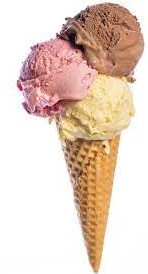 If there was a plus side to my Charleston sleep, it was this. We discovered a very good ice cream place within walking distance of the hotel. Don’t know about you but ice cream does wonders for my sleep. Specifically, my dreams. Maybe it’s the sugar or maybe it’s just the late-night munchies, but I’m guaranteed all kinds of REM-sleep adventures when I’ve had ice cream. Some are haunted-house scary, others earn a movie-theater R-rating, and still others are a jumbled hodgepodge of individual memories making no sense when thrown together. Whatever the subject, my ice cream dreams are a ton of fun. They also disappear from memory as fast as the ice cream did the night before. I’m not one of those who greet you at breakfast with, “You’re not gonna believe what I dreamed about last night!” Because I’ve already forgotten.
Dreams are the topic of an entire post and alas, I’ve already used up my typical word count this time around. But let me leave you with some dreamy trivia. The average person enjoys three to five dreams a night. Like me, most people quickly forget their dreams the moment they wake up. Dreams last longer as the night progresses. The older you get, the less you dream. Finally, for all we know about the brain, we know next to nothing about dreaming.
 I can’t fit a bed in my suitcase so I already know the next time I travel means quality sleep stays behind. But maybe I’ll pack a little ice cream on dry ice. If I can’t get my usual dose of Z’s, the least I can do is enjoy a forgettable sweet dream or two.
Some content sourced from Wikipedia, “the free encyclopedia”.
-
Gadgets… Be Gone!
The defining elements of the 1970s included disco music, bell-bottom pants, and really big sunglasses. You had block-long lines at gas stations thanks to the “Energy Crisis”, President Nixon’s resignation because of Watergate, and the long-overdue wrap of the Vietnam War. People preferred their clothes and cars in bright colors, their hair shaggy. I don’t remember much of this stuff, since I was only a budding teenager. But I’ll never forget my very first audio cassette tape deck.
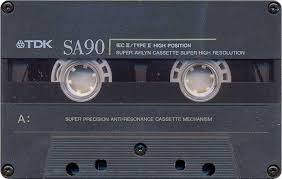
90 minutes of songs in your pocket You’re seeing obituaries in the news these days for noteworthy people of the 1970s. Fifty years ago these people were generally in their thirties or forties; a reasonable age to invent something. So it didn’t surprise me to read about Lou Ottens, who died in March at the age of 94. Ottens was an engineer for the Philips Corporation. Never knew him, never heard of him, but I’m forever grateful he invented the compact cassette audiotape.
[Millennials, roll back the clock on music media. From your digital subscriptions, pass through Blu-Ray and DVD, then compact disc (CDs), until you finally land in the 1970s and the compact cassette audiotape. If you made it to long-play (LP) vinyl records you went a little too far.]
Cassette tapes were a sensation in the 1970s because not only were they pants-pocket-portable, they were recordable. Me and my cassette deck spent many an afternoon capturing Top-40 hits off the local FM radio station (Barry Manilow! Helen Reddy!) Then I’d store my precious cassettes in their little suitcase, which could hold twenty or thirty inside plastic cases. Add in the invention of the Sony Walkman at the end of the decade (the first handheld cassette player) and you’ve got a broad overview of 1970s music media.
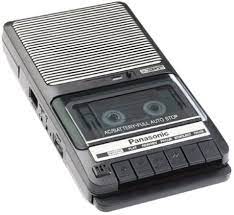
1970s chic I did have a Walkman somewhere along the way, but the better memories come with my tabletop cassette deck (like the one shown here). It lived on the desk in my bedroom, with its square speaker and giant pushbuttons, a precursor to today’s boom box. It ate the occasional cassette tape with relish, and background noise always accompanied recordings off the radio, but my tape deck was still fairly state-of-the-art for the 1970s. It only weighed a couple of pounds including the four C batteries. The pop-out handle made for easy carry.
Lou Otten’s passing speaks to how many inventions, no matter how novel or cutting-edge, are sooner or later kaput. Like the wax occupants of Madame Tussauds, you know your useful life has passed when you’d be better off in a museum. So how about a few more inventions from my childhood years – once useful but now “almost gone”?
1960s
- magnetic stripe card (smartphones are saying, “move over”)
- plasma display panel (PDP)
- handheld calculator (just ask Siri now)
- 8-track cartridge (whoa, that’s ancient history)
- Liquid Paper
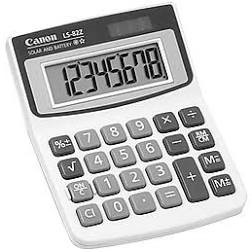
Soon to be kaput 1970s
- Pong (one of the earliest arcade video games)
- floppy disk (removable computer file storage)
- portable GPS device
- cell phone (audio calls, nothing else)
- videocassette recorder/player (VCRs)
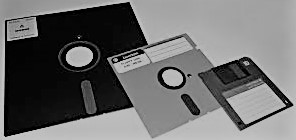
“Floppy” file storage I was just as curious to check out the decades of my parents’ childhood. What inventions from their formative years are no longer?
1930s
- Polaroid photography (in its original form)
- IBM electric typewriter
- coin-operated parking meter (now accepts credit cards)
- drive-in movie theater (making a COVID-era comeback, perhaps?)
- twist-tie (now built into your kitchen trash bag)
1940s
- aerosol spray can (can we at least agree, these need to go?)
- Slinky and Silly Putty (not today’s child’s toy of choice)
- atomic bomb (let’s just pretend these are obsolete, shall we?)
- lp phonograph record
- jukebox
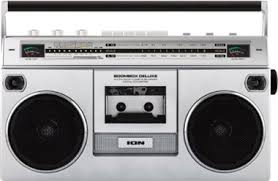
Early-model boombox Last summer I went through a few neglected boxes in the garage and found a few of my old audiocassette tapes. I keep a still-kicking boombox in the garage (for AM radio baseball games), with a dusty cassette tape player in the middle. One afternoon I popped in one of those old tapes, pressed PLAY, and behold: John Denver was alive and singing again. The music was as crisp and clear as 1970.
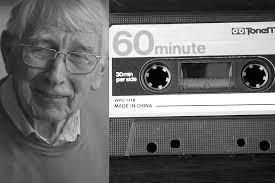 So give it up for Lou Ottens. Not only did he design audiocassette tapes, he designed those little guys to last!
Some content sourced from the Hackaday.com article, “RIP Lou Ottens, Developer of the Compact Cassette and More”, and Wikipedia, “the free encyclopedia”.
-
Polishing the Pearls
Twice a day, my toothpaste tube and I do battle. When I take the tube out of the medicine cabinet and realize there’s only a little bit left, I can see it smirking as if to say, “You’re not getting any more out of ME!” Yeah, right. I just flatten it from one end to the other (I recommend a hairbrush here), forcing every last bit of paste to gather at the top, ready to launch. Then I take off the cap and squeeze like crazy. It’s a good workout for the hands, and a mindless challenge to extend the life of your toothpaste.
 Speaking of toothpaste – yep, that’s my topic today – here’s a really good trivia question. In the Roald Dahl classic, “Charlie and the Chocolate Factory”, what did Charlie’s dad do for a living? He screwed the caps onto toothpaste tubes… before machines were invented to do the job for him. (He also died before the first paragraph and was never part of the story, so it’s a little weird I remember that bit. But I digress.)
 Quick, name the first ingredient you think of in toothpaste. Flouride? Not a bad guess, but did you know fluoride makes up only a tenth of a percent of toothpaste? That’s like a pinprick on the tip of your finger. Flouride is potent, my friends. Good for healthy enamel but only in itty-bitty doses. Keep those chemicals close, but not too close.
Was your first ingredient surfactants? A surfactant is basically a “foaming agent”, which helps distribute the paste around the inside of your mouth, which translates to better cleaning. Surfactants remind me of those animated scrubbing bubbles you’d see in TV commercials, whirling around the bathtub surface. You also find them in shampoos and conditioners. Without surfactants, most of the hairs on your head would get clean and conditioned, but others would be left high and dry.

“Minty fresh!” How about flavorants – you know, peppermint, spearmint, wintergreen, or cinnamon? If flavorants were the first ingredient you thought about with toothpaste, go directly to Jail (i.e. do not pass GO, do not collect $200). Flavorants do zilch for your teeth. They just make brushing a more pleasant experience and fool you into thinking you have a fresher mouth when you’re done. You might as well chew gum. The sugarless kind, that is.
Okay, let’s cut to the chase. The primary ingredient in toothpaste is abrasives (and if this was your answer, you win a free dental drill). Abrasives make up 50% of what’s inside the toothpaste tube. They’re “designed to help remove plaque” (remember that phrase). Think of abrasive-laden toothpaste as liquid sandpaper. Abrasives are the reason you don’t want to swallow toothpaste. And don’t brush too hard either. With enough pressure, these bad boys would be happy to remove your enamel.
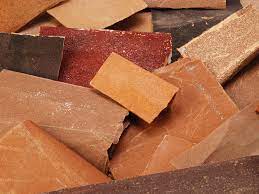
Toothpaste also has grit I could list even more toothpaste ingredients (ex. antibacterial agents, whiteners, re-mineralizers), but let’s just agree: there’s a big, diverse party going on inside the tube. Now for the bad news. Toothpaste has no significant impact on the reduction of plaque – so says certain clinical studies. That’s why abrasives are described as “designed to help remove”. That’s a sneaky way of saying they just keep things in check until your next appointment with the dentist. Sorry (Charlie), no amount of brushing can replace those nasty power tools your hygienist has so much fun using.
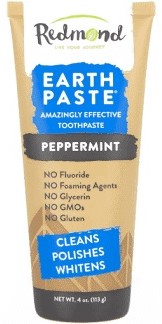
 For all my talk about toothpaste ingredients, the brand I use has very few. Earthpaste (“Amazingly Effective!”) has no fluoride, no foaming agents, and almost no flavor. In fact, Earthpaste has only four ingredients – water, clay, salt, and essential oils. It’s like brushing with mud. Wait, it IS brushing with mud! Just as effective, without the chemicals (subtle plug). You’ll find it on Amazon.
So all this talk about toothpaste may be important, but so is getting every last bit out of the tube. And there may finally be a solution to that battle. The very smart peeps at Massachusetts Institute of Technology (MIT) have developed an edible product called LiquiGlide. It’s invisible (which okay, is a little disturbing), and it’s designed to coat the inside of a container so the contents will completely empty with just gravitational pull. Can you imagine? No more flattening, squeezing, or hand workouts. Just upend the tube and 100% of the product comes pouring out. Get-your-money’s-worth people like me silently rejoice.
LiquiGlide’s proof is in the pudding, er – ketchup. No more smacking or shaking the bottle. No more “An-ti-ci-pay-yay-tion” (for those of you who remember the 1970s Heinz jingle). Our future ketchup bottles and toothpaste tubes will be transparent – and empty – by the time they head to the recycling bin.
 Unfortunately, I’d have to give up my Earthpaste and move to Europe if I want to experience the benefits of LiquiGlide. (The company has no immediate plans to sell its products in North America). That’s not gonna happen, so until further notice you’ll find me in the bathroom, doing battle with my toothpaste tube. It’s not so much about getting my teeth clean. It’s about getting my money’s worth.
Some content sourced from the CNN.com article, “How MIT could help you pour ketchup”, the CNN.com article, “Colgate’s new toothpaste tube…”, and Wikipedia, “the free encyclopedia”.
-
Tale of the Little-Dog
When my son and his wife visited with their daughters last week, the consensus for dinner was hamburgers and hot dogs on the grill. These choices were noteworthy in that I honestly can’t remember the last time I ate a hot dog. Sweet Italian sausage? A couple of times a month cut up into a stir-fry of vegetables. Beer brats? Also delicious, hot off the grill with a little mustard. But a hot dog is child’s play by comparison. Or should I say, a “dachshund sausage”?
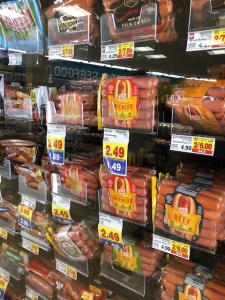 It’s true. The Germans, who by all accounts can take credit for the invention of the hot dog (five hundred years ago!) nicknamed their frankfurters “dachshunds” – or “little-dog” sausages because, well, they looked exactly like the dog breed. The only history Americans claim is the re-nickname “hot dog”. Even the hot dog bun – which really took hold at the Chicago World’s Fair in 1893 – points back to the Germans, who always ate their sausages with bread.
Are hot dogs a staple in your diet, or like me are they simply a distant memory? If they weren’t hot off the grill in the backyard or at a summer picnic, perhaps you had one at a baseball game (but not so much football or basketball, go figure). You’ve probably also seen hot dogs on the midway at carnivals and county fairs. Wherever you get your franks today, they’re just not as likely to come from established restaurants.
 In the 1970s, America seemed to have hot dog stands on every corner. The most popular of these was the distinctive drive-thru Der Wienerschnitzel’s, but you also had – at least from my California-based memory – Pup ‘N’ Taco, Ben Franks, Tail o’ the Pup, and the walk-up Hot Dog on-a-Stick booths you’d find at amusement parks. Today’s retail hot dog is at a Sonic Drive-In or the food court at Costco. If you live anywhere near New York’s Coney Island, you can also include “Nathan’s Famous”, or at least the annual hot dog eating contest of the same name.
 A hot dog may be “a cooked sausage eaten in a long, soft piece of bread”, but its secondary meanings are less definitive. “Hot Dog!” is something you used to say when you were VERY happy about something else (“used to”, meaning sixty or seventy years ago). A “hot dog” is also a person “who makes fast, skillful movements in skiing, snowboarding, or surfing to make people notice them”. That last definition still stands.
Speaking of “used to say”, we also used to sing about hot dogs, didn’t we? Oscar Mayer’s jingle convinced us we should BE hot dogs (so everyone would be in love with us). But the better song came from Armour, which asked us what kind of kids eat Armour hot dogs? Per the lyrics, “…fat kids, skinny kids, kids that climb on rocks… tough kids, sissy kids, even kids with chicken pox…” Today’s version of the Armour jingle would probably be censored just for using the word “kids”.
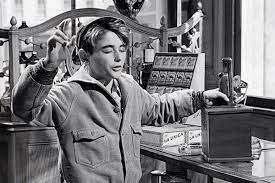
“I wish I had a million dollars. HOT DOG!” (Courtesy of Paramount Pictures and “It’s A Wonderful Life”) Hot dogs will always be a childhood memory more than a dietary preference in my book. My mother, raising five hungry boys, developed several dinner recipes when time and ingredients were in short supply. These included canned baked beans and weenies (two ingredients = dinner!), and a truly odd creation from the Betty Crocker cookbook made up of hot dogs, mashed potatoes, and cheese (three ingredients!). Whether it tasted good or not – I honestly can’t remember – dogs, mash, and cheese conveniently covered the protein, carb, and fat categories, all in one broiler-blasted casserole.

The Oscar Mayer “Wienermobile” My most vivid childhood hot dog memories are not the dinners mentioned above. Instead, I can’t forget snacking on raw hot dogs from the refrigerator (which sounds awful now, but hey, I was a kid). My mother was faithful to the Oscar Mayer brand so I ate a lot of their hot dogs raw. Speaking of Oscar Mayer, here’s the better memory. They built a motorized advertisement which to this day may be the coolest vehicle on wheels. The “Wienermobile” cruised the streets of Los Angeles, stopping every now and then in a parking lot so you could view it up close. The driver handed out tiny plastic replicas of the vehicle, appropriately labeled “Weenie Whistles”.

(Courtesy of Walt Disney Pictures and “The Santa Clause”) Let me conclude with a solved hot dog mystery. Your grocery store sells most brands in packages of ten. They also sell hot dog buns but in packages of eight. Why? Because hot dogs weigh about 1.6 ounces, which makes a package of ten a convenient sale of exactly one pound of meat. On the other hand, hot dog buns are baked in trays of four, which work best with conveyor belts and processing. An odd number of buns – trays of five – is a model of inefficiency. So until one or the other manufacturer changes their standard, you’ll always have leftovers for snacks. Or better yet, for your dog.
The hot dogs I served my granddaughters last week were comically advertised as healthy: no fillers, no preservatives, and so on. They weren’t very good. Maybe the worst part of a hot dog is what makes it taste so good? Or maybe hot dogs have simply lost their appeal to me? No, wait, that can’t be true. Anything my granddaughters ask me to eat has instant appeal.
Guess I haven’t eaten my last little-dog sausage just yet.
Some content sourced from the National Hot Dog and Sausage Council (NHDSC) website, and Wikipedia, “the free encyclopedia”.
-
A Million Little Leaks
Several years ago, I worked out with a personal trainer in a bunch of one-hour sessions at my gym. She was all about proper lifting and careful stretching – and nasty core exercises I’ve patently avoided to this day. But she did give me one time-proven piece of advice: after working out, go relax 10-15 minutes in the dry sauna. You’ve already revved up your metabolism with the workout, so the sauna helps extract toxins from the body. Yes, and the sauna also helps imitate the heat and humidity of South Carolina in the summertime.
 My wife & I are heading to the Palmetto State for a long-overdue getaway at the end of May. We’ll be spending a few days in the western counties before catching up with our daughter and her boyfriend in coastal Charleston. We’ve taken this trip before. The difference? Last time we were there in early April when the heat and humidity sort of caressed your cheek with a soft kiss. This time we’ll be there to kick off summer and it’ll feel like standing under a hot shower. Outdoors. Fully dressed.
 I’ve always been a sweater (no, I don’t mean the extra layer you pull over your head in the winter months). After a long jog, my t-shirt and shorts are so wet they could double as sponges. My hair falls wet-stringy straight down my forehead and the perspiration runs in rivers here and streams there. Yep, I’m one handsome dude. But where most people say ick, I recognize sweating for the healthy cooling/cleansing process it is. A sign my metabolism is alive and kicking. Turn on the faucets, baby.
Speaking of moisture, isn’t moist one of the most atrocious-sounding words in the English language? I’ve never made peace with those five letters and I know I haven’t used moist in a sentence in years (no matter how good my baked goods taste). The English language has such beautiful words, like chimes and delicacy and silhouette. Why disrupt the sweet-sounding party with a word like moist?

Photo courtesy of Warner Bros. I’m not gonna pretend a good sweat is ever comfortable (maybe it’s because I feel moist) but I’ve certainly gotten used to the sensation over the years. And now that I live in Colorado? Zero humidity. Well, okay, there’s a little humidity here at 7,500 feet above sea level. But most of the time it’s so dry, the needle on your tank seems to be perpetually on “E”. This pathetic little voice deep inside your body pleads for, “water… water…” (think Tin Man asking for his oil can – that kind of voice).

A dry sauna room (aka a “hot box”) Let’s go back to my dry sauna sessions. Since you’re already asking the question, I don’t mean “wet sauna” (where steam is introduced into a room as tiled as a Chinese kitchen). I’m talking about that other room, with nothing but wooden benches and a nasty little blast furnace in the corner (wood-burning, electric, hot rocks – whatever heats like hell). You sit there draped in a small towel in 200º F and for a few minutes, all is quiet and comfortable. But then, almost imperceptibly, your skin develops a sheen. You begin to glisten. Suddenly droplets of perspiration pop out all over the place and it’s “open the floodgates, Poseidon”. A million little leaks.
I won’t speak for the ladies’ locker room (that mysterious country club adjacent to our locker room), but sometimes the men’s dry sauna can get a little awkward. When you approach the glass door, it’s so steamed you can’t tell how many guys are already in there. Once you enter, choose a place on the bench without hesitation or you’ll be judged. Good chance you’ll end up next to a heavy breather, which in some schools of thought is therapeutic. Other times you’ll end up next to someone with headphones, which somehow don’t block the four-letter words of his rap music. One time I was subjected to the wellness preachings of a huge Samoan-looking guy, where I thought it best not to argue with his musings. All of which is to say, you never really know what you’re gonna get with the dry sauna. It’s an intimate little sweatbox filled with semi-naked strangers. Good times, huh?

South Carolina’s “Holy City” When I’m in Charleston I won’t miss the dry sauna because Mom Nature will provide her own version round-the-clock. The heat and humidity will promote enough of my perspiration to – as the family says – “make my face rain”. I’m like one of those mysterious underground springs, where the water keeps bubbling up from the ground and you wonder if it’s ever gonna stop. Every gonna stop? Not with my metabolism. For sheer entertainment value, if you’re in Charleston later this month, keep an eye out for me. I’m the one with the million little leaks.


About Me
The sky is not completely dark at night. Were the sky absolutely dark, one would not be able to see the silhouette of an object against the sky.
Follow Me On
Subscribe To My Newsletter
Subscribe for new travel stories and exclusive content.
 Life In A Word