
Hello, I’m Veronica
The sky is not completely dark at night. Were the sky absolutely dark, one would not be able to see the silhouette of an object against the sky.


-
Pandora’s Box
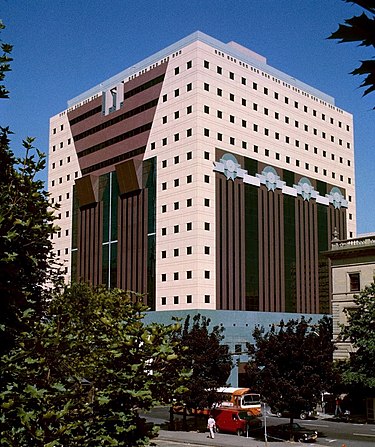
When America’s cities bred lifeless glass-and-steel skyscrapers in the 1960s, an architectural movement was born known as postmodernism. “Postmod” buildings were bold reactions to their dull and repetitive counterparts, using more distinctive materials and brighter colors. Perhaps no better example (or context) exists than in the city government offices of Portland, OR. Welcome to the Portland Building.

Michael Graves’ “Portland Building” Every structure I’ve covered in my recent posts on architecture lands on the American Institute of Architects’ America’s Favorite Architecture list. Even Phillip Johnson’s Glass House – the one I have a love/hate relationship with – makes the cut. But not the Portland Building. This may be architect Michael Graves’ signature design but it’s also known as “the building we love to hate”.
Take a good look at the Portland Building photo and tell me what comes to mind. Christmas gift? Child’s transformer toy? Strawberry-chocolate cake? I suggest Pandora’s box. I studied the Portland Building in college because the construction was completed in 1982, in the third year of my degree. It was a landmark statement of postmod. It was also a disaster from the day its doors opened.

Architects don’t always consider the practical aspects of a building, and budgets sometimes compromise on essentials. As soon as the city’s employees moved in, they realized the tiny windows don’t bring in much natural light, and the lack of adequate ventilation made it something of a hot box. Of greater concern, the Portland Building ran into water infiltration and structural issues almost immediately. The building required the first of several remodels only eight years after its construction, even though the city commissioners would’ve preferred it demolished instead. Like Pandora’s box, the Portland Building seemed to be an endless font of bad news.

“Portlandia” There’s not much to say about the Portland Building to entice you to visit (not even the rather bizarre 6.5-ton copper female poised menacingly above the entrance). The building is surrounded by blocks of nondescript skyscrapers, which makes the design all the more jaw-dropping when you see it in person. The only vote of confidence might’ve come from Portland’s mayor himself when it opened. He proclaimed the building “Portland’s Eiffel Tower… an emblem of the city which will draw the curious from around the world”.

The “goddess” seems to wonder why you’d even enter the building. The negative commentary is much more fun. A columnist from a local paper described the Portland Building as “something designed by a Third World dictator’s mistress’ art-student brother.” Architect Pietro Belluschi said “it’s not architecture, it’s packaging… and there are only two good things about it: it will put Portland on the map, architecturally, and it will never be repeated.” Travel + Leisure magazine called it “one of the most hated buildings in America”. Need I say more?

Fish out of water? The Portland Building is a case study of noteworthy architecture, yes… but that may be its only upside. The difference between “attractive” and “atrocious” can be as wide as the Grand Canyon. There’s value in whether you “like” a building. There’s also a reason you won’t find many other postmodernist structures in Portland.
Now for the latest on LEGO Fallingwater…
____________________
 LEGO Fallingwater – Update #8 (Read how this project got started in Perfect Harmony)
Today the off-model structure finally settled into the base, in a brisk twelve minutes of assembly time. 70 pages (or 77%, or 181 minutes) into the build, this is what we have:
 As you can see on the left, the house is starting to rise rather dramatically from the underlying landscape and water. Check out the photo above to understand the vertical glassed-in area that rises from the bottom of the house all the way to the top.
Boring as the build has been these last few weeks, I realize the underlying structure is necessary to support Fallingwater’s distinctive concrete balconies and stone chimneys. I also realize I have only two weeks remaining on this project. No wonder the piles of remaining pieces are dwindling! And rudimentary as those pieces may be, I expect the last two chapters to really bring the house into its fullest presentation.
Tune in next Thursday as construction continues! Now for another nod to Frank Lloyd Wright…
Taliesin West
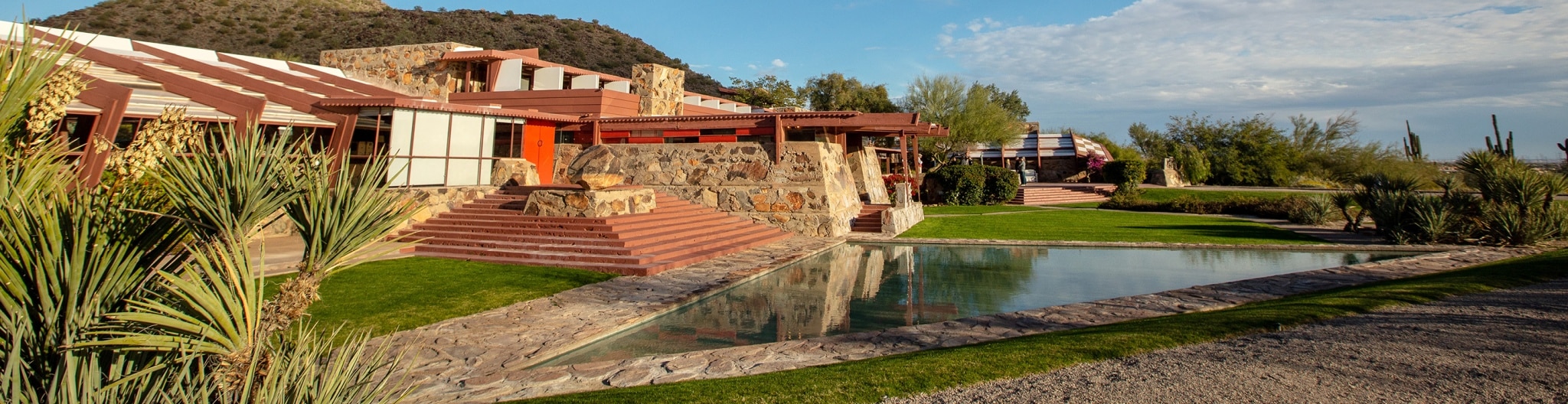
Most of Wright’s life (and designs) took place in America’s Midwest, but at some point the architect visited Arizona and later created the winter getaway he described as his “desert utopia”. Taliesin West is a campus of buildings, constructed of local materials intent on blending in with the surroundings – rock, sand, redwood; even canvas for the roofs. The structures are low and horizontal, connected organically by walkways, terraces, and gardens. The furniture and decor were also designed by Wright.

Taliesin West Is there a Taliesin East, you ask? Of course there is! Wright’s primary estate was built in the Wisconsin River valley on one of his favorite boyhood hills.
 But over the years, Taliesin West has gained the most notoriety. What was once Wright’s winter residence, studio, and offices is now a National Historic Landmark and a museum to the man. Taliesin West serves as the home of the Frank Lloyd Wright Foundation and School of Architecture, and is open daily for tours.
Some content sourced from the Frank Lloyd Wright Foundation website, and Wikipedia, “the free encyclopedia”.
-
Don’t Throw Stones
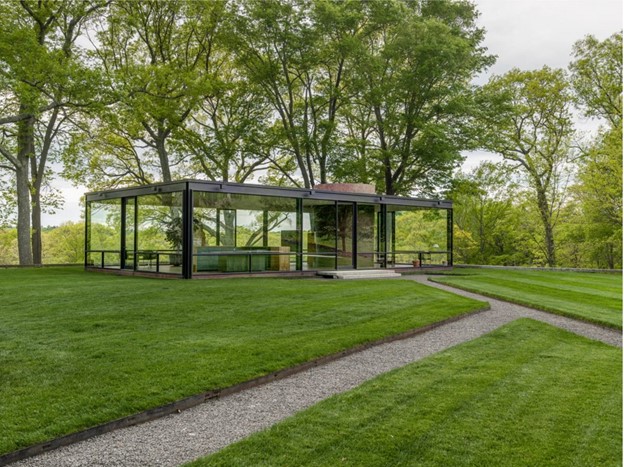
Back in Colorado where we used to live, there was a house down the street – a new build – where you walked through the front door, crossed a narrow hallway, and immediately found yourself outside again on a terrace. The design was intentional (thanks to stunning views of Pikes Peak), encouraging outdoor living as much as indoor. It’s a design principle rooted in one of America’s most famous residences. Welcome to New Canaan, Connecticut’s Glass House.
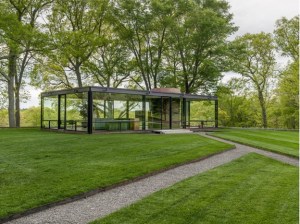 Imagine a classroom assignment where you’re asked to create a pizza. You choose whatever toppings and seasonings you like, the pizza’s shape and size, and the means to bake it. But there’s a catch: You can’t use a crust. Somehow you’d still put it together, right? Maybe that’s how architect Phillip Johnson approached his design of The Glass House back in 1949. It’s got windows and doors, a roof, rooms, and furniture, just like any other house; just no walls.
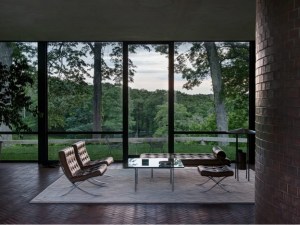 Okay, The Glass House has walls, of course, but their transparency is meant to throw the concept of “house” for a major loop.
As a student of architecture, I have a love/hate relationship with The Glass House. My first thought when I learned about it was, “I hate it. It’s just a steel and glass box. And everything I’d do in there would be on display for all the world to see. Everything“.
But like important works of art, the more you study The Glass House the more you appreciate all that it has to offer. You notice the fully open floor plan (bathroom aside), suggesting “rooms” can be defined by furniture or floor coverings, not just walls. Its transparency invites the outdoors in (whether or not you open the glass door on each of its four sides), suggesting the experience of “home” can go well beyond the walls. Finally, The Glass House boldly declares that less is more, meaning life in the dozen rooms of a McMansion pales in comparison to a cohesive collection of just three or four.
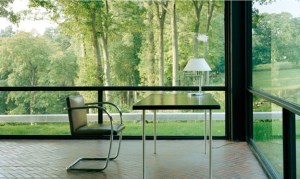 [Architect’s Note: “Less is more” is a famous mantra in architecture circles, coined by American architect Mies van der Rohe (of whom Phillip Johnson was a disciple). Marie Kondo might come to mind as well.]
Am I a fan of the harsh German glasarchitektur style of The Glass House? No. Would I want to live in such a house? Absolutely not. Yet I must admit, its concept of indoor-outdoor living (which has inspired countless residential designs since) is intriguing. It’s what makes Fallingwater such a captivating design. Furthermore, the siting of The Glass House puts to rest any concerns I had about privacy, since it’s nestled within fifty acres of open landscape.
 The Glass House, as you might expect, is in America’s National Trust for Historic Preservation, and open to visitors through guided property tours. As the famous saying goes, “People who live in glass houses shouldn’t throw stones”. I’m pretty sure Phillip Johnson didn’t throw any. After all, The Glass House was where he made his home for over fifty years.
Now for the latest on LEGO Fallingwater…
____________________
LEGO Fallingwater – Update #7 (Read how this project got started in Perfect Harmony)Today we spent entirely “off-model” again, building up the structure you see in front. 60 pages (or 66%, or 169 minutes) into the build, this is what we have:
 This week’s photo should look virtually identical to last week’s, because all I did was add layers to the “house” in front (which doesn’t look at all like a house). The only excitement was adding that balcony jutting out in the left rear corner.
I’ve bored you again with the model update, so here’s a poetic quote instead, from Wright himself about designing Fallingwater:
“The visit to the waterfall in the woods stays with me and a domicile has taken vague shape in my mind to the music of the stream… this structure might serve to indicate that the sense of shelter… has no limitations as to form except the materials used and the methods by which they are employed…”
Tune in next Thursday as construction continues! Now for another nod to Frank Lloyd Wright…
Wingspread
The last of Wright’s Prairie Style houses may have the most creative name. “Wingspread” was designed and built in 1937 in Racine, WI for the SC Johnson family, for whom Wright also designed his more famous Johnson Wax administration building nearby.
 Wingspread is a sprawling pinwheel plan, with each of its single-story arms serving a different purpose. The central octagon is three stories high. Wingspread is full of fireplaces (five), but more of interest is Wright’s accommodation of requests by the Johnson children. For them he added a Juliet balcony bedroom and a crow’s nest. Let it also be known Wright had an occasional bit of fun with his designs. Wingspread contains a disappearing dining table and a great room clerestory ceiling inspired by the look of a teepee.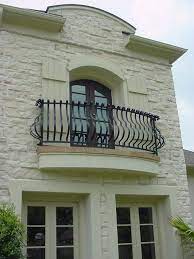
“Juliet” balcony Wingspread has been converted into a conference center today, but is open for tours by reservation.
Some content sourced from The Glass House website, the Frank Lloyd Wright Foundation website, and Wikipedia, “the free encyclopedia”.
-
Built More than Most
My short but adventurous blogging tour through my favorite works of American architecture has included Frank Lloyd Wright’s Fallingwater and Greene and Greene’s Gamble House, two residences that couldn’t look more different if they tried. Today we add a third, but to call this one a “house” would be like saying Niagara Falls is a tall drink of water. Palace? Château? Both fit the bill, er… Bilt. Welcome to North Carolina’s Biltmore Mansion.

Biltmore Mansion If you enjoy the occasional retreat into the mountains, maybe you’ve thought about owning a second place someday. A modest cabin on a lake or a condo on the ski slopes. You’d get away for the weekend to enjoy the fresh air and recharge. You might call it your “little mountain escape”, which is exactly how George Washington Vanderbilt II described his summer home in Asheville, North Carolina. All 180,000 square feet of it.

“Front door” I’ll say this for G.W. Vanderbilt II: he knew how to spend money. Beginning in 1889 and for the next six years, Vanderbilt created the Biltmore estate on hundreds of thousands of forested acres in North Carolina. His undertaking was so massive it required the purchase of 700 separate parcels of property. The mansion itself, the design of architect Richard Morris Hunt, required a temporary three-mile railroad connection (to deliver materials), a woodworking factory, and a kiln capable of creating 32,000 bricks/day. At the height of its construction the Biltmore estate employed over 1,000 workers.
The mansion itself is fairly indescribable, at least with the handful of paragraphs I allot myself today. Vanderbilt opted for 250 rooms spread across four stories, with 65 fireplaces and three kitchens. This was his second home? What the heck did his first place look like, Versailles?

“Dining room” Since we just watched the Super Bowl, here’s a fitting way to picture the size of Biltmore: each of its four floors is the size of a football field. You can sleep in any one of 35 bedrooms. You can dine in 3,000 square feet of banquet hall alongside sixty other guests. You can choose from 10,000 books in the two-story library. You’ll climb a hundred steps on Biltmore’s massive spiral staircase to get to your fourth-floor bedroom (I suggest turning in early). Finally, the adjacent carriage house is 20,000 square feet – another third of a football field – because you get to choose from Vanderbilt’s twenty horse-drawn vehicles.
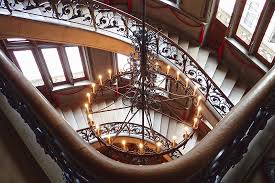 The Biltmore mansion also has a basement (of course it does), the largest in America. Vanderbilt liked his fun, so this floor houses a 70,000-gallon swimming pool, a bowling alley, and a gymnasium. Throw in electric lights, forced-air heating, walk-in refrigerators, and elevators, and you have a thoroughly state-of-the art structure (at least for the late 1800’s).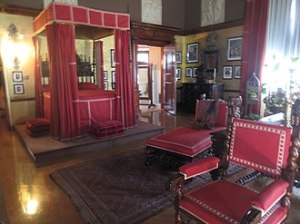
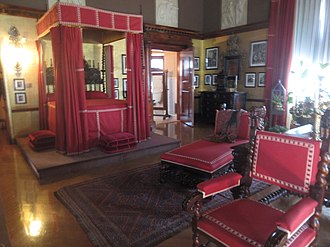
Vanderbilt’s bedroom News to me, one of architecture’s styles is known as “Châteauesque”. It describes a handful of the mansions designed in the Gilded Age of the late 1800’s (some covered in a recent tour of Newport, R.I. by blogger Lyssy in the City). The Biltmore certainly qualifies as a château. It’s the largest privately-owned house in the United States. If you’re looking to get your 10,000 steps, check out the tour information here.
Now for the latest on LEGO Fallingwater…
____________________
LEGO Fallingwater – Update #6 (Read how this project got started in Perfect Harmony)Today we spent entirely “off-model”, creating the random looking structure you see in front. 50 pages (or 55%, or 148 minutes) into the build, this is what we have:
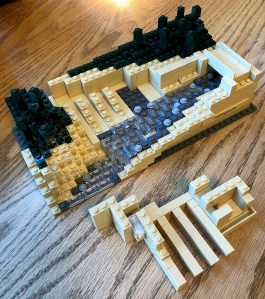 I had to reference the photo of the completed model to understand what I’m building here. It’s the house itself, of course, but only the base, largely hidden from view when the model is complete. It appears I’ll be building up this part of the house in similar fashion for the next couple of weeks.
Since today’s update was a little boring, how about an interesting coincidence instead? I just noticed “Fallingwater” contains the letters, F, L, and W… in that order. Talk about an architect’s “signature”, eh? Wouldn’t surprise me if Frank Lloyd Wright came up with the name himself.
Tune in next Thursday as construction continues! Now for another nod to Frank Lloyd Wright…
Frederick C. Robie House
No history of residential American architecture would be complete without including the Robie House, which you’ll find on the south side of Chicago. This very long, very narrow house is often described as “two large rectangles that seem to slide past one another”.

Frederick C. Robie House The Robie House is Wright’s best example of his Prairie Style, which “responds to the expansive American plains by emphasizing the horizontal over the vertical”. The cantilevered roof, window bands, and liberal use of brick are also characteristic of the style. The house is laid out with an open, naturally-lit floor plan, a novel design concept for the early 1900s.
 Given its troubled history (including its sale a mere fourteen months after it was built), it’s a wonder the Robie still stands today. The house is now incorporated into the University of Chicago campus and open most days for tours.
Some content sourced from the Frank Lloyd Wright Foundation website, and Wikipedia, “the free encyclopedia”.
-
Terminal Trans-formation
In the United States, you have what are known as the Big Four airlines: American, Southwest, Delta, and United. According to Statistica, these carriers account for two-thirds of America’s commercial flights. Not so long ago, the Big Four were American, Eastern, Trans World (TWA), and United. Eastern folded its wings in 1991; TWA a decade later. But TWA left an iconic legacy structure behind. Welcome to JFK International’s Terminal 5.

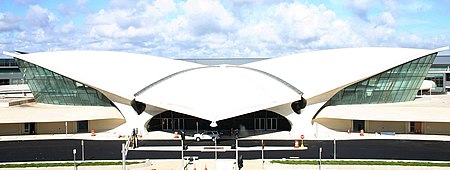
JFK International Airport’s “Terminal 5” If you’re flying to New York City, LaGuardia Airport is just a hop, skip, and a landing from Manhattan. For my money I prefer JFK International, ten miles to the south, if only for the chance to visit Terminal 5. “T5”, as it’s known today, embraces one of the most unique airport buildings in the world – the TWA Flight Center. We’re lucky it’s still standing.
 Go back to the first photo of T5. Doesn’t it look like a giant, white B-2 Stealth Bomber draped over the rest of the building? That part of the structure – or the “head house” as it’s called – was designed by Finnish-American architect Eero Saarinen as the TWA Flight Center. Would you have guessed it was constructed in the 1960s? I think it looks decidedly more modern.
 You can tell how dramatic the interiors of the Flight Center are without even stepping inside. Those window walls at both ends are two stories tall. The soaring “bomber” thin-shell concrete roof is shouldered at its corners by massive Y-shaped piers, allowing for the uninterrupted gathering space within. The Flight Center was the first terminal to introduce concourses and jetways to airport design, allowing passengers to board an airplane without having to drop down to ground level first.
Washington D.C.’s Dulles International Airport Saarinen’s most famous designs feature similar swoops and curves. He gave the main terminal at Dulles International Airport the same look. He served on the advisory board for the design of the Opera House in Sydney, Australia. But his best-known work towers over St. Louis (coincidentally, TWA’s headquarters city): the Gateway Arch. Sadly, Saarinen saw none of these structures to completion, passing away in 1961 at the age of 51.

St. Louis’s Gateway Arch So if TWA is long gone, why is the Flight Center still around? Because it’s been transformed into a wholly different animal. Yes, you’ll find the typical mix of concourses, gates, and restaurants you see at most airports – the so-called “T5” aspect of the building. But the Flight Center itself – the head-house – has been converted into a kitschy hotel, with hundreds of rooms, a central lounge between the window walls, and a cocktail bar inside a restored Lockheed Constellation airliner. Brass light fixtures, rotary phones, and bright red carpet evoke the heyday of TWA. They’ve even retained the mechanical split-flap display board used to advertise arriving and departing flights.

“Trans-formed” into the “TWA Hotel” Architecture is an important part of a culture, a museum of pieces placed here and there in the landscape. Preserving those pieces takes time, money, and sometimes, the gamble to repurpose. The TWA Flight Center may now be referred to as the TWA Hotel, but it’ll always be Eero Saarinen’s masterpiece.
Now for the latest on LEGO Fallingwater…
____________________
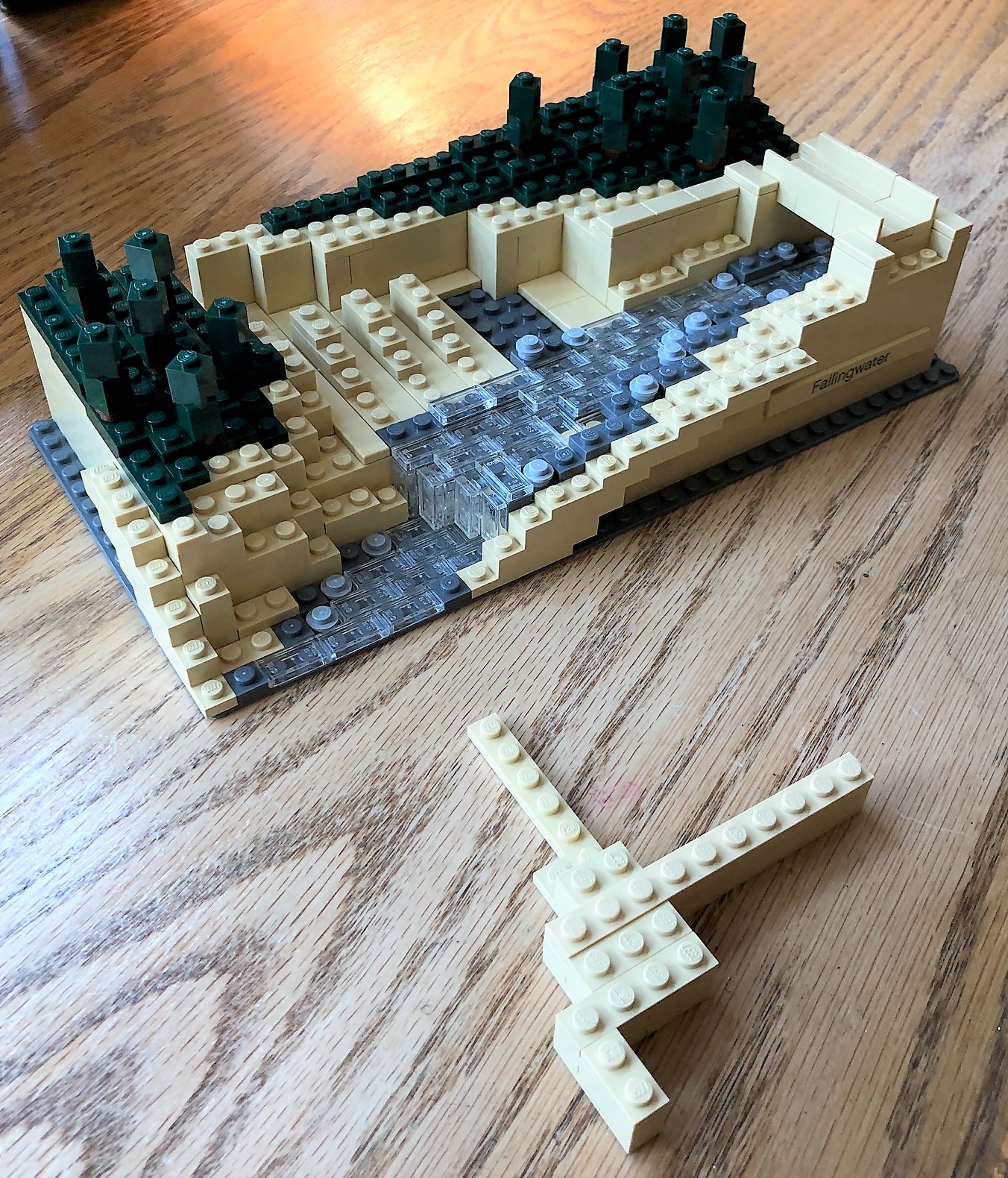
LEGO Fallingwater – Update #5 (Read how this project got started in Perfect Harmony)Today we spent landscaping “outdoors” around the foundation of the house. 40 pages (or 44%, or 136 minutes) into the build, this is what we have:
 The fourteen trees on the Fallingwater model property are each nothing more than one small green LEGO cube snapped on top of another one. Compare this basic look to LEGO’s more recent take on growees, as in blogger Andrew’s View of the Week’s LEGO Flower. Slightly more realistic, wouldn’t you say?
At least we’re seeing a portion of the house itself begin to emerge. We’ve built a bridge over the stream (back right), and we’re starting construction on one wing of the house – the piece you see in front of the model.
Tune in next Thursday as construction continues! Now for another nod to Frank Lloyd Wright…
R. W. Lindholm Oil Company Service Station
No commission is to big or too small for an architect, which is why Wright put his signature on a gas station, very close to the time he was designing Fallingwater.

R. W. Lindholm Service Station The Lindholm Service Station was part of Wright’s vision of Broadacre City, a utopian community planned for a four-square-mile property in Cloquet, MN. The Service Station fueled automobiles, yes, but also encouraged residents to gather in its upper space for what Wright envisioned as “… neighborhood distribution center, meeting place, restaurant… or whatever else is needed.” The cantilevered copper roof and band of glass windows is vintage Wright. The angular end of the roof canopy points to the St. Louis River as a symbolic nod to river transport.
The Lindholm Service Station is the only part of Broadacre City ever constructed, is included on the National Register of Historic Places, and is open to the public… to fill up your car, of course.
Some content sourced from the Frank Lloyd Wright Foundation website, and Wikipedia, “the free encyclopedia”.
-
Wings and Prayers
One of the must-sees on a visit to Colorado Springs is the campus of the United States Air Force Academy (USAFA). Besides a training ground for our future servicemen and women, the Academy hosts a high school, an airfield, two golf courses, and a cohesive campus of modernist buildings spread across 18,500 acres of the Rocky Mountain Front Range. But one structure stands prouder and taller than anything else on the property. Welcome to the USAFA Cadet Chapel.

USAFA Cadet Chapel If you’re following my blog posts on architecture (as I complete my LEGO Fallingwater model), you’ll recall Thorncrown Chapel from a few weeks back. The USAFA Cadet Chapel is a much bolder animal, dominating the academy campus skyline and easy to see from miles around. Instead of Thorncrown’s wood and glass, the Cadet Chapel boasts an impressive open structural steel frame, married with tall triangular stained glass windows. The main sanctuary is big enough to seat 1,200 (or about 25% of the USAFA student body); more like a church than a chapel. Frankly, the only thing the Cadet Chapel has in common with Thorncrown is its design inspiration: France’s Sainte-Chapelle.

Fighter jets all in a row? The distinctive feature of the USAFA Cadet Chapel is its seventeen spires, marching from one end of the building to the other. The bold design, by architect Walter Netsche, took a little getting used to when the doors opened in 1962. Visitors described the structure as a giant accordion made of triangles. I describe it, more fittingly, as a series of fighter jets standing on their tails.
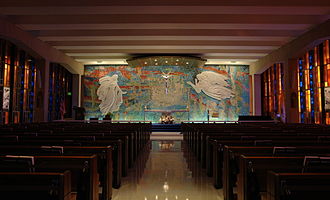
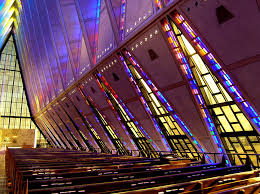 If you haven’t visited the Cadet Chapel you probably don’t know its biggest secret. It’s a chapel for all faiths. The main sanctuary is just the top floor of a multi-level structure. Hidden below, you’ll find individual chapels for Catholics (500 seats), Jews (100 seats), Muslims, and Buddhists. You’ll even find two “all-faiths rooms” and an outdoor area for “Earth-Centered Spirituality” (reserved for you Pagans and Druids). It’s safe to say your acceptance into the Academy has nothing to do with who or how you choose to worship.
USAFA Catholic chapel (lower level) The Cadet Chapel is a structural marvel, assembled from precisely one hundred prefabricated tetrahedral panels. Over the years its popularity has grown to where it was designated a National Historic Landmark in 2004. That’s the good news. Now for the bad. The original design called for a series of gutters to transfer water away from the building, instead of streaming directly down its panels. But the gutters were scrapped due to budget constraints…
Mistake.
Sixty years of caulking and recaulking leaks finally forced the Academy to close the chapel for remodeling in 2019. Now for the really bad news… they’re still not finished with the repairs. In fact, you won’t be able to walk through the doors for another four years. What’s taking so long? Adding all those gutters, the ones that were supposed to be there in the first place.

The Cadet Chapel is “boxed” until 2027 One more bit of bad news (the fighter jets are really nosediving). Getting construction workers to the tops of the chapel spires meant building an entire hangar-like structure around the chapel. No joke – they put the whole building in a box. In other words, not only can you not walk through the doors, you can’t even see the Cadet Chapel today. Trust me, absence makes the heart grow fonder. Mark your calendar for 2027, because you really need to see the USAFA Cadet Chapel. It’s the only place I know where a (jet) wing and a prayer can be found in the same place.
Now for the latest on LEGO Fallingwater…
____________________
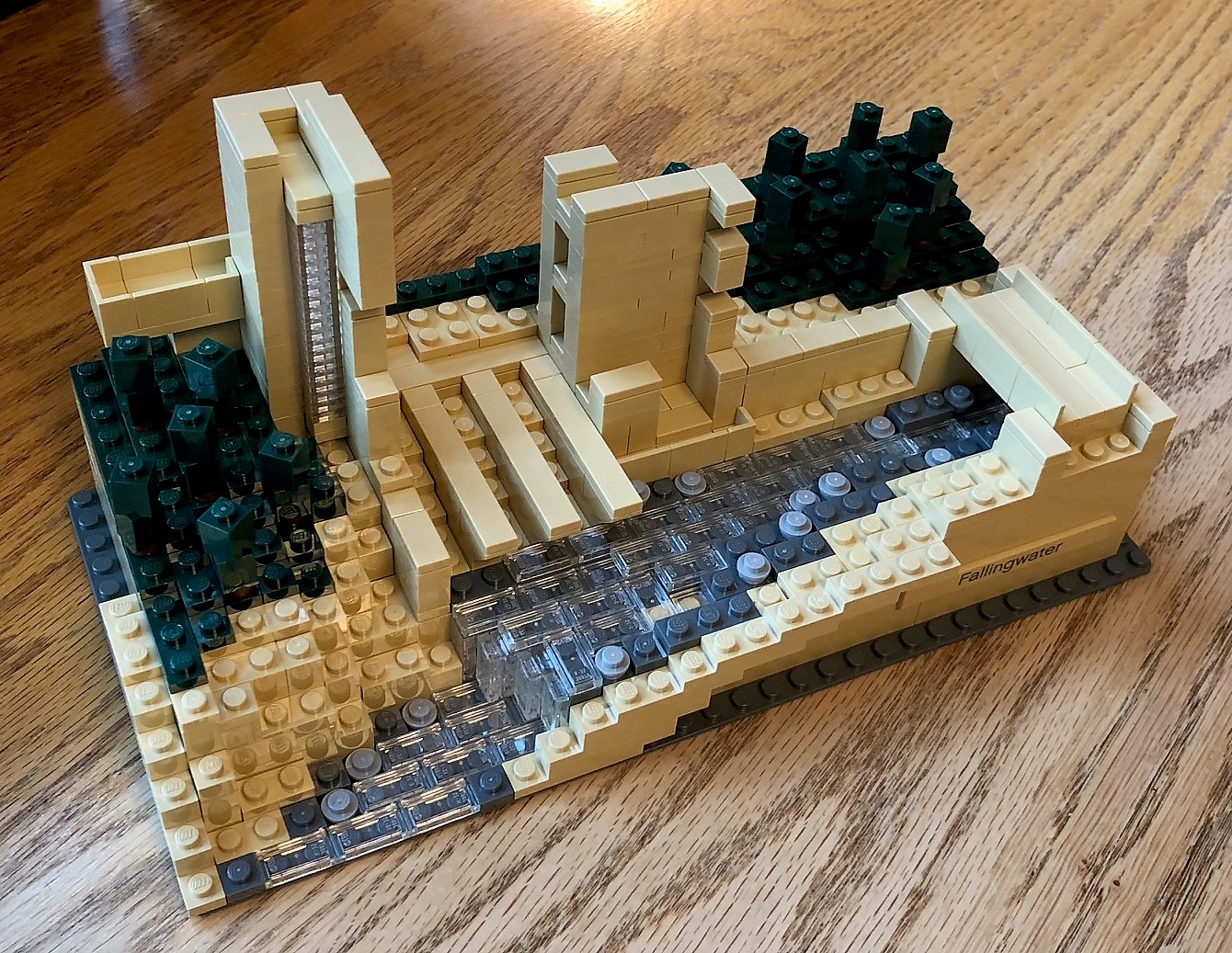
LEGO Fallingwater – Update #4 (Read how this project got started in Perfect Harmony)I’m starting to wish I’d built Fallingwater before the LEGO Grand Piano, so you’d see me taking on a greater challenge versus the other way around. 30 pages (or 33%, or 118 minutes) into the build, this is what we have:
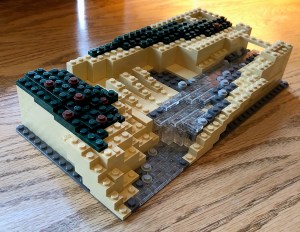 Pretty much the same as last week. We added some landscape to the left side (the green/brown pieces), more landscape along the back, and we raised the foundation a little higher up off the water. We have yet to see any of the distinctive house itself. Not so adventurous.
What IS adventurous is sifting through 800 tiny pieces. There’s no logic in how they were bagged (thanks, LEGO!) so I end up just spilling everything out onto the desk, searching for a lot of minutes followed by building for a few minutes. Tedious? Heck no, this is a blast. If “tedious” entered my brain I’d have no business building LEGO models.

LEGO Gamble House by Grant W. Scholbrock Props to my college buddy Bruce for sharing this photo, an example of a custom LEGO build… and one you can’t buy. It belongs in a museum if you ask me. There are pedestrian model builders (yours truly) and then there are professionals. Way to go, Grant!
Tune in next Thursday as construction continues! Now for another nod to Frank Lloyd Wright…
Solomon R. Guggenheim Museum

Guggenheim Museum I’m not a big fan of museums. Maybe that’s because, as Frank Lloyd Wright said, a lot of them look like “Protestant barns”. No wonder New York City’s Guggenheim Museum is radically different. When Wright set out to design it in 1943 he vowed to “make the building and the paintings a symphony such as never existed before in the World of Art”.
 I can’t describe “The Goog” any better than the website of the Frank Lloyd Wright Foundation. Their words: “… a white ribbon curled into a cylindrical stack that grows continuously wider as it spirals upwards towards a glass ceiling.” In other words, you the visitor climb in circles ever-ascending, enjoying the art as you go. The Guggenheim was the first museum design where the “physical home” played an important role in the experience of the art itself. If you’ve ever been to a museum that deserves a similar description, you have the Guggenheim to thank.
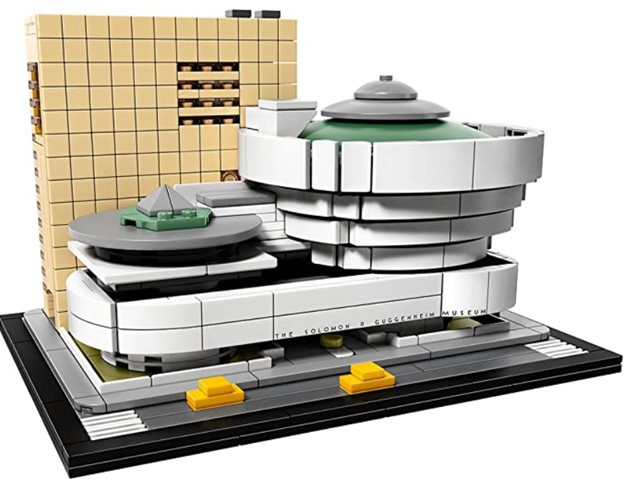
LEGO Guggenheim In closing I ask, is the Goog significant enough to earn a spot in the LEGO Architecture series of models? Why yes, it is!
Some content sourced from the Frank Lloyd Wright Foundation website, and Wikipedia, “the free encyclopedia”.














About Me
The sky is not completely dark at night. Were the sky absolutely dark, one would not be able to see the silhouette of an object against the sky.
Follow Me On
Subscribe To My Newsletter
Subscribe for new travel stories and exclusive content.
 Life In A Word