
Hello, I’m Veronica
The sky is not completely dark at night. Were the sky absolutely dark, one would not be able to see the silhouette of an object against the sky.


-
Let Freedom Ring
In an Election Week – especially one as consequential as this year’s – it’s only fitting I can’t seem to focus on blogging. After all, my country and its prospective leaders demand (and deserve) my undivided attention. Any topic I choose to write about here pales in comparison.
So I urge you to do the same. Set aside the blogs you read or write, if only for a little while. Watch tonight’s tallies, accept tomorrow’s outcomes, and pray for peace and continued prosperity. As the patriotic “My Country, ‘Tis of Thee” reminds us, we live in a sweet land of liberty.Let freedom ring.
 Some content sourced from Wikipedia, “the free encyclopedia”.
-
Flop O’ the Mornin’
Parked prominently within my wife’s impressive collection of teas are colorful boxes of English Breakfast and Irish Breakfast. The first is described as “expertly blended… a smooth classic” (strength: 4 tea leaves) while the second is “brilliantly blended… bold & robust” (3 tea leaves). Maybe those descriptions are right on the money but I’m a coffee drinker so what do I know? What do I know? I know I’d never let English breakfast or Irish breakfast anywhere near my dining table.
 Sorry to disappoint but we’re not talking about tea at all today. Instead, we’re talking about the food that goes with the tea. Or rather, the food that should go with the tea. In my world, the sanctity of breakfast is second only to the cornucopia of the Thanksgiving meal. There’s a certain well-defined menu of dishes that screams BREAKFAST!!! and nobody in the Western Hemisphere (or at least, in the New World) would disagree. Even so, I must acknowledge the “illegal aliens”; the dishes that try to crash the morning party when they really belong on the lunch or dinner table. Or in the trash. Or at least on the other side of the Atlantic.
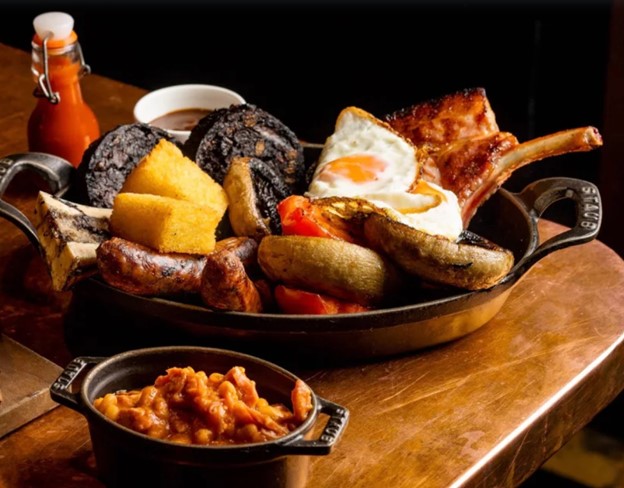
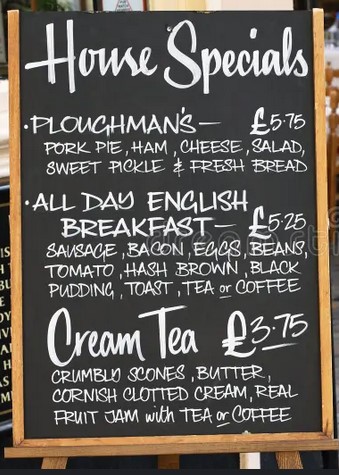
The “Full English” In its various forms, the full English breakfast starts out promising. You’ll find eggs, bacon, and sausage almost without fail; even hash browns on occasion. But the plate shatters after that. You have a tomato, cut in half, fried, and doused with salt and pepper. You have baked beans in tomato sauce (which aren’t even sweet the way Americans think of VanCamp’s or Bush’s). Finally, you have the horror known as black pudding, which can only be described through the hyperlink above instead of the words of this post, for fear I’ll lose my lunch – er, breakfast.
Unlike the teas, the full Irish breakfast is virtually identical to the full English, with the singular exception of white sausage instead of black. Again, the definition will remain behind hyperlinked for the sake of a clean keyboard. I was in Dublin on business years ago and took the “try anything once” approach with white pudding. Bad, bad, very bad decision.

White pudding (not for the faint of stomach) If I were born in England or Ireland I probably wouldn’t rain on the breakfast parade on the other side of the pond. But here’s the thing: even if you like a savory tomato or “pudding” for breakfast, the entire plate is greasier than the wheel bearings in your car. There’s not even anything to mop up said grease (like the slices of dry toast we Americans prefer). I can’t imagine having much pep in my step after a weighty meal like this.
Denny’s is very helpful to reestablish breakfast order. If you walk into one of their restaurants and order the “Build Your Own Grand Slam”, you can construct your plate from four of the following: Eggs (7 different ways), pancakes (9 different), bacon (2), sausage, potatoes (3), toast (countless), muffin, biscuit, ham slice, or seasonal fruit. With all those combos you could eat breakfast at Denny’s every day of the year and no version would be the same as another. But more to the point, Denny’s offers breakfast items decidedly “All American”. Add in waffles, hot/cold cereal, baked goods, and hash browns, and you’re looking at everything deserving of the list.

Where real “full breakfast” is served American breakfast menus do include a few trendy alternatives these days (even at Denny’s). You can keep it simple with a fruit smoothie, breakfast sandwich, or avocado toast. These all-in-ones strike me more like convenience foods than full breakfasts. Yes, you paint yourself a little healthier just for ordering them. But let’s hang in there a few generations and see if they still show up on breakfast menus. More likely they’ll just be memories the way porridge or salted meats have become breakfast history.
 For the record, my wife’s English and Irish tea boxes sit largely untouched, except for the few bags she’s brewed. They’re untouched for good reason. Just the words on the box have me thinking of tomatoes, baked beans, and pudding. Someone bring me a blueberry waffle stat.
Some content sourced from the CNN Travel article, “The Full English: How a greasy feast came to define and divide a nation”, and Wikipedia, “the free encyclopedia”.
-
Parts Party
I’ve always been fascinated – mesmerized even – by the mechanics of assembly line manufacturing. A product takes form from a single part, then moves down the line to where another part is added. Then another part, another, and another, until at long last the completed product presents itself at the very end for packaging. Assembly lines are becoming more and more automated, which begs the question: When will humans be removed from the process altogether?

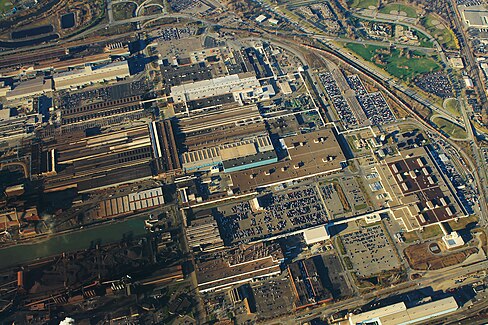
“The Rouge” On a recent trip to Detroit with my brothers, we were lucky enough to snag tickets to a tour of the Ford River Rouge Complex, where the F-150 truck (gas engine) is mass-produced. Ford has over 65 manufacturing plants worldwide but I think “The Rouge” is the only one you can tour. And boy is it worth it. You walk away with a lot more admiration for a fully-built F-150 than when you first set foot in the building.

The tour begins on the bridge at the lower left Ford doesn’t allow you to take photos inside The Rouge (and they keep a close eye on visitors) else I’d include a few here. The tour starts with a couple of promotional videos in comfortable theaters, followed by an elevator trip to the top of the visitors center for a look down at the vast campus. Then things get serious. You put away your phones, listen to the rules and regulations about behaving inside the factory, and off you go.

Ford F-150 Here are the eye-popping numbers. The F-150 travels the length of a four-mile assembly line as it grows from parts to finished product. That line includes over two hundred stops to add parts (which aren’t really stops because the truck is always being pulled along). A fully-functioning F-150 rolls off The Rouge assembly line every 52 seconds, which translates to a remarkable 650 new vehicles per ten-hour working shift. And finally, the whole process is far from automated. 6,000 workers assemble the vehicles, each a specialist in the given part, calibration, or inspection the truck demands.
Of course, an F-150 has far more than two hundred parts. Some of those assembly line stops are for the installation of major components. The entire dashboard, for example, or most of the engine are installed in a single stop. But you also have workers who do nothing more than take a rubber mallet and pound on rear taillight covers. Think about it. Can you imagine hammering on taillight covers 650 times a day? It’s mindless, it’s repetitive, and you have to wonder about the toll it takes on the human body.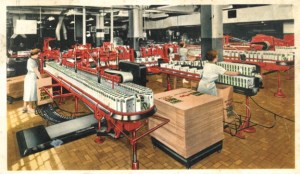
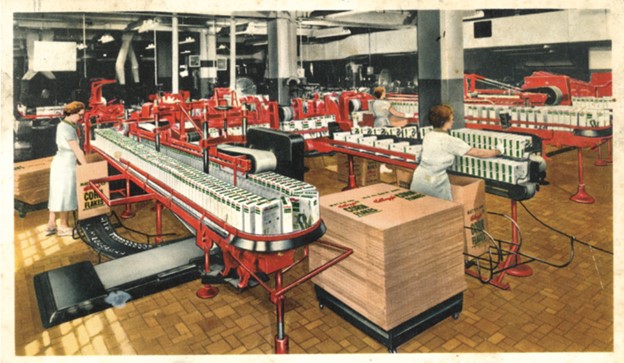
Cereal-making “back in the day” Assembly line work can be more fun and less repetitive than building cars. My family and I visited the Kellogg’s (cereal) factory in Battle Creek, Michigan in the early 1970s. The smell of cooked corn flakes might’ve turned a kid’s nose but the tour was the next best thing to Willy Wonka’s. You’d don a Kellogg’s paper hat and read the colorful brochure story about how “this little kernel went to Kellogg’s… first it was milled… then it was flavored…”. Then you’d walk the assembly line of breakfast cereal, from cooking all the way to box filling. The best part was at the very end, where you’d get free samples of all your Kellogg’s favorites, and postcards so you could brag about the place to your friends. Alas, like many manufacturing facilities, safety and espionage concerns brought an end to the Kellogg’s tours in the mid-1980s.
 At least I could watch assembly lines on TV after that. How It’s Made was my kind of show. The Canadian documentary spent years creating virtual factory tours so viewers could see the ins and outs of manufacturing processes. In a single episode you’d watch the dizzying mechanics behind the creation of everything from candies to clothing to cars. How It’s Made kind of gave you access where access wasn’t allowed.
Speaking of no access, the electric-engine version of the Ford F-150 – the “Lightning” – is produced in a plant where no tours are permitted (back to the espionage thing). Instead, you watch a short video of the process after you’ve completed The Rouge tour. How are the two F-150 assembly lines different? Several thousand humans. The Lightning production is almost entirely automated, with robotic machines hovering over the vehicles as they come together. Our tour guide said the assembly line is eerily quiet, since a robot doesn’t require a banging mallet to add on a taillight cover.
 For all my fascination with assembly lines and automation, I wonder whether “loss of humanity” is really the way to go. All those jobs at The Rouge would disappear. Machines would be one step closer to taking over the world. Suddenly “handmade” sounds better than ever.
Some content sourced from the Michigan Blue article, “Visiting the Kellogg’s Factory”, and Wikipedia, “the free encyclopedia”.
-
Apple Pie meets Maple Syrup
On a visit to Detroit with my brothers last weekend, I was surprised to discover just how close the city streets are to the edge of the United States. Walk out of Detroit’s downtown Renaissance Center through the south doors (yes, I did just say “south”), cross Atwater Street, and you’ll find yourself standing on the edge of the Detroit River staring at Canada on the other shore. Almost has you thinking in metric, “eh?”

Canada is south of the U.S. – who knew? Here’s something I probably learned in middle school and promptly forgot: the border between Canada and the U.S. runs right through the middle of Lake Erie (and the Detroit River). It’s as if Americans and Canucks had a long drawn-out discussion about who deserved the lake more, and then clinked glasses of Budweiser and Molson with, “Okay, you get half and we get half”. The same thing happened with three of the other four Great Lakes (America somehow got all of Lake Michigan) and that’s why – at least in Detroit – Canada lies to the south.

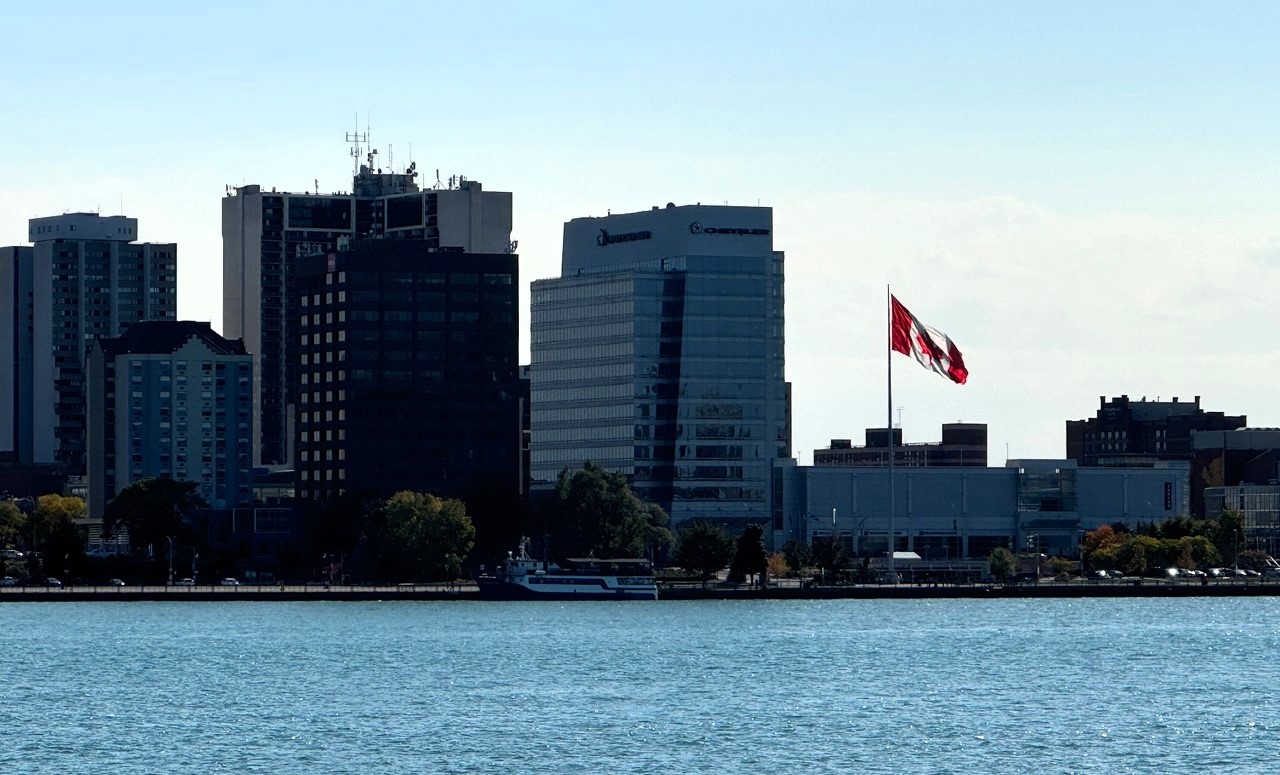
The view of Canada from Detroit Not that you’d know it’s Canada, mind you. Aside from the giant red and white flag billowing on the far shore, the streets, buildings, cars; everything looks exactly the same as America. You might as well be looking at Saint Paul from Minneapolis. And Windsor (the Canadian town you see) is so close you might as well swim for it. The Detroit River is only a mile wide at this juncture. I kind of wondered what would happen if I did swim for it. Would a flurry of border patrol boats appear out of nowhere to haul me in?
Instead, my brothers and I kept it legal and drove across the Ambassador Bridge (there’s the Detroit-Windsor tunnel if you prefer). It felt a little strange to hand over passports just to go to dinner. And once we sat down at our Windsor table we were greeted with a hearty “Happy Thanksgiving!” Thanksgiving? Had we gone through some sort of time warp? Oh, right – Canada celebrates Thanksgiving in October.

The view of Detroit from Canada Naturally we asked our server how Canadians celebrate Thanksgiving. She thought about it for a moment and said, in her wonderful Inland North accent, “Oh, y’know, we gather with our families and have the meal.” That’s it? Not even an embarrassingly-large, dozens-of-dishes, eat-’til-you-burst meal? Just food with family? But in fact, Canadian Thanksgiving is pretty much the same as “down south”. Explorers crossed the ocean, landed safely in the New World, established a settlement, held a feast of thanks, blah-blah-blah.
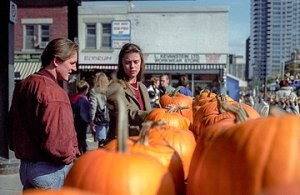
Pumpkins make sense for Canadian Thanksgiving Despite our server’s succinct description, the Canadian Thanksgiving meal includes most of the dishes we enjoy on this side of the Detroit River (including turkey). Canucks also celebrate with parades, Oktoberfests, and other festivals. There’s even a “Thanksgiving Classic” courtesy of the Canadian Football League. Makes me wonder if the Detroit Lions somehow found a way to play that football game along with every (U.S.) Thanksgiving Day game since 1934.

Ambassador Bridge As we crossed back over the bridge after dinner, two thoughts entered my mind. One, the waterfront houses on the Canadian side of the Detroit River have a view of the United States all day long instead of seeing their own country. That seems a little odd. And two, I wondered whether goods and services in Windsor (or beyond) would be worth leaving the U.S. for, instead of just purchasing the same in Detroit. You’d have to pay the bridge/tunnel toll both ways for a little Canadian Bacon (or backbacon), which might compromise the benefit. You’d most certainly run out of pages for the stamps on your passport.
 Earlier I said something about “almost” thinking in metric. No, you really do have to think in metric in Canada. As soon as we crossed over the Detroit River, our car’s GPS changed directions into kilometers (clicks) and meters. Suddenly the next turn was “100 meters” away instead of “300 feet”. Believe me, it’s a little disorienting watching the meters count down (slower) than the feet you expect. After several bottles of wine at dinner (liters?), at least we could still navigate back to the bridge. Otherwise this post might be coming to you from “up north”.
Some content sourced from Wikipedia, “the free encyclopedia”.
-
Tricks of the Trader
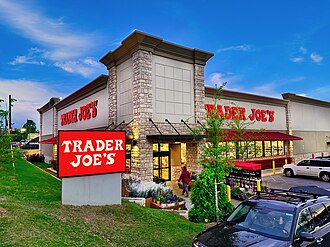
Our town, like so many others, offers the choice of grocery shopping at a national-brand market or at one with a more local vibe. We spend our dollars at Publix (1,300 stores across eight Southeastern states) but also splurge at The Fresh Market (161 stores) when we’re after something a little more unique. Having said that, our town lacks another popular market and it begs the question: What is the appeal of Trader Joe’s?

Chattanooga, TN This post was originally headed in a different direction. Trader Joe’s made the headlines because of its popular cloth “mini-tote” bags; so popular they were reselling on eBay for $500. That led me to think, America has an obsession with miniatures and let’s make that today’s topic. But no, I can’t get Trader Joe’s itself out of my mind, so let’s walk through their aisles for a few minutes.
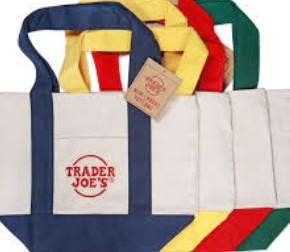
Very popular! The cloth bags are a great place to start. Did you know Trader Joe’s was the first grocer to offer reusable shopping bags, beginning in 1977? The trend didn’t catch on with other stores for another fifteen years. Even better, “TJ’s” encourages use by refunding you $0.05 per bag or entry into a weekly raffle for a $25 gift card.
The above paragraph was brought to you by the food-and-drink enthusiast website Tasting Table. Their 25 Facts About Trader Joe’s… is a convincing sell, maybe getting you to dash over to your nearest TJ’s for a look inside. But a company’s commitment to sustainability isn’t enough to draw me in over and over. There must be something else at play.
 Maybe it’s more about TJ’s “revolving door of new products”. They frequently discontinue one product in favor of another, so what you find on the shelves is constantly changing. They limit certain items to seasons (right now you’ll find pumpkin-spice everything). And their product line is impressively diverse for a medium-sized grocery store, which probably attracts more than your run-of-the-mill shopper.
 I suppose you could make the same argument for a restaurant. Shaking up the menu is a good idea every now and then (hence “specials”). Leave the core set of entrees alone but occasionally introduce new ones to see if they’ll take. Yet it’s not a perfect analogy for Trader Joe’s. My impression is, nothing on TJ’s shelves is safe for the long haul because all products are under constant scrutiny.
How about “affordable prices”? Here’s where I take my hat off to TJ’s. The advertised price of a given product at Trader Joe’s is the one-and-only price. No discounts, coupons, gift card offers, special promotions, or even online ordering to cloud the cost to the consumer. And since 80% of what TJ’s sells can only be purchased at their stores, price-shopping the competition is a waste of time.
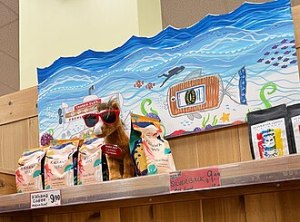
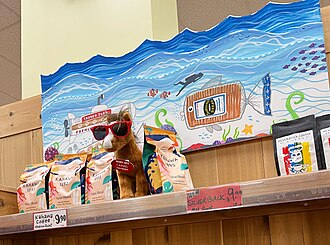
Stuffed animals are hiding at TJ’s TJ’s probably draws in young families because the shopping experience is fun. The nautical theme is apparent in its decor, as well as on its “crew member” uniforms. A stuffed animal hides somewhere in the store – find it and win a prize. And a bell rings (again, the nautical thing) to alert employees to open new check-out lines or answer customer questions. I like that approach a whole lot more than simply announcing the need over a loudspeaker.
You can try a lot of things at Trader Joe’s (Costco on steroids?), you can call the store ahead of time to reserve popular items, and you can usually get a refund on anything you regret buying (regardless of reason, proof of purchase, or the amount of the product you’ve consumed). What I highlight in italics here is impressive for a grocery store yes, but it still doesn’t make me a return customer.
At the end of the day (or a list of “25 Facts…”) I go to a grocery store because it carries the items I need. To put it another way, I am brand-loyal and fairly routine in what I buy. Perhaps that is the genius of Trader Joe’s. It draws people in again and again because, well, they want to be more creative in the kitchen. Try out new things. Emerge from the doldrums of the same thing on their plates every other week. And who can argue with variety as the spice of life?

Oakland, CA Maybe, collectively, 25 facts explain Trader Joe’s success. Or maybe someone from out West will chime in and solve the mystery. After all, California was the birthplace of Trader Joe’s (Pasadena), and the number of stores in the state has ballooned to over 200. There should be plenty of TJ’s experts out there to explain what the fuss – er, repeat business is all about. Then, just then, I might get into my car to drive the hour and change it’ll take me to get to my nearest location.
Some content sourced from Wikipedia, “the free encyclopedia”.








About Me
The sky is not completely dark at night. Were the sky absolutely dark, one would not be able to see the silhouette of an object against the sky.
Follow Me On
Subscribe To My Newsletter
Subscribe for new travel stories and exclusive content.
 Life In A Word tv