
Hello, I’m Veronica
The sky is not completely dark at night. Were the sky absolutely dark, one would not be able to see the silhouette of an object against the sky.


-
Music of the Night
Last weekend we went to Saturday night church to hear our daughter-in-law sing. Or more accurately – as I discovered the next day – we went to Evensong.

I was raised as a Methodist, with little exposure to the customs of other faiths. It was only later in life that I came to appreciate the different spins on “church”. Our Methodist church had three services on Sunday mornings – that was about it for formal worship. But my years at a Catholic university taught me that “church” can happen on Saturday nights, or Friday nights, or every morning, afternoon and evening of the week if you simply can’t get your fill. “Church” also has different names, like Vespers, Eucharist, or Matins. Or Evensong.
Saturday night’s service with my daughter-in-law didn’t seem so unusual. We were sitting in pews in a sanctuary; a healthy congregation of worshipers around us. The service began with singing and music. But fifteen minutes into the hour it was still singing and music. The stubborn Methodist in me wondered when we’d get to the sermon and the Bible verses and the prayers (they came eventually).
Evensong wouldn’t “even” (ha) have become this week’s blog topic if it wasn’t for Jeffrey Archer. I was reading the British author’s latest novel last Sunday and he made reference to Evensong. The word stuck with me – a beautiful term – so I had to learn more. Evensong has its roots in the Church of England: an evening prayer service delivered through singing and music.
Today, Evensong in its purest form is still more common in the U.K. than in the U.S. You can attend the service every day in most cathedrals in the Church of England, but you’ll only find a handful of options in the States. And you’ll have to search even harder to find Choral Evensong; the original version of the service sung “a capella” (without instruments).
One of my neighbors down the street here in rural Colorado saw fit to name her “relaxing forest getaway rental” Evensong Place (made the top ten in my Google search!). That’s a little eerie considering I chose this topic at random just this week. Maybe I should wander down and have a look.
A popular Methodist hymn – from the early nineteen century but still sung at Christmas – is “There’s a Song in the Air”. It doesn’t rate as high as “Silent Night” or “It Came Upon a Midnight Clear” but the melody and the words captivate me. In the final verse we sing “…and we echo the song that comes down through the night…”. Well what do you know? Even us Methodists had a sense of Evensong well before it became “Saturday night church”.
Some content sourced from Wikipedia, “the free encyclopedia”.
-
Don’t Mess with Jack!
This week, the original junk food Cracker Jack introduces a new look to its packaging, and – brace yourself – no more “prize inside”. The tiny toys synonymous with the brand since 1912 have been replaced with QR code stickers, which connect to games on your phone when scanned. Farewell to those temporary tattoos, finger-sized comic books, and decoder rings; – another slice of Americana is gone. Check out Facebook’s Cracker Jack page if you want a sampling of the overwhelmingly negative reaction to the news.

Cracker Jack’s announcement shamelessly reduces the “toy surprise inside” to mere click bait. Akin to so many Facebook posts, the allure of click bait is to discover the rest of the story. In the process you get a healthy dose of advertising. Click bait never gets my attention, nor will Cracker Jack’s QR codes. The thrill of the prize is gone.
Cracker Jack has a special place in my heart. My great uncle became synonymous with the treat when he showed up at family gatherings with enough boxes for his dozen grandnephews and nieces. More significantly, I hid my wife’s engagement ring inside the prize packet of a box of Cracker Jack just before my proposal. She used to be a Crunch ‘n Munch fan until she opened that particular “toy”.
Cracker Jack is another link to the past that has suffered never-go-back changes. The boxes are smaller now (in fact, the latest packaging is not even a box), and the ratio of peanuts to popcorn has increased. It’s the typical product manipulation that has you thinking you’re consuming the same thing you did ten years ago. Like ice cream, where brands are now sold in smaller containers designed to look like the standard half-gallon. Or fast-food “quarter-pound” burgers that are no longer as big, yet still qualify by definition. Perhaps the most obvious example: Oreos have less filling and thinner cookies than the originals. Ironically, today’s “Double-Stuff” are probably more like the “singles” from a generation ago.
Changes like Cracker Jack hit me hard, not only because I’m paying more for less but because the tampering seems like an injustice. Why not keep the original and charge more? I’d pay. And I’m not alone. Wikipedia claims the New York Yankees tried to replace Cracker Jack with Crunch ‘n Munch at home games ten years ago, but the public outcry forced them to switch back within a matter of days. Don’t mess with Jack!
Speaking of baseball, Cracker Jack is immortalized in the lyrics of “Take Me Out To the Ballgame”, sung in the middle of seventh inning stretches. I wonder if today’s generation knows what they’re singing about with “…buy me some peanuts and Cracker Jack”? Even if they do they’re singing about a different product now, including the updated images of mascots Sailor Jack and his dog Bingo. No doubt Cracker Jack’s founder had that in mind before he passed away in 1937. The original Sailor Jack is carved on his tombstone. Now there’s something they can never change.
-
Impersonal Delivery
Why does Amazon ask for “packaging feedback”? Do they really want my opinion on a plain brown box? Yesterday I came home to an Amazon delivery on my front door step. But that’s already not true. The box was dropped into a plastic bag and suspended from my mailbox (“front door step” just sounded better). My packaging feedback to Amazon: lackluster.

Let’s chat about delivery as it used to be. My fondest childhood memories include the noisy, colorful, “old-fashioned” delivery trucks that made their way into the neighborhood regularly. No kid from that era will ever forget the bakery, dairy, and ice cream trucks, and the allure of fresh-made bread and other goodies – temptations limited only by Mom’s permission or the amount of change in your pants pocket.
Growing up in Los Angeles, the Helms Bakery had a fleet of hundreds of bright yellow delivery trucks. The drivers dressed in smart uniforms and used a distinctive “toot-toot” horn to announce their arrival. The neighborhood gathering at the truck was as much social as it was for baked goods. At the end of grade-school field trips through the Helms factory, each kid received a coupon for something free from the delivery truck. It was like a golden ticket to a candy store, where you walk in and the owner spreads his arms and says “pick one”.
The dairy truck came from Edgemar Farms, not that we ever knew (or cared) where the farm was. Edgemar delivered milk in glass bottles with foil caps. The “milkman” would walk into the kitchen like he was family. He’d take the order from Mom and return with his wire basket full of milk, eggs, and butter. Then he’d unload everything right into the refrigerator, tip his cap with a cheery “good morning” and be on his way. Now that’s anything but lackluster delivery.
Ice cream (Good Humor or some other brand) appeared in our neighborhood on summer nights – the very best truck of them all. I can still hear the beckoning jingle from the roof-mounted loudspeakers. The neighborhood kids would flock – I mean flock – to the truck’s side window, where the all-in-white ice-cream man would lean out and wait too patiently while we made up our minds. Bomb pops. Push-ups. Ice cream sandwiches. Heaven on earth delivered right into your hands.
Okay – end of time-gone-by chat – back to today’s delivery by Amazon. Boring brown box. Got it? So how did my box get to me? What did the truck look like (was it even a truck)? Did the delivery person wear a uniform? Did he or she come to the front door?
Lack of delivery details equals lackluster delivery. And it’s only going to get worse. Amazon Prime Air is described as “a future delivery system designed to safely get packages to customers in 30 minutes or less using small unmanned aerial vehicles”. So now my brown boxes are going to arrive by parachute. In my packaging feedback, I’m going to request a beckoning jingle from the drones to announce their arrival – er, landing?
-
Pageant of the Masters
In the small but wealthy community of Laguna Beach, California, the crown jewel of the annual Festival of Arts is an event known as the Pageant of the Masters. The Pageant is remarkable entertainment: ninety minutes of classical and contemporary art pieces, recreated one-by-one on stage in larger-than-life frames, using real people instead of their painted counterparts. Makeup, lighting, and carefully choreographed sets complete each “painting”, resulting in a remarkably accurate depiction when the curtain sweeps aside. Add in the accompanying music from the live orchestra and it is a nonpareil performance. Thousands attend the Pageant each summer, as they have since its beginnings in 1932.
In the smaller but modest community of Augusta, Georgia, the sporting world was witness to another nonpareil performance last weekend – the Masters golf tournament. Just like the Pageant, thousands attend golf’s Masters each April, as they have since its beginnings in 1934. To me, the Masters is golf as a fine art.

Whether or not you play golf – whether or not you even like golf – there is no denying the Augusta National Golf Club is a beautiful place. The photos here do not do it justice, but most of us will have to settle for just that – photos. Tickets to the Masters go on the market a year in advance (apply now for 2017!), and a four-day tournament badge runs upwards of $2,500. Candidly, even a golf fan like myself – who has “visit Augusta National” on his bucket list – would rather watch the action on television. The price of cable gets you far more camera angles and coverage than you could ever hope for in person.
Augusta National’s eighteen holes are so revered that each one has been given a name. The first photo above is #12 “Golden Bell”, the shortest but perhaps trickiest of them all. It’s a spectacular par-3 where the tee shot must clear water and then land on a small green protected by several sand bunkers. This year’s tournament was lost on this hole.

This photo is #15 “Firethorn”, a twisting par-5 that tempts you to go for the green in two – if you’re brave enough to tune out the creek that runs in front of and behind the green. Firethorn also has the distinction of a hole where Masters tournaments have been won or lost.

It’s easy to get lost in the pageantry of the Masters, whether it be the ceremonial opening tee shots from prior champions, the CBS theme song “Augusta”, the reverent tones of commentator Jim Nantz, or the endless camera shots of the color-burst of spring azaleas against the backdrop of bright green fairways. But don’t ignore the play itself. You’re witnessing one hundred of the world’s best golfers, competing on one of sport’s most difficult stages. Watch them as they bend shots blindly around trees and over water, or curl in putts that move from left to right and then left again. Augusta National is a true test of composure and will. Masters champions are artists in their own right. Like Laguna Beach, it really is a Pageant of the Masters.
Photos courtesy of the Official Program of the 2006 Masters Tournament
-
Field of Flowers
In the heart of timeless Rome, not far from the Pantheon and the Coliseum and the Vatican City, lies a field of flowers. The Italians call it the Campo de’ Fiori (literally, “field of flowers”) and it is a welcome retreat from the bustling metropolis that surrounds it. The Campo is open and happy and bright; a sanctuary nestled within a vast maze of winding streets and crowded buildings.

You can see the Campo in the photo above: the rectangular area with all the white tents. Admittedly the Campo is not really a field, but rather a piazza (a public square). But the place abounds with flower-vendors. And the square hosts a daily food market, bars and restaurants, and a bath-like fountain to keep all those cut flowers fresh.

The Campo has a special place in my heart, because in 1982-1983 I spent nine months in Rome, studying architecture. The Hotel Lunetta (also in the map photo at the upper right) was our “dorm”, and the streets of the city our “campus”. The Campo was our “quad”. It was where we played Frisbee (while the Italians played soccer alongside us). It was where we had our laundry done or grabbed a snack or shopped for conveniences. But mostly it was just a cozy place to hang out after classes.
The Campo is one of Rome’s smaller piazzas. To contrast, here’s a photo of nearby Piazza San Pietro, the vast open space in front of St. Peter’s Cathedral in the Vatican City:

The Campo has an interesting history that dates back to the Middle Ages (see https://en.wikipedia.org/wiki/Campo_de’_Fiori). It really was a field to begin with, until a Cardinal had it paved over in the fifteenth century. Many of the buildings that surround the open space are the originals from hundreds of years ago. My wife Brigid, an equestrian, would enjoy the fact that a) the one church on the Campo is for Santa Brigida (a Swedish saint), and b) the square was once the site of a twice-weekly horse market.
Several streets that lead to the Campo are named for the trades that occupied the area all those years ago. Via della Corda – approaching from the southwest – means “Street of the Rope-makers”. Via dei Cappellari – approaching from the northwest – means “Street of the Hat-makers”.
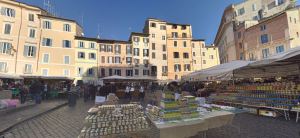
The Campo also boasts a not-so-nice aspect. In the seventeenth century the square was used for public executions, particularly for those at odds with the Church. Almost in kind, the Campo of recent years has become a gathering place for drunken tourists, soccer enthusiasts, and overzealous youth, earning the distinction of “one of the most dangerous places in Rome at night”. What a shame. Perhaps the Campo should remain a keepsake memory for me instead of a place to revisit – my Campo – an unspoiled sanctuary more akin to a field of flowers.
Photos courtesy of Google Maps: https://www.google.com/maps)





About Me
The sky is not completely dark at night. Were the sky absolutely dark, one would not be able to see the silhouette of an object against the sky.
Follow Me On
Subscribe To My Newsletter
Subscribe for new travel stories and exclusive content.

