
Hello, I’m Veronica
The sky is not completely dark at night. Were the sky absolutely dark, one would not be able to see the silhouette of an object against the sky.


-
Dear Little John
Sports Illustrated occasionally puts out an issue titled “Where Are They Now?”, profiling the next chapters of athletes who were once prominent in their given sport. The latest edition – just this week – fittingly covers the gold-medal winning women’s gymnastics team from the 1996 Atlanta games. I can still picture Kerri Strug landing that perfect vault on a broken ankle; the clinching performance for USA team gold.
If my own friends from twenty years ago wondered “where is Dave now?”, they might stare in disbelief as I navigate my John Deere tractor across acres of ranch property here in Colorado. I like to think of my 42-in. 20HP v-twin hydrostatic front-engine ride as a mean, green, mowing machine. My model D125 chews up the fast-growing grass like a teenager in front of pizza. She’s a veritable beast on wheels.
My wife also has a tractor – a Kubota L4330 “Compact Utility”. Here’s a picture of our babies side-by-side:
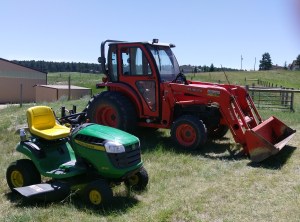
Stop laughing now, and step aside with me for some color fun. If you see a yellow tractor it’s probably manufactured by Caterpillar. If it’s blue it’s probably a New Holland. Red equals International Harvester, (though IH stop making theirs in the mid-1980’s). Then you have Kubota in the bright orange and John Deere in a pleasing shade of green. As Skittles would say, Taste the Rainbow!
Okay, back to the photo. I confess my little green kitten is dwarfed by my wife’s Transformer mega-monster. And the stats don’t lie: her Kubota is twice the length and twice the horsepower, and outweighs my Deere by over a ton. She has a roll bar, which suggests she can go four-wheeling in the fields, or even cartwheel her tractor down sand dunes without the slightest of injuries. Me? I pretty much limit my adventure to little circuits around the back lawn.
While I’m at it, I’ll go to full-on confession mode and say my wife is the real tractor pro; not me. She and her Kubota keep the blizzard snow at bay in winter and the pasture grass at a respectable height in summer. My own occasional efforts with the Kubota are far more amateur, but I often make impressive gouges in our dirt driveway.
Last spring my wife rewarded herself with that cab enclosure you see in the photo, complete with side doors and heat. Maybe I’ll get her a stereo for Christmas. Maybe I’ll get my John Deere a seat cover.
Country music singer Jason Aldean had a nice hit with “Big Green Tractor”, but I wouldn’t be able to duet with Jason without thinking “Little”. Craig Morgan also had a hit with “International Harvester”, but I just can’t relate to the lyric “tip your hat to the man UP on the tractor”. Finally, Kenny Chesney made it big with “She Thinks My Tractor’s Sexy”. Okay, now we’re talking (er, singing). Let’s assume my wife feels that way about my Deere, shall we? I’ll keep wearing the JD colors to show my pride.
Even if it’s just a “little” pride.

-
Grim Reader
While visiting my parents last week, I was delighted to find a few dusty old children’s books on a quiet corner shelf in the family room. The books carry sentimental value because they once occupied a shelf in my grandparents’ house. They were the same books my father read when he was a child. And as we grandchildren were expected to be “seen and not heard”, these books were our refuge, stoking our budding imaginations with dozens of characters and places we longed to be a part of.
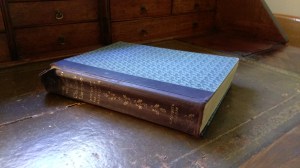
One book in particular – The Illustrated Treasury of Children’s Literature – stands out as a literary beacon of my childhood. The stories within included Aesop’s Fables (i.e. The Hare and the Tortoise), the tales of Danish author Hans Christian Andersen (The Emperor’s New Clothes), and the works of The Brothers Grimm (Rumpelstiltskin). The collection oozed with fantasy and adventure and innocence.
I reread a few of these stories last week and came to an unquestionable conclusion: The Brothers Grimm were a couple of messed-up dudes. On the one hand the Grimms authored Snow White and the Seven Dwarfs and Rapunzel, which Disney sanitized and gave a more positive spin. But more likely, you know the Grimms for their famous “fairy tales”, like Hansel and Gretel and Little Red Riding Hood.
Fairy tales. Doesn’t the term conjure up images of enchanted forests and candy castles and magical sprites? That’s what I thought too, but Hansel and Gretel would vigorously disagree. These kids endured a nightmare on par with today’s R-rated horror flicks. Take ten minutes and read their story (you can find it here). The only detail I recalled was the house in the forest; the one made of cake and candy and spun-sugar glass. But this time around I couldn’t get past the other aspects. Within the first three paragraphs we read that H & G’s mother’s solution to a lack of food is to abandon her children in the forest. Even after they find their way back to the house the mother finds another (more successful) way to leave them behind. Later on, an old woman holds the kids captive in the candy house and prepares to “slaughter and boil” (and eat) Hansel. Gretel gets to watch. But the kids surprise the old woman by pushing her into the oven, and then she burns to death. A celebration ensues.
Little Red Riding Hood (which you can find here) is no less violent. A little girl in red may sound adorable but the story is really about the murderous wolf. Not only does the wolf consume LRR’s grandmother, he has LRR herself for dessert. And it doesn’t end there. A huntsman happens by, recognizes the wolf, decides not to shoot him because “maybe the grandmother is inside”; then cuts open the wolf and pulls out the grandmother and LLR alive and intact. Seriously?
The Treasury introduction says “eight, nine and ten is the fairy tale age”. The Treasury also says “many a child will haul the volume from the shelf and spend countless happy hours…” are you kidding me? This is gratuitous violence disguised as bedtime stories!
I used to cringe at the thought of my young children watching a PG-rated movie. Not anymore. There are over half a million copies of The Treasury out there in the world. I need to find them all and have a bonfire. Those Grimm images go to the grave with you!
-
Four in the Forest
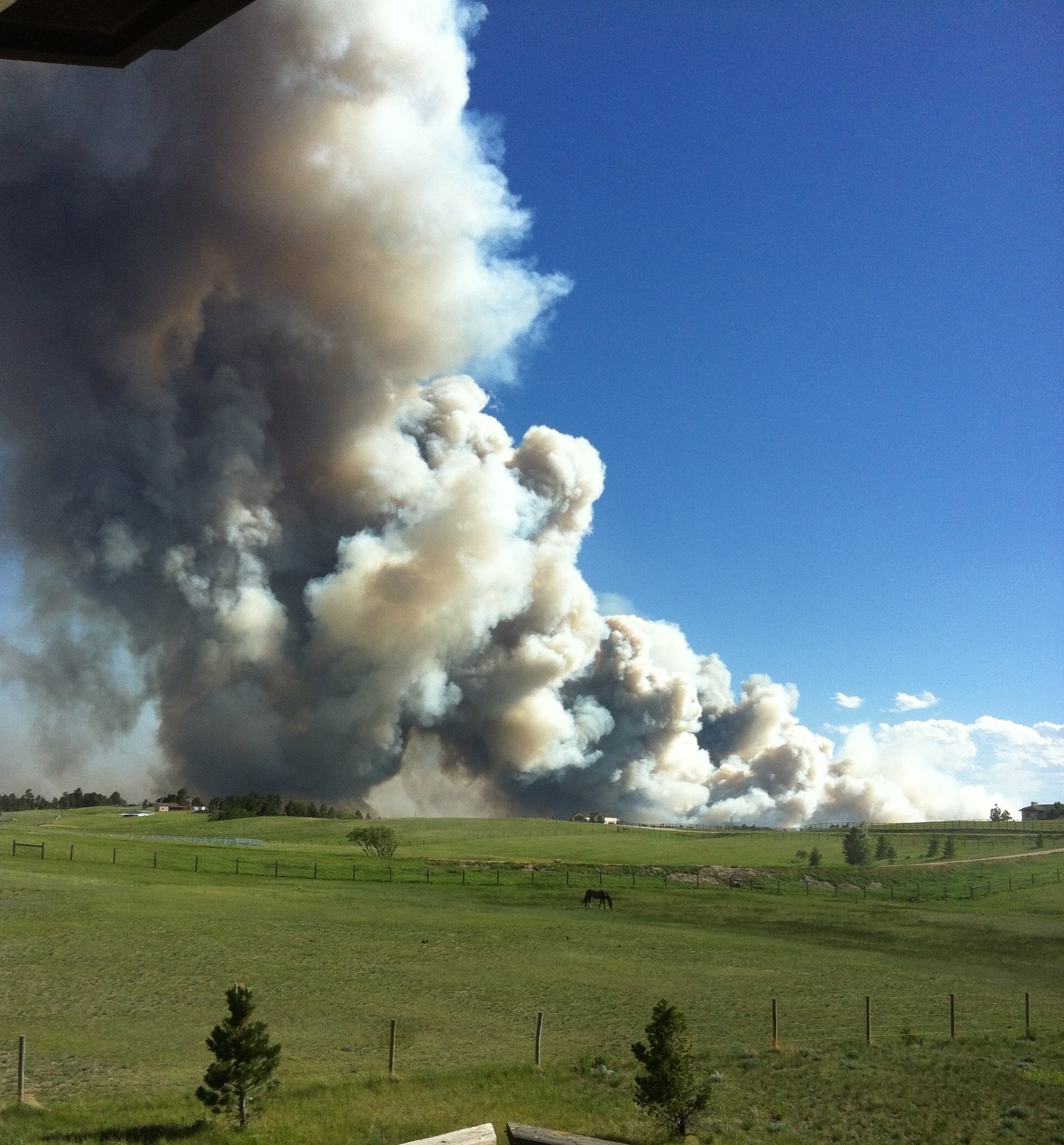
Three years ago this month, our community suffered a devastating wildfire the likes of which had never been seen in Colorado history. Inside of a week, the Black Forest Fire consumed almost 15,000 acres and displaced 38.000 residents. When the fire was finally contained over 500 homes had been destroyed. It was an almost unimaginable force of nature, and a miracle that only two residents lost their lives.
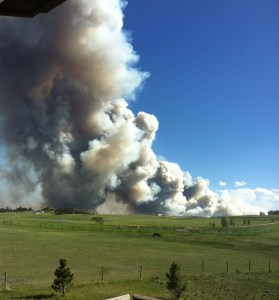
My family and I – and the several horses on our property – were forced to evacuate thirty miles to the north, waiting almost a week to learn the fate of our home. We couldn’t check our phones for real-time updates. Instead, we were at the mercy of twice-daily television reports. We were glued to the screen as the spokesperson would list impacted streets and addresses. By the grace of God our house was spared, even though the fire came within a mile of our property. But the beautiful Black Forest now bears a miles-long scar that will be evident for decades, if not hundreds of years.
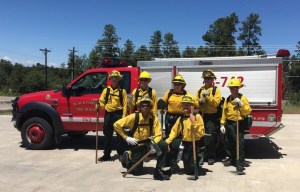
The fire was a testament to a higher power, but also to the efforts of the “first-responders”. Almost 500 firefighters battled the blaze; probably ten times the number manning our local stations. I am in awe of these professionals, working tirelessly as well as putting their lives on the line for people like myself whom they will never meet. They are the epitome of heroism.
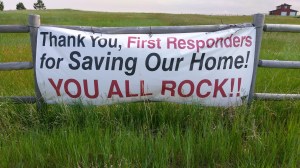
A year after the fire our community established “4 Miles in the Forest”, an annual fun run to benefit the Black Forest Fire/Rescue department. “4 Miles…” attracts several hundred participants, including the firefighters themselves. It is conducted at Section 16, a square mile of the forest with a trail around the perimeter for walking, running, biking, and horseback riding. Thanks to an elementary school within the Section the firefighters held the line and saved the entire property.
When I ran the inaugural “4 miles…”, I was delighted to find I was pacing one of the firefighters most of the way. He must have been carrying 50 pounds of gear as he ran. He was being coached by one of his superiors – as if in boot camp. My own effort was buoyed by the thought that I was accompanied by this truly selfless individual.
This year’s run was different. I found myself alone most of the way, well-spaced between the leaders and the walkers. The solitude gave me time to dwell on the significance of the race: a memorial to a tragic event as well as a testament to those who brought the fire to an end. As I completed the run, I realized my participation had nothing to do with winning the race or where I placed or how fast I had run. In fact it had nothing to do with me at all. Instead my running was a tribute to the selflessness of others; their willingness to fight and protect without reward or recognition. I know they would come to my rescue again without question. They are heroes in every sense of the word.
-
Office Space Capsule
Yesterday I was thinking about my dorm-room desk from the mid-eighties. On it sat the following essentials: a typewriter, a desk lamp, a month-to-month calendar, a clock-radio, a family photo or two, a few pieces of mail, and the latest edition of the campus newspaper. In the desk drawers I could find a small selection of pens, pencils and highlighters, a stack of spiral-bound notebooks, some textbooks, a calculator, stationery (including envelopes and stamps), a copy of the “Yellow Pages”, my camera, my checkbook, and a few menus from nearby restaurants. Dorm-room desks were solid, but my “office supplies” probably doubled the weight. They were my band of brothers, helping wage battle on that ever-elusive college degree.

If I recreate that same desk setup today, I would lug a huge box into my home office (bend the knees so you don’t hurt your back), drop slowly into my chair, reach into the box, and first pull out… a smartphone. I’d set it in the middle of the vast empty space of my desktop, reach into the box again, and pull out… nothing else. Whoa. My entire college setup has been condensed into the confines of a shiny 2″ x 5″ silicon wafer.
I forgot to mention the “telephone”. My college provided a wired phone with the room – (one of those fancy new touch-tone models – ha). Since my roommate and I positioned our desks to face each other, the phone straddled both desks. That way either one of us could reach the corded handset when all those girls would call (okay, I think that was a fictional memory boost).
Sadly, only a few of my college-era office supplies have survived the advent of technology. I have family photos on my desk, but they’re in the form of a digital frame, scrolling every several seconds. I have pens and pencils in the top drawer, but I only seem to need them for my signature. Finally, I have a wall calendar, but I really only glance at the monthly photos (of my college campus, ironically). Heck, I don’t even need my desk. I can just sit back in my chair with my smartphone and choose any item or activity I was geared for in college.
The convenience of having a desk’s worth of productivity inside a smartphone comes with a drawback. It is the convenience itself. When I woke up in the morning in college, my first thought was breakfast; not sitting down to the various tasks at my desk. In today’s world, we wake up to the instant access and undeniable craving for Facebook and text and email. The capsule may be slightly larger than those in the pill bottle, but the addiction to the contents can be just as powerful.
Here is my nugget of advice. Take a lesson from my college days and choose breakfast first. Avoid the temptation of the smartphone when you first wake up (and the premature stimulation to blood flow – see this Finnish study). For me, it means simply charging my smartphone within the confines of my home office. This forces the inconvenience of opening the door and considering the several other temptations and distractions of my work. Those can wait – bacon and eggs not so much.
-
Court of Many Colors
If there’s a high season for jury duty, perhaps it begins in June. My sister-in-law was summoned to serve last week, as was one of my good friends this week. Like voting, jury duty is that sometimes humdrum responsibility that comes with citizenship in the U.S. But our government should spend a few pennies to make the summons itself more exciting. Instead of reading, “You are hearby summoned…”, how about, “Congratulations! You’ve just won a day in court!”.

I was summoned myself several years ago. I think everyone should experience jury duty at least once in a lifetime. My county’s process may be different than yours. After the summons, you call the courthouse and punch in your juror number. If you “win”, you get to report to the courthouse on the designated date. You join a couple hundred of your county-mates in a holding room, where you wait several hours to be called to the individual courtrooms, where you may or may not join eleven of your neighbors in the jury box. The whole filtering process takes about a half a day, and 80% of those who made it to the holding room in the first place are dismissed. No matter where you end up, you won’t receive another summons for at least a year.
During my summons I did make it to the courthouse, but I never made it out of the holding room. The only drama for me was wondering if my parking ticket would be validated. But I did depart with an interesting observation. Surrounded by hundreds of others from my county, I realized I was looking at the purest slice of my neighbors that any circumstance can create.
Think about that. Within your county (or just your immediate neighborhood), there are dozens of places where people gather, and countless reasons more for doing so. Schools. Sporting events. Places of worship. Office buildings. Parks. Supermarkets. Restaurants. The list goes on. But which can you point to and say “now these are the people that live in my neighborhood.”
Jury duty draws everyone; the business executive and the ditch digger; the homemaker and the traveling salesman; the parent and the (over-eighteen) child; the wealthy, the middle class, and the poor; the overworked and the underemployed; and every other walk of life regardless of political, religious, sexual, or ethnic affiliation. I can even include our county’s youngest residents because our courthouse offers child care! In fact, the only neighbors you won’t see at jury duty are those with a doctor’s note or those who aren’t U.S. citizens. Everyone else gets to play.
Jury duty is not sexy. It is typically an inconvenience. Even if you serve, your case is not likely to make headlines. But if you do make it to the courthouse, look around and take a measure of those sitting around you. It’s your county – in a nutshell of the purest kind!







About Me
The sky is not completely dark at night. Were the sky absolutely dark, one would not be able to see the silhouette of an object against the sky.
Follow Me On
Subscribe To My Newsletter
Subscribe for new travel stories and exclusive content.
 Life In A Word