
Now that I have young granddaughters, the songs and nursery rhymes of my own toddling days bubble up from the long forgotten frontiers of my brain. Humpty Dumpty is together again and back up on his wall. The sky is unstable if Chicken Little is to be believed. And the debate rages anew whether “pease porridge” is hot or cold (even if it is forever nine days old). The list goes on and on but none of these tiny tales holds a candle to the one bizarre question asked of Mary. So let’s ask her again, shall we?
 I wouldn’t have remembered Mary were it not for the daily online puzzles of the New York Times. Two weeks ago they devoted an entire word search to the sentences of this odd nursery rhyme. Which got me to thinking, just who was Mary, why was she “contrary” (other than a convenient rhyme), and what the heck was going on in her garden?
 As the saying goes, be careful what you wish for. As Google goes, be careful what you search for. Jack and Jill really did go up a hill. Old MacDonald had a farm. There’s at least one itsy bitsy spider on the water spout. But Mary and her garden? She doesn’t belong anywhere near your grandchildren.
The first interpretation of “Mary, Mary” I came across was completely sanitized from the original. It claims Mary is the Mary (as in, Jesus’ mother). Mary’s garden is the growing Catholic church. Silver bells are the same jinglers used in the church service to recognize miracles with “a joyful noise”. Cockle shells refer to faithful pilgrims, as in the badges worn by those completing the Way of St. James. And pretty maids are nuns, lined up for a life of devotion.

If we stopped right there, Mary would be heartily embraced by the rest of the kid-friendly characters in my granddaughters’ nursery rhymes. But more likely we’re singing about “Mary I”, Queen of England in the 1500’s. This Mary was no saint. In her brief five-year reign she cleansed her country of heretics… by burning hundreds of them at the stake. “Bloody Mary” – her apt nickname – somehow became a drink at the bar (which I will never order) and the subject of a child’s nursery rhyme.

Mary I was at odds with her father King Henry VIII’s agenda; hence she was “quite contrary”. Okay that’s fine, but I wish the rhyme stopped right there. Her garden was likely a reference to a graveyard. The silver bells and cockle shells describe torture devices of the time (and I won’t be using a Google search to learn more about those). The maids were innocent women lined up for execution.
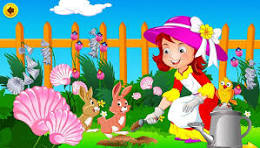 This is the stuff of nursery rhymes? I’m trying to picture little girls back then, sitting around in a circle and coming up with short songs from what they see right in front of them. Like Rosie and her ring, if some interpretations are to be believed. As for Ms. Contrary, I think I’ll go with a garden similar to the one shown here. But since the origins of her rhyme continue to be debated, I’m steering my granddaughters clear of her. Instead, we’ll sing about the other Mary, the one with the little lamb.
Some content sourced from Wikipedia, “the free encyclopedia”.


Wow – and I thought it was just an innocent little nursery rhyme. (the plague interpretation was interesting though apparently not accurate.) They say you shouldn’t read Grimm’s fairy tales either, as their are really very grim, especially the one where Little Red Riding Hood’s grandma gets eaten by the big bad wolf!
LikeLiked by 1 person
Grimm’s Fairy Tales, indeed. Maybe those weren’t based on fact but they’re just as “grim” as some of these. I know there’s been a recent effort to sanitize some of these stories and as someone who appreciates writing I struggle with that. Maybe don’t read them to your three-year old but also don’t change the words authored by somebody else!
LikeLiked by 1 person
You don’t ever want to change the words of a beloved story book period! Believe me they will notice. My grandma was Dutch, and while her spoken English was good she had problems with reading it, and I would tell her, No Gramma that’s not how the story goes! Although I admit, when I was reading to my nieces, I would sometimes improvise and put their names into the story and they seemed to enjoy that. My favorite kids book was an abbreviated edition of The Wind in the Willows, with the speed demon Mr. Toad and his motor cars. Probably sets a bad example but fun!
LikeLiked by 1 person
PS. I bought a musical toy suitable for a one year old a few years ago and it played “Animal Fair” – Now there’s a lyric that is pure nonsense!
LikeLiked by 1 person
I’d say pure nonsense is exactly what the pediatrician should recommend for little ones!
LikeLike
Yeah, nursery rhymes were often the way to write political commentary without getting beheaded. Do not go investigating Ring Around the Rosie!
LikeLiked by 1 person
I read about Rosie somewhere, well before I learned about Mary, Mary. Nothing happy about either girl.
LikeLiked by 1 person
Nursery rhymes were subversive. Mary Quite Contrary is especially fascinating. So many possible explanations, none upbeat that’s for sure. I know about Rosie, am hoping that the Mary with the Lamb doesn’t mean something deeper.
LikeLiked by 1 person
Agreed Ally – I’ll put down the nursery rhymes and move on, lest I unearth more hidden meanings. On that note, why am I suddenly humming “Lucy in the Sky with Diamonds”? 🙂
LikeLiked by 1 person
The more I learn about nursery rhymes, the less I want to say them to children.
LikeLiked by 1 person
Perhaps “nursery” should be stricken from the record.
LikeLiked by 1 person
If I can reinvent Chess and make my own LEGO pieces, you can reinvent Nursery Rhymes!
“There once was a lady named Mary,
who was extraordinary.
She could knit with her thumbs,
while her feet played the drums.
This kept her from being contrary.”
By Kim Merryman
LikeLiked by 2 people
Ha! As I was telling Joni, I’m not a fan of the current movement to sanitize these rhymes and children’s stories. Trying to make everything “G-rated” for the sake of PC. On the other hand a complete rewrite is just fine. Kim Merryman can keep doing what she’s doing!
LikeLiked by 1 person
Dave, I agree that some of those nursery rhymes could terrorize kids but we did live through them and came out okay in the long run. But why have Humpty Dumpty having such a catastrophic injury anyway? I can’t remember how I reacted to those fairytales back in the day as it was soooooo long ago. Maybe kids are “softer” today so the fairytales and stories for kids are too harsh. I “get” that, but to be fair, we did not have the angst over other issues that these kids have today (school shootings comes to mind right away). I once wrote a post about my next-door neighbor, an elderly Hungarian woman who had a beautiful rose garden. Her entire yard was filled with light-pink rosebushes, quite the sight to see and all were propagated from a single rosebush her husband gifted her with when they moved into this house. She had quite the green thumb, but was not the nicest person to be honest … I called the post “Mary” (in those days, in 2013, I only used one-word titles) but the first line I wrote “Mary, Mary, quite contrary – how does your garden grow?”
LikeLiked by 1 person
You and I certainly grew up in different times Linda, and I’m grateful for that. Nobody worried about whether a story was PC or whether it would have some long-term negative impact on a child. We just listened to the stories, used our imaginations, hid under the covers a little, and still turned out okay in the end. Having said that, your neighbor’s garden sounds a whole lot nicer than the one in the rhyme (even if your neighbor would’ve been fast friends with Mary I – ha). My own random connection to the rhyme was a line from the movie “Rudy”. Rudy’s sitting at a bar near the campus talking to his new friend Mary. He’s had one too many, so naturally he launches into the nursery rhyme to get her attention. She doesn’t appreciate the sentiment 🙂
LikeLiked by 1 person
I’m grateful for growing up in our generation too Dave and, thanks to how we were raised, we turned out okay and without issues. I had my basket of books and I sat and read them, had them memorized and enjoyed each story. No, I guess no one would appreciate being called “contrary”. 🙂
LikeLiked by 1 person
That is WILD. And super creepy. Well, the first interpretation is okay, I guess, though I don’t understand the Mary being contrary part, but the second one… nein danke. I’m surprised you didn’t touch on Rockaby Baby in the Treetop. What kind of messed up lullaby is that? But, like so many of these things, I hadn’t stopped to think about it until someone pointed it out. Even Brothers Grimm are certainly grim. How were those okay as children’s stories?
LikeLiked by 1 person
Different times, right? We read or listened to these stories as kids but never would’ve thought to mimic or act on any of the negative stuff. Today’s parents wouldn’t agree that “Hansel and Gretel” or “Little Red Riding Hood” were great children’s stories. To me they are timeless classics.
LikeLiked by 1 person
They have all certainly stood the test of time. Credit due for that!
LikeLiked by 1 person
Children’s rhymes as political satire I can understand. As for the Grimm fairy tales, maybe the brothers collected them for the evening campfire. Older kids love a scary story!
LikeLiked by 1 person
I don’t remember being “older” when I read Grimms’ Fairy Tales so I’m sure there they succeeded in delivering a scare or two!
LikeLike
Very interesting. I always wondered about Hansel & Gretel being a children’s book or Little Red Riding Hood. Scary stuff.
LikeLiked by 1 person