
In early January you walked into my blog, took a seat in a pew up front, and witnessed the longest church service in the history of France. From the first LEGO piece I laid as the cornerstone – a now-hidden flat black rectangle – to this week’s placement of the oversized finial on top of the roof, you watched – for almost two hundred years – the slow, somewhat steady rise of Notre-Dame de Paris. Time sure flies, doesn’t it? But at last we’ve made it to the end (or at least, the year 1345), where the pastor dismisses the congregation with a “Go in peace!”(which sounds much better than “Go in pieces!”)
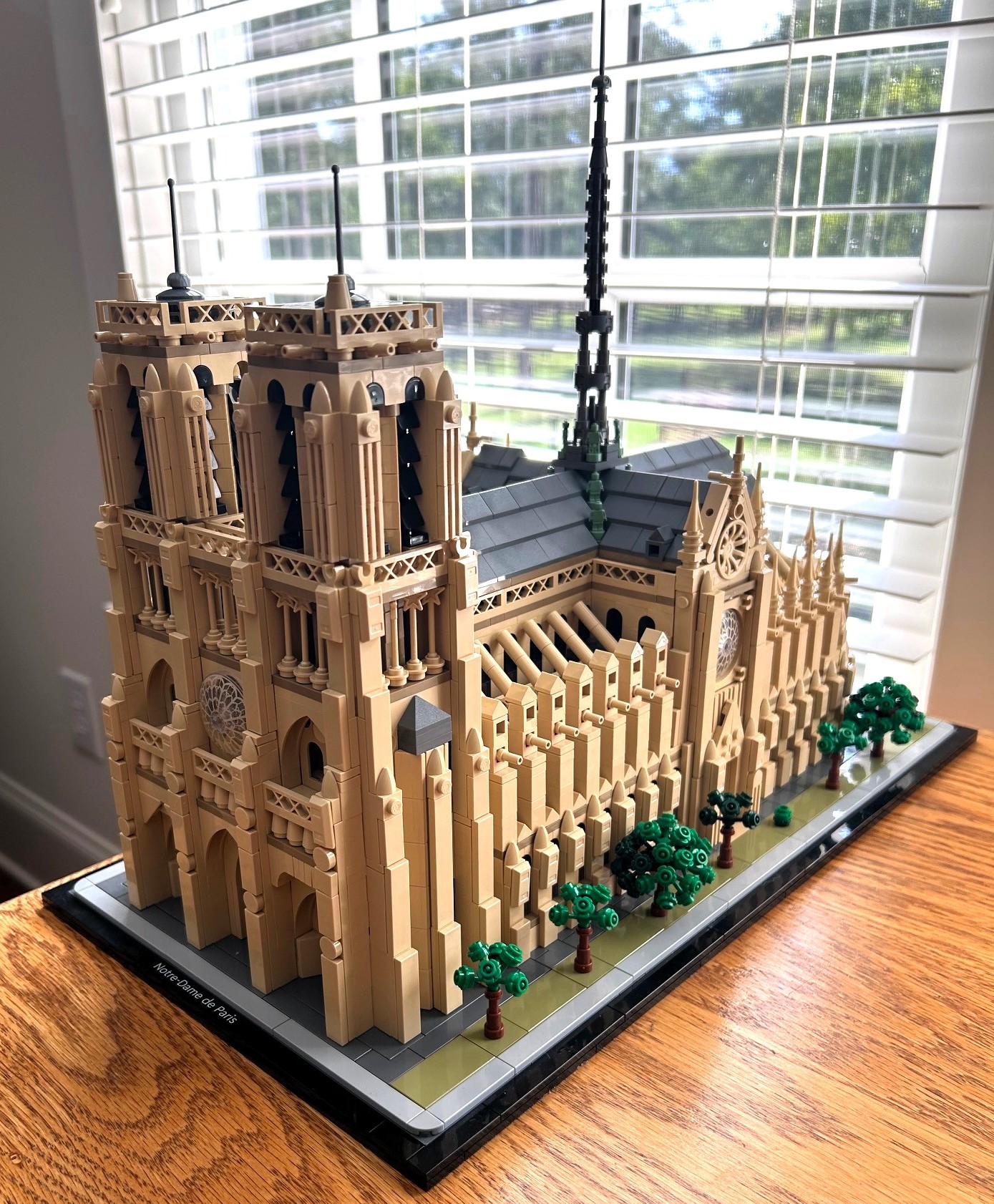
Some reflection is in order today, especially since we’re talking about a building of faith. Our cathedral adventure over the last 19 weeks took us through 4,383 LEGO pieces and 393 steps of the instruction manual, snapped together in fifteen hours, resulting in a five-pound plastic model that – “thank heavens” – really does look like the famous French cathedral on the Seine River in Paris.
[Builder/blogger note: I chose my Spotify classical music playlist while I finished up the cathedral. The first selection was entirely fitting: Edward Elgar’s “Pomp and Circumstance”, because this really did feel like a graduation of sorts. But the second selection was eerily more fitting: the final chorus of Handel’s “Messiah”. Ha-a-a-a-a-llelujah indeed!]
 Some of the photos here aren’t much different than last week’s, but only because bags 31-34… of 34 bags of pieces, were all about embellishment: capstones, pinnacles, tabernacles, finials, statuary, and all the other little architectural flourishes unique to a cathedral (plus a little landscape on the sidewalk). You know those cake decorator videos where a white cake sits on a spinner and you get to witness the slow, mesmerizing development of frosting, flowers, and such? That was me this week; spinning, applying, and fully decorating my cake… er, cathedral.
 Here’s a good photo of some of this decor (and click on any of the photos to see everything better). To the far left you can see several of the pinnacles; the little spires all in a row high up. There are 30 pinnacles on the entire cathedral. To the right you can see a couple of the tabernacles (14 of those); the open box-like structures above the tiny drainpipes. And running along the first floor you can see capstones; the helmet-like headers on either side of the open bays. There are more capstones on Notre-Dame de Paris than any other decorative element (68!)
 Here’s a look at the cathedral’s famous flying buttresses, the exterior structural elements keeping the building from falling in on itself. There are 28 buttresses, including 14 running around the chancel and apse on the east end. Just below the tabernacle boxes you see the drainpipes. There are 46 of those. During a good rainstorm this view would include an elegant line of waterfalls.
 Remember those curious “stars on flagpoles” (or “magic wands”)? Here they are again, all grouped together just below the part of the towers housing the bells. There are 24 of them. You can also see one of the cathedral’s three majestic rose windows front and center. Finally, note the round “medallions” just under the curved arches on either side of the rose window. You’ll find 24 of those on Notre-Dame de Paris as well; several stamped proudly with a “LEGO” logo.
 Okay, one more example of embellishment. Here you can see the 12 disciples in green, symmetrically positioned around the base of the finial (all facing inward). When I pulled these little guys out of the plastic bag I thought they were scale figures for down on the sidewalk, but instead they are the statuary I referred to when I first talked about the cathedral back in January.
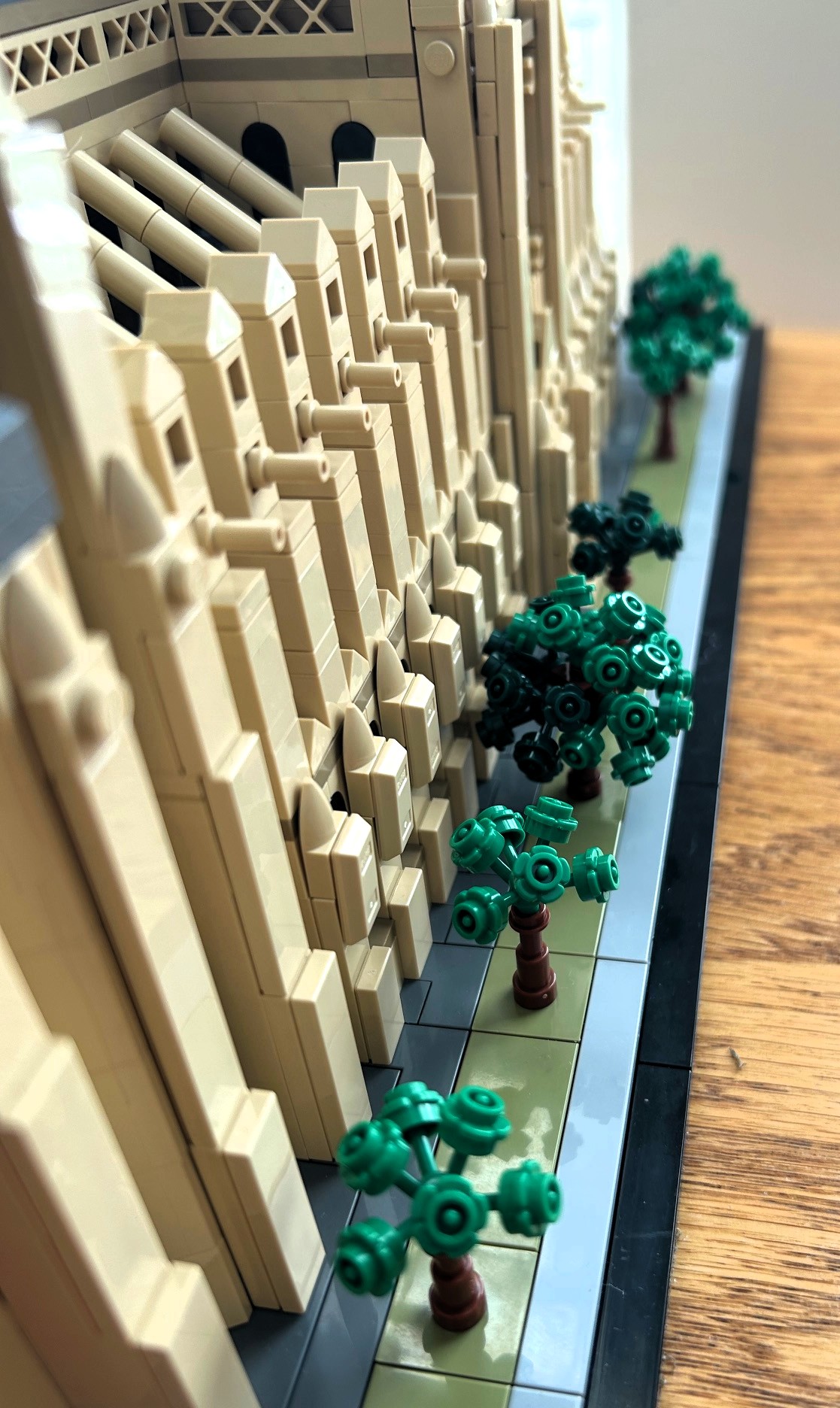 I’d be remiss if I didn’t say something about the model’s landscape elements. LEGO has come a long way since the boxy trees surrounding LEGO Fallingwater. These little “growees” are pretty sophisticated. Consider the tree in the middle. (Click on the photo for more detail). It’s made up of 37 LEGO pieces, including the trunk, branches, and leaves. Furthermore, the branches up against the cathedral are a darker green because, of course, that part of the tree is typically shaded.
 Now then, before you “go in peace” I must mention one more thing; the so-called surprise I teased in last week’s post. Notre-Dame de Paris is such an elegant structure it deserves to be seen by day… and by night. Thanks to the good people at Briksmax, I am able to do just that: light up the cathedral from one end to the other. That’s the good news. The bad? I’m looking at another 2 instruction manuals and another 230 steps to get it done. Are you kidding me?
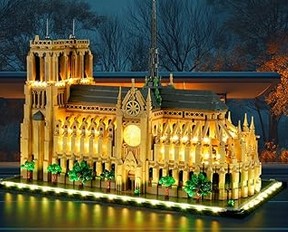
When I purchased the lights I figured they would be simply and cleverly inserted in and around the completed structure, but NO-O-O-O-O-O!!! (cue horror-movie music). In order to light up Notre Dame de Paris I must deconstruct the model. Again I say, are you kidding me? Here I finally complete my cathedral and now you want me to take it apart again? Sorry good readers; it’s just not something I can stomach right now. I’m going to sit and admire my completed cathedral while you settle for admiring the Briksmax photo above. You don’t place the finial on the roof of the catheral with a flourish, only to then remove the entire roof. Another church service for another time.
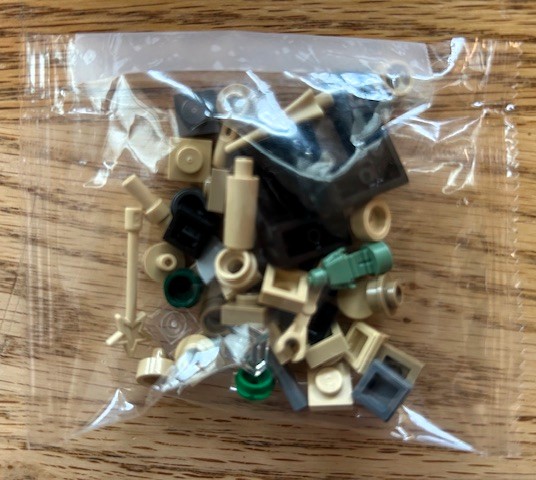 I leave you with one last look at our poor, unused, leftover pieces, all 48 of them in plastic-bagged captivity (but still trying to escape). I think they all ganged up and cried, “RUN FOR IT!”, because the 49th leftover – a tiny cluster of leaves from one of the trees – went skittering off the desk and onto the carpet below, where it immediately hushed and hid. I still haven’t found it, but no worries. The next time I walk into my office I’ll probably step on it with a satisfying crunch.
Running build time: 15 hrs. 6 min.
Total leftover pieces: 49

 Life In A Word
I’m laughing so hard. THOSE darn lights!! Enjoyed seeing the 12 disciples and that big tree. Thanks for telling us to click on the image, so impressive to see it up close. Well, you can be proud, it sure is BEAUTIFUL!! Feels like you are an architect again!
LikeLiked by 1 person
The lighting will come in time. I paid too much for the kit not to use it 🙂
LikeLiked by 1 person
That is just impressive!
LikeLiked by 1 person
Great job! Congrats! You’ve got a lot of patience!
LikeLiked by 1 person
Congrats! How are you going to display it?
I was thinking about displaying LEGO today because my Harry Potter buildings have multiple sides. I’m thinking a turntable might be a good idea!
LikeLiked by 1 person
A turntable… you mean like one of those cake spinners. No, I think it’ll sit motionless on my desk for a while. A spinning church seems a little sacrilegious!
LikeLike
Yes, like a cake spinner! I can see why you don’t want a spinning church. I’m going to try the turntable idea on my Hogwarts castle. My LEGO builds sit on a shelf.
LikeLiked by 1 person
Wow Dave! That is amazing! I would have thought that would have taken a lot longer than 15hours. Was the lighting part sold as a completely separate kit, or was it something you could have done as you were constructing it, it you had only known? Seems unfair not to have warning. I wouldn’t take it apart again right now either, although I suppose it depends on where you are going to display it. Sounds like a winter project.
LikeLiked by 1 person
The lighting comes from a third-party company, and it’s a lot more sophisticated than I expected. As I told Brilliant Viewpoint above, I paid too much for the kit not to use it. I’ll just need a breather for now, content to let the church go dark at night. Eventually I’ll be ready to be an electrician 🙂
LikeLiked by 1 person
Ha! Don’t you need a license for that!
LikeLiked by 1 person
Congratulations on the completion of this project Dave – it’s been a fun journey to follow, and I look forward to the renovations 🙂 Ric
LikeLike
I hope you find the missing in the carpet piece in a less painful way. Though we know the nature of LEGOs, so that’s probably not happening.
It looks amazing! Yes, lit up is really cool, but I don’t blame you one bit for not wanting to go there.
Well done!
And, I feel foolish for asking, but how did you come about having extra pieces?
LikeLiked by 1 person
LEGO includes those extras for the very reason you referred to in your comment – the littlest of pieces tend to go missing. I’m proud to say I never needed any of them, but I’m still in hot pursuit of that tiny (extra) piece of landscape below my desk. Cursing my choice of a dark-colored carpet!
LikeLiked by 1 person
Might be time for a magnifying glass and headlamp to find that little bugger.
If nothing else, I want a blog update in three months that simply says, “Found it!” 😉
LikeLiked by 1 person
Haha, I was only joking last week when I asked if there was a fire and restoration kit. The lighting kit you bought sounds like almost the same thing! But boy will it look great when you decide to tackle it.
LikeLiked by 1 person
The first step in the lighting add is to remove the cathedral roof and finial. Coincidence; those are the pieces that burned in the fire. Glad the lights are LED and not incandescent 🙂
LikeLiked by 1 person
Incredible! Your diligence paid off and you have a beautiful cathedral. Now what will you do with it?
LikeLiked by 1 person
The cathedral will sit at the corner of my office desk for awhile, beckoning me to catch a flight to Paris for a look-see in person. Eventually I’ll move it to a shelf because surely another LEGO temptation will take its place.
LikeLiked by 1 person
Congrats, Dave. You knew you could do it because you did it publicly!
LikeLiked by 1 person
Congratulations! Quite a masterpiece, so detailed. An accomplishment!
LikeLiked by 1 person