
Next Tuesday, if I could drag myself out of bed before dawn, I’d see the planet Venus hole-punched into the inky sky, low and bright. If I looked further I’d probably see Mars – dim but distinctly red. And if I really did see Mars I’d be sad, because I know Ginny’s up there, all alone, waiting for someone to bring her home. I’m sorry, Ginny… I’m so sorry. Nobody’s coming for you, not for a long, long time. Rest your rotors in peace, little helicopter.
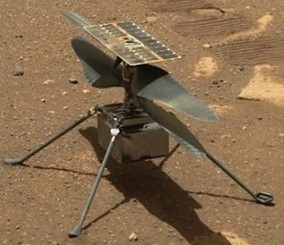
Ginny (known more formally as Ingenuity) is a brave little helicopter. She may look like a nasty bug instead of something you’d want to cuddle with, but she’s quietly been filling up the record books with her remarkable achievements. Four years ago Ginny hitched a ride to Mars on the belly of NASA rover “Perseverance”. A few months after Percy plunked down on Mars, Ginny took her “first steps”. She spun her rotor blade into a blur, rose ten feet above the Martian soil, took a quick look around, and dropped right back to where she started. That brief maneuver earned her the title: “first powered, controlled, extraterrestrial flight by any aircraft”.
[Note: You can read about Ginny’s first flight in the post Whirlybird Wonder]
Ginny may not be easy on the eyes but I’m in awe of what she accomplished in her brief time on Earth (er, Mars). I should’ve paid better attention in science class. Imagine the teacher saying, “Okay Dave, here’s your assignment. I need you to design a mini-copter that can travel to Mars, perform a few lighter-than-air maneuvers, and be able to take a few photos at the same time. You’ll be at the controls back here on earth, so whatever communication mechanism you come up with needs to work over, uh, 140 million miles.” Cue my blank stare.
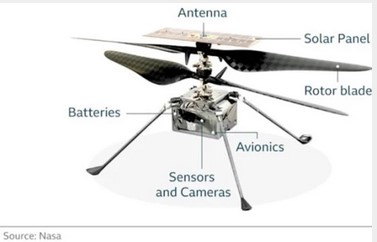 The smarter-than-I-am people at California’s Jet Propulsion Labs (JPL) designed little Ginny to do all those things. What makes her ten-foot hop on Mars so remarkable is this: the atmosphere up there is less than 1% as dense as Earth’s, so there very little to hold Ginny aloft. To put it another way, earthly helicopters can only fly to 25,000 feet. Ginny had to be designed to fly to 80,000.
Let’s call her “The Little Copter That Could”, shall we? Ginny was supposed to fly five times in thirty days. Five little hops in a month’s time and her mission would’ve been considered an unqualified success. But Ginny chose to be an explorer instead of an experiment. She flew seventy-two individual missions, further and longer each time than her JPL designers ever expected. She also captured images as she flew, so scientists could better decide where on Mars they wanted big-brother Percy to rove.

Ginny was more “alive” than any helicopter I’ve ever known. She cleaned herself up after nasty Martian dust storms. Her solar panels froze unexpectedly during the rough winters, rendering her unable to fly or even take commands, yet she still radioed “wellness reports” to Percy so the JPL people would know she was (barely) there. She made three emergency landings when her sensors detected trouble. And even when one of those sensors went dead, Ginny kept her rotors a-whirling on demand.

Whatever happened on Ginny’s Flight #72 two weeks ago remains a mystery, one Percy hopes to figure out as he rovers back to her location. Ginny had been close to another landing when she suddenly stopped communicating. A day later the JPL team reestablished the connection to find Ginny resting comfortably on the Martian soil. Somehow she’d still landed on her feet. Somehow however, she also damaged a rotor blade. Ginny can’t repair herself so alas, her flying days are over. Now her waiting days begin.
 Admirers like me refer to Ginny as “that little extraterrestrial trailblazer”. Haters call the dormant helicopter “the first piece of trash on Mars”. As long as Percy’s in her neighborhood, Ginny will keep sending her little wellness reports (even though she’s really not so well). I just hope the scientists at JPL are already hard at work on their next mission to Mars. A brave little copter is waiting to be rescued and brought home to the Smithsonian.
Some content sourced from the CNN article, “After damaging a rotor blade, NASA’s Ingenuity helicopter mission ends on Mars”, and Wikipedia, “the free encyclopedia”.

 Life In A Word
Great Post Dave! You imbued Ginny with a wonderful personality 😎
LikeLiked by 1 person
This makes me feel a little sad for Ginny, doing her job, all alone waiting to be rescued. I do hope she comes to live her final days in the Smithsonian. She deserves a cushy retirement.
LikeLiked by 2 people
I don’t read enough about missions to space being round-trip. Maybe most rockets/rovers/helicopters are meant to burn up in Earth’s atmosphere? No doubt something (or someone!) will get to Mars again one day. I hope Ginny at least becomes a shrine for these future visitors.
LikeLiked by 1 person
An amazing little device and a perfect story for a children’s book.
LikeLiked by 1 person
If only Ginny had softer edges 😉
LikeLiked by 1 person
Fine essay. Have you seen The Martian? It’s s good movie. Pretty realistic.
LikeLiked by 1 person
By no coincidence, I watched a little of “The Martian” the other night – network TV, I think. Really good book and movie adaptation. Damon’s portrayal reminded me of Tom Hanks in “Castaway” (lots of parallels, actually). He spent a lot of time flying solo on the movie screen.
LikeLiked by 1 person
We just watched (again) the movie Apollo 13. It seems to me that if they an bring men home from a mission like that, they should be able to bring Ginny home some day!
LikeLiked by 1 person
I wonder if Perseverance will ever come home. Not that he’s designed to retrieve Ginny but he’s making landmark discoveries on Mars as well. Maybe they’ll come up with replicas for the Smithsonian, sort of like the approach you see in wax museums 🙂
LikeLiked by 1 person
Super interesting. I hadn’t heard of “Ginny.” Also, Venus hole-punched in the sky–brilliant. No pun intended.
LikeLiked by 1 person
I was lucky to come across the headline about Ginny’s “demise” online. It looked like the kind of headlines that would’ve made pg. 15 of a physical newspaper. C’mon people, this is groundbreaking stuff!
LikeLiked by 1 person
Possibly literally groundbreaking. 🙂
LikeLiked by 1 person
I agree with Andrew, Seems like you could write a wonderful children’s book about Ginny! It’s impressive how people can even come up with these designs.
LikeLiked by 1 person
Ginny’s not much to look at – literally. The diagram I included shows a half-dozen components and no room for anything else. The wonder to me is how simple she looks yet how sophisticated her abilities. I hope there’ll be a “Ginny II” someday!
LikeLike
I have no doubt that Ginny will someday be a hero at the Smithsonian. Enjoyed learning more about her in your story.
LikeLiked by 1 person
That was interesting about “Ginny” Dave. I amit I have not followed anything to do with space exploration. That’s quite a jump from just four “missions” to 72 missions. I’m sorry to read a about her working demise, but I’m glad she will be retrieved and displayed somewhere where her work can be appreciated.
LikeLiked by 1 person
No, as far as I can tell Ginny will sit on Mars for the foreseeable future. I haven’t read about any plans to return her to Earth. Maybe a replica in the Smithsonian?
LikeLike
A replica does make sense. Maybe it is too dangerous to retrieve her and bring her back or she may be damaged in doing so?
LikeLiked by 1 person
*admit” (sticking keyboard)
LikeLike
At first, I wasn’t sure if this was truth or fiction. Cool concept, either way.
LikeLiked by 1 person
I get you. It’s remarkable technology, way beyond my own understanding.
LikeLiked by 1 person
Great story, I did not know about Ginny!
LikeLiked by 1 person