
Our annual summer vacations in San Diego have become a little more adventurous because of an increase in shark activity off the coast of California. I enjoy body surfing, but the thought of a pair of big, hungry jaws beneath the water’s surface gets my heart a-pounding. So imagine my shock when I really did have an encounter with a baby shark. Er, make those letters capitals. I meant to say “Baby Shark”.
 My adorable two-year old granddaughter is just beginning to take off with her vocabulary. She can say “Mama”, “Dada”, and even “Chop! Chop!” when she wants us to hurry up. She also says “Bayba Shawk”… constantly, because she wants an adult to play the song for the forty-thousandth time. After three weeks on repeat I can’t get the darned thing out of my head. I need brain surgery.
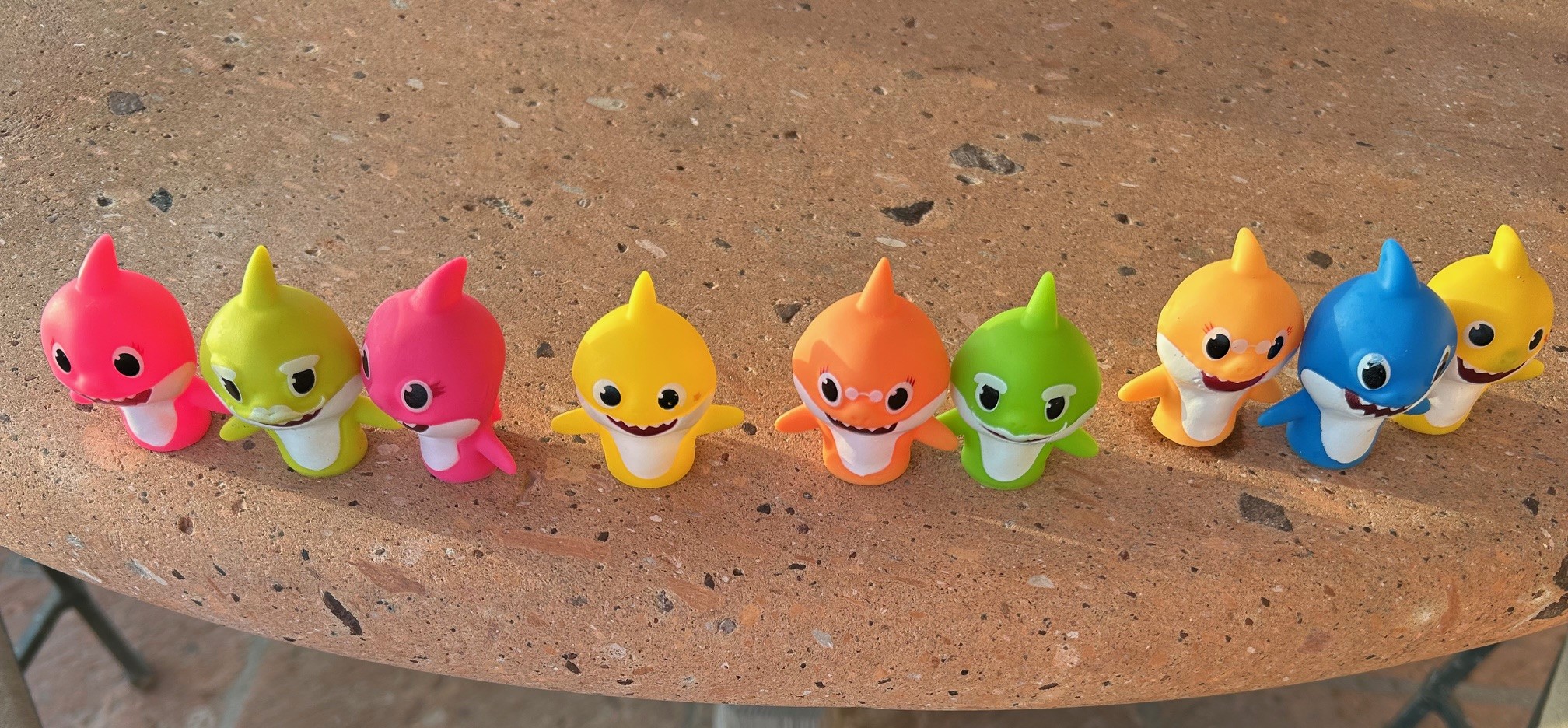
“Baby Shark” is the story of a little family of sharks hunting for fish. The fish get away and… that’s it. It’s not so much a story as an excuse to sing a verse about each family member: Baby, Mommy, Daddy, Grandma, and Grandpa. The first time I heard it (forty thousand time ago) I wondered, Why doesn’t Baby Shark have siblings? Where are his (her?) other grandparents? Aunts? Uncles?
Of course, it’s not really Baby Shark’s family that make the tune so addicting. It’s the “doo’s”… as in doo doo doo-doo doo-doo. You sing those six “doo’s” in every verse and that’s the part that gets into your head. Add in the accompanying up-and-down arm dance (imitating the jaws of a shark) and you somehow have a hit. More like a worldwide phenomenon.
If a children’s sing-song doesn’t get your attention, consider this. “Baby Shark” is the most-watched YouTube video of all time. I said of all time. If your guess would’ve been something by Ed Sheeran or Katy Perry or Maroon 5 you would’ve also landed in the Top Thirty, but nowhere near the top of the list. “Baby Shark” has been viewed over 16 billion times, more than twice the number as the runner-up. And that’s only for the version from South Korea’s Pingfong. The one by Cocomelon (a children’s YouTube channel) lands in twenty-third place with another four billion views.

“Baby Shark” has been around longer than you might think. It showed up somewhere in the late 1990’s in the public domain. Then Pinkfong got ahold of it, created the 2016 video with cute little Korean kids, and the rest continues to be history. Coincidentally, a lawsuit was settled just this month where an American songwriter claimed rights to “Baby Shark”. He lost, but only because the song was still in the public domain when he created his version. You can’t blame him for trying; “Baby Shark” has generated over $150M in revenue in the last ten years.
Of course, all that revenue comes from more than just a YouTube video (hence the “worldwide phenomenon”). “Baby Shark” is showing up in places and with people that seem downright ridiculous. There’s a children’s book and a television series. There’s a video game. It’s part of a tourism promotion for Singapore. It’s used by certain professional baseball players as they walk up to the plate. Or certain politicians as they walk up to the podium. Finally, it’s the subject of a Kellogg’s breakfast cereal, a berry version of Fruit Loops with little marshmallows posing as sharks. “Yum?”
 My favorite use of “Baby Shark” comes out of West Palm Beach, FL. Local authorities were desperate to clear a lakeside pavilion of homeless people, so they played the song over and over on loudspeakers until everyone left (running and screaming for the hills, no doubt). If I’m inclined to run and scream myself, I can drive a couple hours north of here to see a production of Baby Shark Live, a 75-minute stage musical. I’m not inclined.
The whole time I’ve been typing this post I’ve had doo doo doo-doo doo-doo on loop in my head. If my hands and arms weren’t busy on the keyboard they’d be doing the Baby Shark Dance instead. It’s maddening, and makes me want to body surf again with hopes I’ll be eaten by a real shark. Instead, I’ll just hope I find another blog topic next week that consumes me more than “Baby Shark”. I leave you with the video. Guard your sanity.
Some content sourced from Wikipedia, “the free encyclopedia”.


 Life In A Word