
The LEGO Eiffel Tower is the tallest of its model kits and undoubtedly the largest of its Architecture Series. At a deliberate count of 10,001 pieces, this behemoth is a whole lot more detailed than LEGO’s 2014 original, which clocked in at a mere 321 pieces. So imagine my awe (okay, and shock) when I learned about another Eiffel Tower model; one with a staggering 700,000 pieces. Suddenly 10,000 seems like a nice, reasonable number.
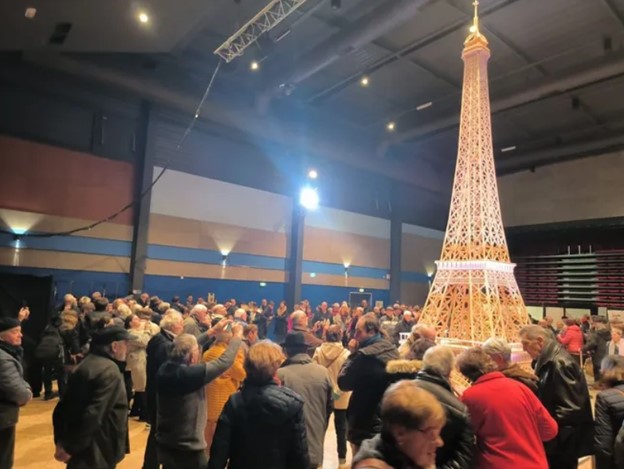
It’s true, of course. A Frenchman recently converted 700,000 matches into a model of the Eiffel Tower, in an attempt to break the world record for, naturally, “tallest matchstick Eiffel Tower”. (Is there a world record for everything these days?) I suppose I can get past the 700,000 matches – even if I can’t picture that many in one model – but what I can’t fathom is the eight years Richard Plaud sacrificed to build his creation. I’m picturing Monsieur Plaud waking up each morning, bidding adieu to his wife after a croissant and some French press coffee, and heading off to his studio to play with matches, a giant bottle of glue in hand. Day after day after day.
 Our Frenchman’s accomplishment wouldn’t be so interesting if there weren’t a little drama thrown in for spice. Turns out his 23.6-foot model may not earn the world record after all. Why? Because Plaud cut the heads off the matchsticks as he built. When he got tired of cutting, he contacted a French “matchmaker” (ha) and asked if he could place a massive order of headless matches. And there’s the rub, fellow model builders. Guinness is disputing Plaud’s claim of the world record because the materials used can’t be purchased by you or me, should we try to build our own matchstick Eiffel Tower (but would we?)
Meanwhile, a 21.6-foot Eiffel Tower model built by Toufic Daher (coolest name ever) retains the world record. Daher’s model was completed in 2009 using six million (headed) matches. I have no idea how long it took him to build, but seriously, how long does it take to simply pick up six million little sticks, let alone shape and glue them into a replica of the Eiffel Tower?

Gustave Eiffel (another cool name) surely had no idea people like Plaud and Daher would be obsessed with his tower 135 years after the fact, in pursuit of world records. Frankly (“France-ly?”) Eiffel’s “Iron Lady” is impressive enough to stand on her own wrought-iron feet. After all, she’s among the most recognizable structures in the world. She surpassed the Washington Monument when she opened to the public in 1889, as “tallest human-made structure” (sadly, seventy years before Guinness started tallying world records). Today she still merits an entry in the world record book, albeit for a different reason:”Most Visited Monument with an Entrance Fee”.
 There’s a touch of iron-y to this post. As much as I’m making blog fodder of these Eiffel Tower model builders, I’m tempted to become one myself. Not with headless matchsticks; the LEGO version. Several years ago I completed the LEGO U.S. Capitol Building (1,032 pieces), followed by the LEGO Grand Piano (3,662 pieces), and more recently, LEGO Fallingwater (811 pieces). I keep an eye on the LEGO catalog for other models of interest but not one calls to me… except La Dam de fer. But then I pause to ask myself, am I really willing to dive into a project that’s effectively one hundred bags of one hundred pieces each, where ever single piece dark grey? Stay tuned.

As for our French ami Richard Plaud, his eight years of pick-up sticks may not have been in vain after all. Guinness admits they might’ve been a little quick to dismiss his claim. In their words, they wanted to make sure “the playing field is level for everyone”. Playing field? Ah, so this Eiffel Tower model-building is a game, is it? For Plaud at least, I’d call it game, set, matches.
Some content sourced from the USA Today article, “8 years down the drain?…”, and Wikipedia, “the free encyclopedia”.
 Life In A Word