
When I take the dog for a walk after dark, I never know what to expect in the night sky above me. We live in an area devoid of city lights so the celestial show is clear and sometimes dramatic. Ursa Major (aka Big Dipper) often makes an appearance. Venus is the brightest star planet low in the western sky at twilight. And the full moon, seemingly biggest as it rises just above the pine trees, can be breathtaking. But none of this prepared me for the bold processional streaking across the heavens last Thursday night.
 It could’ve been Santa Claus and his reindeer for all I knew. Sitting around a backyard fire pit with friends, having drinks and swapping stories, one of the women suddenly shrieked, “LOOK!!!” and pointed skyward. At first it didn’t register what we were seeing (nor at second, nor at third). I can only describe it as a tiny string of bright pearls, two or three dozen in the strand, perfectly spaced and moving silently across the sky. Neither pulling nor pushing, they simply proceeded in a line as if drawn to some unknown destination. It almost looked like the one-after-another cars of a roller coaster, heading up that first steep incline.
Our group was at a loss to explain this extraterrestrial. We thought it might be the neatly arranged contrails of a stealth fighter. Or some faraway electronic billboard advertising in Morse code (only with dots, no dashes). Turns out we weren’t even close. Our little alien spacecraft parade was the latest launch of Starlink satellites from SpaceX.
 You’ve probably heard of SpaceX, even if you don’t know much about what they do. Founded in 2002, SpaceX is one of Elon Musk’s ambitious companies, with the “modest” long-term goal of colonizing Mars. While they design and launch the spacecraft to make that happen, SpaceX is providing Starlink Internet service to under-served areas of the globe by building a “constellation” of satellites around the planet. 42,000 of them.
This is technology way beyond my understanding, but here’s the basic setup. A transmitter somewhere on earth sends the Internet up to one of those satellites and the satellite then rebounds the signal back to you. If the satellite loses your direct line of sight, it can hand off the signal to one of its buddies and your Internet service continues uninterrupted. SpaceX earned the license for a ten-year window – starting in 2019 – to complete its Starlink constellation. At last count they’ve already got 4,000 of these little guys in orbit.
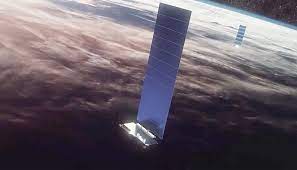
Credit Musk for identifying a market in need. Mars may not be on my bucket list but faster Internet service certainly is. Two years ago 10,000 Earthlings signed up for Starlink subscriptions (at $599 USD for the hardware and $120/month for the service). Today? Fully 1.5 million customers are bouncing data back and forth with all those satellites. My rural location here in South Carolina (and the s-l-o-w speed of my current Internet provider) make me a prime Starlink candidate. Later this year, I’ll also be able to switch over my cell phone service. Yep, Elon Musk is literally taking over the planet. Come to think of it, maybe the entire solar system.

Whether or not I subscribe to Starlink, I find the satellite technology fascinating. We have a lot of “space junk” circling Earth but this constellation of man-made stars seems more elegant. They’re launched in strings of up to 60, separating once they’re high enough. Each satellite’s thruster is powered by krypton and argon. They talk to one another to avoid collisions. They’re currently undergoing “dimming” to appease astronomers by taking a back seat to the real stars in space. Finally, these satellites can “de-orbit”. In other words, when they’re time is done (even satellites don’t live forever), they return home for a proper burial, which means burning up entirely as they attempt reentry through Earth’s atmosphere.

Several websites track the continuing launches of Starlink satellite strings (like this one). You can find out exactly when they’ll be passing overhead in your neighborhood, destined for their rightful place in the budding constellation. If you see them stream by, remember, it’s not Santa and his reindeer (wrong month). It’s a string of pearls designed to provide you with faster Internet service.
Some content sourced from Wikipedia, “the free encyclopedia”.






 Life In A Word