Hello, I’m Veronica
The sky is not completely dark at night. Were the sky absolutely dark, one would not be able to see the silhouette of an object against the sky.


-
Tingling the Spines
When Amazon began opening bookstores a couple years back, I wondered why an uber-successful online enterprise would turn to brick-and-mortar, especially after sales of more than fifty million Kindle e-readers through its website. Turns out Amazon’s walk-in shopping experience is worth the walls. It’s retail at its most relaxing – and it has a place in the equation. As CEO Miriam Sontz (Powell’s Books in Portland, OR) puts it, “something special occurs in a physical bookstore that is not replicable online”.

I’ve been to an Amazon Books just once (fewer than twenty locations in the U.S.), but vividly remember what made my shopping experience so compelling. First, the manager greeted me with, “Welcome to Amazon, and what was the last book you read?” When I told him (Kristin Hannah’s “The Nightingale”), he replied, “Oh, that’s a wonderful book. Wasn’t it so interesting to read an account of the war in France instead of in Germany? Have a look on Aisle 3 – you’ll find some other great WWII fiction.”
As I indeed had a look on Aisle 3, the manager moved on to other customers, prompting similar conversations. Suddenly I realized the whole interaction was intentional. Personalize/focus my shopping experience by discovering what I’m reading. Pique my curiosity by allowing me to overhear what other people are reading. A + B = Increase the odds I’ll make a purchase.

What really sets Amazon Books apart from the others is the displays. The books are laid flat and on angled shelves, so you’re looking right at the cover as you’re standing in the aisle. Below each book, an easy-to-read card delivers a crisp synopsis of the book, as well as a smattering of the ratings and reviews you’d find online. Think about that tactic. You peruse the entire colorful cover. You take in the book title and author without cocking your head ninety degrees to the left or right. And you know a little about the book (and whether it’s a recommended read) without turning a single page. It’s almost like those moments in front of paintings in an art gallery. “Displayed flat” sounds counter-intuitive in the per-square-foot world of retail, but damned if it isn’t a great way to shop.

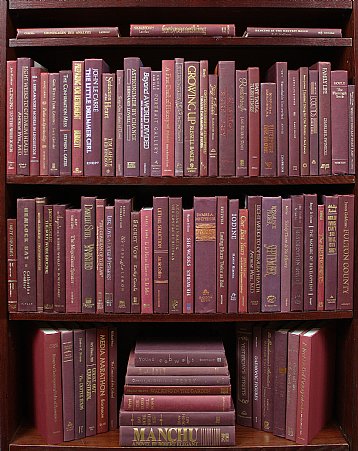
Photo by Natasha Meininger Amazon isn’t the only spine-tingler these days. In a truly baffling trend, interior decorators and collectors are shelving books with the spines… facing the walls. That’s right: take a book off the shelf, turn it all the way around, and place it back on the shelf. Why? Because “eggshell” – the typical color of the pages themselves – is aesthetically pleasing, instead of that rainbow of bright, colorful book jackets. The linen texture is uniform, blending more confidently with whatever else is going on in the room. Really? Is this Feng shui on steroids?

Alas, as the Wall Street Journal reports, backward-bookshelving is no fad, . You can purchase books on the cheap specifically for this approach. Check out the goods at booksbythefoot.com. BBTF sells you reclaimed books, covers removed, of various shapes and sizes, and yes; purchased “by the foot”. You can even purchase your tomes in a color scheme (i.e. “burgundy wine” or “earth tones”). Arrange them any way you want: facing in or out, flat or standing up, in piles or as standalones. Any way you stack ’em they’ll look fully nondescript, suggesting you’d never go so far as to – gasp! – read them. As Chuck Roberts (BBTF President) puts it, “Some people don’t want to have the literature as a distraction… they want books as objects on a shelf.” You mean, like lobotomizing the intellectual meaning from the aesthetic? Weird, just weird.
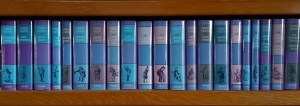
Or maybe not. Now that I think about it, I own the complete works of Charles Dickens, painstakingly acquired years ago, one book at a time through the Franklin Press or some other mail-order rag. My Dickens collection (above photo) sits neatly on the shelf gathering dust, just waiting for me to crack the first spine or read the first page. But no matter; don’t they look pretty?
Some content sourced from Wikipedia, “the free encyclopedia”.
-
Land of Flying Cars
My wife and I live in a rural area of Colorado known as the Black Forest. The high density of Ponderosa Pines in our small geography gives us our name. Remarkably, there’s only one other notable place on the planet named “Black Forest”: the region near Bavaria in southwest Germany. As it turns out, I have personal ties to both places, though I’ve never been to the south of Germany. Follow along as I connect the Forests.
Fill in the blank, “Best Childhood Movie: ________”. Most of you would respond with an offering from Disney. Including “Snow White…”, “Mary Poppins”, and “The Little Mermaid”, you’ve already covered sixty years of film-making, with countless other Disney classics in between. I don’t think I missed a single Disney growing up in the sixties and seventies, yet – go figure – my favorite childhood movie doesn’t come from the Mouse. It doesn’t even come from my home country. My childhood choice? The UK’s “Chitty Chitty Bang Bang”, based on the 1964 novel by Ian Fleming.

“Chitty Chitty Bang Bang” – the captivating musical about the inventor and his kids who lived in a windmill cottage; about those wonderful-though-not-always-perfect inventions (my favorite: the eggs-toast-sausage breakfast machine); about the candy-maker and the toy-maker and the captivating castle world of Vulgaria; and most importantly about the magical flying motorcar itself – created figments of my imagination like no other movie. The lyrics to the title song (“…Bang Bang Chitty Chitty Bang Bang, our fine four-fendered friend…”) were burned into my brain. Someday I vowed to visit the lands of Caractacus Potts and Baron Bomburst.
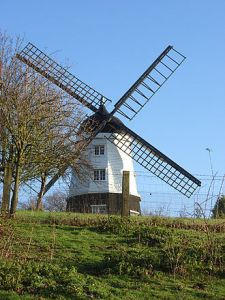
As it turns out, the Potts’ windmill cottage really does exist (and not on a movie set) – as the “Cobstone Windmill” in Buckinghamshire, England. The mansion where “Truly Scrumptious” lived is in the same area of the country. And the Scrumptious Sweets Company was a working factory in Middlesex (today a steam-engine museum). But it was the castle and village in Vulgaria I really wanted to see. Not long after seeing the movie of course, I learned “Vulgaria” was a fictitious country. Baron Bomburst didn’t actually lord over the land, nor did he ever keep all those children as slaves beneath his castle. But the castle and the village are based on actual places. The village is Rothenburg ob der Tauber in Bavaria. The castle is Castle Neuschwanstein, also in Bavaria. And how ironic; both locations were inspirations for Disney as well: Rothenburg for the village in “Pinocchio”, and Neuschwanstein for the Cinderella castles in the theme parks.
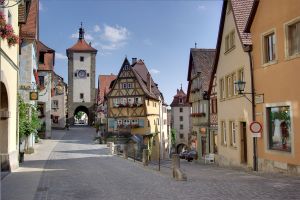

To bring my journey full-circle, Rothenburg, Castle Neuschwanstein, and Bavaria sit in southwest Germany, adjacent to… the Black Forest. Germany’s version of the Forest is a mountainous land of picturesque villages, castles, vineyards and spas. This is the region that brought the world Black Forest Ham and “truly scrumptious” Black Forest Cake. This is the land of glass-making and cuckoo clocks. From the photos above, it looks every bit as charming as “Vulgaria”.
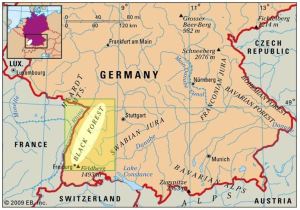

Colorado’s Black Forest barely amounts to a dot on Google Maps. Within our pines, the “town” is a hodge-podge of nondescript businesses clustered around a couple of traffic signals, with nothing more alluring than a Subway, a post office, and a couple of coffee shops. The terrain is fairly flat, with no windmill cottages or mountaintop castles or cuckoo clocks. But it’s a great place to live, with its own unique charm. And every now and then, when I’m deep in the pines, I’ll start humming that forever-familiar Chitty-Chitty tune, as I gaze up to the skies in search of a flying motorcar.
-
Crafts of the Hand
Several months ago, my wife and I went to dinner at one of our favorite Mexican restaurants – a place we frequent every few weeks. As we pondered margarita options, we asked the waiter for an order of table-side guacamole, a delicious specialty and a great way to kick off the meal. Much to our disappointment, our waiter informed us we could no longer get guac table-side; rather, it would come already prepared and straight from the kitchen. Sigh. Add another item to the demise of handmade food and beverages. Rekindle the pour-over argument.

What’s the “pour-over argument”? It’s perhaps the most contemporary example of the struggle between handicraft and automation. At your local coffee bar, most drinks are poured-over, meaning individually-prepared using a single paper filter, adding the coffee grounds and finishing with a slow pour of the water. If your coffee arrives with foam-art, consider it a pour-over. The argument asks whether it’s worth the wait for an individually-prepared coffee, when a large-batch machine can produce the same result in a fraction of the time. One estimate claims large-batch can produce 100 coffees in an hour, while a barista creates less than ten.

I’m not here to defend the pour-over, but simply to discuss it. In fact, my first thought when I heard “pour-over” is what you see in the photo above. Admittedly, I love the speed and consistency of Keurig’s K-Cup’s, and I’m an unashamed frequent-flier at Starbucks. But that’s not to say there’s not a chair at the table of life for pour-over’s. Even if the quality of handmade can’t be distinguished from large-batch (taste test, anyone?), what about the calm of watching “drink-art” creation, and the opportunity to socialize with the barista? Perhaps it’s the fringe-benefits making pour-over’s the healthier option.
Table-side guac is just one example of “pour-over’s” threatened by today’s demand for speed and efficiency. If I ask you to think of a product previously handmade but now produced by automation, I’m sure you can name several. Milkshakes. Beer. Even pizza, which can now be prepared start-to-finish by a robotic chef. But the flip-side of robots is advertisement focused on food-prep the old-fashioned way. “Handmade” milkshakes. “Craft” beers. “Fresh-squeezed” lemonade. And pour-over coffee.

Business’s bottom line loves the idea of automation. Labor is typically your most expensive line-item, so who would argue with removing it? Well, maybe those willing to pay for the experience. At your finer restaurants, you can still find table-side salads (Caesar), entrees (Chateaubriand or Steak Tartare), and flaming desserts (Baked Alaska, Bananas Foster, Cherries Jubilee). At Sunday brunches you can still enjoy made-to-order omelettes and waffles. With those examples, I’d argue you’re not just paying for the food. You’re also paying for a slow-down moment: a chance to enjoy a chef-artisan do his/her thing while engaging in a little conversation. As a recent Wall Street Journal article puts it, “[pour-over]… is more about delivering peace in a fast-paced time”.
Here’s my plea. The next time you’re having something prepared in front of you – whether a simple burrito at Chipotle or an elegant Steak Diane adjacent to your white-clothed table, put away the phone, take a deep breath, and just enjoy the moment. Have a chat with whomever is preparing your meal. It’s an experience worth poring over.
-
The Final Word
This time of year, we assemble our latest collection of “best-of’s” and “…of-the-year’s”. On Monday, America crowned its national champion in college football (Alabama). In a few weeks we’ll get the NFL’s equivalent in the Super Bowl. Last month several magazines recognized 2017 of-the-year’s in photography and current events. Soon we’ll also have best-of’s in music (Grammy) and film (Oscar). In this spirit, did you know there’s an of-the-year for words?

To be clear, “word-of-the-year” doesn’t refer to the annual expansion of the Merriam-Webster (.com) Dictionary or the Oxford Dictionaries Online. With the former, over 250 words were added last fall; with the latter, over a thousand. Instead, word-of-the-year is a single choice, representing “lasting potential as a word of cultural significance”. That’s how the people at Oxford see it, and thus this year’s honoree is “youthquake”. Huh? Maybe if you’re in Britain you’re not shaking your head like me. “Youthquake” means “a significant cultural, political, or social change arising from the actions or influence of young people.” “Youthquake” has been around since 1965, but back then it was only a reference to the fashion and music industries. Today, it could (and is) being used in reference to the myriad demonstrations of change commanded by the millennial generation.
With the Academy Awards – should you not agree with, “and the winner is…” – at least you might have a favorite in the list of nominees. But the short list for 2017’s word-of-the-year is the following bunch of odd ducks: white fragility, unicorn, kompromat, broflake, newsjacking, gorpeore, milkshare duck, and antifa. Okay, maybe “antifa” would’ve been a good choice, but I count at least four others I’m seeing for the first time. More to the point, what happened to better choices like “hipster” or “pregame” or “alt-right”? Did none of those even make it into the dictionary expansion? They’re certainly more word-of-mouth than “youthquake”.

Perhaps “youthquake” will make it across the pond in the next year or two and enter America’s daily conversations. But the word is not off to a good start, considering several in Britain – including the CEO of a youth leadership organization – claim they’ve never heard of it. Maybe Oxford just has an affection for the word, so they throw it out there as an “of-the-year”. But that’s kind of like being labeled “America’s Best City To Live In”. The mere advertisement draws a bunch of tourists and other undesirables and next thing you know you’re no longer “best”. By the time we Americans get right with “youthquake”, Oxford and Britain will have moved on to 2018’s word-of-the-year.
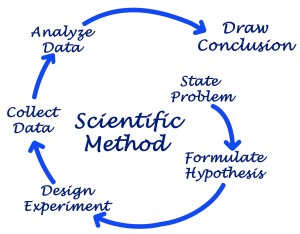
Merriam-Webster’s Peter Sokolowski claims their word-of-the-year (apparently the honor is shared) “…gives us insight into the collective curiosity of the public”. M-W took a more scientific approach to it’s recipient, looking at how often certain words were looked up online, and their context with respect to current events. M-W’s 2017 word-of-the-year? Feminism. Look-ups of “feminism” increased 70% over 2016, and spikes in that activity were tied to comments made by politicians in Washington D.C., “The Handmaid’s Tale” and “Wonder Woman”, and the sexual harassment revelations of the past several months. M-W gives “feminism” two definitions, but I prefer the second: “organized activity on behalf of women’s rights and interests.”

Two years ago, Oxford made a particularly clever word-of-the-year choice in “pictograph”. Rather than show the word, Oxford showed an emoji. If my spell-check is any indication, it takes at least two years to embrace the current word-of-the-year recipient. “Emoji” did not underline. “Youthquake” most definitely did.
-
Sweet Charity
Several times during the recent year-end holidays, I passed through the drive-thru at Starbucks, and as I paid, I asked the cashier to include the purchases of the car behind me. I’ve been participating in this Starbucks-wide trend for several Christmases now, and it brings me an inexplicable feeling of goodwill and satisfaction. The goal of the effort is anonymity. Or to put it more comprehensively, blind faith.
Blind faith is defined as “belief without true understanding, perception, or discrimination”. That’s powerful. “Faith” is a spectrum that starts with basic trust and ends with the highest forms of religion. But add on “blind” and it elevates the meaning.
Buying a free cup of coffee at Starbucks is the easiest form of blind faith, like handing over a dollar to a beggar. No judgment as to “what happens next” allowed. But the intention behind an act of blind faith is worth a bit of exploring here. Dissecting my Starbucks gesture, I note the key components. First, I don’t waffle over the amount of the purchase I’m covering. That’s the blind faith in choosing to pay in the first place – it shouldn’t matter how much. One time I looked in the rear-view mirror and saw a car with four passengers. Their bill was well over $20. But my decision had been made before the car even pulled up behind me, so the point was to stick with it. Another time my recipient was a well-dressed woman wearing sunglasses and driving a recent-model BMW. Again, no judgment. Pay for her coffee and move on.

The second component concerns my “getaway”. As I’m waiting for my own purchases I’m considering my escape route – the path that gets me away from Starbucks as quickly as possible, with enough turns and traffic lights to deter my beneficiary. My goal is to remain anonymous, and unless the person behind me memorizes my license plates (or something else unique about my vehicle), I’ve achieved a moment of goodwill and will never see them again. Frankly, it would spoil the whole effort if the car pulled up next to me at a nearby red light. They might offer their gratitude, or they might offer to pay me back. They might even be annoyed, as if I had no business intruding on their “personal life”. I’d rather not know. I prefer to lean on blind faith that I brought an unexpected smile, or delivered a tiny give-me-a-break in an otherwise trying day. Maybe they’ll even “pay it forward”, as a string of 374 consecutive cars did at a Starbucks in Florida back in 2014.
Come to think of it, there’s a third component in the Great Coffee Giveaway. Never expect the gesture in return. In the countless times I’ve driven through Starbucks during the holidays, I’ve never thought to myself, “I hope the car in front of me picks up the tab”. If I knew this was happening, I might just order a half-dozen breakfast sandwiches and several cake-pops to go with my Flat White. Just kidding, of course. I hope the thought never crosses my mind.

This week and last – no surprise here – I’ve read dozens of blogs about resolutions for the New Year. Allow me to contribute my one-and-only. I’m going to lean on blind faith in the coming year, whenever I have the chance to give someone a break. Remember the rules: 1) No conditions on the amount (read: cost) of the help. 2) Keep it anonymous, as a) recognition defeats the spirit, and b) giving simply for the sake of giving might inspire “pay it forward”. 3) Don’t expect a similar gesture in return. That’s not to say you won’t be pleasantly surprised when someone buys your Starbucks coffee one of these days. You’ll just know there were no hidden agendas.














About Me
The sky is not completely dark at night. Were the sky absolutely dark, one would not be able to see the silhouette of an object against the sky.
Follow Me On
Subscribe To My Newsletter
Subscribe for new travel stories and exclusive content.
 Life In A Word