
Hello, I’m Veronica
The sky is not completely dark at night. Were the sky absolutely dark, one would not be able to see the silhouette of an object against the sky.


-
Rumble in the Jungle
Last Friday, a Miami prep school put on a senior prom. The party included the usual accoutrements: decorated tables surrounding a darkened dance floor, strobe lights sweeping in rhythm to the blaring music, and the students themselves, dressed in never-be-seen-in-again styles and colors. The theme (there’s always a theme at prom) was “Welcome to the Jungle”, played out through the room’s exotic backdrops and fabricated trees. Somewhere during the festivities, a pair of fire-eaters put on a show. And eying everything that moved, from a cage at the edge of the dance floor? One extremely agitated, very-much-alive, time-for-dinner, full-grown Bengal tiger.


I had to watch the video (here) to believe the headline, but yes, snopes.com – true story. A tiger went to prom. Judging from the size of the cage and the attitude of the animal, it’s no wonder the authorities were all over this one, from the Florida Fish & Wildlife Commission to PETA. The students – er, administrators – will “have some ‘splainin’ to do, Lucy”. For starters, where the heck did Principal Pugh find a Bengal tiger for rent? And then, did Pugh and his staff really think students would want to see said tiger up close and personal? My date wouldn’t have been impressed as I peed in my tuxedo pants.

Prom wasn’t always this way. Once upon a time it was entertainment enough to simply go to a high school gathering off high school grounds. Prom was more about the one time you got to borrow Dad’s fancy car; the one time you could be at one of your town’s finer hotels as a minor; the one time you could stay out past curfew (oops; discovered that last one wasn’t actually true after the fact). Prom was simply dinner and a dance; 95% perspiration and 100% awkward moments.

I can’t remember how I asked my date to prom. These days, the asking is an event all of its own. “Promposals” – as the ladies now expect – are supposed to be “creative, elaborate, and over-the-top” invites. A Breaking Bad fan convinced Bryan Cranston to film a promposal for his date. Another guy changed his name and photo in his date’s cell phone, so when he called her, the promposal popped up on the screen. Yet another had a pizza delivered to his date’s house, with “PROM?” spelled out in pepperoni. A phone call just isn’t enough to get a “yes” anymore.
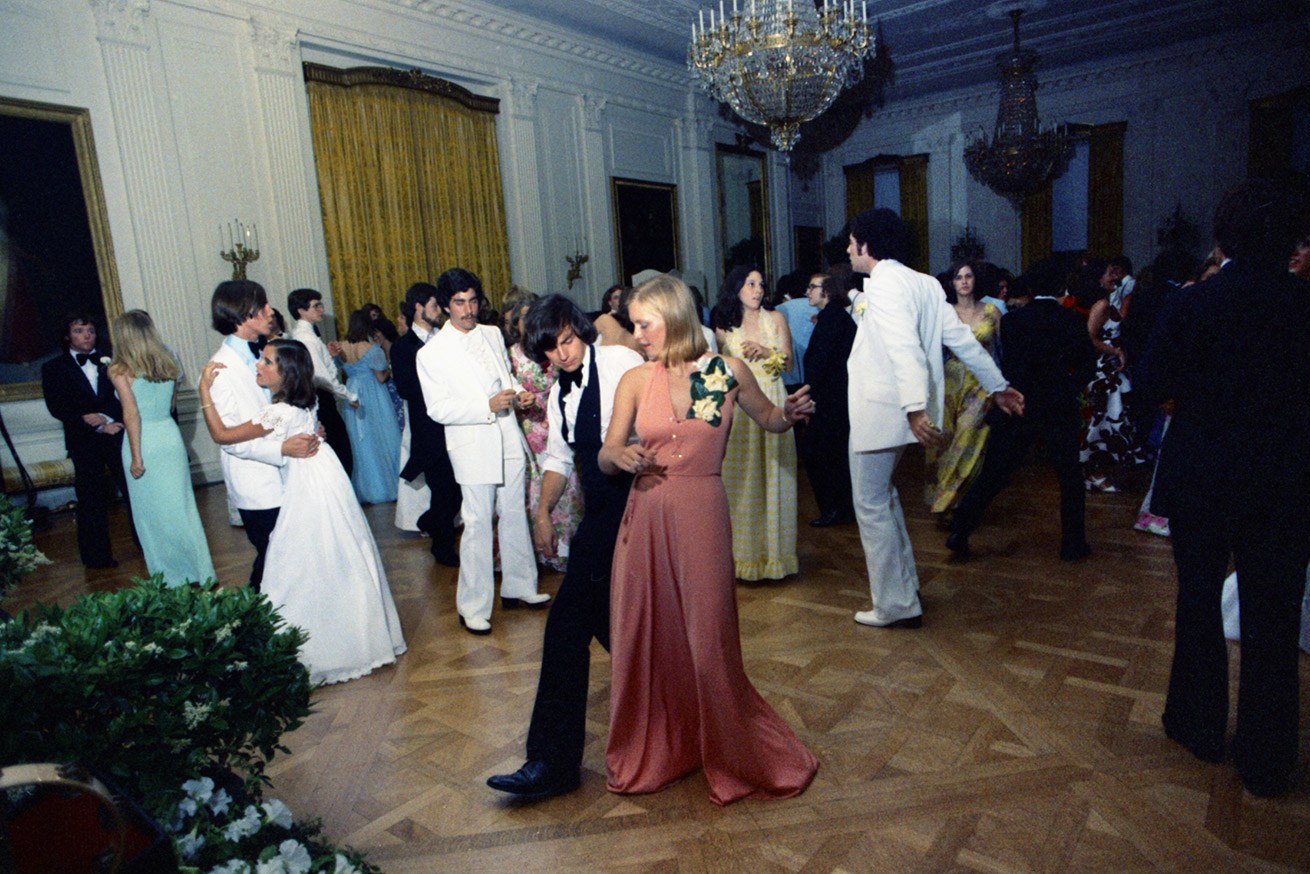
Proms go back a long way; well over a hundred years. Proms were originally deemed “times of firsts”, as in first “adult” social event for a teenager, first time taking the car out after dark, first real dress-up affair, first ride in a limo, first formal photo with a date, and so on. Today, firsts happen a lot sooner, don’t they? Maybe that’s why we add tigers and fire-eaters to quicken the pulse. Or hold our prom in the East Room of the White House, as Susan Ford (daughter of the late President) did alongside her Holton-Arms classmates in 1975.

Photo courtesy of Gerald R. Ford Presidential Library Here’s a bit of prom trivia: the word is short for promenade. Promenade means “a stroll or a walk, especially in a public place, as for pleasure or display”. Makes sense, doesn’t it? Further, promenade comes from the Latin word prominare, which means “to drive (animals) onward, with shouts”. With a nod to Miami – makes sense, doesn’t it?
(Note: PROM also stands for “programmable read-only memory”; a form of computing memory where the setting of each bit is locked. Makes me think of teenage hormones, especially at prom. Locked/loaded – nothing you can do to change any of the settings.)

Not to rain on this parade – er, promenade – but every time I think of prom I can’t help but think of the movie “Carrie” – the original version of course, with Sissy Spacek. Still terrifying after all these years (and I can still hear her mother’s haunting scream, “They’re all gonna laugh at you!!!”). At least now I’ll just have nightmares about hungry tigers.
-
The Life of Spice
“Mikey’s Late Night Slice” in Columbus, Ohio, offers a pizza called “Fiery Death with Hate Sausage”, topped with three of the world’s hottest peppers: Carolina Reapers, Trinidad Moruga Scorpions, and Bhut Jolokias. You must sign a waiver before Mikey’s serves you a slice of Death, acknowledging, “you’re an idiot”, and absolving the restaurant of any responsibility for the unpredictable aftereffects. According to one taster, “It was pretty miserable. My eyes welled up, my nose ran, and no drink could wash away the pain.” Sounds like my kind of heat.

Photo by “Mikey’s Late Night Slice” It all started with the tabletop pepper shaker. Salt’s brother-of-another-color stood quietly to the side in my childhood, hoping for the same constant attention given to his savory companion. If pepper was used at all in my day, it was nothing more than an obligatory shake; a decoration of the food versus a yearning of the taste buds.
Forty-odd years later, the pepper mill has become the king of the spice rack – my go-to final flourish before deeming a meal ready-to-eat. My pepper mill is always cranked to the furthest setting to the left, so the dozens of corns fall out of the bottom virtually intact. When I refill my pepper mill and spill a few of the little guys onto the counter, I scoop them up and pop ’em into my mouth like candy. My family has learned to pass the pepper before I even ask for it.

I blame my parents, of course (something I seem to do with increasing frequency these days). My dad peppered everything on his plate – still does – and kept shaking away until his food literally disappeared under a blanket of black. My dad was the guy at restaurants who mercilessly trapped the poor fellow who politely asked, “would anyone like ground pepper”? My dad would always add, “you can be generous…”, and several minutes of grinding ensued. My dad also had violent (but apparently enjoyable) fits of sneezing, sometimes seven or eight in a row. I never made the association with pepper, but now I wonder. I can still hear him concluding a sneezing session with the word “marvelous“.
My mom, who graduated from the Emily Post School of Etiquette with honors, commanded a family dining table to rival the tightest ships. Every placemat, utensil, plate and bowl were in perfect symmetry. The meal began with a table grace, and concluded with “please may I be excused?” In her world, “please pass the salt” meant passing the salt along with the pepper shaker, and with two hands instead of one so you couldn’t eat at the same time. Thus, the pepper arrived at my plate whether I wanted it to or not.

Sometimes I think my hankering for pepper is borderline-addictive. Eventually the “shaker” no longer sufficed, as the pepper only came out in little bits. Once I discovered the “mill”, there was no going back. A handful of turns became ten, then fifteen; my food turning as dark as my father’s. As it turns out, pepper was my gateway spice. In the last several years I’ve discovered “red pepper flakes”; a significant leap in heat from peppercorns. I used to shy away from those little plastic vials they include with pizzas. Now I ask for two or three more.
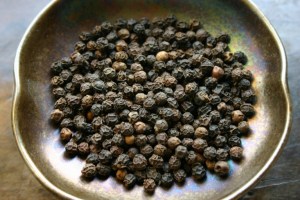
Lucky for me, pepper (and all things spicy) appears to be a healthy habit. According to an article by Dr. Joseph Mercola – an osteopath and proponent of alternative medicine – a full ounce of pepper provides most of the manganese, Vitamin K, and potassium we need in a given day, and even a good dose of iron or fiber. Mercola then missteps when he acknowledges “…it’s true one would not have that much pepper in a day…” Apparently, he hasn’t met me.
Pepper is described as a “stealth antioxidant”, discourages intestinal gas from forming (no wonder my wife peppers my food), and somehow aids in the breakdown of fat cells. Finally, black pepper has much in common with cannabis, with aroma molecules functioning as “cannabinoids”. To be clear, we’re talking about the therapeutic benefits of cannabinoids here. Pepper isn’t playing with my brain cells (I don’t think), but it does help to reduce inflammation.

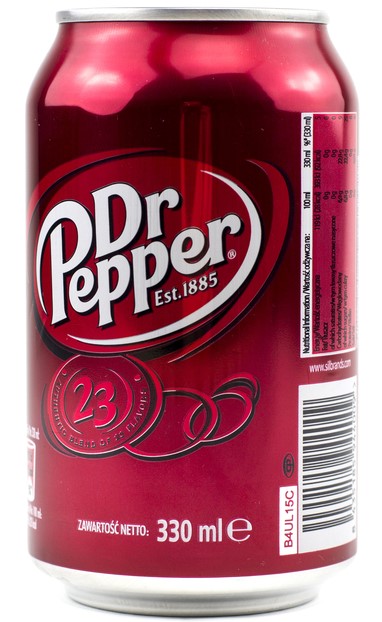
My children are destined to a life of pepper – I’m sure of it – and not because I turn my food black like my father or pass the shakers as a pair like my mother. In high school, my daughter prepped for her team’s volleyball matches by “peppering” with another player (hitting the ball back and forth to warm the hands). Now, she carries pepper spray in her purse. One of my sons went to college in Waco, TX, where Dr. Pepper was invented in 1885 and vended on campus without a Coke or Pepsi in sight. More recently, I’ve seen my children reach for the hot sauce (instead of the mild) at Mexican restaurants. You see, it creeps up on you quietly. Next thing you know they’ll be asking me to take them to Mikey’s Late Night Slice.
-
Fit for a Queen
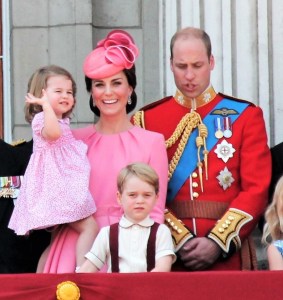
Two weeks this Saturday, the United Kingdom’s Prince Harry and America’s Meghan Markle will be married at England’s Windsor Castle; an event garnering lots of attention on both sides of the pond. In the line of succession to the British throne (still occupied by Queen Elizabeth II after a record sixty-five years), Harry is now sixth, behind his father Charles, his older brother William, and William’s three children: George, Charlotte, and ten-day-old Louis. Of all these royals, I’d love to see William’s daughter ascend to the throne someday. “Queen Charlotte” just sounds so regal, doesn’t it?

Photo by BEN STANSALL/AFP/Getty Images Princess Charlotte is now three years old and already working on her Royal Highness wave (see above). I thought she was named after Princess Charlotte Mecklenburg-Strelitz, the German-born wife of King George III from three centuries ago, but apparently that’s a-little-too ancient history. Charlotte’s name is instead a nod to the feminine form of “Charles”, her grandfather. Add in her middle names Elizabeth (her great-grandmother the Queen) and Diana (her grandmother), and Charlotte’s full name is quite a mouthful. Perhaps you prefer the more formal “Her Royal Highness Princess Charlotte of Cambridge”?
I’m enamored with Charlotte because you just don’t see her given name in print very often. Mecklenburg-Strelitz is one of just three Charlotte’s in the entire British monarchy. Mecklenburg-Strelitz was Queen – by marriage – of Great Britain and Ireland for forty years in the late 1700’s, before those countries became a part of the United Kingdom. Lest you think she was a power Queen, Charlotte was chosen by her husband King George III for just the opposite reason – her lack of interest in politics. Charlotte bore George fifteen children (including future king George IV, who himself had a daughter Charlotte), so it’s fair to say she fulfilled her real obligation to the monarchy.

Princess Charlotte by Johann Georg Ziesenis, c. 1761 There’s America’s city of Charlotte, North Carolina, of course. Charlotte really is named for Charlotte Mecklenburg-Strelitz, as she was the reigning “consort” (monarch’s spouse) at the time of the city’s incorporation in 1768. America was still a grouping of British colonies back then, so the city’s naming makes more sense with that context. Charlotte is aptly named the “Queen City” and is central to the county of Mecklenburg. It’s as if we Americans are of British and German descent.
The only other reference to Charlotte I could find (in case someone up there is reading) is the town of Charlotte, Vermont. “This” Charlotte was incorporated six years before North Carolina’s, no doubt also named for the eighteenth-century queen. No surprise – Charlotte, VT is in America’s geographical region of New England.
On a personal note, my father’s older sister was named Charlotte. She died not ten years old (of scarlet fever), so it’s a shame I never had the chance to know her. I would’ve enjoyed calling her my Aunt Charlotte.
That’s the extent of my tour of Charlotte’s. With any luck (and longevity), I’ll be witness to Queen Charlotte in my own lifetime. Throne or not, the young princess’s estimated worth to the British economy is $4 billion over the course of her life. Big number there. Then again, I just contributed $7.95 of the total. My wife and I renewed our Netflix subscription last night so we could watch “The Crown”.
Some content sourced from Wikipedia, “the free encyclopedia”.
-
Good Times and Laughter Too
My wife and I will attend two weddings this summer; one for friends and one for family. This week I noticed one of the brides-to-be on Facebook, requesting “songs you want to hear/dance-to at the reception”. Clever girl, making sure her guests have a say in the music. My guess is – whether requested or not – the deejay will find room for Kool & The Gang’s enduring party anthem, “Celebration”. It’s as timeless now as it was when we first heard it in 1980. And ce–lah–brate-ing good times is as timeless at weddings as it is for the passing of a loved one.

Plucked from another section of the significant-life-events portfolio, my wife and I attended a Celebration of Life this past weekend, for my uncle (my dad’s twin brother). I label two aspects of my uncle’s passing as “merciful”: 1) He was weakened by a heart condition over the last three years of his life; and 2) One or two of his family members were not available for an immediate memorial. Because of the first aspect, the extended family had plenty of time to make peace with my uncle’s eventual passing. Because of the second aspect, what may have been a funeral became a celebration of life instead.

No need to vote on this topic. Whenever circumstances permit, choose Celebration of Life over Funeral. Funerals lean to the shock and mourning of a life lost – somber affairs are they. Celebrations of Life revel in the happy memories of one life, and the joy brought to countless others. Such was the case with my uncle. His celebration included a church service, hymns, and a homily (given by the “celebrant”, of course), but what moved me to my core – and what I couldn’t get enough of – were the stories shared by my cousins (my uncle’s children) and my father (his brother). Those memories included things I never knew about my uncle, such as his talent as a cartoonist and his childlike demeanor with his grandchildren. I’m even more inspired by the man than I already was.
My uncle’s celebration moved on from the church to a beautiful setting by the San Francisco Bay, where drinks, lunch, photos and memories were shared for several hours. It was as much a family reunion as a celebration, and my uncle wouldn’t have had it any other way. Before he passed, he let it be known we should make merry instead of mourn. And so, …There was a party goin’ on right there; a celebration to last throughout the years.
Whether we celebrate births or birthdays, weddings or wedding anniversaries, Sunday Mass or Christ-mas, we get a healthy dose of festive occasions in our lifetimes. Perhaps that’s why we’ve come up with so many words to describe them. Merriam-Webster published one such list here, including Bash (America’s melding of “bang” and “smash”, somehow maturing into “party”); Blast (surely inspired by loud musical instruments and champagne bottles); Rave (actually inspired by a Middle-Ages term for “acts of madness”); Blowout (once defined as a “one-off indulgence”; somehow morphed into “major festive occasion”), and finally my favorite – Wingding (once “feigned seizures”, now “wild partying”).
But enough digression. Well, almost enough. My nod to all things “celebration” wouldn’t be complete without a mention of the town in Florida by the same name. Developed by Disney as a utopian master-planned unincorporated community “created from scratch”, and “a town worthy of its brand and legacy”, Celebration was/is Disney’s nod to New Urbanism: development based on the small towns of early America, with compact downtowns, “walkable” streets, diverse housing stock, and plentiful public spaces. Celebration doesn’t even consider itself a town, preferring instead the label of community, as in “strong spirit, and desire for friendship with neighbors”. Sounds like a festive gathering to me!

There will be many more celebrations of life before the one that has my own name on it. I’m okay with that. Celebrations of life are a unique blend of revel and revere, partying and paying respects – the dual reasons we raise our glasses to someone’s name. Just be sure it’s a party. As Kool & The Gang puts it: We’re gonna have a good time tonight… Let’s celebrate… It’s all right.
-
Dream Puffs
Last year, Starbucks surpassed Subway as America’s #2 restaurant, measured by gross sales (McDonald’s is still top dog). I don’t consider Starbucks a place to “dine”, so second-place is impressive. Then again, Starbucks’ bakery case has matured since its initial offerings. There are temptations-a-plenty now, en route to the barista. The traditional breakfast items share space with yogurt parfaits, fruit-and-cheese boxes, “fold-over” sandwiches, and entree-size salads. But it’s the smaller offerings I want to talk about today. Look closely through the glass – you’ll see sous vide egg bites and Bantam’s bite-sized bagels. Those little guys could be the future of fast food.
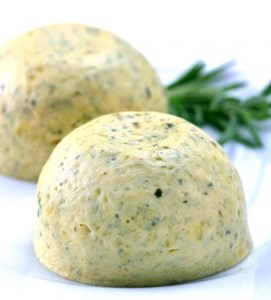
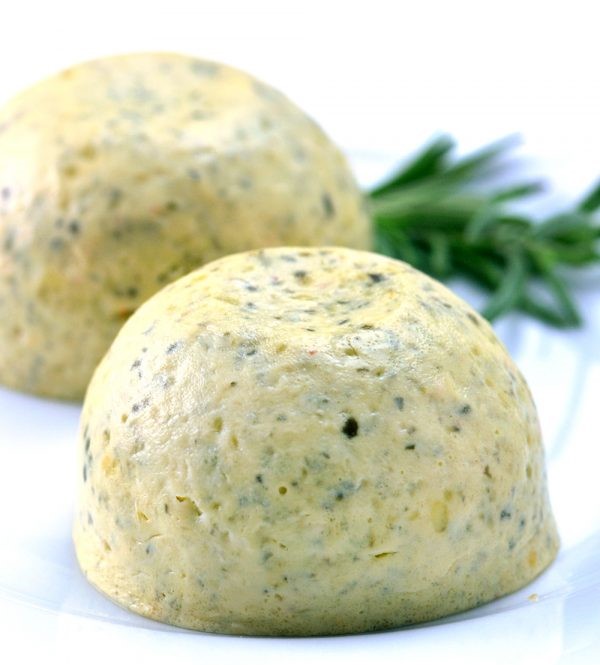
egg bites I haven’t tried the mini bagels, but Starbucks wins me over with its egg bites. The first time I gave them a whirl, my wife and I were in the middle of Lent, trying to find alternatives to the foods we gave up. Egg bites to the rescue. The sous vide prep means cooked in water, with nothing but a bit of spinach, red pepper, and cheese mixed in for flavor. Simply elegant (elegantly simple?), and the light, fluffy texture makes them as delicious as they are convenient.

Three Little Griddles 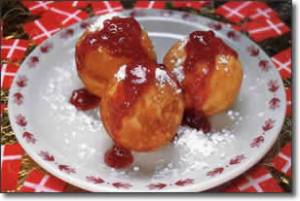
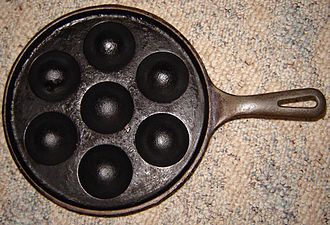
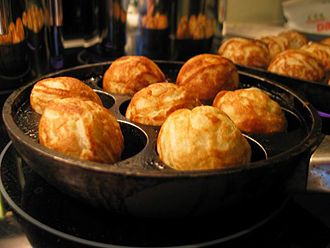
Æbleskiver Now let’s talk about real breakfast foods. Last weekend, my wife and I went to a nearby restaurant called Three Little Griddles. Much to my delight, Griddles had Æbleskiver on the menu. If you’re Danish, you already know what I’m talking about. Æbleskiver is heaven-sent breakfast: puffy little balls of pancake with a sweet surprise in the middle, finished off with a delicate dusting of powdered sugar and a side of raspberry jam. Æbleskiver is Danish for “apple slices”, but you’re more likely to bite into a strawberry or a fruit-compote filling instead. Three Little Griddles also offers Æbleskiver with an egg/bacon filling, coated with a maple-syrup glaze and powdered sugar. A complete breakfast!

NOT Æbleskiver If you haven’t heard of Æbleskiver and the first thing you thought of was “doughnut hole”, shame on you. Doughnut holes don’t even qualify as poor man’s Æbleskiver. Doughnut holes are a clever product designed to get you to buy more when it appears you’re buying less (think “fun-size” candy bars). I have two issues with doughnut holes. One, they’re not actually the “hole” of a solid doughnut, but prepared and baked separately instead. Two, they’re not shaped like a doughnut hole should be (picture it – something more like the hub of a wheel). They should be called doughnut balls. But enough of this talk; I’m wasting words. Let’s keep the focus on Æbleskiver.


My first taste of Æbleskiver came when I was little, in the Central California village of Solvang. Solvang is like, well, a kid’s “Little Denmark” – a town small enough to walk around, with an overabundance of shops selling toys, candy, and ice cream. Several windmills spin slowly above Solvang’s high-pitched shingle rooftops. A church sits prominently on the edge of town. A small park serves as the town square, complete with a bandstand-sized gazebo. All that’s missing is some water-filled canals and cobble-stoned streets. But meanwhile, there’s plenty of Æbleskiver. Some restaurants even bake them out on the sidewalk, rotating those little dream puffs to perfection in their unique iron skillets.
If you credit the Danes with the invention of ball-shaped food, the rest of the world takes a distant second with its imitations. China makes a spherical egg-based fruit-filled waffle called Gai Daan Jai. Japan makes a variety of savory ball-sized snacks called Takoyaki. (Savory? Yuck.) And America makes doughnut holes called Munchkins.

As if Æbleskiver isn’t cool enough as a food, it’s also a cool word with a unique spelling (note the “letter” Æ). Perhaps Starbucks will start carrying it, along with the egg bites. I’d buy both and a coffee for a complete breakfast.
Finally, if Æbleskiver has you wondering what other delights Denmark has to offer, consider Æblekage. Æblekage is “apple charlotte” – stewed sweetened apples layered with butter-roasted bread crumbs and crushed makroner (an almond-flavored meringue), topped with whipped cream and red currant jelly. Oh my; sounds like dream stuff.

Æblekage Some content sourced from Wikipedia, “the free encyclopedia”.












About Me
The sky is not completely dark at night. Were the sky absolutely dark, one would not be able to see the silhouette of an object against the sky.
Follow Me On
Subscribe To My Newsletter
Subscribe for new travel stories and exclusive content.
 Life In A Word