
Hello, I’m Veronica
The sky is not completely dark at night. Were the sky absolutely dark, one would not be able to see the silhouette of an object against the sky.


-
Caring O’ the Green
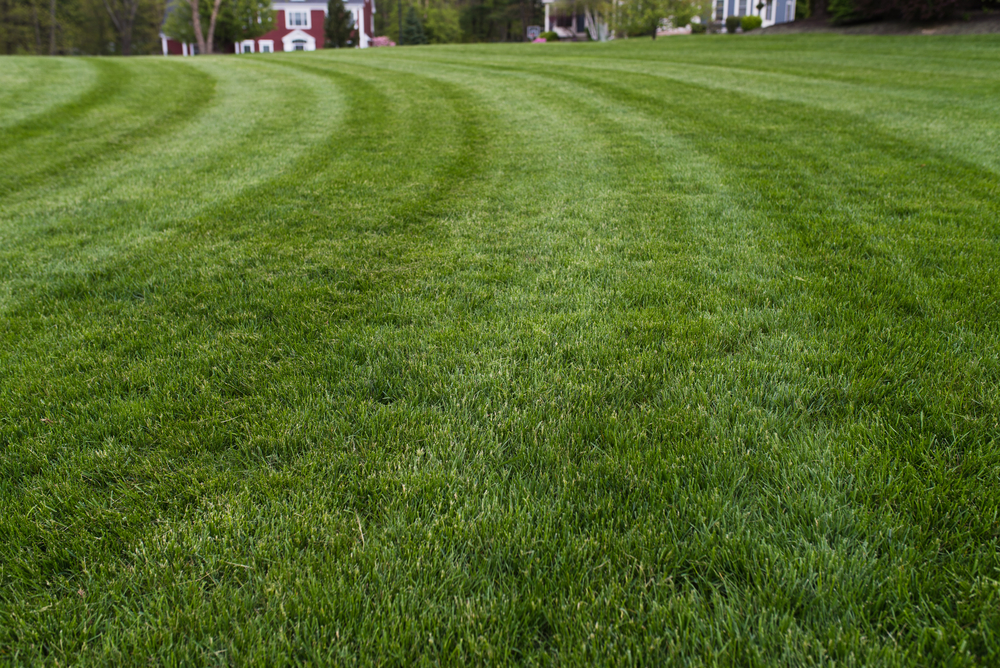
My back lawn stretches north to south along the edge of my house, and half again as far to the west. When I look out the window, it’s an expanse of brilliant green in every direction; about 2,000 square feet by my step-off calculations. I could place the Emerald City at its edge and things would look even better than with the field of poppies. I should invite Dorothy & Toto over for a cup of coffee. Or dress like the Wizard’s guards in one of those head-to-toe outfits while I mow. Even my lawn tractor is green.
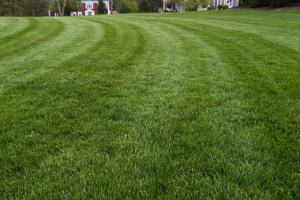
It wasn’t always jade thumbs for me. Growing up, a gardener took care of my parent’s lawn (an even bigger carpet than my backyard Oz). Instead of mowing, trimming, mulching, aerating – all better options in hindsight – my brothers and I commanded weed and leaf patrol. Endless amounts of both packed into endless amounts of extra-large black lawn-n-leaf bags. One summer we helped my dad install a sprinkler system; everything from a rented trencher to miles of PVC pipe. It was a good education in plumbing, but I didn’t learn much about lawn care. Er – change that up – I didn’t care to learn much about lawn.

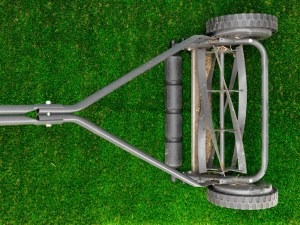
When my wife and I bought our first house, caring o’ the green became a proviso, if only to be good neighbors in such close quarters. We lived on a postage stamp lot in a small neighborhood just south of San Francisco. (If the lot really was a postage stamp, imagine the size of the front lawn.) I could mow and edge in a cool fifteen minutes. Looking back, I get a little nostalgic for my first lawn mower. It was the simple bare necessities – just a rotating blade and a couple of wheels, connected on up to a pair of hand grips. The engine was me, and there was neither seat nor steering wheel. No matter – my “push reel mower” worked just fine when you’re talking postage stamps.
Moving to Colorado, I graduated to a bigger lawn and a gas mower. A yoga class should include the lunge-like move required to start a gas mower. Brace with one leg, deep knee bend with the other, arm extended forward (but not locked!), fingers closed lovingly around the cord handle, deep breath, and… PULL! Sometimes the engine wouldn’t start after several PULLS on an early morning, adding colorful words to my vocabulary.

After that, we moved to the ranch we live on now. Mr. 2,000-square-feet beckoned out back that first summer, but with my smallish mower I pushed about a five-mile spiral to get him cut (my neighbor still smirks at me today… “city boy”). Too many years later I graduated to a John Deere ride-on: seat, steering wheel, drink/snack holder – the works. I even have the matching JD hat so I look like I know what I’m doing.
DO I know what I’m doing? DO I care enough about my lawn? Sometimes I wonder, as in a recent Wall Street Journal article, which story-tells lawn care at a whole different level. Some of my neighbors out there, in what can only be called obsession, take scissors to their grass or pluck the blades by hand. Others use a vacuum to clean up the scraps. Still others attach a roller to their mower for a finishing flourish – those light/dark stripes normally reserved for baseball fields. If I too want to be “extreme” I can purchase the video, “How to Dominate Your Neighbor’s Lawn”.

No, I’m not that guy. No scissors, no vacuums, no videos. I’m content to just putt-putt-putt every-other-week spirals around my green, with the occasional hand-rake of the trimmings. I’ll even admit to using a lawn service to hold back the weeds. It looks acceptable. The Wizard of Oz would probably approve and that’s good enough for me.
-
Kindling the Fire
Last Sunday, in the midst of a sleep-in/no-alarm kind of vacation, my dad dragged my wife and I to early church. That meant falling out of bed by 7 and leaving the house by 8:15. Not my idea of a relaxed schedule, to be sure. On the drive to church and all through the service, I found myself in a fog and close to nodding off (the meh sermon didn’t help). Even at brunch afterwards – stoked with a double-dose of mimosas – I couldn’t seem to shake the cobwebs. It wasn’t until much later in the day I realized something significant went missing from my daily routine. I hadn’t had my morning coffee.

Morning coffee is more a habit than an addiction for me. Or so I thought. It wasn’t so long ago I occasionally substituted juice or water, and the day proceeded as normal. Sunday’s drowsiness made me pause. Maybe the impact of caffeine is more significant as you age. Maybe drinking a hundred cups (or more) in a hundred days creates a dependency. As they say, caffeine is “the world’s most widely consumed psychoactive drug”.
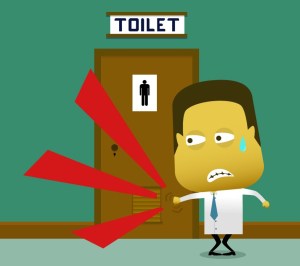
While I debate the impact of no caffeine today, I can absolutely attest to the impact of lots of caffeine, with two examples of inconvenience. For me, caffeine sends a loud-and-clear, pulsing, Times-Square-sized announcement to my bladder saying, “IT’S TIME TO PEE.” Not in fifteen minutes. Not in fifteen seconds. Now; as in – get up and go NOW. I better have my path to the bathroom mapped out, and that door better be open. It’s like clockwork biology, forty-five minutes after that first coffee sip. Remarkably, the experts still question whether caffeine is a diuretic AND they wonder whether the amount of liquid expelled is equivalent to the amount consumed. I emphatically answer “yes” and “MORE”. With all the expelling, it’s a wonder my body doesn’t dry out and disintegrate. No matter; it’s a small price to pay for my daily drug.
Here’s the second impact of caffeine. Beware the cup of coffee (or any choice from Starbucks) after three in the afternoon. Let that late-day caffeine hit take hold and you’re in for a long night. I can very dependably fall asleep within five minutes of hitting the pillow except when my coffee intake is late-day (and on that note, why is upscale after-dinner restaurant coffee so good?). I toss and turn like laundry in the wash cycle, staring at the ceiling and ruing my beverage mistake. Then I stare at the bedside clock. What a pretty clock it is. Such colorful numbers. It’s fun to watch the numbers change every minute. Every hour.

Let’s review. Assuming I plan my bathroom trips and lay off the coffee by mid-day, I can safely embrace my caffeine habit. And if “habit” concerns me at all – its synonyms include “addiction” after all – here’s some good news. Four cups a day is ideal for heart health, according to recent research by the Germans (my new favorite people). Not up to four cups, but exactly four cups, netting you about 300 mg of caffeine. Four cups is also the equivalent of a Starbucks “Venti” (the Nitro cold brew somehow packs in 469 mg of caffeine) but I steer clear of the big cups. Wouldn’t want to get “addicted”.

We’ve only been talking about coffee here, but thankfully caffeine is found in only a handful of other foods and drinks. What starts as a naturally-occurring compound in plants finds its way to teas, cocoa, cola soft drinks, energy drinks, and over-the-counter meds (i.e. cough syrup). The only one I touch is cocoa (my chocolate habit justifies its own blog post). So, unless I exceed my daily two-square ration of a Lindt 70% Cocoa Excellence Bar, my caffeine intake is all about coffee.

If you count milligrams the way you count calories, know that 300 of caffeine is the threshold to avoid anxiety and panic attacks. A warning sign might as well pop up after 300 saying, “STOP! Proceed with caution”. It’s like there’s this sweet spot with coffee – an oasis between falling asleep in church and earning the jitters – that kindles my fire. Gives me justification to start every day with a cup of coffee. Or four.
-
Which Came First?
When my son wrapped up his undergraduate college years, he gradually reduced the stock in his refrigerator to just about nothing. Living on a shoestring budget, he wasn’t about to purchase food he didn’t need after graduation. I’ll never forget the phone call one of those last couple of nights. He told us – rather proudly – he’d made a meal with two eggs… and a can of processed chicken. A “chicken scramble” if you will. To which I replied, “ick“. If we’d been on FaceTime he’d have seen my face turn a lovely shade of green.

Some foods were just not intended to be consumed in the same bite. I can’t think of a better example than chicken and eggs. All chickens hatch from eggs and all chicken eggs are laid by chickens, so why on earth would we eat them together? Can we skip the biology class and agree – at least by one definition – chickens and eggs are essentially the same “thing”? And really; how often have you found them side-by-side on your breakfast plate? Hopefully never.

The memory of my son’s kitchen creation locked itself away in my brain until recently, when Starbucks decided to meddle with their sous vide egg bites menu. Not content to offer just “Egg White & Pepper” and “Bacon & Gruyere”, Starbucks now offers “Chicken Chorizo Tortilla”, described as “perfectly cooked, cage-free sous vide egg bites, including chicken chorizo, and…” and… and… and I stopped reading right there. I couldn’t get past eggs and chicken in the same offering, gag reflex included. I’m not sure I’ll order any egg bites anymore.
To lend credence to my chicken-OR – not chicken-AND – claim, I turned to one of the experts in the field: fast-food icon Chick-Fil-A. CFA offers an extensive breakfast menu (Starbucks does not) so I figured, a restaurant built entirely on chicken would never offer eggs mixed up with chicken. Wrong-o. To my disbelief (and horror), two entrees loom large on CFA’s breakfast menu where you can get plenty of both. Choose from the Egg White Grill: a breakfast portion of grilled chicken stacked with freshly cooked egg whites on an English muffin; or the Chicken, Egg, and Cheese bagel: a boneless breast of chicken along with a folded egg and American cheese. Seriously, who buys this stuff?
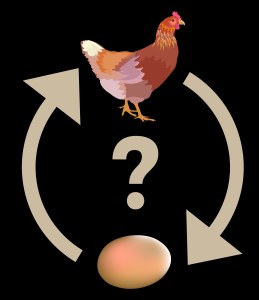
I’m not sure who said it, but some would assert “the chicken is merely the egg’s way of reproducing itself”. (The same applies to the caterpillar’s “use” of the butterfly.) I like that, evil as it sounds. Kind of devalues the chicken, but also kind of proclaims: the egg came first. And what about that quandary, “which came first”? There’s not much to discuss if you really think about it. Make the simple choice – science or religion. Science votes for the egg, laid by something that wasn’t quite a chicken (but evolved into one once the egg hatched). Religion votes for the chicken, created by a higher power in those first six days.
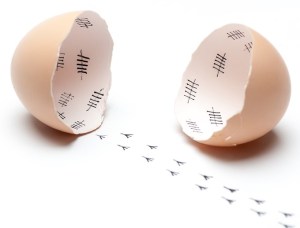
Maybe chicken + eggs is the greatest thing never eaten and I just don’t know what I’m missing. I suppose I could ease into the idea one entree at a time. Start with corned-beef hash… with fried eggs. Move to full-on steak… and eggs. Swallow hard over chicken… and waffles (eggs in the batter). Then, at long last, order that new sous vide egg bite from Starbucks. Yeah right, that’ll happen… as soon as we all agree on “which came first”.
-
Behind Bars
Every now and then I crave a Kellogg’s Frosted Brown Sugar Cinnamon Pop Tart. You can debate the matter and say the fruit Tarts are better – Strawberry, Cherry, and Blueberry – and I’ll give you those, but I stand by my boring-looking Brown Sugar Cinnamon. Maybe that’s because I consumed hundreds of them as a kid, piping hot from the toaster.

Somehow Pop Tarts eluded the otherwise healthy content of my mom’s pantry. You’d walk in to dozens of those little red boxes of raisins, a pretty good assortment of nuts (which were more meant for recipes than snacking), and the occasional graham cracker. The fruit and veggie drawers in the frig were loaded and there was always a gallon of milk on hand. Yet there they were, in foil-wrapped packages of two: Kellogg’s Pop Tarts. I wish I could see the ingredients list from the 1970’s versions versus those of today’s Tarts. Surely the former leaned more towards “real food” and less towards chemicals, or my mom would’ve never gone for them.

Pop Tarts now come in twenty-seven varieties, which by any standard is ridiculous. Who wouldn’t be happy with the four I already mentioned? (Okay, let’s add Frosted Chocolate Fudge and call it good). Do we really need options like “Wildlicious Wild! Cherry”, or “Confetti Cupcake”? Apparently so, because that’s where our demand for choices has taken us. The new approach to snacks: invent one, sell enough to get them into everyday conversation, then evolve to twenty-seven varieties. Have you seen your options with Oreo’s these days? I rest my case.
The other day I traveled down the cereal aisle of our grocery store for the first time in a long time (we have house guests). I was shocked to discover the “healthy cereal” section is just as big as the space reserved for regular cereals. Even more interesting, the overhead signs on the aisle first announce “Cereals”, followed by “Granola” a little further down, followed by “Diet and Fitness” a little further than that. The entire aisle feels like the same kind of food, only you start with boxes, morph to bags, and end up with little bars. I’d love to know the combined total grams of protein in the products in the “Diet and Fitness” section. Gotta be ten thousand or more.

Fun facts: Americans now choose from over 400 brands of “healthy” bars, in 4,000 varieties. At $6 billion in 2012, the healthy bar market was only 17% as big as that of savory snacks ($34 billion) but growing in a hurry. American children consume almost 500 calories a day in snacks. The routine starts when we’re young.
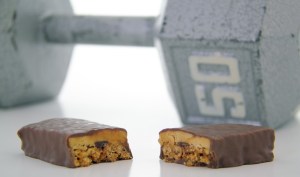
Snack bars seem to be almost-entirely carbs or almost-entirely protein. I won’t comment on the first variety because I don’t eat them (I’ve moved on from Pop Tarts), and I don’t even see the carb variety because our store puts them over in the cookie aisle. But protein bars are a challenging enough decision. For starters, are protein bars a “snack” or a “meal”? Many are advertised as “meal-replacements”. Others look small enough to be snacks. Even the ever-present “Nutrition Facts” label doesn’t really lend a hand, except to confirm you’re taking in more calories and sugar than you’d hoped.

I belong to Lifetime Fitness here In Colorado, a gym which stresses “healthy lifestyle” in everything they offer, whether personal training sessions, workout classes, spa treatments, or a cafeteria full of healthy choices. The mantra I hear like a broken record: “carb-up” at least an hour before the workout; “protein-up” within 45 minutes after. I’m sure some would dispute that approach, but regardless, it suggests a “snack” before AND after a workout. And as I stand in “Diet and Fitness”, I ask myself, “Is that snack half of a “meal-replacement” bar? Two or three of the “fun-size”? Scrap the whole aisle and go with fruit and cheese instead?”
For my money, snack bars before and/or after a workout neither benefit the short run nor ease the long run. It’s kind of like my daily multi-vitamins: no clue whether they help me either (but I still take them). This much I know: I need to have a somewhat full stomach before I work out. On that note, maybe I’ll just skip the “Diet and Fitness” aisle from now on and go back to Pop Tarts.
Some content sourced from the Wall Street Journal article, “Our Misplaced Mania for ‘Healthy’ Snacks”.
-
Sneakin’ Around
Six years ago, my wife and I visited Ireland for our 25th wedding anniversary. I remember the locals having this uncanny ability to figure out we were Americans, even before we uttered a word. They’d start with, “So where ya from in the States, the both of ya?”, or “What’s the weather like in America now?”, or “Traveled across the pond, did’ja?” It wasn’t until several years later I realized our feet had given us away. Our footwear – bright sneakers with white laces – effectively shouted, “Hello world! We’re from America!” We might have been the only rubber-soled couple in all of Dublin.
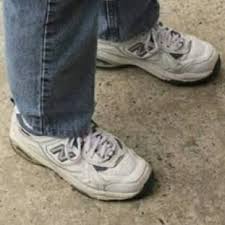
Funny people, those Europeans. They wear gym shoes when they’re going to the gym; running shoes when they’re going for a run. That’s about it. We Americans on the other hand (er, other foot), have a decades-long love affair with our “tennis shoes”. We have entire stores dedicated to the soft-soled shoe – Foot Locker, for example – though you’re more likely to find synthetics instead of rubber these days. Walk into a Foot Locker and say, “I need a good walking shoe”, and the salesperson will direct you to every single pair in the store. Americans and their gym shoes: where fashion trumps function.

“Gym shoes” is an awkward, dated description of America’s casual footwear, but we’ve yet to come up with a better name. Once upon a time we called them “tennis shoes”, but today that ask gets you a specialty shoe (for tennis, of course). As kids we wore “Keds”, “Converse” and “Vans”, because they were practical and cheap. 95% of my childhood plodded along in pairs of Keds (with the other 5% in bare feet, or the single pair of dress shoes my parents insisted for church). Today, Keds, Converse, and Vans have made a furious comeback, albeit as a pricey fashion statement.

More recently, Americans claim to be wearing “running shoes”, but how many of us run, really? Maybe we should side with the Brits and wear “trainers” instead. At least we could fib about being “in training”.
The Euros may be quick to judge footwear but trust me; that’s not all they’re looking at. American tourists give themselves away with a host of other fashion statements. If you’re partial to baseball caps, flip-flop sandals, or “athletic shorts” (another item demanding a name change), you’re an American. Speaking of shorts, any shorts in Europe labels you an American. Shorts are “children’s clothing” over there. Care to repack that suitcase? While you’re doing so, white “athletic socks” are a no-no. Euros match their socks to their pants (meaning skip the white pants too). Finally, leave the untucked, oversized, logo’d t-shirts in the drawer. Euro’s aren’t interested in poorly-fitting walking advertisements.
I may be guilty of several items on the “American Tourister” list, but I simply can’t give up my gym shoes. They’re too comfortable and practical, and they’ve become a lot more stylish than the Keds of old. That’s not to say I don’t feel self-conscious wearing them. A good friend – the author of the entertaining blog Brilliant Viewpoint – always insisted her husband wear “nice” shoes, no matter the occasion. Considering her Italian background (and his German), it makes a lot more sense now.
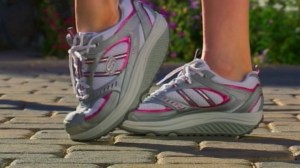
For the record, the American airport is a great place to catalogue footwear. On a recent visit, the traveler shoe pie was split into equal slices (whether males or females): gym shoes, sandals, and dark-soled. heeled, business-casuals. The irony of this airport visit – my wife and I were picking up two teenage visitors from Germany; students staying with us for awhile. As they walked out of the Customs area, my eyes dropped to their feet. What were they wearing? Gym shoes – both of them. Apparently there’s more to America’s global influence than fast food.








About Me
The sky is not completely dark at night. Were the sky absolutely dark, one would not be able to see the silhouette of an object against the sky.
Follow Me On
Subscribe To My Newsletter
Subscribe for new travel stories and exclusive content.
 Life In A Word